
Reaction to US tariff policy: EU and Mexico sign free trade agreement – Trump's tariff hammer backfires
Xpert Pre-Release

Available in 27 languages 📢
Prefer Xpert.Digital on GoogleⓘPublished on: May 23, 2026 / Updated on: May 23, 2026 – Author: Konrad Wolfenstein
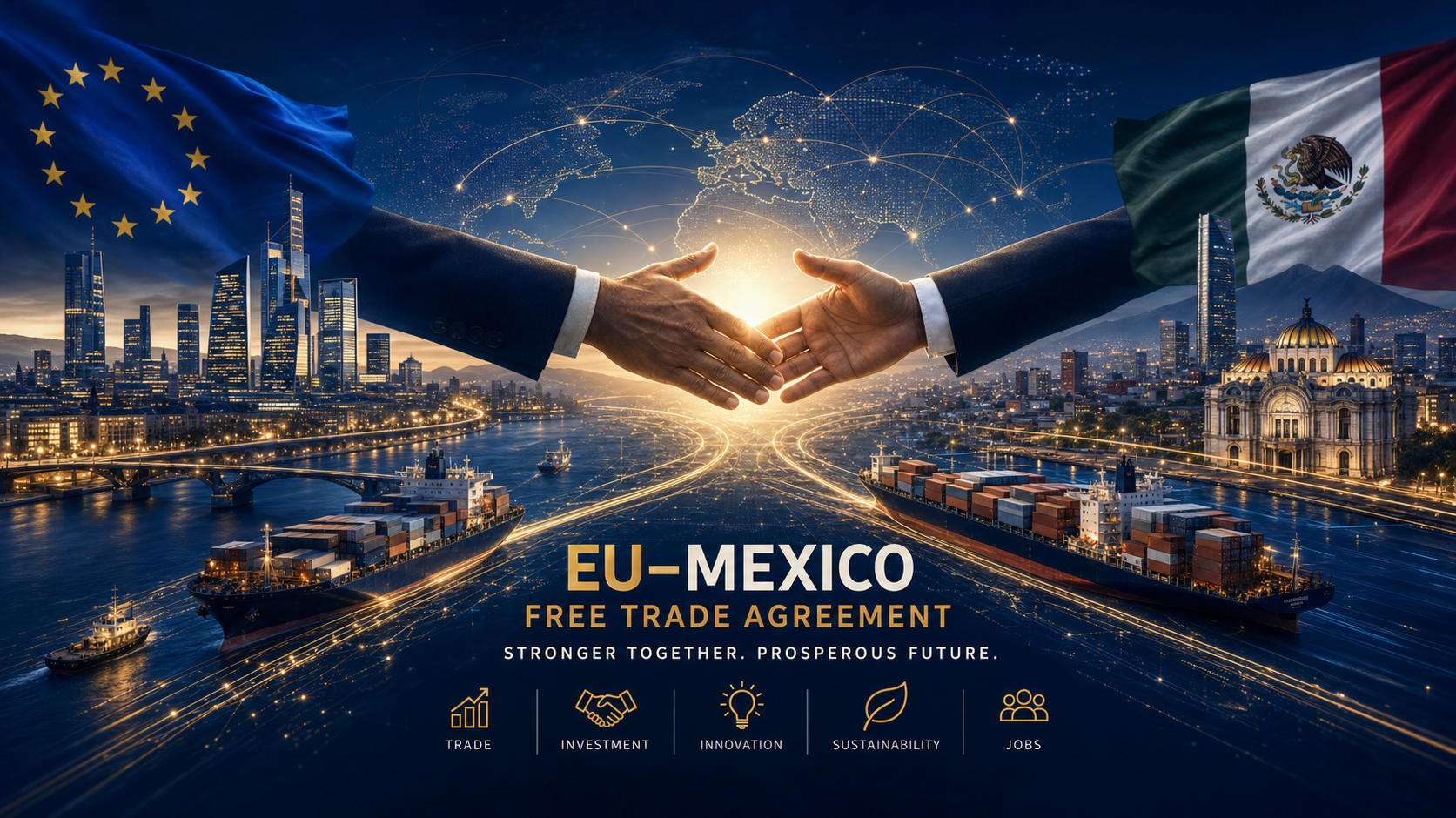
Reaction to US tariff policy: EU and Mexico sign free trade agreement – Trump's tariff hammer backfires – Image: Xpert.Digital
The EU and Mexico are forging a new mega-alliance: salvation for the German economy? Why the new EU-Mexico agreement is a real game-changer
Geopolitical bombshell: How Brussels and Mexico City are jointly defying Washington
The real reason for the billion-dollar deal: How the EU is securing Mexico's most valuable raw materials
After more than a decade of tough negotiations, the European Union and Mexico have reached a historic milestone: With the signing of the modernized free trade agreement in May 2026, two global economic powers are moving closer together than ever before. What at first glance appears to be a dry bureaucratic act is in reality a tangible geopolitical show of force – and a direct response to Donald Trump's aggressive protectionist and tariff policies.
For Europe, and especially for Germany's export-driven economy, the pact not only opens up vast, previously inaccessible markets, but also secures strategically vital access to critical raw materials for the energy transition. While the US is increasingly pursuing protectionist policies, Brussels and Mexico City are forging a multi-billion-dollar alliance that could fundamentally transform global trade. Read on to find out why this agreement is far more than just tariff reductions, what role billions in investments will play, and what enormous opportunities it presents for the future.
When a trade agreement is more than just trade – Why Brussels and Mexico City are jointly giving Washington the middle finger
On May 22, 2026, the European Union and Mexico signed their modernized Global Trade Agreement and an accompanying interim trade agreement in Mexico City. What at first glance appears to be a bureaucratic update of a 26-year-old treaty is, upon closer inspection, a tangible shift in economic policy by two economic powers increasingly pressured by the unpredictability of Donald Trump's trade policies. EU Council President António Costa summed it up perfectly when he called the agreement a "genuine geopolitical statement." Rarely has a trade agreement reacted so directly and so openly to external political provocations.
Ten years on hold: The long story of an overdue agreement
The signing marks the end of a grueling negotiation marathon that stretched over a decade. The EU and Mexico had already had a free trade agreement in place since 2000, which at the time was considered groundbreaking and triggered a dramatic revival of bilateral trade relations. Since that first agreement came into force, bilateral trade volume has quadrupled, reaching a value of around €87 billion in 2025. However, the original agreement was severely limited in its scope: it focused almost exclusively on industrial goods and left entire sectors of the economy, such as agriculture, services, digital trade, and public procurement, largely untouched.
Negotiations on modernization began in 2016, stalled repeatedly, and, following a political agreement in principle in 2018, remained frozen for years. On the European side, concerns regarding human rights, environmental standards, and agriculture blocked the process. On the Mexican side, changing governments and differing trade policy priorities created uncertainty. Only the tectonic shifts in global trade policy from 2025 onward, triggered by the Trump administration's escalating tariff policy, gave both sides the necessary political momentum to bring the process to a conclusion. The negotiations were formally concluded in January 2025, the European Commission presented its proposals for signature to the Council in September 2025, and the EU Council approved the agreement on May 11, 2026. A few weeks later, the agreement was officially signed at the first EU-Mexico summit in a decade.
The Trump Factor: Protectionism as the Unwitting Architect of Multilateral Alliances
It would be a gross oversimplification to interpret the EU-Mexico agreement solely as a reaction to Donald Trump's trade policies. And yet, without the Trump administration's systematic erosion of the multilateral trading system, this agreement would likely have remained shelved in Brussels' bureaucracy for considerably longer. Trump's first year in office brought a veritable cascade of tariffs: In April 2025, nearly every country in the world was confronted with a base rate of 10 percent on all imports, while the EU was subjected to individual retaliatory tariffs. For Mexico, Trump introduced specific tariffs on automobile, steel, and aluminum exports, which hit the country's vital manufacturing sector particularly hard.
In July 2025, the situation escalated further when Trump announced his intention to impose 30 percent tariffs on all EU goods starting August 1st. Although these tariffs were initially suspended after negotiations, the signal was unmistakable: the US under Trump was no longer a reliable trading partner that adhered to international rules and long-term agreements. The EU, which had previously hoped to reach a compromise through negotiation, was forced to fundamentally rethink its strategy. The mantra of "reducing risks, diversifying, and reorienting trade," originally aimed at mitigating dependence on China, was now applied with equal urgency to the US.
For Mexico, the situation posed an even more acute threat. The country is economically intertwined with the United States: Bilateral trade between Mexico and the US exceeded $900 billion in goods and services in 2024. This extreme dependence on a single market was suddenly transformed into a strategic vulnerability by Trump's aggressive tariff policies. President Claudia Sheinbaum's decision to use the EU summit to sign the agreement must also be seen in this context: as a deliberate signal to Washington that Mexico has alternative trade policies and is prepared to pursue them.
What the modernized agreement actually contains: More than tariff reductions
The scope of the modernized global agreement goes far beyond what the old agreement of 2000 ever achieved. While the comprehensive reduction of tariffs is central, the true depth of the treaty lies in the accompanying areas, which fundamentally reshape the economic foundation of bilateral relations.
In the agricultural sector, Mexico is eliminating approximately 95 percent of its high tariffs on EU agricultural exports, creating enormous new sales opportunities for European farmers and food manufacturers. Specifically, this benefits products such as pork, powdered milk, cheese, and chocolate, which were previously kept out of the market by prohibitively high Mexican import duties. Conversely, Mexican exporters gain duty-free access to products such as chicken, asparagus, coffee, fresh fruit, chocolate, and agave syrup. Furthermore, a total of 568 European and 26 Mexican geographical indications are being protected, including well-known products such as Parma ham, Bavarian beer, Tyrolean bacon, and Champagne. This protection is economically significant, as product piracy and the unauthorized use of European quality brands have previously been a considerable problem in the Mexican market.
In the area of public procurement, European companies will not only gain access to tenders at the federal level, but for the first time also at the state level of Mexico, opening up a previously completely closed market segment. EU service companies will gain access to markets in sectors such as finance, telecommunications, transport, e-commerce, environmental services, and postal and courier services. E-commerce will be enshrined in a legal framework for the first time, which is of considerable importance for the increasingly vital platform economy and cross-border e-commerce. Furthermore, the investment protection regime has been modernized: the old investor-state dispute settlement (ISDS) procedure, which critics considered biased towards corporations, will be replaced by a new, more transparent and balanced investment court system.
Beyond purely commercial aspects, the agreement also contains legally binding commitments in the areas of climate protection, labor rights, and sustainable development. The promotion of sustainable fisheries and forestry, as well as the fight against illegal practices in these sectors, have been explicitly enshrined. These non-trade policy elements are not merely symbolic but part of a broader understanding of modern trade agreements as instruments of geoeconomic influence.
Critical raw materials: The strategic core of the agreement
Beyond the obvious trade benefits, the clauses on access to raw materials may contain the most strategically important element of the entire agreement. Mexico is a major producer of critical raw materials essential for Europe's green transition and digital transformation. Fluorspar, a mineral used in steel, iron, and aluminum production as well as in the refrigeration sector, is particularly significant: Mexico currently supplies 33 percent of the EU's demand for this raw material.
The new agreement not only guarantees duty-free trade in these critical materials but also includes a number of provisions aimed at ensuring long-term security of supply. Dual pricing systems, which differentiate between domestic and export prices, as well as export monopolies and export taxes that could reduce the quantities available to European buyers, will be prohibited. Transparency and predictability requirements for government price regulations will provide planning certainty for European investors. Furthermore, European companies will be granted the right to establish operations and must not be discriminated against when investing in Mexico's raw materials sector.
This dimension of the agreement must be seen in the context of the broader EU raw materials strategy. In recent years, the EU has painfully experienced how dangerous one-sided dependencies in supply chains can be, whether for energy imports from Russia or rare earths from China. The Critical Raw Materials Act of 2023 established the framework, and the EU-Mexico agreement is a concrete building block for diversifying critical supply chains. Mexico is relevant not only as a producer but also as a stable, democratic partner that respects international rules and, unlike other raw material suppliers, does not need to be classified as a geopolitical risk.
Germany at the center: Why no other EU state has so much to gain
The agreement's particular relevance for Germany stems from the deep economic ties between the two countries. Mexico is not just any trading partner, but Germany's most important trading partner in all of Latin America. Around 2,000 German companies are active in Mexico, a number that has doubled since the first free trade agreement came into force in 2000. This significance extends to all key sectors of the German economy.
The German automotive industry occupies a prominent position in this context. In 2023, Mexico was the second most important production location for German manufacturers in the Americas, after the USA, with a production record of 716,000 vehicles. German automotive suppliers maintain more than 330 locations in Mexico. Companies like ZF Friedrichshafen, the largest German employer in Mexico with 25,000 employees, have made investments totaling billions. BMW is investing around US$860 million in its plant in San Luis Potosí, which is scheduled to begin producing electric cars and high-voltage batteries in 2027. These investments were long conceived primarily as a springboard into the North American market, particularly through the use of the USMCA trade agreement. The new US tariffs on automobile and parts exports from Mexico have fundamentally altered this calculation, and the new EU-Mexico trade agreement could enhance the European market as a strategic alternative.
Mexico is also of strategic importance to the German mechanical engineering sector. The country is one of the most important sales markets worldwide for German machine manufacturers, and the German Engineering Federation (VDMA) has considered Mexico one of its core markets for years. The elimination of bureaucratic trade barriers and the improved protection of intellectual property offered by the new agreement will particularly benefit the predominantly medium-sized German mechanical engineering sector, which relies on reliable contractual foundations and protection against product piracy. Johannes Hauser, Managing Director of the German-Mexican Chamber of Commerce and Industry (AHK Mexico), emphasizes that the intellectual property protection in the new agreement represents a significant improvement in quality, enabling German companies to take more effective action against product counterfeiting in the future.
Our global industry and economic expertise in business development, sales and marketing

Our global industry and economic expertise in business development, sales and marketing - Image: Xpert.Digital
Industry focus areas: B2B, digitalization (from AI to XR), mechanical engineering, logistics, renewable energies and industry
More information here:
A thematic hub offering insights and expertise:
- Knowledge platform covering global and regional economies, innovation and industry-specific trends
- A collection of analyses, insights, and background information from our key areas of focus
- A place for expertise and information on current developments in business and technology
- A hub for companies seeking information on markets, digitalization, and industry innovations
EU-Mexico Agreement: Opportunities for infrastructure, industry and geopolitical stability
Global Gateway: Five billion euros as leverage for Mexico's transformation
In addition to trade agreements, EU Commission President von der Leyen announced investments of five billion euros for Mexico at the summit as part of the Global Gateway program. This sum is intended to flow into strategic infrastructure projects and trigger a multiplier effect by mobilizing private capital. Specifically, projects are planned in the areas of renewable energy, sustainable mobility, digital infrastructure, the pharmaceutical industry, and the circular economy. Projects already identified include 13 new solar and wind power plants, as well as sustainable mobility initiatives, including new urban rail systems.
The Global Gateway Programme is Europe's geostrategic response to China's Belt and Road Initiative and has mobilized more than €306 billion worldwide in just four years. By focusing on Mexico, the EU is sending a clear signal that it intends to expand its strategic presence in Latin America, a region where China has gained considerable influence in recent years. For Mexico, these investments offer the opportunity to modernize its infrastructure in critical areas while simultaneously reducing its economic dependence on North American partners.
The nearshoring paradox: When decoupling from the US creates new opportunities
Mexico's economy finds itself in a peculiar double bind: Between 2022 and 2024, the country benefited enormously from the nearshoring boom, the relocation of production processes by companies seeking to reduce their dependence on Chinese supply chains while simultaneously better serving the North American market. Foreign direct investment increased by 48 percent, and technology companies and automakers expanded their capacities. However, Trump's tariffs, which also affected Mexican exports to the US, significantly clouded this outlook. Many companies postponed planned investments because the financial basis for manufacturing in Mexico with the aim of selling to the US suddenly became questionable.
The EU-Mexico agreement opens up a new strategic perspective in this situation. Mexico could transform itself from a primarily North America-oriented production hub into a genuine link between two of the world's largest economies. President Claudia Sheinbaum has stated that she sees enormous opportunities in the agreement for sectors such as pharmaceuticals, agriculture, technology, and electromobility. The Mexican Ministry of Economy forecasts that the new agreement could increase Mexican exports to the EU from the current level of around $24 billion annually to $36 billion by 2030. This would represent a 50 percent increase, which is a remarkable ambition given the current trade volume.
Mexican President Sheinbaum further emphasized that the trade agreements with the EU and the US do not represent contradictions for Mexico, but rather complementary opportunities. This assessment is likely pragmatically correct, as Mexico cannot afford a complete decoupling from the US for geographical and historical reasons. The EU agreement, in fact, serves as a diversification buffer: it strengthens Mexico's negotiating position vis-à-vis Washington by creating genuine alternatives.
With Plan México, which came into effect in January 2025, Mexican President Sheinbaum is pursuing an ambitious economic agenda aimed at making Mexico one of the world's ten largest economies by 2030. Tax incentives for foreign companies establishing operations in Mexico, facilitating nearshoring investments, and increased support for key sectors are the core elements of this plan. The EU agreement and Plan México are strategically intertwined and could together usher in a new phase of Mexican industrialization.
Europe's new Latin America strategy: Between opportunism and long-term vision
The EU-Mexico agreement is not an isolated measure, but rather part of a broader realignment of European trade policy towards Latin America. In parallel, the EU-Mercosur interim trade agreement entered into provisional application on May 1, 2026, thus establishing closer trade relations between the EU and the major economies of South America. Together with existing agreements with Chile, Peru, Colombia, and other Latin American countries, this creates a dense network of European-Latin American trade relations, which as a whole has considerable geoeconomic significance.
The EU and Mexico together form a common market with more than 582 million people and a combined gross domestic product of $25.1 trillion. This alone illustrates the potential economic power of this alliance. However, critics rightly point out that trade agreements alone are no guarantee of actual increases in trade and investment. Transport costs between Europe and Mexico remain high, cultural and linguistic differences are significant, and bureaucratic hurdles beyond official tariffs can considerably weaken the anticipated effects.
Furthermore, the EU must be careful that its Latin America strategy does not give the impression of pure opportunism. For decades, agreements with Mexico and other Latin American countries were only half-heartedly pursued by the European side. If it now suddenly acts with great urgency, primarily because pressure from Washington is increasing, this could create the feeling among its partners that it is being used. Long-term credibility as a trading partner is built on reliability even in good times, not just on strategic pragmatism in times of crisis.
Ratification and open questions: The path from signature to reality
As significant as the signing of the agreement is, in the case of the EU, a lengthy ratification process always lies between a signed agreement and one that enters into force. The interim trade agreement, which covers only those trade areas falling under the exclusive competence of the EU, can enter into force after approval by the European Parliament, which is expected within a few months. The comprehensive global agreement, however, additionally requires ratification by all 27 EU member states, which, based on experience, can take years.
A comparison with the EU-Mercosur agreement is illuminating here: Although this agreement is also already provisionally in force, the European Parliament decided in January 2026, by the narrowest of margins, to request the European Court of Justice to review its compatibility with the EU treaties, thus delaying the process by 18 to 24 months. Similar political conflicts cannot be ruled out with the EU-Mexico agreement either, particularly with regard to the agricultural provisions, which could encounter considerable resistance in some EU member states.
The interim trade agreement secured by the treaty provides a pragmatic way to quickly implement the trade provisions while the full ratification process is underway. This two-stage approach, also used in the EU-Mercosur agreement, has now become standard European practice and prevents political obstacles from delaying the economic benefits indefinitely.
Geopolitics meets economics: What the agreement says about the future of the world trade order
In a broader perspective, the EU-Mexico agreement is a symptom of the profound transformation currently underway in the international trading order. The rules-based global trading system, as established in the post-war era by the GATT and later by the WTO, is under considerable pressure. Trump's willingness to arbitrarily ignore or redefine trade rules is forcing other actors to adapt.
The reaction of the EU and Mexico is characteristic of a pattern observable worldwide: countries affected by US tariffs are increasingly forging bilateral and regional ties to reduce their vulnerability. This phenomenon is not limited to Europe and Latin America: China is deepening its trade relations with Southeast Asia and the Global South, India is concluding agreements with the Gulf Cooperation Council, and even the previously rather passive ASEAN region is showing new activity in terms of trade policy. The result could be a fragmented global trade order in which large economic blocs operate with a dense network of bilateral and regional agreements, and the WTO is increasingly losing its significance as a universal framework.
This is not a pleasant prospect for Europe, as the EU has always considered the multilateral trading system an essential building block of its own prosperity and its security. At the same time, the EU must recognize that multilateralism as a principle only works if all major players are prepared to adhere to common rules. The EU-Mexico agreement is therefore a pragmatic adaptation to the new reality: it upholds the spirit of the multilateral trading system by concluding partnership-based, rules-based agreements, while simultaneously adapting to the changed geopolitical circumstances.
The agreement between the European Union and Mexico, in its depth and strategic dimension, is therefore far more than a trade pact. It is a commitment by two middle powers to open markets and rules-based exchange at a time when both are under pressure from a superpower. It is an instrument for ensuring security of supply of critical raw materials, a vehicle for infrastructure investment, a bulwark against excessive dependence, and a political signal to Washington, Beijing, and the rest of the world. Whether the hoped-for economic effects will materialize in full depends on many factors beyond the text of the agreement. However, there is little doubt that the agreement heralds a new quality in transatlantic relations.
Your global marketing and business development partner
☑️ Our business language is English or German
☑️ NEW: Correspondence in your native language!

Konrad Wolfenstein
I and my team are happy to be available to you as your personal advisor.
You can contact me by filling out the contact form here simply call me at +49 7348 4088 965. My email address is [email protected]:or
I'm looking forward to our joint project.
☑️ SME support in strategy, consulting, planning and implementation
☑️ Creation or realignment of the digital strategy and digitization
☑️ Expansion and optimization of international sales processes
☑️ Global & Digital B2B trading platforms
☑️ Pioneer Business Development / Marketing / PR / Trade Fairs
🎯🎯🎯 Data-driven B2B industry hub as a quasi-in-house solution

The quasi-in-house solution: How Xpert.Digital closes operational gaps in B2B marketing and sales – Smart Content-Driven Business - Image: Xpert.Digital
Xpert.Digital is a data-driven B2B industry hub led by Konrad Wolfenstein . The company acts as an external, quasi-in-house solution for industrial partners, closing operational gaps in marketing, content, and sales – without requiring additional resources on the client side.
More information here:










