
Trump's tariffs are taking their toll: US companies are filing for bankruptcy en masse
Xpert Pre-Release

Available in 27 languages 📢
Prefer Xpert.Digital on GoogleⓘPublished on: January 29, 2026 / Updated on: January 29, 2026 – Author: Konrad Wolfenstein
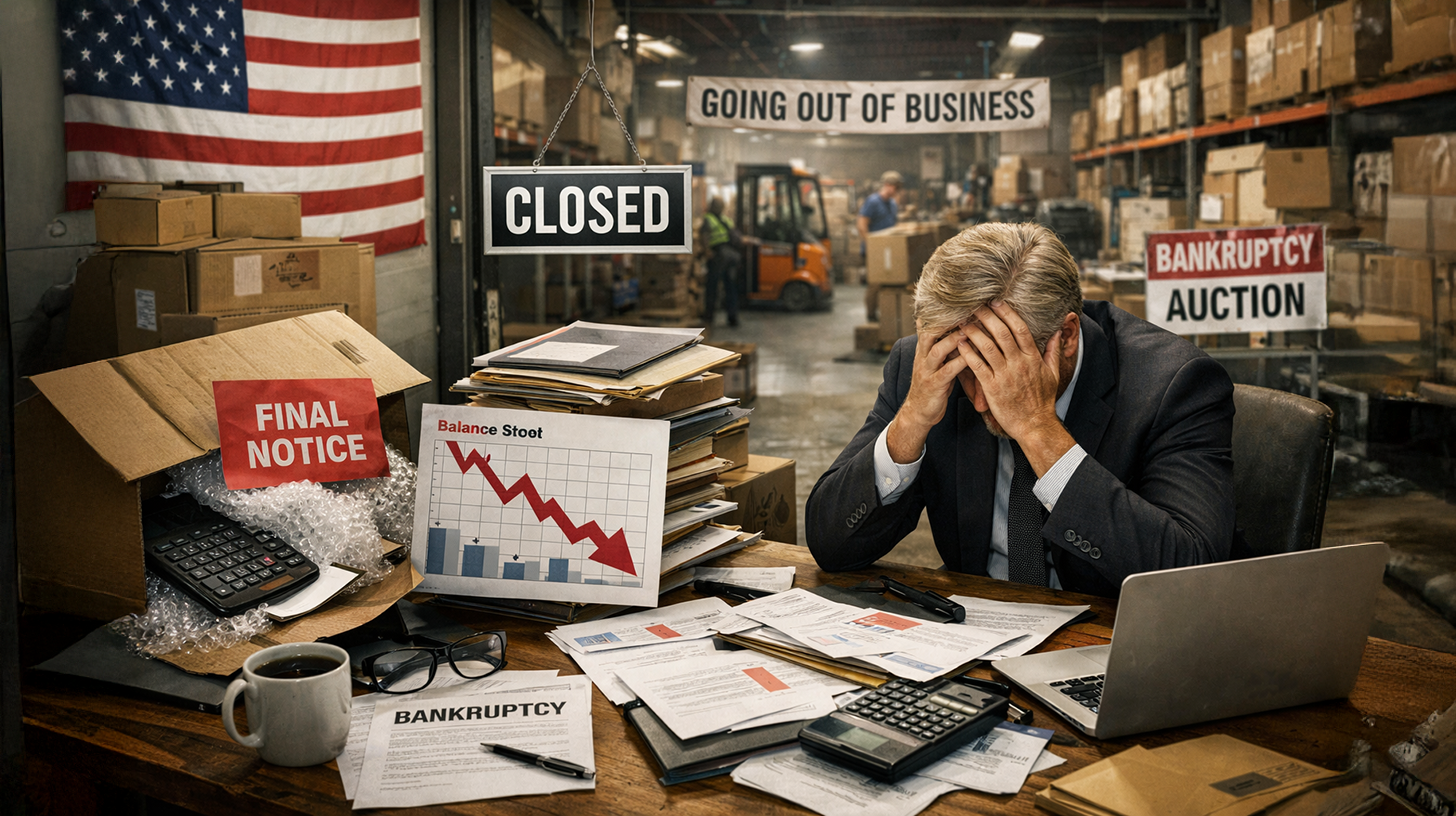
Trump's tariffs are taking their toll: US companies are filing for bankruptcy en masse – Image: Xpert.Digital
Instead of a job boom, hundreds of companies are filing for bankruptcy
"America's own goal": Experts deliver a damning verdict on Trump's first year in office
Donald Trump's vision upon taking office in January 2025 was grandiose: a golden age of the American economy was to dawn, protected by high tariffs and fueled by revitalized domestic production. The self-proclaimed "greatest jobs president" promised falling prices and flourishing landscapes. But a year later, reality is mercilessly catching up with those promises – with devastating consequences on both sides of the Atlantic.
The results of "Trumpomics 2.0" are sobering: Instead of the hoped-for boom, the US economy is experiencing a historic wave of bankruptcies. Over 700 companies have already gone out of business, long-established retailers are closing their doors, and the once robust US labor market is weakening more than it has been since the 2009 financial crisis. Particularly bitter: The aggressive tariffs, which were actually intended to target foreign competitors, are backfiring on American small and medium-sized businesses.
But the shockwaves don't stop at the US borders. The German export sector, particularly the automotive and mechanical engineering industries, is also feeling the full force of the protectionist headwinds. Falling exports and gloomy growth forecasts are alarming experts, while consumers in the US are struggling with rising prices.
This article analyzes in detail why the US government's calculations are wrong, which industries are on the brink, and why experts are talking about an "economic own goal" that could permanently change the global economy.
Suitable for:

What promises did Trump make regarding the economy, and why are they being criticized?
Upon taking office in January 2025, Donald Trump promised an unprecedented economic boom for the United States. The president announced his intention to become "the greatest jobs president God ever made" and pledged to defeat inflation, lower the cost of living, and create millions of new jobs. With his aggressive tariff policies, Trump aimed to boost domestic production, reduce the trade deficit, and bring back American jobs.
However, the reality is quite different. One year after taking office, the economic indicators are sobering. Instead of the promised millions of new jobs, only 584,000 new jobs were created in 2025 – the weakest year since 2009, excluding the COVID-19 pandemic. The unemployment rate rose to 4.6 percent by December 2025, the highest level in four years. The situation is particularly dramatic in the manufacturing sector, which Trump had intended to strengthen: 8,000 manufacturing jobs were lost in November 2025 alone.
The promised reduction in the cost of living has also failed to materialize. Instead, prices have continued to rise, and inflation has remained at 2.7 percent. Senate Majority Leader Chuck Schumer, a Democrat, accused Trump of failing to deliver on his key campaign promises: "He promised to cut costs from day one. And costs are rising and rising and rising.".
How many US companies have actually gone bankrupt?
The figures are alarming: More than 700 US companies filed for bankruptcy in 2025 – the highest number since 2010 and a 14 percent increase compared to the previous year. In the third quarter of 2025 alone, bankruptcies rose from 23,043 to 24,039 cases. Particularly noteworthy is the shift in the sectors affected: Unlike in previous years, when retailers were primarily affected, in 2025 it was mainly the industrial sector – companies in manufacturing, transportation, and logistics – that was hit hardest.
In the first half of 2025, there were 17 significant bankruptcies of companies with assets exceeding one billion dollars. This total number of bankruptcies surpasses pre-pandemic levels and marks a turning point in the US economy. Experts attribute this dramatic development to a combination of high interest rates, persistent cost pressures, inflation, and, in particular, the effects of Trump's tariff policies.
Which sectors are particularly affected by bankruptcies?
The retail sector was hit particularly hard. Over 8,000 chain stores closed their doors in 2025. Among the most prominent victims were Party City, which closed all 700 of its stores in December 2024 after nearly 40 years in business, and Big Lots, which also abandoned all of its remaining locations. Fashion jewelry chain Claire's filed for bankruptcy for the second time in August 2025 and announced the closure of hundreds of stores. In January 2026, Saks Global experienced one of the largest retail bankruptcies since the COVID-19 pandemic – the luxury department store conglomerate, formed in 2024 through the merger of Saks Fifth Avenue, Neiman Marcus, and Bergdorf Goodman, was forced to file for Chapter 11 bankruptcy protection.
The situation is particularly dire for smaller companies. Shoe manufacturer Crocs lost 30 percent of its market capitalization after a profit warning and estimated the burden of tariffs at $40 million. Traditional chains like Joann Fabrics and Rite Aid also filed for bankruptcy multiple times within a short period.
Unlike in previous years, however, the industrial sector was hit particularly hard in 2025. Companies in manufacturing, transportation, and logistics suffered especially from the tariffs. The reason: Many of these firms rely on imported raw materials and components, the prices of which have risen dramatically due to the tariffs. According to an analysis, small retailers with assets under $50 million are especially vulnerable – their profit margins have plummeted, and 36 percent of them are considered at acute risk of insolvency, compared to only 12 percent of larger retailers.
How do the tariffs affect small and medium-sized enterprises?
For small and medium-sized enterprises (SMEs), Trump's tariffs are becoming an existential threat. Unlike large corporations, SMEs lack both the financial resources and the global supply chain structures to absorb the burden of these tariffs. The figures are clear: 97 percent of all US importers are small businesses, and 88 percent of small businesses rely on imports for their products and services.
The financial burden is precisely calculable and brutal: An average small business with annual sales of $1.2 million can lose 10 to 15 percent of its revenue due to tariff volatility. The additional annual costs resulting from trade policies amount to $856,000 for a typical small business. At the same time, only 37 percent of these businesses have access to business loans to weather this turbulence.
A dramatic example is Beth Benike, CEO of Baby Tula, a small company that sells baby products. The 145 percent tariffs made shipping her goods from China unaffordable—putting $160,000 in production costs at risk. “I’m terrified for my business and for all small businesses in the US,” she explained desperately. “I could lose my house.”.
The situation is exacerbated by constant policy changes. In the past twelve months, there have been eight major tariff adjustments—a “policy whiplash” that large corporations with trade consultants and legal departments can navigate, but small businesses cannot. Banks require multi-year business plans for loan approvals, but when tariffs on inputs can fluctuate between 0 and 145 percent every quarter, financial forecasts become meaningless. The result is a credit desert for small businesses.
A group of small business owners joined forces and filed a lawsuit against the Trump administration in April 2025. The five affected companies argue that no national emergency exists that could justify the extreme tariffs. But even if they were to succeed, it could take years for the case to go through the courts—time many businesses don't have.
What specific tariffs did Trump introduce?
The Trump administration's tariff policy is complex and encompasses numerous product categories and countries. Since September 2025, a general tariff of 15 percent has applied to most goods in the European Union. The automotive industry is particularly hard hit: vehicles and vehicle parts are also subject to a 15 percent tariff, after Trump had initially announced 25 percent.
The tariffs on steel and aluminum are even more extreme: a flat rate of 50 percent is levied – and this applies not only to pure steel products, but also to the steel content in other goods such as machinery. This regulation hits the German mechanical engineering sector particularly hard.
China, as the main competitor of the US, was subjected to even harsher sanctions. Tariffs on Chinese goods temporarily rose to as high as 145 percent. After intensive negotiations and a deal in the summer of 2025, Chinese tariffs stabilized at around 30 percent for most products, but tariffs of 25 percent or more still apply to certain categories such as semiconductors.
Other countries were not spared either. South Korea faced an increase in tariffs from 15 to 25 percent in January 2026 because the South Korean parliament had not ratified a trade agreement that had already been negotiated. Particularly significant are the additional tariffs announced in January 2026 in connection with the Greenland conflict: Germany and seven other European countries are to pay staggered additional tariffs of 10 percent from February and 25 percent from June 2026.
Trump justified his tariffs by citing "national security" under Section 232 of the Trade Expansion Act of 1962 and the International Emergency Economic Powers Act (IEEPA). He also introduced so-called "reciprocal tariffs," which were supposed to be based on the respective trade surplus of the countries with the US.
How severely does customs policy affect the German economy?
The impact on Germany is massive. German exports to the US plummeted by 9.4 percent to €135.8 billion in the first eleven months of 2025. The situation is particularly dramatic in the automotive industry, traditionally one of the pillars of the German export economy: Exports of cars and car parts fell by 17.5 percent to €26.9 billion. In mechanical engineering, exports declined by 9 percent to €24.1 billion. Only the pharmaceutical industry managed to maintain its export figures, with a slight increase of 0.7 percent to €26.2 billion.
The economic costs are considerable. The ifo Institute estimates the negative growth effects of the US tariffs on the German economy at 0.3 percentage points in 2025 and forecasts 0.6 percentage points for 2026. The Institute for Macroeconomics and Business Cycle Research (IMK) of the Hans Böckler Foundation assumes that Germany will have to accept growth losses of more than one percent of GDP in the first two years after the introduction of the tariffs.
German companies are feeling the strain directly. The Volkswagen Group was burdened with €2.1 billion in tariffs in the first nine months of 2025. VW CEO Oliver Blume told the Handelsblatt newspaper that the planned Audi plant in the US was not financially viable with unchanged tariffs and required reliable framework conditions.
German industry as a whole is facing massive impacts. According to an ifo survey from June 2025, companies in the highly export-oriented mechanical engineering sector, in particular, report the most negative effects from tariff policies – a quarter of mechanical engineering companies even report very negative effects. The situation is similarly dramatic in metal production and processing, where around 70 percent report negative impacts.
A particularly problematic phenomenon is the indirect effects: China has once again overtaken the US as Germany's most important trading partner, as trade with the People's Republic reached €230.8 billion in the first eleven months of 2025, while trade with the US amounted to only €222.8 billion. At the same time, the German steel industry fears massive diversions in production: If Chinese and other steel can no longer be exported to the US due to US tariffs, the European market risks being flooded.
Which German industries are most affected?
The automotive industry is on the front lines of the crisis. The US has traditionally been one of the most important foreign markets for German premium manufacturers like Porsche, BMW, and Mercedes. The tariffs hit the sector harder and earlier than other sectors – initially at 27.5 percent, which fell to 15 percent after the EU-US deal in August 2025, though this is still six times the previous 2.5 percent. Automotive expert Stefan Bratzel warns: “Trump has massively impacted the automotive industry in Germany and Europe. With his tariffs, he is reinforcing the trend of cars being increasingly manufactured where they are sold. For our export-oriented automotive industry, this represents a complete erosion of its traditional business model.”.
The mechanical engineering sector is suffering under a double burden: On the one hand, it is hit by the general tariffs of 15 percent, and on the other hand, the Americans are also applying their 50 percent steel tariffs to the steel content in machinery. The result: Production in the German mechanical engineering sector has shrunk for the third year in a row, leading to job cuts and short-time work in many companies.
The steel industry is facing the highest tariffs, at 50 percent. In the first ten months of 2025, steel exports to the US shrank by eleven percent. While the direct impact on Germany may be limited, as the US is not a significant destination for EU steel and aluminum exports, the indirect effects of volume diversion are causing greater concern for the industry.
The chemical and pharmaceutical industries are also affected, although pharmaceutical companies have so far managed to stabilize their export figures. Experts warn, however, that pharmaceutical exporters in particular have reason to fear for their US business, as tariff increases are also looming in this sector.
The medical technology sector faces particular challenges. Medical devices that were previously virtually duty-free are now subject to 20 percent tariffs on imports from the EU. The industry's global supply chains – a single device might contain Japanese electronics, German precision parts, and US software, be assembled in Mexico, and sterilized in Ireland – are burdened by tariffs at every stage.
Interestingly, smaller sectors such as food and agriculture (1.6 percent of exports), medical devices (7.4 percent), jewelry and textiles (1.2 percent each), and electronic devices are also affected. The export sector as a whole faces fundamental uncertainty, which is hindering investment and making planning more difficult.
Our US expertise in business development, sales and marketing

Our US expertise in business development, sales and marketing - Image: Xpert.Digital
Industry focus: B2B, digitalization (from AI to XR), mechanical engineering, logistics, renewable energies and industry
More about it here:
A topic hub with insights and expertise:
- Knowledge platform on the global and regional economy, innovation and industry-specific trends
- Collection of analyses, impulses and background information from our focus areas
- A place for expertise and information on current developments in business and technology
- Topic hub for companies that want to learn about markets, digitalization and industry innovations
America's own goal: How a controversial policy threatens to ruin its own economy"
How are the German insolvency figures developing?
Corporate insolvencies are also rising sharply in Germany. Allianz Trade expects an increase of eleven percent to 24,320 cases in 2025 – a rise twice the international average. For 2026, the company forecasts further stabilization at a high level, with an increase of one percent to a peak of 24,500 corporate insolvencies. A significant trend reversal, with a decline of four percent, is not expected until 2027.
Allianz Trade significantly revised its forecast upwards in October 2025: The company had originally projected an increase of only three percent for 2026, but due to the growing risk of payment defaults, a global rise in corporate insolvencies of five percent is now expected. A key factor in this negative development is cited as the import tariffs introduced by the US, which are causing massive difficulties for exporters.
Particularly alarming is the warning from Allianz experts about domino effects: The growing number of bankruptcies among large companies could increase the risk of chain reactions. The impact becomes especially clear in international comparisons: In Canada, up to 1,900 additional bankruptcies could occur in the worst-case scenario, in France 6,000, in Spain 10,000, and in the Netherlands 700.
Although Germany is considered less affected than some other countries, the situation remains tense. The companies that had to file for insolvency in 2025 range from the residential real estate firm Ziegert Group and the chemical company Venator Germany to the shoe retail chain Görtz. The long-established automotive supplier Brose, a major provider of door locking systems for the automotive industry, also had to file for insolvency.
Miro Bartz of Allianz Trade in Vienna, Austria, and Switzerland sees a glimmer of hope at the end of the insolvency tunnel for Germany: After the peak in 2026, a relaxation of the situation is in sight. However, this depends heavily on whether the trade policy framework stabilizes and tariffs are not further increased.
Suitable for:

How do tariffs affect inflation and consumer prices?
The question of who ultimately bears the cost of the tariffs is central to evaluating Trump's trade policy. A study by the Kiel Institute for the World Economy arrives at a clear conclusion: 96 percent of the tariff costs are borne by American importers and consumers. This finding directly contradicts the Trump administration's portrayal, which consistently claimed that foreign exporters would pay the tariffs.
The concrete impact on American households is significant. The Yale University Budget Lab estimates that the tariffs will lead to a price increase of 1.3 percent, which translates to an average income loss of about $1,751 per household. Other analyses suggest additional annual costs of between $1,300 and $2,100 per household.
The Austrian National Bank (OeNB) forecasts that US tariffs will increase the US inflation rate by approximately 0.8 percentage points in 2025. Experts warn of a further increase in 2026: the inflation rate could even rise above four percent due to the combined effects of the delayed impact of the tariffs, a tight labor market, and expansionary fiscal policy.
The timing of the price effects is interesting. Initially, inflation remained relatively stable at 2.7 percent despite the tariffs, which the Trump administration cited as proof that the critics were wrong. However, economists explained that the adjustment processes would be "slower than expected." An analysis by the St. Louis Federal Reserve found that by early summer 2025, companies were already passing on 35 percent of the tariff costs to consumers, while Goldman Sachs estimates that this rate could rise to as high as 55 percent.
Amazon CEO Andy Jassy confirmed at the World Economic Forum in Davos in January 2026 that tariff policies were gradually driving up consumer prices in the US. While the online retailer had built up significant inventories before the tariffs took effect, these reserves ran out in the fall, meaning the tariffs were now "creeping" into prices.
For the eurozone, however, the OeNB forecasts an inflation rate that is 0.2 percentage points lower for 2025, as the negative growth effects of the US tariffs will dominate and dampen inflation. At the same time, increased imports from China are expected because China will be able to export less to the US, which will also have a dampening effect on prices.
How is the US economy as a whole reacting to the tariff policy?
The macroeconomic impact of Trump's tariff policies on the US economy itself is substantial – and negative. The Institute for Macroeconomics and Business Cycle Research (IMK) of the Hans Böckler Foundation has determined through simulations that the US could lose up to five percent of its economic output. In the "Trump 2" scenario, which includes more substantial tariff increases and Chinese retaliatory measures, US GDP would be almost four percent lower at the end of 2025 than it would have been without tariffs, and by more than five percent in the fourth quarter of 2026.
“It is remarkable how hard the US economy is hit in this scenario,” the IMK researchers emphasize. The main reasons: Consumer prices rise, thus reducing the purchasing power of US households. At the same time, rising inflation is likely to prompt the US Federal Reserve to adopt a more restrictive policy.
The labor market figures underpin these gloomy forecasts. With only 584,000 new jobs, 2025 was the weakest year since 2009. The high tariffs, which were supposed to "bring back" industrial jobs, have had the opposite effect: Since April 2025, the number of industrial jobs has been declining steadily. A study by the German Institute for Economic Research (DIW) already estimated the losses from Trump's first round of tariffs at around 75,000 jobs in 2020. Economists blame the tariffs for the currently higher production costs, which are stifling investment.
Interestingly, the US trade deficit has barely changed despite the tariffs. IMK simulations show that the US trade balance has improved by a mere 0.2 percentage points. The reason lies in complex economic relationships: While imports are declining, the US dollar is also appreciating, making imports cheaper and exports more expensive, thus counteracting the trade balance.
A detailed analysis by the Wharton Budget Model at the University of Pennsylvania concludes that Trump's tariffs would reduce GDP by approximately 5.1 percent by 2054. The combination of reduced private capital and fewer hours worked leads to this significant decline in output. Even the additional tariff revenue, which helps reduce the national debt, cannot offset this effect.
One comparison is particularly revealing: raising corporate taxes instead of tariffs to generate the same revenue would be less economically damaging. Corporate taxes are considered one of the most economically distorting methods of revenue generation, yet tariff policies reduce GDP and wages more than twice as much.
Are there any winners in customs policy?
While the negative effects of tariff policies dominate, there are indeed some areas that benefit from them. The Trump administration collected nearly $300 billion in taxes and tariffs in 2025 – a significant fiscal effect. In this sense, the stated goal of filling the treasury through tariffs was achieved.
In the US itself, contrary to international trends, corporate bankruptcies actually fell by four percent over the course of the year, as tariffs protect US suppliers from international competitors. American companies, which do not have to pay tariffs and do not require imported intermediate goods, benefit from the reduced competitive pressure. Exporters from other countries had to offer their products in the US at higher prices or reroute supply chains through countries like India, Vietnam, or Mexico to minimize the tariff burden, which benefited US-based companies.
Certain industries did indeed see success: steel imports reached twenty-year lows, solar panel production doubled in the first quarter, and reshoring—the relocation of production back to the US—jumped by 454 percent. These figures show that Trump's policies had the intended effect in specific areas.
Large retailers like Walmart have weathered the crisis and are even continuing to expand. Walmart's success is attributed to several factors: a focus on essential products, competitive pricing, and an emphasis on value for money. The company's online sales rose by 27 percent last year. Other large retailers with deep pockets and diversified supply chains are also better positioned than smaller competitors to survive the tariff turmoil.
But trade experts warn that these apparent successes are deceptive: “We are measuring success incorrectly,” argues one analyst. The victories in the steel sector and in reshoring mask deeper damage to small businesses, which employ 46 percent of the private sector workforce. If these businesses shrink, the damage spreads: workers lose jobs, and labor markets weaken.
How do experts assess customs policy overall?
The vast majority of economic experts consider Trump's tariff policy a failure or at least highly problematic. A 2020 study by the German Institute for Economic Research (DIW) concluded, even after Trump's first term, that his aggressive trade policy had not achieved the desired results. "Neither the termination and renegotiation of various agreements nor the numerous import tariffs have created jobs in the US or significantly reduced trade deficits," the study found.
The Kiel Institute for the World Economy, in its latest analysis, delivers a damning verdict: “America’s own goal.” The costs of the tariffs are borne almost entirely by the American economy itself, not by foreign exporters. Paul Krugman, Nobel laureate in economics, writes in his Substack: “One Year of Trumponomics,” warning that Trump is obsessively clinging to tariffs and responding to evidence of their failure with denial and redoubled measures.
Interestingly, some analysts admit that their initial forecasts were too pessimistic. A commentary from RSIS (Rajaratnam School of International Studies) in Singapore analyzes why economists' catastrophic predictions about Trump's "Liberation Day" tariffs failed to materialize. Three overlooked factors cushioned the anticipated blow: Trump's pattern of backpedaling from threats (referred to as the "TACO" effect), structural shifts in green technology and AI investments, and monetary policy flexibility in ASEAN countries.
However, analysts warn: “Our forecasting errors do not justify Trump’s tariff arsenal. The minimal actual impact so far has largely resulted from factors beyond his control.” The higher tariffs and the ongoing uncertainty about their final levels have created enormous uncertainty costs that continue to burden businesses.
The German Institute for International and Security Affairs (SWP) in Berlin describes Trump's trade policy as "erratic" and warns of the systemic risks. The idea that political measures could create more industrial jobs was highly controversial, since a large proportion of industrial jobs are not lost to China or Mexico, but are replaced by machines and robots.
Sebastian Dullien from the IMK sums it up: "For German exporters, the US market is no longer a growth market in the foreseeable future, but has transformed into a risky business." Alexander Krüger, chief economist at Hauck Aufhäuser Lampe Privatbank, criticizes: "The Greenland case illustrates that US trade policy is increasingly being used for geopolitical purposes.".
A recent poll reveals the mood of the American public: According to YouGov, a shocking 69 percent of Americans – including a majority of Republicans – believe that Trump's tariffs will raise prices instead of protecting workers. This is remarkable, as even supporters of the Trump administration acknowledge the negative effects.
The economic policy record after one year of Trump 2.0 is thus sobering. Little sign of the promised economic boom has materialized. Instead, companies on both sides of the Atlantic are struggling with bankruptcies, higher costs, and massive uncertainty. Tariff policy has proven to be a double-edged sword, doing more harm than good – and ultimately, American consumers and businesses themselves are footing the bill.
Your global marketing and business development partner
☑️ Our business language is English or German
☑️ NEW: Correspondence in your national language!

Konrad Wolfenstein
I would be happy to serve you and my team as a personal advisor.
You can contact me by filling out the contact form or simply call me on +49 7348 4088 965 (Munich) . My email address is: wolfenstein ∂ xpert.digital
I'm looking forward to our joint project.
☑️ SME support in strategy, consulting, planning and implementation
☑️ Creation or realignment of the digital strategy and digitalization
☑️ Expansion and optimization of international sales processes
☑️ Global & Digital B2B trading platforms
☑️ Pioneer Business Development / Marketing / PR / Trade Fairs
🎯🎯🎯 Benefit from Xpert.Digital's extensive, five-fold expertise in a comprehensive service package | BD, R&D, XR, PR & Digital Visibility Optimization

Benefit from Xpert.Digital's extensive, fivefold expertise in a comprehensive service package | R&D, XR, PR & Digital Visibility Optimization - Image: Xpert.Digital
Xpert.Digital has in-depth knowledge of various industries. This allows us to develop tailor-made strategies that are tailored precisely to the requirements and challenges of your specific market segment. By continually analyzing market trends and following industry developments, we can act with foresight and offer innovative solutions. Through the combination of experience and knowledge, we generate added value and give our customers a decisive competitive advantage.
More about it here:
📈🔵 Order acquisition and organizational development: From classic sales to a strategic business function💡

Order acquisition and organizational development - Image: Xpert.Digital
Xpert.Digital supports companies in this complex transformation, whether it's building a modern order acquisition function from the ground up or optimizing existing processes. With comprehensive expertise in marketing, sales, data analysis, digital transformation, and organizational development, we guide your company toward strategic repositioning. Our approach is holistic: We not only optimize processes but also develop the people and organizational culture necessary to achieve sustainable, measurable success.
More about it here:










