
Enterprise VR for continuous operation: Is the DPVR P1 Max the secret revolution for training?

Available in 27 languages 📢
Prefer Xpert.Digital on GoogleⓘPublished on: August 11, 2026 / Updated on: August 11, 2026 – Author: Konrad Wolfenstein
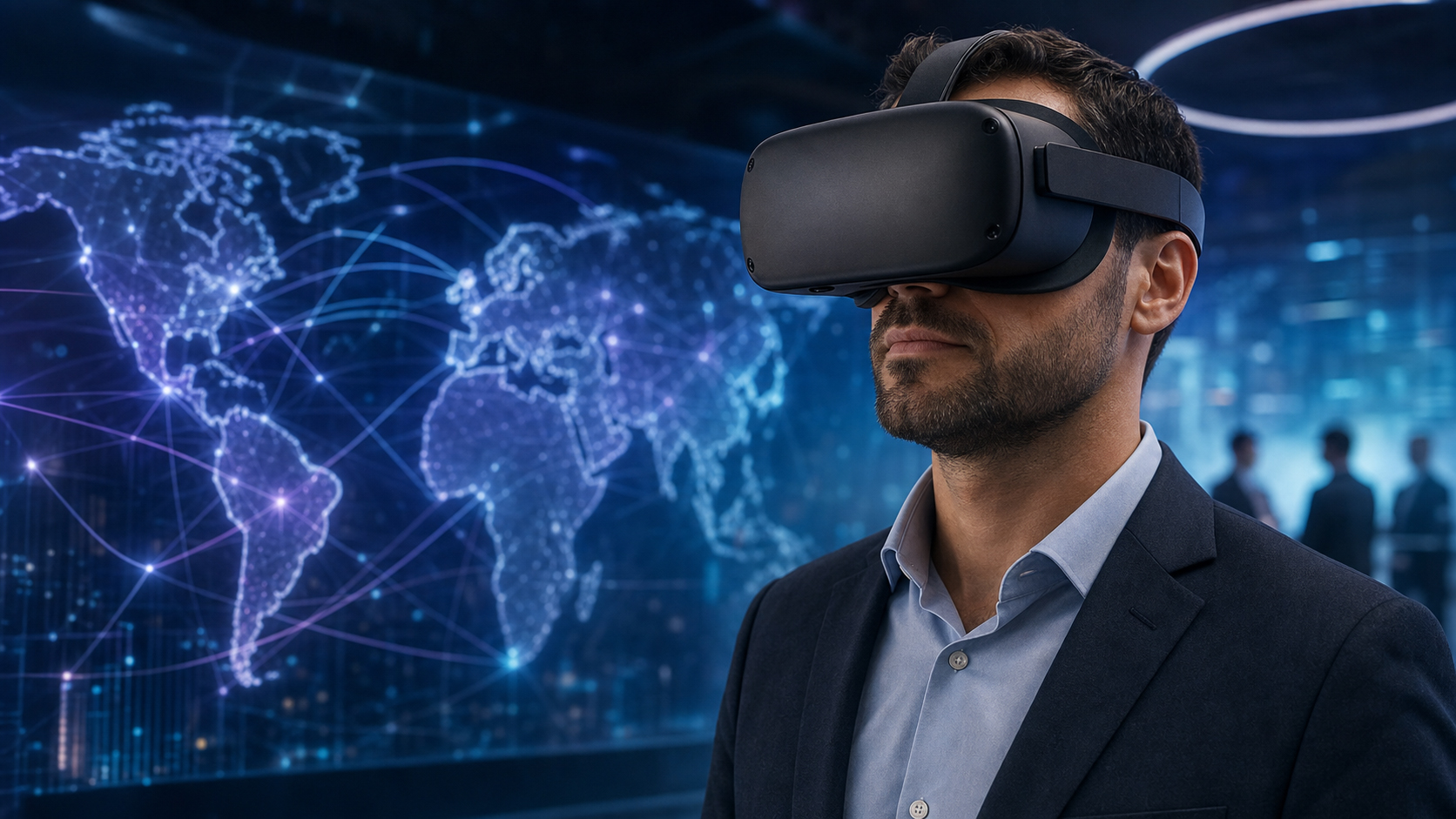
Enterprise VR for continuous operation: Is the DPVR P1 Max the quiet revolution for training? – Image: Xpert.Digital
Smart Glasses vs. VR Headsets: Why this business device still has a future in 2026
Between hype and added value: Is the new enterprise VR headset worthwhile for companies?
No more overheating: Does the DPVR P1 Max solve the biggest VR problem for businesses?
The enterprise VR market is at a crucial turning point in 2026. While the next graphics hype often dominates the consumer market, hard facts count in the corporate environment: reliability in continuous operation, local support, and a clear return on investment. The recently announced exclusive distribution partnership between the Asian hardware specialist DPVR and the established Western distribution network VR Expert addresses precisely this need. At the heart of the alliance is the standalone headset "DPVR P1 Max"—a device designed not for high-end gimmicks, but for robust everyday usability in training, trade fairs, and exhibitions. But is an improved cooling system paired with a clever sales strategy enough to hold its own in a market fiercely contested by tech giants like Meta and Pico? The following analysis examines the technical details, the strategic logic of the deal, and the broader market forces that will determine the true success of virtual reality in business.
Between hype and added value – is the VR promise actually worthwhile for companies?
On August 7, 2026, news broke that, at first glance, appeared to be a typical sales announcement from the XR industry, but upon closer inspection, it signaled a significant maturity level in the enterprise VR market. The Chinese hardware manufacturer DPVR and the European-North American distributor VR Expert announced an exclusive distribution partnership for the DPVR P1 Max headset in Europe and North America. This collaboration combines the hardware expertise of a Chinese manufacturer with an established sales and service network that, according to the companies, serves more than 2,000 organizations in 26 countries. For an economic assessment, it's worth considering three levels: the product itself, the strategic rationale of the partnership, and the broader market forces within which this move is embedded.
A look under the hood – what the P1 Max is really capable of technically
The DPVR P1 Max is a standalone, all-in-one VR headset designed specifically for commercial and institutional use cases, not for the mainstream gaming market. It's powered by the Qualcomm Snapdragon XR2 chipset, which enables video playback up to 8K resolution, providing sufficient processing power for complex simulations where reliability is paramount, rather than maximum graphics quality. The binocular display has a resolution of 3664 x 1920 pixels and a field of view of approximately 100 degrees, considered adequate for applications such as training simulations or virtual reality walkthroughs.
Particularly noteworthy is the technical design for continuous operation. A newly designed active cooling system with intake and exhaust vents on the top and bottom of the housing is intended to improve thermal efficiency by up to 50 percent compared to the previous model. This investment in thermal management is no coincidence, but a direct response to a key problem with stationary VR installations: devices running for many hours at a time in training centers, at trade fairs, or in VR arcades often overheat and then fail for the rest of the day. This is complemented by an optional wired power supply via a top-mounted connector, which also supports reinforced, steel-sheathed cables and is therefore suitable for public, high-traffic environments such as exhibition spaces. A reserved Type-C expansion port on the mainboard also allows for the subsequent installation of add-on modules such as eye-tracking. This gives the device a degree of future-proofing and adaptability to specific customer requirements. With RAM configurations of 6 to 8 gigabytes (depending on the source) and 128 gigabytes of internal storage, as well as Wi-Fi 6 and Bluetooth 5.1 as connectivity standards, the device clearly positions itself in the upper segment of standalone-capable business hardware, without achieving the performance of PC-bound high-end systems required for professional engineering applications.
The logic behind the deal – why a manufacturer needs a distributor
The real economic substance of this announcement lies less in the hardware than in the sales architecture. DPVR is an established name in China with a long history in the VR segment. As early as 2017, the company claimed market leadership among Chinese VR brands with a 24 percent market share and has since continuously launched new product generations such as the P1, P1 Pro, P1 Ultra 4K, and now the P1 Max. However, for a manufacturer with a primarily Asian sales base, access to Western enterprise customers represents a structural hurdle that cannot be overcome simply by having a good product. Enterprise customers in Europe and North America typically expect local contacts, warranty processing in their own time zone and language, integration support, and the option to test or rent devices before purchasing. VR Expert, a company with roots in the Netherlands, has been active in the market since 2012 and now operates with over 40 multilingual specialists and offices in the Netherlands, Germany, France, Poland, and the United States, filling precisely this gap.
Over the past few years, VR Expert has established itself as a kind of neutral distribution platform for several competing XR hardware manufacturers, including Meta, HTC, Pico, and Microsoft. In parallel, partnerships have been forged with specialized providers such as Varjo for high-end mixed reality, ArborXR for device management, and HoloLight for industrial XR streaming solutions. This multi-vendor strategy is economically remarkable because it positions VR Expert not as dependent on a single manufacturer, but as a platform for needs analysis and procurement. This brings it closer to the classic distribution model of a systems integrator than that of a pure reseller. For DPVR, however, the exclusivity of the partnership in Europe and North America means a concentration of sales resources on a single, specialized channel, saving enormous costs associated with building its own sales structures in foreign markets. However, this step also creates a certain dependence on the performance of this one partner.
Growth market with reservations – how big is the pie really?
The partnership comes at a time when the commercial VR market is gaining significant momentum, according to several independent market research institutes, although the exact figures vary considerably depending on the definition used. The global virtual reality market as a whole is estimated to reach approximately US$26.7 to US$43 billion by 2026, with annual growth rates between 28 and 29 percent, depending on the underlying market definition. The specific area of corporate VR training, which is particularly relevant for a device like the P1 Max, is projected to reach around US$10.9 billion in the software segment alone by 2026, and even approximately US$18.6 billion when hardware is included. Forecasts predict annual growth of 24 to 45 percent until 2033. Furthermore, a market research finding suggests that corporate customers will account for more than 60 percent of total VR revenue by 2030. According to surveys, 91 percent of companies are already using VR or AR or planning to introduce them.
These figures, however, warrant critical evaluation, as market research forecasts in the XR sector have repeatedly proven overly optimistic in the past, particularly regarding the timing of mass adoption. In this context, an assessment by the market research firm IDC is interesting, according to which 2026 will be a transitional year in which the focus of the XR market will increasingly shift from traditional VR headsets to smart glasses without full-screen displays. The vast majority of the 33.5 percent shipment growth expected for 2026 is projected to be attributable to precisely these display glasses. For dedicated VR headsets like the P1 Max, this means they will increasingly have to concentrate on more narrowly defined, specialized use cases instead of aiming for general mass growth. This narrowing of focus to niches such as training, education, healthcare, and location-based entertainment also explains the product positioning of the P1 Max, which is explicitly marketed not as a consumer device, but as a robust work tool for continuous use.
🎯🏢🥽 Enterprise XR Solution Hub for B2B projects – from digital twins to customized extended reality solutions

Enterprise XR Solution Hub for B2B projects – from digital twins to customized mixed reality solutions – Image: Xpert.Digital
Xpert.Digital acts as a holistic Enterprise XR Solution Hub, seamlessly integrating high-performance Pimax hardware into industrial B2B workflows. From digital twin analysis in engineering ("top floor") to immersive training on the production floor ("shop floor"), companies receive a customized, comprehensive solution including strategic consulting and support.
More information here:
Enterprise VR between Meta and Varjo: Why DPVR focuses on modularity and service
Competitive pressure from all sides – DPVR's narrow position in the ecosystem
Despite its growth, the enterprise VR market is not a sure thing for individual vendors, as competition is entering the market from several directions simultaneously. On the one hand, there's Meta with its Quest series, which, despite its consumer focus, is increasingly being used in commercial environments and benefits from a huge pool of software developers. On the other hand, specialized vendors like Varjo are positioning themselves in the professional high-end segment for engineering and design applications, while Pico – formerly independent and now part of ByteDance – is also aggressively expanding in the enterprise market. DPVR must differentiate itself in this environment through a combination of price, robustness, and adaptability, as direct competition based solely on computing power against its financially stronger rivals would be virtually impossible.
The modularity of the P1 Max, particularly the ability to add features like eye-tracking via the USB Type-C expansion port, is a strategically sound solution in this context. It allows enterprise customers to start with a more affordable base configuration and increase their investment only when needed. At the same time, it's important to note that DPVR, as a Chinese manufacturer, may face geopolitically motivated skepticism towards Chinese hardware in certain Western market segments, especially in the defense and government sectors. While not explicitly addressed in the available sources, this factor, based on general market observations, must be considered a real limitation for certain target groups.
The service factor as the actual value driver
An often underestimated aspect of such hardware distribution partnerships lies not in the product itself, but in the accompanying services. VR Expert explicitly promotes consulting, configuration, software installation, international shipping, and initial support as part of its offering. For enterprise customers who haven't built up their own internal XR expertise, this service layer is often more decisive for the purchasing decision than technical data sheets. Experience from VR Expert's past partnerships, such as with Varjo, ArborXR, or most recently with HoloLight in the field of industrial XR streaming solutions for sectors like manufacturing, automotive, energy, and defense, reveals a pattern: VR Expert is increasingly positioning itself as an integrator and consultant, not just a "box mover." For DPVR, this collaboration increases the likelihood that the P1 Max will actually be used in production environments and not end up in a drawer after a disappointing initial setup—a fate that has befallen many VR projects in companies in the past.
Opportunities and risks: a reality check
A sober assessment of the partnership reveals both plausible opportunities and significant risks. On the opportunity side is the growing maturity of the enterprise VR market, which is increasingly moving beyond the phase of mere technology demonstrations and resulting in concrete procurement decisions. This is supported by compelling return-on-investment arguments in areas such as security training, onboarding, and simulation training. The P1 Max's technical focus on continuous operation and ease of maintenance aligns well with the actual needs of training centers and exhibition spaces, which, unlike individual users, require high operational reliability over many hours.
On the risk side, the available sources regarding the partnership itself are still very new, and reliable sales figures or customer references are currently lacking. The economic success of the collaboration cannot yet be quantified; it remains, for now, an announcement with future promises. Furthermore, the 3DoF tracking standard (the mere recording of head rotation without position tracking in space) is a technical limitation that renders the device unsuitable for applications involving free movement in virtual space—such as complex training scenarios with physical interaction. It clearly restricts its use to viewing and presentation scenarios like 360-degree videos and guided tours. Finally, it remains to be seen how stable an exclusive distribution agreement with a multi-vendor distributor like VR Expert will be in the long term. Structurally, this distributor has no interest in promoting only a single manufacturer but will always guide its customers to the most suitable solution within its own portfolio—which, in some cases, may even be a competitor's product.
Enterprise VR market in transition: What the cooperation between DPVR and VR Expert means
The distribution partnership between DPVR and VR Expert is a solid, but not revolutionary, signal for the enterprise VR market. It exemplifies how competition in the XR hardware market is increasingly decided by specialized niche products and strong regional distribution partnerships rather than disruptive technological breakthroughs. For companies seeking a cost-effective, low-maintenance solution for 360-degree video content in training, education, or at exhibitions, the P1 Max is certainly a viable option. However, more demanding applications involving spatial interaction will still rely on more powerful, albeit more expensive, alternatives. The true economic success of this partnership will only become apparent in the coming quarters, based on concrete installation figures and customer testimonials, which are currently pending.
Your global marketing and business development partner
☑️ Our business language is English or German
☑️ NEW: Correspondence in your native language!

Konrad Wolfenstein
I and my team are happy to be available to you as your personal advisor.
You can contact me by filling out the contact form here [email protected]:or simply call me at +49 7348 4088 965. My email address is
I'm looking forward to our joint project.
☑️ SME support in strategy, consulting, planning and implementation
☑️ Creation or realignment of the digital strategy and digitization
☑️ Expansion and optimization of international sales processes
☑️ Global & Digital B2B trading platforms
☑️ Pioneer Business Development / Marketing / PR / Trade Fairs
🎯🎯🎯 Data-driven B2B industry hub as a quasi-in-house solution

The quasi-in-house solution: How Xpert.Digital closes operational gaps in B2B marketing and sales – Smart Content-Driven Business - Image: Xpert.Digital
Xpert.Digital is a data-driven B2B industry hub led by Konrad Wolfenstein . The company acts as an external, quasi-in-house solution for industrial partners, closing operational gaps in marketing, content, and sales – without requiring additional resources on the client side.
More information here:





