
Cables as a competitive advantage: Why wired PCVR is categorically superior to standalone headsets in the enterprise sector

Available in 27 languages 📢
Prefer Xpert.Digital on GoogleⓘPublished on: June 26, 2026 / Updated on: June 26, 2026 – Author: Konrad Wolfenstein
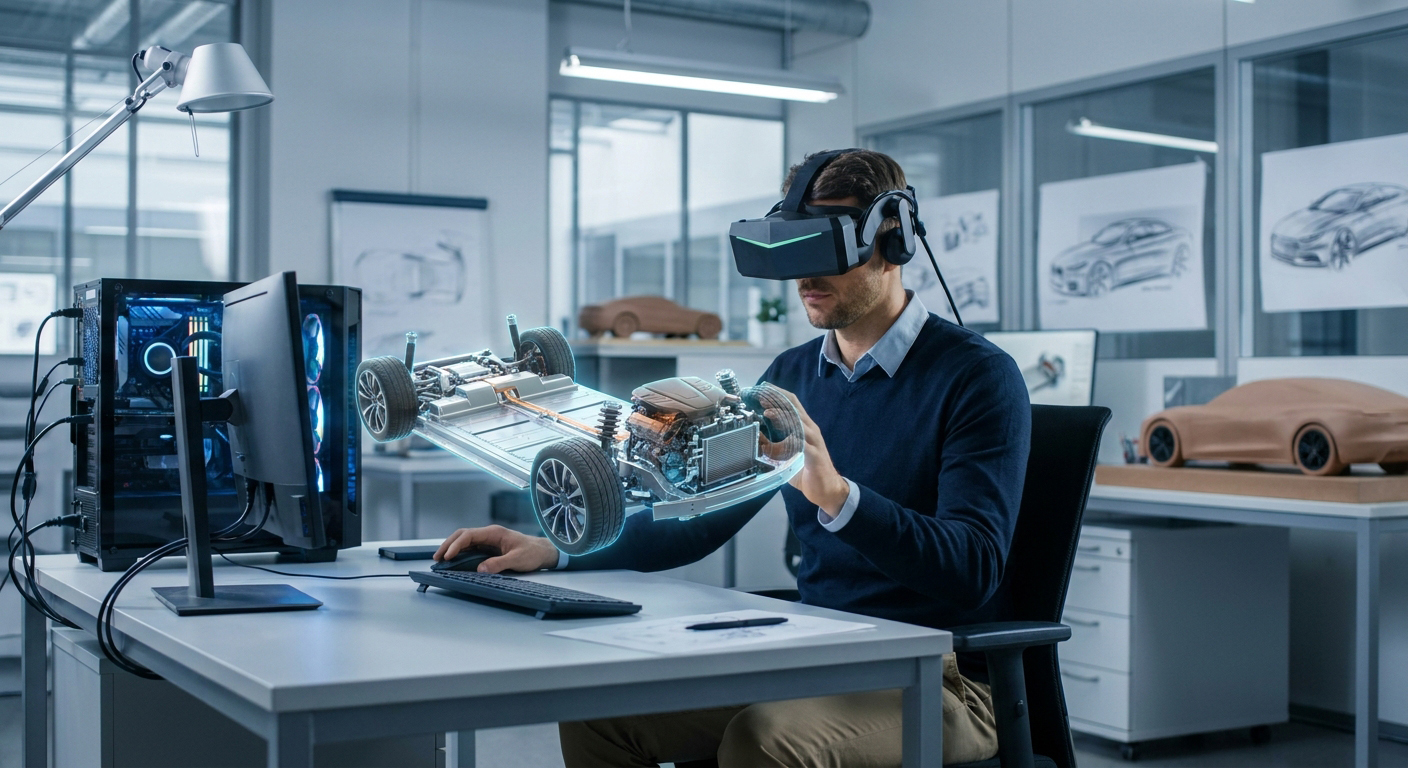
Cables as a competitive advantage: Why wired PCVR is categorically superior to standalone headsets in the enterprise sector – Creative image: Xpert.Digital
Avoiding design flaws in VR: Why cables are not a compromise, but a necessity in virtual reality
The expensive illusion of wireless VR: Why business-critical workflows need uncompromising PCVR
Forget MetaQuest & Co.: Why the cable is the real competitive advantage for enterprise VR
In the world of virtual reality (VR), the verdict seemed to have been long in hand: wireless is king. Standalone headsets, with their promise of maximum freedom, low costs, and easy deployment, have conquered enterprise tenders. But this myth of convenience harbors a massive blind spot that can prove costly for industrial companies. While mobile VR headsets are perfectly adequate for simple training and standard onboarding processes, they fail miserably when it comes to business-critical precision—be it in evaluating automotive prototypes, in complex flight simulations, or in assessing fine surface structures in mechanical engineering. Those who rely on fractions of a millimeter and photorealistic textures don't need a "sufficient" compromise solution, but uncompromising performance. And it is precisely here that the supposedly defunct cable is making its strategic comeback. Learn why wired PCVR – driven by unexpected B2B disruptors like Pimax – is not only technologically superior but also economically essential for high-end enterprise workflows. Discover why the cable isn't a hindrance, but rather provides the crucial competitive advantage.
The comfort myth is costing the industry millions
The debate between wired PCVR and standalone headsets has long been settled in the public eye: the freedom of the wireless experience has conquered the mass market. MetaQuest, Pico, and HTC Vive dominate enterprise tenders, their sales arguments sounding convincing – no cables, no dedicated PC, simple deployment via MDM systems, ready in seconds. This narrative is absolutely accurate and legitimate for large parts of the B2B market. Training, onboarding, safety briefings – all of this can be handled well and cost-effectively with standalone hardware.
The problem lies elsewhere: The industry has so thoroughly internalized the success narrative of the affordable, mobile solution that a growing, strategically highly relevant segment of business-critical applications is systematically supplied with undersized hardware. Anyone evaluating an automotive prototype in VR, virtually touring an industrial building, inspecting a turbine blade for surface defects, or simulating a complex maintenance process on a real-world plant doesn't need a headset that's merely "adequate." They need one that's "accurate enough"—and that's a fundamentally different requirement.
This is precisely where the technological and economic argument for wired PCVR as a categorically superior platform for a clearly defined, economically significant class of enterprise workflows begins. This argument is not anti-standalone – it is a precise segmentation of requirements.
Five criteria where the cable makes the difference
Image quality and pixel density as a basis for decision
The single most important argument for PCVR in a professional environment is image quality – more precisely, pixel density, measured in pixels per degree (PPD). Standalone headsets are based on mobile chipsets whose GPU performance is physically limited. A Snapdragon XR2 Gen 2, used in current consumer standalone headsets, achieves a rendering performance at maximum load that falls far short of the capacity of an NVIDIA RTX 4080 or 4090. The consequence is directly measurable: Current top-of-the-line standalone headsets achieve around 20 to 25 PPD. The human eye with normal visual acuity can resolve up to 60 PPD under optimal conditions.
Pimax, the Shanghai-based company founded in 2015 and the undisputed market leader in the high-end PCVR segment, achieves up to 57 PPD per eye with its Crystal Super series at a resolution of 3,840 × 3,840 pixels. This is more than double the performance of current standalone headsets. In practice, this means: fine text on virtual instrument panels is legible. Surface textures of CAD components appear realistic. Distance information can be reliably estimated. An engineer examining a prototype in a PCVR setup and a colleague using a standalone headset literally see different things – and make differently informed decisions based on this.
The Varjo XR-4, until now the only serious competitor at this PPD level (around 51 PPD), costs from approximately €5,200 net in its basic version and well over €8,600 net with autofocus cameras (Focal Edition). In addition, there are mandatory software licenses: those who have to work in high-security environments without an internet connection need an offline license for an additional €2,400 per headset. The Pimax Crystal Super costs around US$1,700 – a fraction of the Varjo's cost with comparable or even superior resolution.
Uncompromising computing power
A wired connection between a headset and a PC is, from a physical perspective, a high-speed data highway. The rendered image comes from the GPU, the tracking data goes back – in real time, with minimal jitter and virtually no compression loss. Wireless streaming solutions like Meta's Air Link or Wi-Fi 7-based systems have made impressive progress, but they still suffer from latency, compression artifacts, and dependence on network stability. For most training applications, this is irrelevant. For simulation scenarios that require precise timing, photorealistic rendering, or real-time physics calculations, it's a serious technical problem.
The latency of a wired PCVR connection is typically less than 20 milliseconds—a value below the threshold of perceptible delay for the human brain. Wireless systems fluctuate depending on infrastructure and network load. Even the technically impressive Intel AX1690 solution for MetaQuest achieves average latencies of less than 5 milliseconds under optimal conditions, but exhibits measurable fluctuations during network disruptions. In a flight simulation or a safety-critical maintenance simulation, this variability is unacceptable.
Tracking precision for complex interactions
Wired PCVR systems, especially those with optional Lighthouse tracking (SteamVR base stations), are considered the gold standard for tracking precision. The base stations emit laser and infrared light, which is detected by sensors on the headset and controllers, triangulating the user's position in three-dimensional space with sub-millimeter accuracy. This method is known for its robustness against rapid movements, extreme angles, and peripheral areas of the action space. Modern standalone headsets use inside-out tracking via built-in cameras. For most training applications, the quality is now excellent. However, for applications requiring sub-millimeter accuracy—such as surgical training simulations or precise assembly instructions for complex machinery—the outside-in Lighthouse system remains unsurpassed.
The Pimax Crystal Super supports both tracking modes: Inside-Out for simple setups and optional SteamVR Lighthouse tracking for maximum precision. This flexibility is strategically valuable for enterprise deployments: Standardized training rooms can be equipped with base stations, while mobile deployments can utilize Inside-Out.
Continuous operation without battery management
Standalone headsets must integrate a battery, which adds weight and necessitates design compromises. Typical runtimes are two to three hours. This is sufficient for occasional training sessions. For four- to eight-hour design review sessions, intensive simulation exercises, or all-day product development workshops, battery operation poses a serious operational problem: swappable batteries cause interruptions, MDM-based charging management creates overhead, and the physical mass of the battery in the device is weight that cannot be invested in better optics or more advanced processor architecture. Wired PCVR headsets draw their power from the cable and run indefinitely. For defined stationary work environments, this is not a limitation but a significant operational advantage.
Software ecosystem and content abundance
The PC VR software stack is the most comprehensive and mature in the entire VR market. SteamVR alone includes thousands of titles, encompassing a wide range of industrial applications, architectural visualization tools, CAD viewers, simulation engines, and professional training platforms. Pimax Crystal Super is compatible with SteamVR, OpenXR, and a variety of proprietary enterprise software frameworks. Standalone platforms operate in more curated, smaller ecosystems. For organizations deploying custom developments via standard OpenXR pipelines or relying on PC-native CAD direct connections (such as NVIDIA Omniverse or Autodesk VRED), the PC VR infrastructure is simply the natural home for their application stacks.
Market dynamics: A multi-billion dollar market seeking quality
The global VR market is growing with a momentum that is surprising even optimistic analysts. The total market volume is estimated at $20.83 billion for 2025 and is projected to reach $171.33 billion by 2034 – an annual growth rate of 26.2 percent. The immersive VR submarket, which also includes industrial and medical applications, is estimated at $16.29 billion in 2026 and is expected to grow to $55.29 billion by 2031.
The primary drivers of this growth are not gaming or consumer entertainment, but increasingly enterprise deployments. Companies in the aerospace, defense, automotive, architecture, and medical technology sectors are scaling their VR programs from pilot projects to company-wide rollouts. It is precisely at this stage of market maturity that the question of the right hardware for the right use cases becomes a fundamental strategic decision – no longer a purchasing decision, but a question of operational excellence.
The demand for digital twins directly reinforces this trend: According to a Bitkom survey of 552 German industrial companies, 63 percent consider digital twins indispensable for remaining internationally competitive – in the mechanical and plant engineering sector, this figure rises to 73 percent. A digital twin only unfolds its full potential when it can be experienced with a visualization infrastructure that truly meets the requirements – and this generally means PCVR.
Pimax: The gaming market leader as a B2B disruptor
The surprising qualification of a niche leader
When people talk about VR hardware in a B2B context, they usually think of MetaQuest, HTC Vive, or Pico – companies with dedicated enterprise sales channels, MDM certifications, and institutional support offerings. Pimax is an outsider in this group, but it possesses a qualification that no other company can replicate: It is the undisputed market leader in the high-end VR gaming segment, which simultaneously houses the most quality-critical user group in the entire VR market.
Simulation enthusiasts—flight simulator pilots in DCS World, Microsoft Flight Simulator, or IL-2; racing simulator drivers in iRacing and Assetto Corsa; and space simulator fans—are the most meticulous hardware testers on the market. This community evaluates image quality, latency, optical aberrations, god rays, and rendering accuracy with a precision that institutional enterprise procurers can scarcely replicate. The fact that the Pimax Crystal Super is considered the undisputed benchmark within this community—the headset that allows you to read instrument needles at a distance and perceive horizon lines sharply in flight simulations—is substantial proof of quality in the B2B context.
Microsoft recognized this qualification and selected Pimax as the official VR hardware partner for Microsoft Flight Simulator 2024. At the simulation's global preview event, the Pimax Crystal Light was the headset of choice – a decision motivated not by marketing contracts, but by technical superiority. From a B2B perspective, this partnership sends a strong signal: Flight simulation is one of the most direct technological bridges between consumer gaming and professional avionics training.
NASA Armstrong Flight Research Center: An independent adopter signal
NASA's Armstrong Flight Research Center in Edwards, California, has been exploring the use of VR and AR for flight research and pilot training for years. The center—named after Neil Armstrong and specializing in flight testing of unique research vehicles—independently procured Pimax headsets for use in flight simulation and research contexts. This independent procurement decision by one of the world's most prestigious aerospace research institutions sends a strong, independent signal of market validation.
Armstrong researchers are actively using VR to develop augmented reality cockpit displays, providing pilots with additional visual information during real-time flight tests. The center has explicitly identified the narrow fields of view of most AR systems as a problem and has moved to a solution that uses a VR headset with inward-facing cameras as the base technology – precisely the configuration where a wide FOV and high pixel density are not mere comfort features, but functional requirements.
The NASA signal carries particular weight because, in an institutional purchasing context, it's not a marketing collaboration but an operational decision based on technical requirements. When a research institution whose core competency is defining precision standards independently procures a headset, it represents the most credible form of product validation a B2B manufacturer can seek.
Related to this:

Pimax Business: Case studies from industrial and educational applications
The Pimax Business Enterprise Case Library documents use cases from education, industrial training, cultural tourism, and immersive cinema. In industrial training, the documented projects include VR training systems for heavy machinery maintenance and repair—high-resolution, simulated scenarios in which machine operators practice troubleshooting, disassembly, and inspection of complex systems without risking real equipment. In education, Pimax has developed partnership projects for VR language learning and scientific internship simulations that place learners in reproducible, immersive scenarios, significantly reducing training effort and resource consumption.
The Cologne TimeRide project, based on Pimax hardware, demonstrates the direction of technology transfer towards cultural tourism and immersive edutainment: visitors experience Cologne's city center of the 1920s in a precise historical reconstruction with spatial sound and wind effect integration. This example illustrates that the strengths of PCVR hardware also have an impact outside of the narrow industrial sector – wherever immersion depth, attention to detail, and continuous operation are crucial.
🎯🏢🥽 Enterprise XR Solution Hub for B2B projects – from digital twins to customized extended reality solutions

Enterprise XR Solution Hub for B2B projects – from digital twins to customized mixed reality solutions – Image: Xpert.Digital
Xpert.Digital acts as a holistic Enterprise XR Solution Hub, seamlessly integrating high-performance Pimax hardware into industrial B2B workflows. From digital twin analysis in engineering ("top floor") to immersive training on the production floor ("shop floor"), companies receive a customized, comprehensive solution including strategic consulting and support.
More information here:
Why PCVR is the economic heart of industrial design reviews: From mechanical engineering to medicine – use cases where image quality saves millions
The economic calculation: ROI analysis for PCVR investments
Cost-benefit analysis in an industrial context
The investment analysis for a professional PCVR setup must include all cost components: A Pimax Crystal Super costs around US$1,700. Add to that a powerful workstation with an NVIDIA RTX 4080 or 4090 (starting at around €2,500 for the GPU alone), so the total system typically costs between €5,000 and €7,000. This isn't a mass deployment budget, but it's also dramatically less than historical professional visualization solutions: A Varjo XR-4 alone costs over €10,000 in full configuration, and classic CAVE systems for industrial visualization were in the six-figure euro range.
The benefits of this investment are well documented. In a representative analysis from the mechanical engineering sector, researchers found that VR-based design reviews can reduce development time from 27 to 9 months and achieve savings of over $100,000 by eliminating the need for physical models. General Electric Mexico discovered an assembly error in a turbine during a VR design review; correcting it physically would have cost between $100,000 and $1 million—the VR review cost a fraction of that. Ford reports a 90 percent reduction in prototype costs through the use of VR in vehicle development. Boeing achieved a 30 percent reduction in design time for complex aircraft components.
The Forrester study on mixed reality quantifies the overall ROI at 177 percent over three years, with a net added value of $7.6 million and a payback period of 13 months. Capgemini, in a separate analysis, notes that three out of four companies adopting VR achieve operational improvements of over 10 percent. NVIDIA reports that fully VR-integrated projects have 60 to 65 percent fewer design flaws.
By using mixed reality in global design reviews, Kia increased the speed of these reviews by approximately 98 percent and achieved significant cost savings. This case exemplifies the core argument for high-resolution PCVR: Autodesk VRED, the leading software for 3D automotive design, explicitly requires headsets with extremely high resolution and color reproduction to achieve the level that automotive designers need for reliable judgments – and only PCVR can meet this requirement.
Scaling logic: PCVR and standalone as complementary investments
An economically sound enterprise VR strategy doesn't rely on either PCVR or standalone systems, but rather understands both as complementary investments for different application classes. Standalone hardware with MDM management remains the right choice for scalable training and onboarding programs where mobility, easy deployment, and low total cost of ownership across a large number of users are crucial. PCVR stations are the right investment for strategic design review rooms, simulation labs, prototype validation processes, and high-precision training scenarios, where a single avoided error can many times over offset the hardware investment.
This segmentation of the hardware strategy according to application classes – and not according to technological preference or procurement convenience – is the core of a mature enterprise VR strategy.
The industrial application atlas: Where PCVR is systemically superior
Mechanical engineering and plant design
Mechanical engineering is the classic use case for high-resolution PCVR. CAD models of machines and systems contain thousands of individual components with defined dimensions, fits, and surface qualities. A design review in VR only offers real added value if the designer can actually see whether a sealing surface is flat, whether a cable duct provides sufficient space, or whether the assembly of a component is ergonomically feasible. With a pixel density of 57 PPD, Pimax Crystal Super enables precisely this kind of detail perception, which is simply not achievable with a standard business headset at 20 to 25 PPD.
Automotive and vehicle design
The automotive industry is among the early adopters of VR and, at the same time, the sector where image quality plays the most critical role. Body designers assess lighting, shadows, color gradients, and surface reflections—qualities that become blurred and indistinct at low pixel densities. Ford, Volkswagen, BMW, and Hyundai use VR in product development and manufacturing. The challenge is not the availability of VR, but the reliability of visual judgment. A designer examining a prototype side mirror using a Pimax Crystal Super headset sees something fundamentally different than a colleague using a standalone headset with 20 PPD.
Architecture, construction and urban planning
VR is already widespread in the field of architecture. BIM data can be directly transferred into walkable virtual models, allowing clients, investors, and users to experience the building before construction even begins. The crucial question, however, is how convincing this experience is. Materials such as polished concrete, exposed brickwork, or wooden planks have surface textures that only appear convincing in VR with sufficient pixel density. For building construction projects, where a single design decision can involve millions of dollars, the quality of the visual impression is directly linked to the project's economic risk. Changes identified during the initial virtual building walkthrough can cost many times the hardware investment after construction—as the Penn State Ice Arena example, with its avoided change order costs of over $475,000, impressively demonstrates.
Aerospace and defense
High-resolution VR is nothing new in the aerospace industry. Flight simulations place particularly high demands on image quality because instrument displays, horizon lines, and terrain details must be clearly visible at great distances—precisely the use case that has made Pimax headsets the preferred device in the global simulation community. NASA Armstrong is actively researching VR and AR for flight research and pilot training and has used Pimax hardware for its own simulation applications. Varjo reports that using an XR headset for fighter jet simulators at a cost of only $40,000 per hour results in savings of millions of dollars per year.
Medicine and medical simulation
Surgical training simulators, anatomical visualizations, and the preparation of complex operations based on CT data are among the areas where VR image quality is directly related to the quality of clinical decision-making. Fine anatomical structures, tissue differentiations, and implant contours are pieces of information that can only be reliably transmitted in a VR environment with high pixel density—a requirement that standalone headsets cannot structurally meet.
Industrial training and safety training at expert level
Even in industrial training, there are use cases where standalone hardware reaches its limits: Expert-level training courses, where participants learn to recognize and assess visual quality defects, can be counterproductive with low-resolution hardware. If a maintenance technician learns to assess the quality of a weld in a VR simulation and completes the training with a headset that doesn't display the weld sharply enough, they will be working with a distorted reference image in real-world situations. Siemens VR training programs running on EducationXR platforms report a threefold improvement in knowledge retention and a 70 percent reduction in time to proficiency for key tasks. These effects are tied to quality standards – and image quality is one of the crucial ones.
The communication problem: When technological leadership remains invisible
Despite its compelling technological profile, Pimax has a structural communication problem in the B2B context. The company primarily speaks the language of its gaming community: PPD values, FOV specifications, rendering optimizations, compatibility with Steam titles. This language is self-evident to simulation enthusiasts, but largely opaque to a purchasing manager in a mechanical engineering company or a digital manager at an automotive supplier.
This paradox is symptomatic of a manufacturer that is technologically far ahead but hasn't yet found its strategic niche within the enterprise purchasing narrative. The necessary reinterpretation is clear: not "the sharpest image for simulations" as a marketing promise, but rather its translation into decision-making relevance: How many iterations in product development can be saved by a design flaw identified in a VR review? How much travel time for international design reviews is avoided through high-resolution VR collaboration? What prototype costs are saved by early detection of design flaws?
Market researchers estimate that 43 percent of manufacturers expect VR to become standard technology in even more companies before the end of the decade. Anyone who wants to be perceived as a benchmark for quality in this market needs to start establishing their narrative now – before Meta or HTC do it with their next generation of mobile headsets, which, while good enough for most tasks, will never be good enough for the most important ones.
Technological outlook: Hybridization without sacrificing quality
The clear dichotomy between wired PC VR and standalone VR will become increasingly blurred in the coming years – but not at the expense of top-tier quality. With its optional "Cobb" compute module, which houses a Snapdragon XR2 Gen 2 chip, Pimax has taken initial steps towards a hybrid architecture. This allows the Crystal headset to be used independently when needed, with the corresponding limitations in image quality, but with the option of greater flexibility in situations without a PC connection.
Wi-Fi 7 streaming has significantly narrowed the gap between wired and wireless quality, but it hasn't eliminated it. For applications where precise physical movements, absolute latency stability, or maximum image quality are non-negotiable, the cable remains the superior medium for the foreseeable future. Pimax's Dream Air series, which combines Sony Micro OLED panels with 3,840 × 3,552 pixels per eye in a chassis weighing less than 170 grams, points the way forward: more quality with less weight, but still primarily designed for PC VR use.
The next technological hurdle in enterprise VR won't be wireless transmission – that's largely solved from a technical standpoint. The question will be whether micro-OLED technology and advanced compression algorithms will allow PCVR image quality to be transmitted over wireless infrastructures without measurable loss of quality. Until then, for precision-critical applications, the cable remains the non-negotiable feature.
The right tool for the right task
The economic and technological analysis leads to a nuanced yet clear conclusion: Wired PCVR is not the VR headset for all B2B use cases – but it is the categorically superior tool for all those applications where the quality of visual judgment directly correlates with the economic value of the decision. Training, education, and maintenance support are legitimate and important applications for mobile, wireless solutions. But design reviews, engineering inspections, virtual prototype validations, architectural walkthroughs, simulation scenarios, and high-quality customer visualizations – these are use cases where PCVR offers a different class of tools than any standalone platform below the Varjo price point.
Strategic wisdom lies not in evaluating all VR hardware based on a single characteristic – wirelessness or image quality. It lies in precisely segmenting application classes and selecting the technologically appropriate platform for each class. For the growing and most economically significant segment of industrial visualization, virtual product design, digital planning, and precision-dependent simulation, that platform is the Pimax Crystal series – the system that has demonstrably bridged the quality gap between the gaming enthusiast market and professional enterprise applications, at a price point that, for the first time in the history of this technology, is also accessible to mid-sized companies.
The cable is not a compromise. It is a requirement.
Your global marketing and business development partner
☑️ Our business language is English or German
☑️ NEW: Correspondence in your native language!

Konrad Wolfenstein
I and my team are happy to be available to you as your personal advisor.
You can contact me by filling out the contact form here [email protected]:or simply call me at +49 7348 4088 965. My email address is
I'm looking forward to our joint project.
☑️ SME support in strategy, consulting, planning and implementation
☑️ Creation or realignment of the digital strategy and digitization
☑️ Expansion and optimization of international sales processes
☑️ Global & Digital B2B trading platforms
☑️ Pioneer Business Development / Marketing / PR / Trade Fairs
🎯🎯🎯 Data-driven B2B industry hub as a quasi-in-house solution

The quasi-in-house solution: How Xpert.Digital closes operational gaps in B2B marketing and sales – Smart Content-Driven Business - Image: Xpert.Digital
Xpert.Digital is a data-driven B2B industry hub led by Konrad Wolfenstein . The company acts as an external, quasi-in-house solution for industrial partners, closing operational gaps in marketing, content, and sales – without requiring additional resources on the client side.
More information here:





