

Crisis? Not at all: World market leader from the provinces – The quiet foundation of the German economy with 1,600 companies and 25% of exports
Xpert Pre-Release

Available in 27 languages 📢
Prefer Xpert.Digital on GoogleⓘPublished on: June 29, 2026 / Updated on: June 29, 2026 – Author: Konrad Wolfenstein
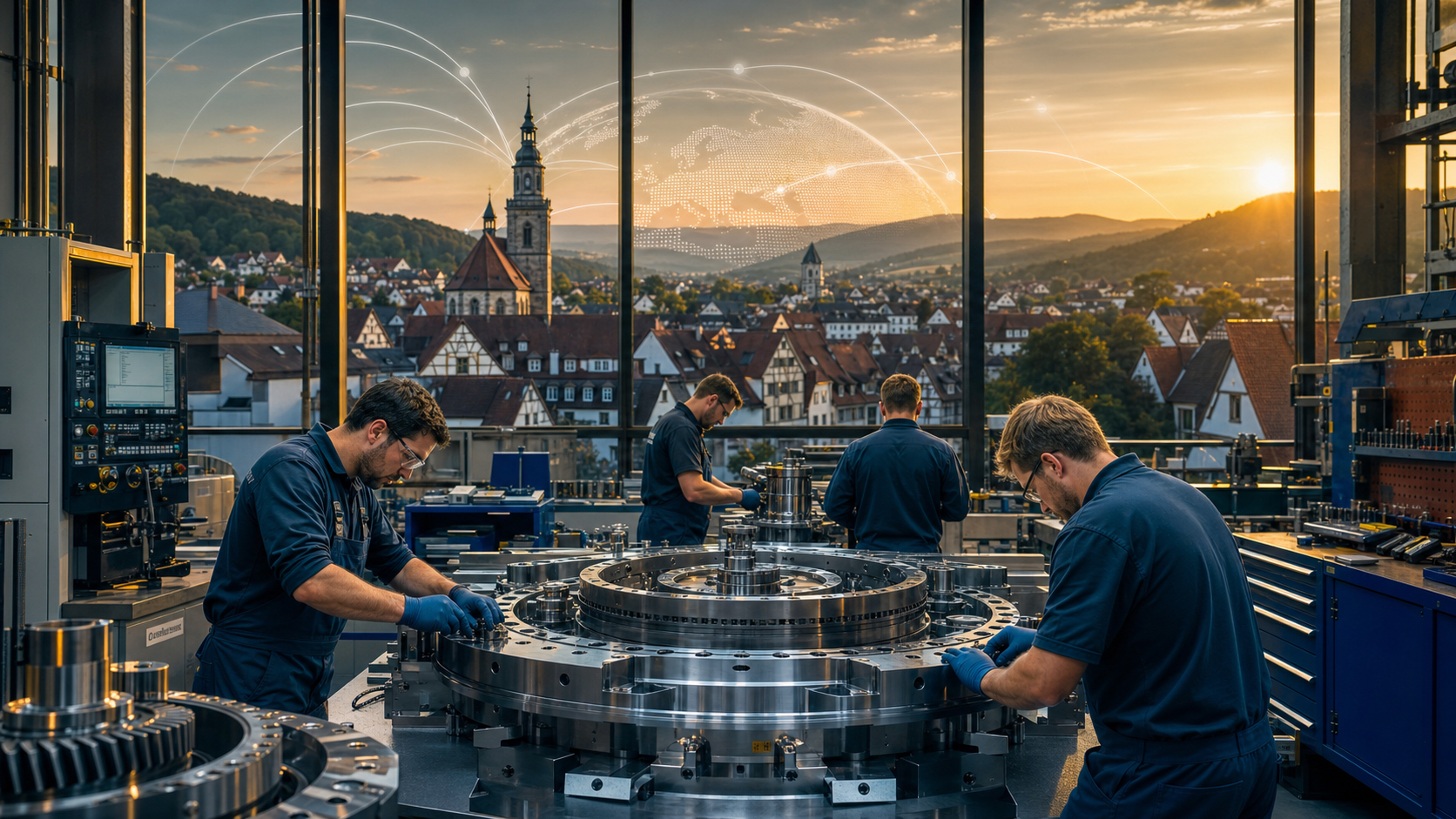
Crisis? Not at all: World market leader from the provinces – The quiet foundation of the German economy with 1,600 companies and 25% of exports – Image: Xpert.Digital
The incredible secret behind Germany's "hidden champions": Without these German companies, the tech world would stand still
Not Munich or Berlin: Why the true German economic miracle is happening in the countryside
Autonomous driving & AI: How German SMEs are quietly building the future
Germany is currently often dismissed as the "sick man of Europe." Recession, deindustrialization, exploding energy costs, and endless bureaucracy dominate the headlines. But this pessimistic narrative overlooks the true foundation that keeps the world's third-largest economy running: far from the glittering metropolises, hidden away in the provinces, some 1,600 highly specialized global market leaders operate. These so-called "hidden champions" quietly generate a quarter of German exports. Without their high technology, there would be no modern computer chips, no autonomous cars, and no global logistics. Anyone who wants to understand why Germany hasn't collapsed despite all the crises needs to look beyond the DAX-listed companies and consider places like Schwanau, Kirchhundem, or Künzelsau. A search for clues in the true engine room of the republic—and an analysis of what makes these companies so unbeatable.
While Berlin debates, Schwanau, Kirchhundem and Künzelsau are delivering – 1,600 unknown companies quietly dominate the world, and hardly anyone talks about it
The paradox of the German economy: crisis and world-class at the same time
Germany is in crisis – at least that's the prevailing sentiment in the business press, talk shows, and political debates. Faced with economic stagnation, fears of deindustrialization, and growing competition from the Far East, the former economic powerhouse seems to be inexorably losing its luster. Gross domestic product shrank in 2023 and 2024, recovering by a meager 0.2 percent in 2025 – the third consecutive year without real growth, a unique occurrence in post-war German history. Economic research institutes have lowered their forecast for 2026 to just 0.6 percent. Production in the German chemical industry has reached a historic low of around 70 percent, and 143,000 industrial jobs were lost in 2025.
But beyond this noisy crisis scene, which gets bogged down in the minutiae of a political struggle for resources, another, far quieter and more focused class of companies is at work: Germany's hidden champions. They are the silent foundation on which Germany stood and on which it will stand again. Anyone who wants to understand why Germany isn't simply collapsing, even though the general conditions seem worse than they have been in decades, needs to know these companies. The answer to this apparent paradox lies in an economic stratum that never appears in any news broadcast and never gets its own item on any political agenda – even though it generates around 25 percent of German exports and accounts for almost half of all corresponding global market positions held by niche leaders.
Measuring the Invisible: What defines a Hidden Champion and how many there really are
The term "hidden champion" wasn't coined in a government ministry, but rather emerged from empirical analysis. Economist and management consultant Hermann Simon first used it in 1990 in a magazine article he aptly titled "Hidden Champions – Spearhead of the German Economy." Simon was searching for an explanation for Germany's export success, which couldn't be attributed solely to well-known corporations like Volkswagen, Siemens, or BASF, and found it in a layer of companies that remained virtually invisible to the public.
The definition is precise: A company is considered a hidden champion if it ranks among the top three in its market globally or is a market leader on its own continent, has an annual turnover of less than five billion euros, and is largely unknown to the general public. These companies are usually owner-managed, not publicly traded, rooted in rural Germany, and strongly export-oriented. Their export ratio is typically over 50 percent, often over 70 percent. A high degree of vertical integration—they cover the majority of their value chain themselves—is another key characteristic that ensures them exceptional control over quality and supply chains.
Hermann Simon currently counts 1,602 hidden champions in Germany – out of approximately 4,000 worldwide. This means that Germany accounts for almost half of all hidden champions worldwide, even though the country represents less than one percent of the global population. If you combine the German-speaking countries of Germany, Austria, and Switzerland, they are home to about 56 percent of all hidden champions. If you count all German world market leaders according to the somewhat broader definition used by "Die Deutsche Wirtschaft" (DDW), the number rises to 2,084 companies with a secure global market position. Germany thus has more hidden champions than the next four countries – the USA (approx. 360), Japan (approx. 220), China (approx. 180), and Switzerland (approx. 130) – combined. Per million inhabitants, Germany has 16 hidden champions, ten times more than Japan with 1.6 and more than fourteen times more than the USA with 1.1.
Historical roots and structural causes: Why Germany in particular?
This concentration is no accident. It has historical, cultural, and institutional causes that no other country has replicated in a comparable form. Until 1871, Germany was not a centralized nation-state, but a patchwork of 23 monarchies and three republics. This resulted in a polycentric industrial structure with many regional economic centers instead of a few metropolises. Even today, the hidden champions are geographically distributed across these historical economic centers – particularly densely in Baden-Württemberg, Bavaria, North Rhine-Westphalia, and Hesse.
North Rhine-Westphalia currently leads the distribution with around 470 hidden champions, followed by Baden-Württemberg with approximately 360 and Bavaria with around 290. Saxony and Thuringia are catching up rapidly in the east, with a particularly high-performing optics cluster developing in the Jena area. Around a third of all German hidden champions – 518 companies – are headquartered in small towns, 174 of them even in peripheral locations. This impressively refutes the common assumption that economic excellence arises exclusively in metropolitan areas.
Five structural features of Germany, in a unique combination, foster the emergence of hidden champions. The dual vocational training system ensures that skilled workers learn directly in companies, developing practical know-how that cannot be found in any textbook and cannot be copied by foreign competitors. The engineering culture, supported by above-average investments in research and development, drives the technological depth of these companies. The globally unique Fraunhofer model, with over 30,000 researchers in 76 institutes, directly connects applied research with small and medium-sized enterprises (SMEs), giving these companies access to cutting-edge research that their size alone could never finance. Family-owned businesses allow for investment horizons of 10 to 30 years instead of quarterly-driven return expectations. And the decentralized economic structure creates a close bond between companies, employees, and the region in small towns – a social glue that fosters loyal workforces and unusually low employee turnover.
Seven principles for success: What distinguishes hidden champions from all other companies
Hermann Simon has analyzed more than 1,000 hidden champions over a period of over three decades, identifying seven patterns that recur across industries, regions, and crises. These patterns are not random, but rather the result of conscious strategic decisions made over generations.
The first and most fundamental principle is a radical niche focus. Hidden champions don't strive for large market shares in mass markets, but rather occupy extremely narrow market segments. "Tunnel boring machines over 10 meters in diameter" instead of "construction machinery," "high-strength bolts for wind turbines" instead of "fastening technology." Only through this depth of focus is world-class performance possible – the focus generates the knowledge, the knowledge generates the superiority, and the superiority generates the market position. Companies like RATIONAL from Landsberg am Lech, which manufactures professional kitchen appliances for thermal food preparation and maintains a 56 percent global market share with a product range limited to just three categories, illustrate this principle in its purest form.
The second principle is the ambition to be number one. No "good enough" and no "third place is also a success." This attitude permeates every investment and personnel decision and creates a corporate culture that differs fundamentally from that of average medium-sized companies. The third principle is globalization through their own foreign subsidiaries: no distributors, no agents, but rather their own subsidiaries worldwide for direct customer contact, rapid response, and controlled growth. The fourth principle is the exceptionally high research and development intensity. According to Simon's data, hidden champions file 31 patents per 1,000 employees—compared to only 6 patents in large corporations. They spend twice as much on research and development as the industry average and file five times more patents. Individual companies like the measurement technology specialist Testo continuously invest around ten percent of their annual revenue in research and development—compared to a German industry average of 2.7 percent in 2023.
The fifth principle is long-term thinking. The average age of these companies is 71 years, and board members remain in office for an average of 15 to 20 years – in large corporations, it's six. The high equity ratio and the absence of external capital pressure enable investments during downturns, which are structurally impossible for publicly traded companies. The sixth principle is the exceptional customer proximity combined with a sales philosophy that focuses not on the list price, but on the total benefit over the product lifecycle. Hidden champions are, on average, five times closer to their customers than large corporations. Finally, the seventh principle is the decentralized, motivated organization with flat hierarchies, profit sharing, and regional roots. The employee turnover rate at hidden champions is 2.7 percent per year – compared to 7.3 percent for German companies on average.
Hidden innovation engine: How hidden champions maintain the technological front without making headlines
Hidden champions don't develop their innovative strength through disruptive breakthrough innovations presented at press conferences or keynotes, but rather through a consistent series of gradual improvements that accumulate over time into an insurmountable advantage. Stihl incorporated 42 innovations into a single chainsaw in one year. None of these improvements ever made headlines, but collectively they lead to the overall superiority that keeps every competitor at bay. Over 80 percent of hidden champions have introduced product or process innovations in the past three years – ten percent more than comparable companies of their size.
A particularly striking example of the depth of innovation within Germany's small and medium-sized enterprises (SMEs) can be found in the field of autonomous driving. Since 2010, 7,313 patents for autonomous driving have been registered worldwide, 48.8 percent of which originate in Germany – not from the US, Google, Tesla, or Silicon Valley. Germany thus technologically dominates precisely that future-oriented sector in which it is publicly perceived as lagging behind. Equally little known is the fact that the LSTM (Long Short-Term Memory) software, which powers around three billion smartphones worldwide, was developed by the Technical University of Munich. And DeepL, the world's best AI translation program according to independent tests, comes from Cologne. What appears in the global perception of tech as American or Chinese dominance is, upon closer inspection, often built on German foundations.
The world of hidden global market leaders extends to the high-tech foundation of the global chip industry. Without TRUMPF's industrial lasers and Zeiss SMT's EUV optics from Oberkochen, there would be no modern computer chips. ASML's extreme ultraviolet lithography machines, on which the entire global semiconductor manufacturing system is based, function only with these German precision components. Every research laboratory in the world uses laboratory equipment from Eppendorf in Hamburg, a company with an annual turnover of €1.2 billion that manufactures pipettes, centrifuges, and PCR instruments. And in 2014, the European Parliament declared the Type 2 charging connector from the Sauerland-based family business Mennekes in Kirchhundem the EU standard for charging electric cars – a company with an annual turnover of around €300 million thus literally set an infrastructural standard that permanently links every electric vehicle sold in Europe to the Sauerland region.
Stable growth in times of crisis: What current business figures reveal about resilience
The abstract strengths of hidden champions only become tangible and verifiable through concrete company figures. The current business results of the most important German niche leaders reveal a pattern that is analytically highly relevant: In an environment where the overall German economy is stagnating or shrinking, these companies are expanding – calmly, methodically, and with impressive consistency.
Würth, based in Künzelsau, Baden-Württemberg, the archetypal hidden champion and world-leading manufacturer and distributor of assembly and fastening materials, achieved sales of approximately €20.7 billion in fiscal year 2025 – another record figure, representing a nominal increase of 2.3 percent, or even 3.2 percent adjusted for currency fluctuations. International business grew by 3.3 percent to €12.7 billion, significantly outperforming domestic business and impressively underscoring its structural decoupling from the German domestic economy. Würth employs around 86,400 people worldwide, 44,000 of whom work in direct sales.
Stihl, based in Waiblingen, Germany, the world's leading manufacturer of chainsaws and power-driven garden equipment, increased its revenue to €5.48 billion in 2025 – a rise of 2.8 percent compared to the previous year, despite US tariffs, regional consumer restraint, and negative exchange rate effects. More than 91 percent of revenue is generated abroad. At the same time, Stihl is undergoing a strategic transformation: battery-powered products already account for 27 percent of global sales, and in Western Europe, around two-thirds of the devices sold are battery-powered. Stihl thus serves as a prime example of how a hidden champion can perceive a fundamental technological transformation not as a threat, but as a market opportunity – and consistently implement it using its own resources.
Kärcher, based in Winnenden, the global market leader in professional cleaning technology, increased its revenue to €3.483 billion in 2025, a rise of 3.2 percent on a currency-adjusted basis. The company operates in 85 countries through more than 170 subsidiaries with over 17,000 employees and invested over €200 million in expansion in 2024 alone. Herrenknecht, based in Schwanau in the Ortenau district – the world's leading manufacturer of tunnel boring machines – recently delivered two mixshield machines with a record diameter of 15.62 meters each for India's largest tunnel construction project in Mumbai and received orders for a total of eight machines for the Brenner Base Tunnel and five machines for the Lyon-Turin rail project. The company generates approximately 90 percent of its revenue abroad.
Symrise, based in Holzminden, Lower Saxony, a global market leader in fragrances and flavorings, achieved sales of nearly five billion euros in 2024, an increase of 5.7 percent, with an EBITDA margin of 20.7 percent – compared to 19.1 percent in the previous year. Exports accounted for 90 percent of sales, with organic growth in Latin America of 15.2 percent. TRUMPF, the Ditzingen-based laser technology group, considered a global market and technology leader for machine tools and industrial lasers, also remains structurally strong despite a challenging economic climate in 2024/25, with a 16 percent decline in sales to 4.3 billion euros. Its research and development expenditure of 12 percent of sales is a level that competitors cannot maintain structurally, even during downturns. TRUMPF opened its fourth Smart Factory in Farmington, Connecticut, in May 2025, with an investment of $40 million and supply chain commitments of over $150 million to US suppliers.
Our EU and German expertise in business development, sales and marketing

Our EU and German expertise in business development, sales and marketing - Image: Xpert.Digital
Industry focus areas: B2B, digitalization (from AI to XR), mechanical engineering, logistics, renewable energies and industry
More information here:
A thematic hub offering insights and expertise:
- Knowledge platform covering global and regional economies, innovation and industry-specific trends
- A collection of analyses, insights, and background information from our key areas of focus
- A place for expertise and information on current developments in business and technology
- A hub for companies seeking information on markets, digitalization, and industry innovations
The invisible giants: How hidden champions drive Germany's economy – Why small global market leaders are bigger than DAX companies
The economic dimension: What hidden champions mean for Germany and the world
The overall economic importance of hidden champions is difficult to overstate, yet it is regularly underestimated. Around 25 percent of all German exports originate from these companies – making them the true drivers of Germany's trade balance and explaining why, with an export volume of €1.57 trillion in 2025, Germany will be the world's third-largest exporter, after China and the USA. In North Rhine-Westphalia alone, hidden champions generate over €150 billion in annual revenue and employ nearly one million people. Nationwide, the approximately 1,602 hidden champions employ a total of around 3.5 million people – comparable to the combined workforce of all DAX-listed companies, but spread across more than 1,600 companies nationwide.
According to Simon's analysis, the average annual revenue of a hidden champion is €467 million. The distribution is highly asymmetrical: companies like Würth, Stihl, or Knauf, with billions in revenue, are the exception; the typical hidden champion is significantly smaller yet holds a leading global position. This combination of manageable company size and global market power is the true economic miracle of Germany's Mittelstand (SMEs). It explains why Germany, with 28 of the world's 500 largest companies, appears unassuming, while simultaneously accounting for 48 percent of small global market leaders. The large corporations are the tip of the iceberg; the hidden champions are the ice beneath.
Their industry distribution reflects the strengths of German engineering culture: around 40 percent come from mechanical engineering, 19 percent from industrial products, 12 percent from plant engineering, 10 percent from automotive supply, and another 10 percent from electronics and optics. Over 80 percent belong to the manufacturing sector – they produce physical goods, not software or platforms. This puts Germany at the forefront internationally, particularly in the manufacturing, assembly, and precision processing of complex industrial products.
Family businesses as anchors of stability: The underestimated strength of the equity capital model
Around 70 percent of Germany's hidden champions are family businesses that are not publicly traded and rely on external investors. This ownership structure is not a nostalgic relic, but a significant economic structural advantage, especially in times of crisis. Family-controlled companies act structurally differently than publicly traded corporations during downturns: Instead of implementing restructuring programs and cutting investments, they protect their workforce, maintain or increase their research spending, and prepare for the next expansion phase.
The average equity ratio in German SMEs was 30.7 percent in 2024, and often significantly higher for leading hidden champions. This capital buffer allows them to invest even during recessions, thus widening the gap with competitors during downturns instead of narrowing it. The average tenure of top management at hidden champions is 20 years – compared to six years at large corporations. This factor is crucial for strategic continuity: those who have been in office for 20 years think in different time horizons, build deeper customer relationships, and understand the technological changes in their niche in a way that remains structurally inaccessible to managers who change every two to three years.
Added to this is the depth of their founding: Half of Germany's hidden champions were founded between the mid-1910s and the early 1960s, and many even have their roots in the 19th century. Professor Hermann Simon determined an average age of 70 years, and many companies are over 100 years old. This historical depth creates something that money can't buy: the accumulated knowledge from generations of skilled workers, engineers, and entrepreneurs who have dedicated their entire careers to a single field and systematically passed on this knowledge.
The principle of stable identity: change without loss of self as the actual success factor
Behind all the measurable key performance indicators – market share, patent density, export quota – lies a less tangible, but equally crucial factor. Hidden champions know precisely what they stand for. They don't see their core competence as a strategic formula, but as part of a corporate identity that has been built and defended over decades and generations. They don't chase every trend, but they constantly evolve without losing their core.
This characteristic distinguishes, in the struggle for economic survival, the companies that weather crises from those that collapse under them. The former know who they are and adapt their form accordingly. The latter change their form and lose themselves in the process. Stihl has been the specialist for chainsaws for almost 100 years – but today with battery power, digital networking, and a presence in 160 countries. TRUMPF has been the laser specialist for decades – but today with EUV lasers that enable global chip production and with smart factories in Connecticut. Herrenknecht has been the tunnel builder since the 1970s – but today with machines that are 15 meters in diameter and bore their way through the rock strata beneath Mumbai.
This ability to maintain continuity amidst change requires an entrepreneurial discipline that seems almost anachronistic in an age of disruption and constant new business creation. However, it is highly efficient from an economic perspective: no knowledge is discarded, no market position is carelessly abandoned, and no strategic shift risks product expertise built up over decades. The business model is not invented, but rather refined.
Global threat landscapes: The structural challenges that even hidden champions cannot ignore
Despite all their resilience, it would be analytically dishonest to ignore the challenges under which even the hidden champions operate. China has become a serious technological competitor, no longer just the cheap imitation market of the past. According to the KfW SME Panel, 29 percent of German industrial companies are already feeling increasing pressure from high-quality Chinese products. In markets where Chinese state-owned enterprises operate with massive subsidies, superior engineering is not always sufficient compensation. China has pumped at least $230 billion in subsidies into its automotive industry, and similar logic is increasingly taking hold in robotics, mechanical engineering, and specialized technologies.
The structural shortage of skilled workers is particularly acute for owner-managed companies based in rural areas. In 2025, 62 percent of medium-sized enterprises were unable to fill their apprenticeship positions. Demographic change is depriving German SMEs of precisely the human capital that is indispensable for knowledge-based niche production. Added to this are structurally unacceptable energy costs: In 2026, the German industrial electricity price will be around 16 cents per kilowatt-hour, while US and Chinese competitors can calculate with 7 to 9 cents. For energy-intensive hidden champions in glass, ceramics, metal processing, and chemicals, this locational disadvantage is real and structural.
The wave of takeovers by strategic investors also remains a risk. Recently, Chinese investors alone acquired or significantly invested in 264 German companies. These include well-known former hidden champions: Putzmeister (concrete pumps, world market leader) to Sany Heavy in 2012, KraussMaffei (plastic machinery) to ChemChina in 2016, KUKA (industrial robots) to the Midea Group in 2016, Biotest (blood plasma products) to Creat Group in 2018, and Grammer (seating systems) to Ningbo Jifeng in 2019. The strengthened investment screening regime since 2020 has slowed this dynamic somewhat, but has not eliminated it. The greatest danger is not the obvious relocation of jobs, but the gradual loss of patents, R&D budgets, and strategic decision-making authority after the takeover.
Finally, the problem of bureaucracy disproportionately affects small and medium-sized enterprises (SMEs). Supply chain due diligence, GDPR, CSRD sustainability reporting obligations, CBAM – all these regulatory requirements force companies, even those with DAX-listed corporations that employ a compliance department, to obtain the personal signature of their managing director. Sixty-five percent of SMEs competing internationally consider the burden of bureaucracy problematic – more than the burden of high taxes (60 percent) or energy costs (41 percent). This figure is remarkable: many perceive the regulatory burden as heavier than the economic costs of the energy crisis.
The silent geography of prosperity: Why the provinces beat the metropolis
It is one of the less discussed, yet most economically fascinating phenomena of the German economic model: Most hidden champions are not located in Frankfurt, Munich, or Berlin, but in Schwanau, Kirchhundem, Künzelsau, Holzminden, and Landsberg am Lech. This provincial location is not a sign of a lack of ambition, but rather part of their strategy.
In small towns, these companies find loyal employees who build homes and stay, rather than leaving town at the next corporate raise. This emotional and social connection fosters a culture of loyalty that becomes a crucial productivity factor in times of crisis. At the same time, small-town companies, as the dominant local employer, can build training infrastructures that would have to compete with hundreds of rival employers in large cities. This combination of local roots and global ambition is characteristic of the model.
The influence of hidden champions on their regions is considerable: they are often the largest employer, the most significant taxpayer, the most important provider of vocational training, and the decisive factor for the economic development of their small town or district. Their existence secures regional purchasing power, local business tax revenues, and the socio-cultural fabric of entire regions in a way that is not adequately reflected in any growth statistics. When discussing the economic strength of rural areas in Germany, it is primarily the hidden champions who constitute this strength.
What politics and economic strategy can learn: A sober conclusion
The economic reality of Germany in 2026 is a story of two Germanys. One is loud and visible: a country whose structural strengths are undermined by energy policy errors, overregulation, and political paralysis. This Germany is shrinking, losing industrial jobs, and ranking near the bottom of the European growth scale. The other Germany is quiet and invisible: a network of 1,602 hidden champions that dominate the world in their respective niches and invest heavily in times of crisis instead of capitulating.
The crucial economic policy lesson is not that the state should provide more support. It is that the state should impede less. Hidden champions don't need subsidies, five-year plans, or government strategy papers. They need a functioning infrastructure, internationally competitive energy prices, a bureaucracy that doesn't paralyze, and effective protection against strategic takeovers by state-subsidized foreign investors. It is precisely these companies that sustained the last century of German economic history and can also sustain the next – if they are relieved of institutional headwinds.
The concept of the German hidden champion has become a global model. China is investing heavily in building its own niche leaders, Japan is seeking to revitalize its Mittelstand (SMEs), and numerous emerging economies are copying the dual vocational training system. The fact that the combination of a radical niche focus, global reach, family entrepreneurship, and an engineering culture is a sought-after model worldwide is the strongest possible proof that this economic form is not a historical accident, but rather embodies structural superiority.
Germany has around 1,600 global market leaders – and hardly anyone knows them. That's not a tragedy. It's the key to their success. What would be tragic, however, is if Germany itself stopped recognizing and protecting them. These quiet global players from Schwanau, Kirchhundem, and Künzelsau deliver results. The question is whether Germany will continue to enable them to do so.
Your global marketing and business development partner
☑️ Our business language is English or German
☑️ NEW: Correspondence in your native language!

Konrad Wolfenstein
I and my team are happy to be available to you as your personal advisor.
You can contact me by filling out the contact form here [email protected]:or simply call me at +49 7348 4088 965. My email address is
I'm looking forward to our joint project.
☑️ SME support in strategy, consulting, planning and implementation
☑️ Creation or realignment of the digital strategy and digitization
☑️ Expansion and optimization of international sales processes
☑️ Global & Digital B2B trading platforms
☑️ Pioneer Business Development / Marketing / PR / Trade Fairs
🎯🎯🎯 Data-driven B2B industry hub as a quasi-in-house solution

The quasi-in-house solution: How Xpert.Digital closes operational gaps in B2B marketing and sales – Smart Content-Driven Business - Image: Xpert.Digital
Xpert.Digital is a data-driven B2B industry hub led by Konrad Wolfenstein . The company acts as an external, quasi-in-house solution for industrial partners, closing operational gaps in marketing, content, and sales – without requiring additional resources on the client side.
More information here:










