
Salvation for the hidden champions? How a former OpenAI engineer is stopping the silent demise in mechanical engineering
Xpert Pre-Release

Available in 27 languages 📢
Prefer Xpert.Digital on GoogleⓘPublished on: February 22, 2026 / Updated on: February 28, 2026 – Author: Konrad Wolfenstein
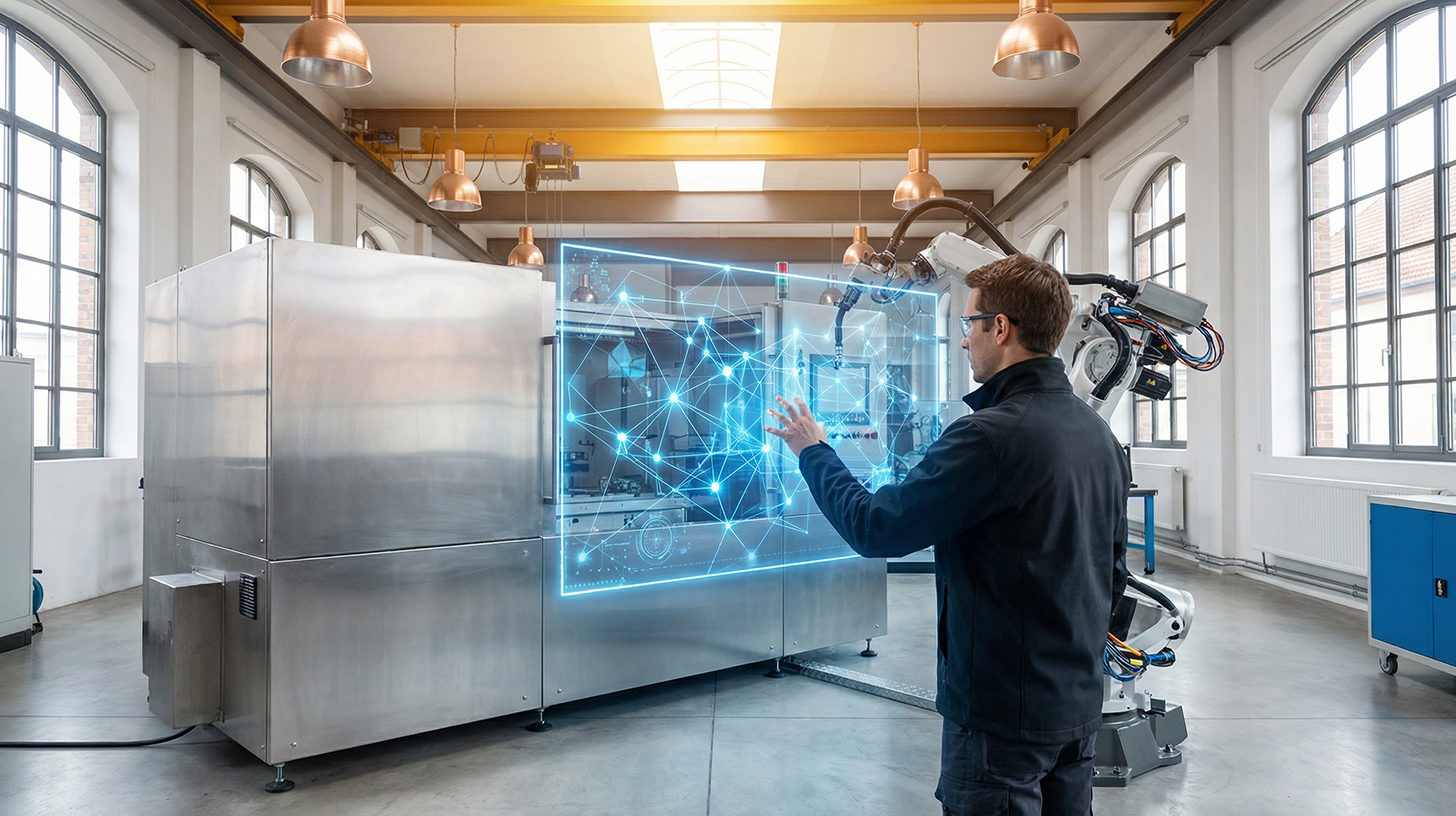
Salvation for the hidden champions? How a former OpenAI engineer is stopping the silent demise in mechanical engineering – Creative image: Xpert.Digital
While traditional companies are dying out: Karlsruhe's AI factory is building the future of German industry
Demographic time bomb in industry: Why artificial intelligence is creating new jobs right now
Declining orders, geopolitical upheavals, and drastic overregulation are taking a heavy toll on the industry. But the greatest threat is invisible: a demographic time bomb is ticking. When around a quarter of the workforce retires in the coming years, their irreplaceable experiential knowledge—the so-called *tacit knowledge*—will disappear along with the skilled workers. The result will be the quiet demise of numerous long-established companies.
A technological revolution from Karlsruhe is now stepping into precisely this gap. The startup Daedalus, founded by former OpenAI engineer Jonas Schneider, is poised to reinvent the staid machining industry. With millions in American venture capital and a radical approach, the company is digitizing decades of experienced milling machine operators' knowledge into machine learning software. The AI-driven factory is already producing highly complex precision components for the defense, aerospace, and medical technology industries – faster, more scalable, and independent of the skilled labor shortage. The Daedalus story is not only a fascinating journey from Silicon Valley to the German factory floor, but also raises a highly topical question: Is artificial intelligence the death knell of industry – or rather the only way to secure production and jobs in Germany for the long term?
Related to this:

When algorithms guide the chisel: How a Karlsruhe start-up is turning German mechanical engineering on its head
Why is a former OpenAI engineer shaking up the dusty machining industry, while traditional companies in the Black Forest bleed out in silence?
German mechanical engineering, once the backbone of an entire economy and the epitome of industrial excellence, is experiencing its worst crisis since reunification. Production has been declining continuously since the beginning of 2023, now for the twelfth consecutive quarter. At the same time, skilled workers are in short supply across the board, and geopolitical turmoil caused by US tariffs and Chinese competition is further exacerbating the situation. Into this vacuum steps a young company from Karlsruhe that claims to be redefining an entire industry: Daedalus. Founded by a former OpenAI engineer who once taught robotic hands to solve a Rubik's Cube, the company now produces precision components for defense, aerospace, and medical technology, controlled by artificial intelligence. The Daedalus story is far more than a startup success story. It is a lesson in the future of German industry, in the question of whether tradition can survive without transformation, and in the economic logic of software-defined manufacturing.
German mechanical engineering in a downward spiral
To understand the significance of what Daedalus is building in Karlsruhe, one must first grasp the extent of the crisis facing the German mechanical and plant engineering sector. The figures are sobering. For the full year 2024, the industry recorded a real production decline of eight percent compared to the previous year. The industry association VDMA projected a further decline of five percent for 2025. Capacity utilization recently stood at only 78.3 percent, significantly below the long-term average of around 85 percent. These figures do not describe a mere cyclical downturn, but rather a structural downward trend that is shaking the industry to its core.
The consequences for the labor market are already being felt massively. At the end of 2025, just over one million people were employed in the mechanical and plant engineering sector, around 22,000 fewer than the previous year, a decline of 2.2 percent. The industry association VDMA explicitly pointed to US tariffs and growing competition from China as key contributing factors. VDMA labor market expert Fabian Seus put it unequivocally: Currently, more companies are planning to cut jobs than to create new ones, and this trend is expected to continue in 2026. For 2026, the VDMA anticipates only a minimal increase in production of one percent, which, given the preceding declines, amounts to little more than stagnation at a low level.
The crisis in the mechanical engineering sector is not an isolated case. The German Association of the Automotive Industry (VDA) reported an estimated 47,000 job losses last year. German industry as a whole is grappling with an economic crisis that has affected large parts of the value chains. VDMA President Bertram Kawlath spoke of a world characterized by uncertainty, due to wars, trade disputes, and persistent structural damage. His appeal to policymakers was clear: an end to overregulation, an end to restrictive technological requirements, and an end to the excessively high cost burden on Germany as a manufacturing location.
The demographic time bomb in machining
Behind the economic problems lies an even more profound structural risk: demographic change. A study by the German Economic Institute (IW), commissioned by the Impuls Foundation for Mechanical Engineering, revealed figures whose dramatic impact can hardly be overstated. In the next ten years, an estimated 296,000 employees in the mechanical engineering sector will retire, representing roughly a quarter of the total workforce. This is contrasted by only about 118,000 young people expected to enter the field. The resulting gap of 178,000 skilled workers is not an abstract prediction, but a demographically determined fact.
In machining technology, precisely the sector in which Daedalus operates, the situation is particularly precarious. Most skilled machinists are now between 55 and 65 years old and are gradually retiring. The problem is not merely quantitative. Each of these skilled workers carries with them a wealth of experiential knowledge that is not stored in any database, that has grown over decades, and that cannot simply be transferred to a successor. In traditional machining operations, as Jonas Schneider described it, someone with 20 to 30 years of experience sits in front of printed drawings, considering how best to manufacture the component. This implicit knowledge, the so-called tacit knowledge, is the industry's true asset, and it is in danger of being irretrievably lost within a single generation.
The DIHK Skilled Workers Report confirms the scale of the problem: 38 percent of mechanical engineering companies have vacant positions, and 83 percent of all companies expect negative consequences from the labor and skilled worker shortage in the coming years. In October 2024, over 530,000 positions for qualified specialists were unfilled in Germany, with technically specialized professions in industrial manufacturing being particularly affected. The main causes have been clearly identified: demographic change, the declining attractiveness of technical professions among young people, and the increasing qualification requirements due to advancing digitalization.
From OpenAI to the factory floor: The unusual path of Jonas Schneider
The founding story of Daedalus doesn't begin in a machine factory, but in the labs of OpenAI in Silicon Valley. Jonas Schneider, born in Germany and a graduate of the Karlsruhe Institute of Technology with a bachelor's degree in computer science, was one of OpenAI's first engineers. There, he served as technical lead and co-founded the robotics team. Under his leadership, the team succeeded in teaching a humanoid robotic hand to solve a Rubik's Cube and manipulate objects with unprecedented dexterity, an achievement reported by the New York Times and IEEE Spectrum. Schneider published several research papers on topics such as multi-goal reinforcement learning, hindsight experience replay, and domain randomization—precisely those AI methods that enable the transfer of learning from simulation to the real world.
In 2019, Schneider left OpenAI and Silicon Valley to return to Karlsruhe and found Daedalus. The idea was as simple as it was radical: if artificial intelligence could teach a robotic hand to solve a Rubik's Cube, then it should also be able to automate the complex decisions involved in machining. Together with co-founder Martin Lander, also a KIT graduate, Schneider began translating the implicit knowledge of experienced machinists into software. Daedalus started as a classic startup, went through the renowned incubator Y Combinator, and raised a total of $40 million in venture capital, including from prominent investors such as Khosla Ventures, Addition, and NGP Capital. In February 2024, the company closed a $21 million Series A funding round led by NGP Capital.
What makes Schneider's background particularly noteworthy is the direct link between his academic research and its practical application at Daedalus. The techniques of transfer learning and domain randomization developed at OpenAI—the ability to transfer learning learned in simulated environments to the real world—form the conceptual foundation of the Daedalus software. When the Daedalus AI system learns how best to manufacture a specific component and then applies this knowledge to similar components, this is essentially the very type of knowledge transfer that Schneider researched in robotics at OpenAI.
Anatomy of an AI-controlled factory
Daedalus' production hall on the former Siemens site in Karlsruhe covers 4,000 square meters, which is approximately 50,000 square feet. Here, 150 employees from 30 countries work on around 30 CNC machine tools. What distinguishes this factory from conventional machining operations is not the machinery, as Daedalus uses standard manufacturing equipment, but rather the way the entire production process is orchestrated by an internally developed AI platform.
The system functions as a kind of digital nervous system for the factory. It knows at all times which employee is available where and what is currently needed at which machine. When a new order comes in, the responsible employee receives a notification on their smartwatch. The system provides them with precise instructions on which tool is required for the desired product. An autonomous robot delivers the correct components, the tool cabinet opens automatically, and the worker has the necessary material readily available to go to the appropriate CNC machine. There, the component is manufactured with an accuracy of one micrometer, or one thousandth of a millimeter.
The system's learning component is crucial. The AI platform studies how a component is manufactured and applies the insights gained to other projects with similar parameters. Real-time information from the production process is continuously collected and fed back into the AI, which then makes independent decisions and optimizes further production. On its website, Daedalus describes its approach as a software-defined manufacturing method that enables the production of each new component with minimal human intervention. According to the company, team members with minimal training can implement customers' mission-critical designs from the CAD model to the finished component with, they claim, superhuman precision, reliability, and speed.
The economic logic behind this approach is twofold. First, AI control significantly reduces the error rate because it minimizes human decision-making errors and fatigue. Second, it reduces reliance on highly specialized personnel by integrating the implicit knowledge of experienced machinists into the software. This doesn't mean Daedalus employs fewer people; on the contrary, the company is growing rapidly and creating jobs. However, it does mean that the barrier to entry for new employees is lowered and production becomes scalable.
Precision components for zero-tolerance industries
Daedalus' customer list reads like a cross-section of Germany's and beyond's high-tech industry. Customers include Bosch, Siemens, and Zeiss, as well as numerous companies from the semiconductor, defense, aerospace, medical technology, and energy sectors. In total, Daedalus already produces for more than 100 customers. A common characteristic of all these industries is the uncompromising demand for precision: In semiconductor manufacturing, aerospace, or medical technology, the slightest deviation can render an entire product unusable.
The range of manufacturing capabilities includes three- to five-axis milling of components up to 500 x 500 x 400 millimeters, as well as turning and mill-turning parts up to 1,800 x 520 millimeters. Daedalus processes all common aluminum, steel, and stainless steel alloys and offers various surface treatments in cooperation with partners. Production can encompass individual pieces and prototypes as well as series production in any quantity, customized to individual customer requirements.
What makes the company special in this market segment is the combination of flexibility and reliability. Software-defined manufacturing enables rapid switching between different orders and the production of customized products without sacrificing the efficiency of mass production. Daedalus founder Jonas Schneider estimated the untapped market in Germany alone at $100 billion annually and pointed out that demand from existing customers already exceeds the company's current capacity several times over.
🎯🎯🎯 Benefit from Xpert.Digital's extensive, five-fold expertise in one comprehensive service package | BD, R&D, XR, PR & Digital Visibility Optimization

Benefit from Xpert.Digital's extensive, five-fold expertise in a comprehensive service package | R&D, XR, PR & Digital Visibility Optimization - Image: Xpert.Digital
Xpert.Digital possesses in-depth knowledge across various industries. This allows us to develop tailored strategies precisely aligned with the requirements and challenges of your specific market segment. By continuously analyzing market trends and monitoring industry developments, we can act proactively and offer innovative solutions. The combination of experience and expertise generates added value and provides our clients with a decisive competitive advantage.
More information here:
AI as a job creator? This company is turning the debate on its head
Creating jobs instead of destroying them: The employment policy dimension
One of Daedalus' most provocative claims concerns the employment impact of artificial intelligence. While public debate is often dominated by the fear that AI destroys jobs, the founders of Daedalus argue the exact opposite: their company creates jobs using AI that would otherwise be lost elsewhere. This argument is economically sound and deserves a more nuanced examination.
The mechanism works as follows: In an industry suffering from an acute shortage of skilled workers, where knowledge holders are gradually retiring, many traditional companies face the dilemma of no longer being able to accept orders because they lack qualified staff. The result is often a relocation of production abroad or simply a downsizing of the business. Daedalus breaks this cycle by using AI to replace some of the expertise that otherwise exists only in the minds of experienced skilled workers. This allows employees with less specialized skills to be deployed productively, and the company can grow instead of shrinking.
The figures support this thesis: Daedalus already employs 150 people from 30 countries, a multinational workforce that also points to the company's recruitment strategy. While traditional companies rely on the shrinking pool of German-speaking, dual-trained machinists, Daedalus, thanks to its software-driven processes, can also productively utilize employees from other backgrounds. The team includes engineers who previously worked at SpaceX and Google, as well as specialists from numerous other countries. In the next two years, the company also plans to train its own specialists, a clear signal that it is not just consuming jobs, but systematically creating them.
At the same time, it would be naive to assess the employment effects as entirely positive. AI-driven manufacturing lowers the barrier to entry and makes certain specialist qualifications partially obsolete. For the individual highly skilled machinist with decades of experience, this means that their unique selling point loses value. Nevertheless, the overall societal effect is likely to be positive, because the alternative is not maintaining the status quo, but rather the quiet decline of entire companies due to a lack of successors.
Related to this:

Scaling as an economic promise
Daedalus' growth plans are ambitious. The company aims to double its production area by 2027. A significant portion of its Series A financing is earmarked for opening a second factory in Germany, and in the long term, the company plans to establish factories wherever its customers need them. Schneider described the current factory in Karlsruhe as a "blueprint factory," where all systems and knowledge are developed and distilled into the production methodology.
This scaling model fundamentally distinguishes Daedalus from traditional machine tool companies. A conventional machining operation essentially scales linearly: more orders require more machines and more skilled workers, who are becoming increasingly difficult to find in the job market. Daedalus, on the other hand, scales via software. The knowledge stored in its AI platform can be replicated at no marginal cost. Each new factory doesn't start from scratch, but rather with the entire accumulated wealth of experience from existing production. This is a classic platform business model applied to physical manufacturing, and it explains why venture capitalists like Khosla Ventures and Y Combinator, who typically invest in software startups, are excited about a machine tool company.
The company's financing structure underscores this promise. With a total of $40 million in capital raised, Daedalus boasts a financial foundation unusual for a contract manufacturer. The company is headquartered in both Karlsruhe and San Francisco, symbolizing the bridge between German engineering culture and the American tech ecosystem. The appointment of an experienced CFO with a background in scaling successful companies like Clark indicates that Daedalus is systematically preparing for a period of accelerated growth.
The Hidden Champions in the Black Forest and the Risk of Silent Death
The founders of Daedalus explicitly refer to the so-called hidden champions, the numerous small and medium-sized mechanical engineering companies in the Black Forest and elsewhere in Germany that are world market leaders in their niche markets. These companies do excellent work, according to Martin Lander, but their demographic structure is worrying. Most experienced specialists are approaching retirement, and there is a lack of young talent.
This phenomenon of silent demise is well-documented in industrial sociology. Unlike large corporations that announce job cuts with considerable media fanfare, small and medium-sized machining companies often disappear without a trace. The owner retires, no successor can be found, the few remaining employees either leave for other jobs or also retire, and a company that has manufactured precision parts for industry for decades closes its doors. The study by the Cologne Institute for Economic Research (IW Köln) confirms this picture with its forecast of a skilled labor shortage of 178,000 workers in the mechanical engineering sector by 2034.
This has far-reaching consequences for the entire German industry. If contract manufacturers, who work as suppliers for large companies, lose their capacity, the end producers also come under pressure. An automotive manufacturer or a medical technology company can only assemble its products in Germany if the supply chain for precision parts functions properly. This is precisely where Daedalus' vision comes in: to create efficient, flexible, and reliable production capacities in Germany so that industrial companies can continue assembling products here and remain competitive.
Artificial intelligence as a strategic location factor
A broader economic perspective shows that Daedalus is not an isolated case, but rather part of a fundamental transformation in German industry. Already, 42 percent of German industrial companies are using artificial intelligence in production, and another 35 percent have plans to do so. Eight out of ten companies agree that the use of AI will be crucial for the future competitiveness of German industry. Currently, AI is most frequently used in analytics, for example, to monitor the functionality of machines, with 32 percent of companies already using it for this purpose.
What sets Daedalus apart from the majority of AI users in industry is the depth of its integration. While most companies use AI to supplement existing processes, such as predictive maintenance or quality control, Daedalus has built its entire manufacturing operation from the ground up around its AI platform. The company describes itself as a technology company reimagining the CNC industry. This difference isn't a matter of degree, but of principle: it's the difference between an automaker retrofitting a navigation system and Tesla designing the car around the software.
The development towards Industry 5.0, which builds on the technological foundation of Industry 4.0 but additionally emphasizes the harmonization of interactions between humans, machines, and the environment, underscores the strategic relevance of this approach. AI is not seen as a replacement for humans, but rather as an enabler of a new form of collaboration in which human creativity and machine precision complement each other. Daedalus embodies this concept in practice: AI takes over repetitive decisions and process optimization, while human employees can concentrate their skills on tasks where human judgment remains irreplaceable.
The risk behind the promise
A balanced economic analysis must also examine the risks and open questions associated with the Daedalus model. Firstly, despite its impressive growth, the company is still young and has not yet proven its scalability beyond a single factory. The blueprint factory hypothesis, which posits that the Karlsruhe model can be replicated at will, is a promise that remains unfulfilled. Physical manufacturing operates according to different principles than software, and complexity does not increase linearly with the number of locations.
Secondly, Daedalus is heavily reliant on venture capital. While the $40 million in funding enables aggressive growth, it also creates high expectations among investors. In the venture capital world, growth is prioritized over profitability, and it remains to be seen whether Daedalus' business model is sustainable in the medium term if investor funding dries up. Traditional mechanical engineering companies typically operate with low but stable margins, and it is an open question whether a VC-funded model can function in this environment over the long term.
Third, the company operates in a market that, while large, is also fragmented and characterized by relationships. Schneider estimated the addressable market in Germany alone at $100 billion, but this volume is spread across thousands of suppliers who have often maintained close relationships with their customers for decades. The willingness of industrial companies to switch from an established supplier to a startup is not a given, no matter how compelling the technological superiority may be.
Fourth, the heavy reliance on a proprietary AI platform also carries technological risks. If the software makes faulty decisions in areas requiring micrometer-level precision, the consequences can be significant. Quality control in an AI-driven system must be at least as robust as that of an experienced human worker, ideally more so.
The regulatory dimension
The Daedalus example also raises regulatory policy questions that extend beyond the individual company. The VDMA (German Engineering Federation) has long been calling for a fundamental shift in economic policy, particularly regarding high social security contributions and a modernized working time law that stipulates maximum weekly working hours instead of daily maximum hours. The association also opposes overregulation and restrictive technological requirements. These demands are directly relevant for a company like Daedalus, which operates in a regulated environment and simultaneously aims for rapid growth.
The fact that Daedalus has its second headquarters in San Francisco is a revealing detail in this context. It suggests that the company needs proximity to the American capital market and tech ecosystem to finance and develop its business model. That a German industrial company manufacturing precision parts for the German defense and medical technology industries relies on American venture capital says a lot about the availability of growth capital in Germany. It reflects a structural weakness in the European capital market that forces innovative industrial companies to seek their financing across the Atlantic.
At the same time, Daedalus benefits from location factors that only Germany can offer: proximity to a highly developed industrial clientele, excellent technical training at KIT (Karlsruhe Institute of Technology), the existing industrial infrastructure on the former Siemens site, and its central location in the Karlsruhe Technology Region. The company thus exemplifies that the often-lamented deindustrialization of Germany is not an inevitable state of nature, but rather that it is possible to build new industrial capacities in Germany with the right technological approach and sufficient capital.
Between industrial renaissance and structural upheaval
The story of Daedalus can be read in two fundamentally different ways. In the optimistic interpretation, the company is the pioneer of an industrial renaissance in which artificial intelligence secures Germany's competitiveness, bridges the skilled labor shortage, and creates new, highly qualified jobs. In this interpretation, Daedalus is the model that others will follow, and German mechanical engineering will transform rather than perish.
From a skeptical perspective, Daedalus is a special case, a VC-funded flagship project that works under very specific conditions but cannot be applied to the broader range of medium-sized businesses. The majority of small machining companies lack both the resources and the know-how to develop a comparable AI platform, and demographic change will catch up with them despite all the rhetoric surrounding digitalization.
The truth, as so often, probably lies somewhere in between. Daedalus demonstrates that it's possible to rethink mechanical engineering using the tools of the software industry. The company proves that AI not only creates added value in the digital world, but also in the most physical of all industries, where metal, milling, and micrometers are involved. Whether this model can transform the entire German mechanical engineering sector depends on factors that extend far beyond Daedalus: the availability of growth capital in Europe, the willingness of policymakers to modernize regulatory frameworks, the openness of small and medium-sized enterprises (SMEs) to technological disruption, and, last but not least, whether industry is prepared to translate its most valuable asset—the implicit experiential knowledge of its skilled workers—into software before it is lost forever.
The clock is ticking. In 30 years, according to the confident prediction of the Daedalus founders, their company will still exist. The uncomfortable question that arises from this is: How many of the traditional mechanical engineering companies will still be around then?
Your global marketing and business development partner
☑️ Our business language is English or German
☑️ NEW: Correspondence in your native language!

Konrad Wolfenstein
I and my team are happy to be available to you as your personal advisor.
You can contact me by filling out the contact form here or simply call me at +49 7348 4088 965. My email address is: [email protected]
I'm looking forward to our joint project.
☑️ SME support in strategy, consulting, planning and implementation
☑️ Creation or realignment of the digital strategy and digitization
☑️ Expansion and optimization of international sales processes
☑️ Global & Digital B2B trading platforms
☑️ Pioneer Business Development / Marketing / PR / Trade Fairs
Our EU and German expertise in business development, sales and marketing

Our EU and German expertise in business development, sales and marketing - Image: Xpert.Digital
Industry focus areas: B2B, digitalization (from AI to XR), mechanical engineering, logistics, renewable energies and industry
More information here:
A thematic hub offering insights and expertise:
- Knowledge platform covering global and regional economies, innovation and industry-specific trends
- A collection of analyses, insights, and background information from our key areas of focus
- A place for expertise and information on current developments in business and technology
- A hub for companies seeking information on markets, digitalization, and industry innovations










