
The hidden brake on growth: Why German companies have lost the courage to innovate
Xpert Pre-Release

Language selection 📢
Published on: March 14, 2026 / Updated on: March 14, 2026 – Author: Konrad Wolfenstein
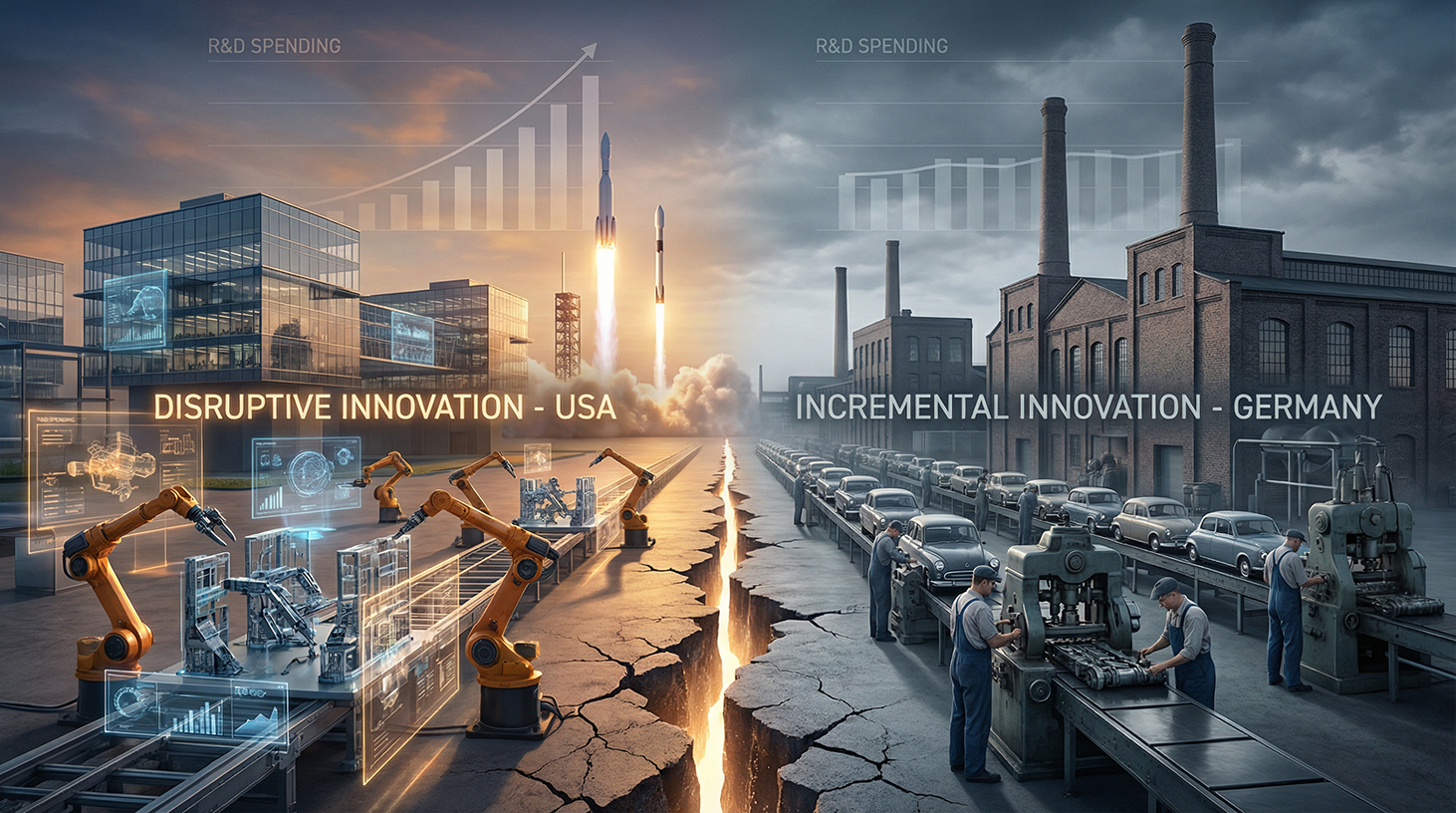
The hidden growth inhibitor: Why German companies have lost their courage to innovate – Image: Xpert.Digital
Despite billions in investments: Why Germany's economy is missing out on the future
The medium-sized technology trap – Why Germany's innovation model is reaching its structural limits
Germany is investing record sums in research and development – yet it continues to fall further and further behind the US and Asia in future technologies such as artificial intelligence, software, and biotechnology. While American tech giants dominate the markets of tomorrow, German companies remain stuck in the so-called "mid-technology trap," merely optimizing their established products of the present. But the cause of this alarming innovation lag lies neither in a lack of inventiveness nor in insufficient budgets. A recent study reveals an uncomfortable truth: it is the structure of German labor law that systematically penalizes radical innovation. The enormous costs incurred by companies due to rigid dismissal protection in the event of failure practically force CEOs into an innovation-conservatism. Why this will prove disastrous for us in the AI revolution – and how a look at the "Danish model" of targeted flexicurity could point the way out of the crisis.
When the cost of failure is so high that you can't afford to be brave
Germany is investing more in research and development than ever before. In 2024, German companies' internal R&D expenditures amounted to €92.5 billion, an increase of 2.3 percent compared to the previous year. R&D spending as a percentage of GDP was 3.13 percent, a figure that appears quite respectable internationally. And yet, Germany is falling behind. Innovation spending by German businesses rose to a record €203.4 billion in 2023, but at the same time, the revenue share of market-new products is declining. Germany invents a lot, but sells little of what it produces. The question of why one of the world's most research-intensive countries is systematically falling behind in future markets leads to an uncomfortable answer: The problem does not primarily lie in politics. It lies in the structure of the German innovation system itself.
The gap in numbers
A comparison with the United States reveals the scale of the problem. The 135 US corporations among the 500 companies with the highest R&D expenditures worldwide invested a total of €524 billion in innovation in 2024. The 128 European companies in the same ranking only reached €231 billion. Germany alone achieved €79 billion. The EU's R&D expenditure ratio is around 2.3 percent of GDP, compared to 3.4 percent in the US. The gap is particularly acute when it comes to private R&D investment: European companies invest only around 1.5 percent of GDP in R&D, just half as much as their US counterparts at around 2.7 percent.
But the crucial difference lies not in the amount of spending, but in its direction. Around 85 percent of R&D spending by US companies goes into high-tech sectors such as software, semiconductors, and biotechnology. In the EU, half of R&D spending is allocated to medium-sized high-tech industries such as automotive, mechanical engineering, and chemicals. In Germany, this figure is around 60 percent. US companies invest in the technologies of the future, while German companies improve the technologies of the present.
The mid-range technology trap
The report on Germany's growth agenda, prepared by the advisory staff of the Minister of Economic Affairs, identifies this phenomenon as the "medium-tech trap." Germany focuses on traditional sectors such as the automotive and mechanical engineering industries, frequently integrating technologies from the US and Asia instead of developing its own platforms and standards. For two decades, Europe has been improving existing technologies, but increasingly less so developing the underlying foundations.
In 2013, Europe and the US were still at a similar level in terms of R&D intensity. Since then, a clear gap has opened up because US companies have massively expanded their software and AI budgets, while Europe has invested relatively more heavily in traditional industries. US and increasingly Chinese technology companies dominate the global rankings of the largest R&D investors. European companies appear less frequently in the top ranks, and when they do, they are still primarily automotive companies. China, in turn, has now almost caught up with the EU in absolute R&D spending and is also investing heavily in high technology.
The costs of failure as a structural brake on growth
The underlying cause of Germany's conservatism regarding innovation lies in a factor that has long been overlooked in economic debate: the cost of failure. A groundbreaking study published in the ifo Schnelldienst in January 2026 systematically surveyed the restructuring costs of large companies in various countries for the first time and analyzed their impact on innovation behavior.
The results are striking. In Germany, the average restructuring cost is 31 gross monthly salaries per employee laid off. In the specific case of Infineon, which cut 500 jobs in Germany in 2024 and had to spend €140 million doing so, this equates to roughly 50 monthly salaries per employee. Thyssenkrupp recorded costs of 36 monthly salaries, Goodyear 33, and ProSiebenSat.1 24 monthly salaries.
In comparison, restructuring costs in the US average seven months' salary. In Switzerland and Denmark, countries that follow the so-called flexicurity model, they typically amount to less than ten months' salary. Three clearly distinguishable groups of countries emerge: countries with strict dismissal protection, such as Germany, France, Italy, and the Netherlands, with costs of 18 to 50 months' salary; flexicurity countries, such as Sweden, Denmark, and Switzerland, with costs of two to ten months' salary; and the US, with costs of around seven months' salary.
The business logic of hesitation
These cost differences have a direct impact on innovation behavior. Disruptive innovation, the development of fundamentally new products and technologies, inherently has a higher failure rate than incremental innovation. In industries such as software, biotechnology, or semiconductor technology, revenue fluctuations are high, and restructurings are frequent and extensive. If a company launches five radical innovation projects and only one is successful—which already represents an above-average success rate in markets with disruptive innovation—then, under German labor law, the high restructuring costs of the four failed projects result in massive losses for the company.
The Monte Carlo simulation in the ifo study, based on company data from 4,200 firms over 20 years, quantifies the effect: In disruptive industries, high German restructuring costs lead to a profitability disadvantage of three to five percentage points compared to US companies. In the pharmaceutical and biotechnology sector, the difference in net profit margin is 5.0 percentage points, in software and computer services 2.8 percentage points, and in technological hardware 3.4 percentage points. In the established automotive industry, however, the difference is only 0.8 percentage points. The costs of failure thus hit disruptive industries disproportionately hard.
Our EU and German expertise in business development, sales and marketing

Our EU and German expertise in business development, sales and marketing - Image: Xpert.Digital
Industry focus areas: B2B, digitalization (from AI to XR), mechanical engineering, logistics, renewable energies and industry
More information here:
A thematic hub offering insights and expertise:
- Knowledge platform covering global and regional economies, innovation and industry-specific trends
- A collection of analyses, insights, and background information from our key areas of focus
- A place for expertise and information on current developments in business and technology
- A hub for companies seeking information on markets, digitalization, and industry innovations
Why German companies are driving into the future with the handbrake on
The growth brake and the winner-takes-all dynamic
Even more significant than the profitability gap is the effect on growth. The study shows that German companies in disruptive industries grow 50 percent slower than their US competitors in growth years. The logic behind this is strikingly simple: A company that cannot react quickly in an emergency naturally operates more slowly. The study's authors compare it to a car with poor brakes: The driver instinctively drives slowly. In technology sectors, where the winner takes everything, this self-imposed speed limit leads to an unsustainable competitive position.
Another aspect to consider is that the average restructuring process in Germany takes 4.3 years. In the US, comparable plans are implemented within weeks or months. Fewer than eleven percent of German restructuring plans affecting more than 500 people expect to be completed within a year. Furthermore, in many European countries, employment protection laws prohibit hiring similar staff for a certain period after a restructuring plan is completed: six months in Italy, seven months in Germany, and one year in France. In the technology sector, where cycles are short and responding to technological disruptions requires agility within weeks, these timeframes are structurally incompatible with the pace of innovation.
The Danish model as European proof
The example of Denmark demonstrates that reform within the European social model is possible. The introduction of flexicurity in the mid-1990s, with the active labor market policy of 1994 and the Active Social Policy Act of 1998, led to a dramatic increase in corporate R&D investment. Within eight years of the reform, private R&D spending in Denmark rose by 125 percent, compared to 40 percent in Germany, 75 percent in Spain, and 60 percent in the USA.
The effect on disruptive innovation was even more pronounced. A significant shift also became apparent around 1994/1995 in high-risk R&D investments. The Danish flexicurity model combined generous unemployment benefits—up to two years at approximately 90 percent of the last salary—with state-organized education and retraining programs and efficient advisory services. Simultaneously, it enabled companies to restructure their workforce without incurring excessive costs. The crucial feature: Economic reasons for restructuring are not questioned by either courts or governments.
Switzerland and Sweden show similar patterns: significantly higher R&D spending on disruptive innovation coupled with higher GDP per capita and a better standard of living. This observation confirms Mario Draghi's analysis in his report on the future of European competitiveness, which concluded that the innovation lag of major European countries has led to a relative decline in GDP per capita of 20 percent.
The proposal for targeted flexicurity
The authors of the ifo study propose targeted flexicurity as a solution: maintaining existing job security for 90 percent of employees, but modernizing the rules for the top ten percent of earners. In Germany, the threshold would be around €6,000 gross monthly salary. The logic behind this is that high-risk sectors such as information and communication technology predominantly employ highly paid, highly qualified staff. For this group, faster hiring, dismissal, and redistribution would be permitted, accompanied by strong unemployment benefits and active labor market policies.
Such a targeted reform would fully preserve the four central pillars of the European social model – namely free education, universal healthcare, pension systems, and unemployment benefits. It would, according to projections, increase overall productivity and raise GDP per capita in countries like Germany by around 20 percent, which could mean additional tax revenue of €400 billion per year. The result would be a general wage increase of the same amount.
The time pressure caused by the AI revolution
The urgency of this debate is massively increased by the current wave of artificial intelligence and robotics. The technologies that are currently creating the greatest economic value—whether AI models, cloud platforms, semiconductor design, or biotechnology—fall precisely into those disruptive sectors where the costs of failure put European companies at the greatest disadvantage.
While US technology companies cut tens of thousands of engineering jobs in 2022—not to reduce investment, but to reallocate resources to more promising areas and accelerate innovation there—such a strategic reallocation is virtually impossible under European job security laws in most countries. The American technology sector restructured itself within months and emerged stronger from the adjustment phase. European companies would have needed years for the same process.
Herbert Giersch, the German economist who coined the term "Eurosclerosis" four decades ago, already observed that Europe's weakness ultimately lay not in technology, but in institutions. This diagnosis is more relevant today than ever. Discussions about reform have already begun at the European Commission within the framework of the planned 28th Regime, which aims to allow innovative companies to benefit from uniform, harmonized EU-wide regulations. Debates are equally necessary at the national level, large-scale business surveys are indispensable, and academic research is required.
The inconvenient truth for entrepreneurs and politicians
The debate about Germany's lack of innovation is too often framed as a narrative of mere political failure. The data paints a more nuanced picture. Yes, policymakers bear responsibility for the regulatory framework, particularly for employment protection laws, which structurally disadvantage disruptive innovation. But companies, too, must ask themselves whether their focus on incrementally improving existing products isn't also an expression of a comfort zone that is becoming unsustainable in the face of global competitive pressure.
If only one out of five innovation projects succeeds, and the costs of the four failed projects in Germany are three to five times higher than in the US, then for any rational business owner, it's a calculated risk they cannot take without jeopardizing the very existence of their company. The solution lies not in demanding more courage from German entrepreneurs, but in creating a framework that makes courage profitable. Denmark and Switzerland have shown that this is possible without abandoning the European social model. The question is whether Germany will muster the political will to follow this example before it loses touch with future markets for good.
Your global marketing and business development partner
☑️ Our business language is English or German
☑️ NEW: Correspondence in your native language!

Konrad Wolfenstein
I and my team are happy to be available to you as your personal advisor.
You can contact me by filling out the contact form here or simply call me at +49 7348 4088 965. My email address is: [email protected]
I'm looking forward to our joint project.










