
"We need to communicate differently" – Germany's silent crisis: More communication, less lamenting – SMEs as a treasure for the future
Xpert Pre-Release

Available in 27 languages 📢
Prefer Xpert.Digital on GoogleⓘPublished on: May 30, 2026 / Updated on: May 30, 2026 – Author: Konrad Wolfenstein
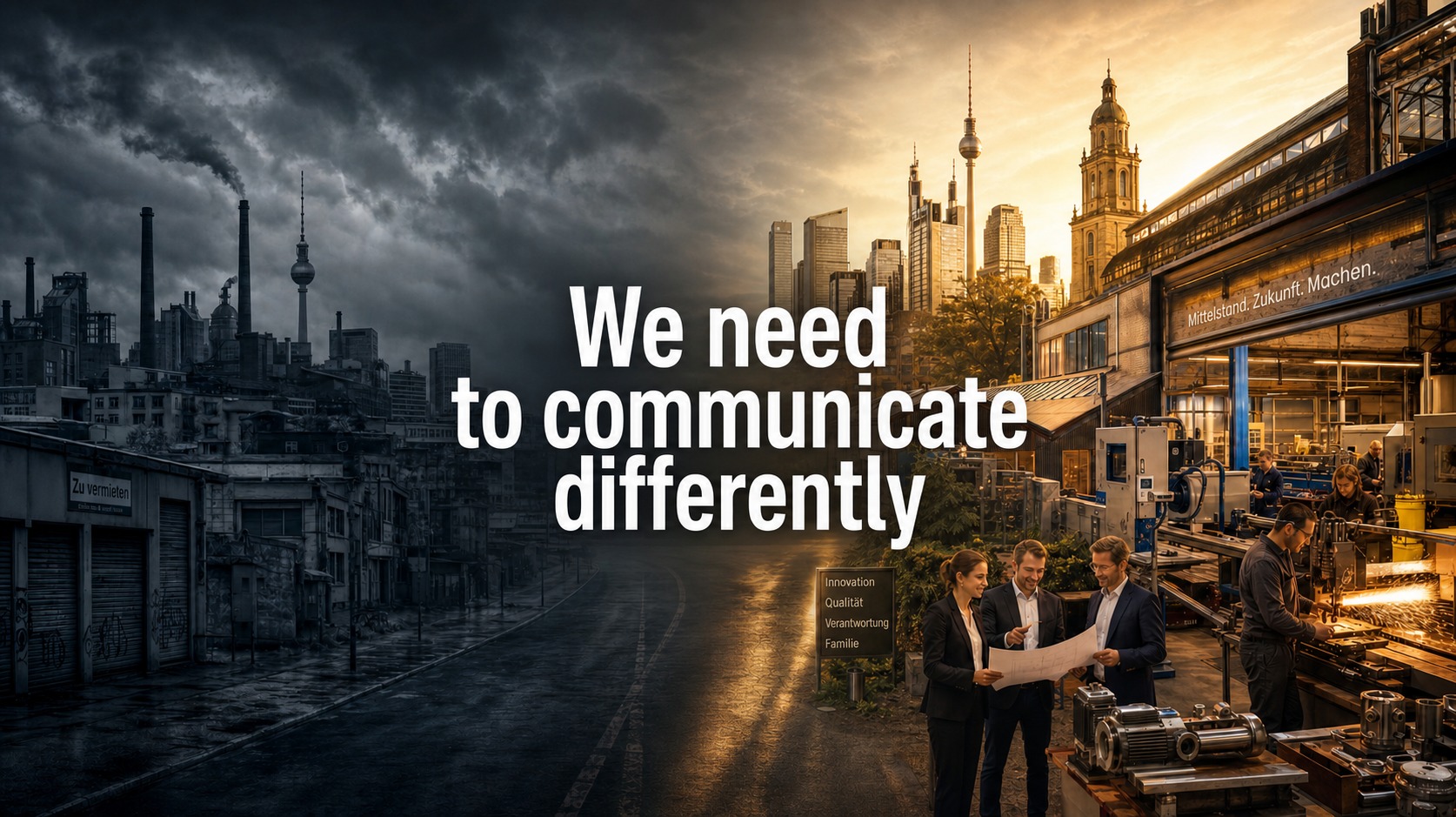
"We need to communicate differently" – Germany's silent crisis: More communication, less lamenting – SMEs as a treasure for the future – Image: Xpert.Digital
33 Million Reasons for Confidence: The Untold Truth About Germany's Small and Medium-Sized Businesses
Dangerous paralysis: How constant lamenting blocks economic recovery
The secret of start-up nations: What Germany urgently needs to learn about communication now
The German economy is in crisis – at least that's the prevailing narrative in the media, politics, and society. But anyone relying solely on this bleak picture overlooks a crucial factor: the massive discrepancy between hard facts and public sentiment. Despite rising real wages and a remarkably robust small and medium-sized enterprise (SME) sector, which boasts record figures with over 33 million employees, the country is mired in chronic pessimism. We don't just have a structural problem; above all, we have a serious communication problem. While other nations are writing success stories and using crises as catalysts for renewal, Germany cultivates a tradition of lamentation. The consequences are disastrous: when businesses and consumers expect only a downturn, this pessimism becomes a self-fulfilling prophecy, stifling investment and hindering innovation. This article analyzes why we must stop systematically concealing our own strengths, why SMEs are key to a turnaround, and how we urgently need to find a new, positive narrative of progress. It is time to communicate the solutions more loudly than the weaknesses.
Related to this:

Those who complain lose – why Germany systematically conceals its own strength
When numbers are no longer enough: The real diagnostic problem
Anyone who truly wants to understand the German economic crisis must look beyond the usual economic indicators. The facts are well-known and frequently cited: three consecutive years of economic stagnation, pronounced deindustrialization trends in traditional sectors, digital backwardness compared to other European countries, and structurally above-average energy costs. But these figures describe symptoms, not causes. The truly pressing question is: Why is societal mobilization failing? Why is there no signal for a new beginning, even though the diagnosis and proposed solutions have long been available?
At the turn of the year 2024/2025, the IW (German Economic Institute) survey of industry associations recorded that 31 of the 49 surveyed industry associations assessed the situation in their sector as worse than a year earlier. Only four sectors – waste management, insurance, trade fairs, and real estate – reported an improvement within the year. At the same time, 20 of the 49 industry associations expected a decline in production for 2025, while 25 associations anticipated job cuts and only seven expected an increase in employment. IW Director Michael Hüther succinctly summarized the situation: "No turnaround in the economic trend, rather a continuation of stagnation."
A fundamental contradiction is remarkable here: despite rising real wages – German real wages rose again by 1.9 percent in 2025 – and at least partially stable consumption, the mood is dismal. According to an EY consumer survey, almost six out of ten Germans expected the economic situation to worsen, while only ten percent anticipated an upswing. This finding cannot be fully explained by economics. It is a cultural phenomenon – and as such, it must be analyzed.
The Silence of Strength: When Pessimism Becomes a Self-Fulfilling Prophecy
A significant part of the answer lies in the communication culture and the psychological state of German society. Economic success is to a considerable extent psychology – trust, confidence, the willingness to take risks and try new things. Where these fundamental psychological conditions are lacking or disrupted, even structurally healthy economies lose momentum. Germany finds itself in precisely this situation.
The German language reflects the problem: it has a rich tradition of lament and problem description. Words for concern, crisis, lack, rule violation, and failure fill public discourse with a self-evidence that is striking in international comparison. Visionary language that opens up possibilities rather than closing them often sounds foreign or even suspicious in German. In economic reporting, political debates, and even corporate communications, the analysis of the negative dominates. This creates a general social mood that oscillates between complacency, maintaining the status quo, and paralysis – three attitudes that can have fatal consequences in an era of economic acceleration.
As early as October 2024, the German newspaper Die Zeit ran the headline: "Complaining is becoming dangerous." The paper observed that pessimism was significantly worse than the actual situation and threatened to paralyze politics and the economy, ultimately bringing about the very crisis that was being sought. This is no coincidence. Behavioral economics offers solid evidence of self-fulfilling prophecies: If companies anticipate a recession, they hold back on investments; if consumers expect income losses, they increase their savings rate. The combination of these two factors creates precisely the weakness that was feared. At the end of 2025, the propensity to save among German consumers reached its highest level since the financial and economic crisis.
This explicitly does not mean that problems should not be named. Critical engagement is a historically developed strength of German discourse culture. The deficit lies in the one-sided emphasis: Compared to the diagnosis of problems, there is a lack of constructive solution perspectives, a visionary framework, and—quite specifically—a willingness to describe Germany's considerable structural strengths as the starting point for a genuine new beginning. A country that does not narratively define its own strengths relinquishes the power to interpret itself to others.
Related to this:

The middle class: 33 million reasons not to complain
The most striking example of the systematic under-communication of Germany's strengths is its small and medium-sized enterprises (SMEs). Around 3.87 million SMEs generated total revenue of €5.2 trillion in 2024. The number of employees in SMEs rose to 33.01 million in 2024 – more than ever before – an increase of 207,000 compared to the previous year. According to the German Association for Small and Medium-Sized Businesses (BVMW), 50.7 percent of all employees subject to social security contributions in Germany work for SMEs. Over 70 percent of all apprentices are trained by SMEs, and 97.7 percent of German exporters are SMEs.
These figures are remarkable – especially because their positive aspects are so rarely communicated. Small and medium-sized enterprises (SMEs) are frequently portrayed in public discourse as victims of the crisis, but hardly ever as a potential resource for overcoming it. However, the KfW SME Panel 2025 reveals a far more nuanced reality: despite economic headwinds, profit margins remained stable, the average return on sales was seven percent in 2024, and the equity ratio rose slightly to 30.7 percent. While there was a slight decrease in sales of one percent after adjusting for inflation, this was significantly better than the ten percent decline in the previous year.
The narrative of the declining strength of small and medium-sized enterprises (SMEs) is not empirically tenable. What is actually shrinking is the willingness to invest – especially larger SMEs are holding back on investments. This is a specific problem that requires specific solutions: less regulation, better access to capital markets, and more reliable planning conditions. However, it is not proof of a fundamental erosion of the SME base itself. The foundation is there – it's just waiting for the building.
Communication as a strategic factor: What other countries are doing right
Experience from other economies shows that economic renewal almost always begins with a narrative—a shared story about where a society wants to go and what it is willing to do to achieve it. In the 1960s and 1970s, South Korea initiated a comprehensive, state-led industrialization strategy that communicated technology and export-oriented growth as a national goal, a goal that was internalized by the population. The promotion of large chaebol conglomerates like Samsung, Hyundai, and LG was not merely industrial policy—it was part of a national self-image that defined catching up and progress as a collective endeavor.
Israel has cultivated this mechanism in its own unique way. Since Dan Senor and Saul Singer coined the term "startup nation," the concept has functioned as a self-reinforcing ecosystem: the narrative attracts capital, the capital validates the narrative, and the narrative inspires new ventures. Around 1,000 startups are founded in Israel every year; the country has listed 92 companies on the US Nasdaq—more than any other nation except the US and China. Germany managed eight.
The reasons for this are multifaceted, but a key factor is cultural: In Israel, failure is seen as a learning experience, while in Germany it's considered a stigma. In Israel, authorities and processes are questioned, while in Germany they are managed. This isn't an immutable characteristic – it's a learned attitude that can be changed through communication, role models, and institutions.
The EU single market is also a massive, systematically under-communicated competitive advantage for Germany. With around 450 million consumers and 24 million businesses, it represents the world's largest common trading area. Germany gains approximately €68 billion annually from the single market, which equates to a per capita benefit of over €1,000 per year. In 2023, 55.1 percent of German exports went to the EU single market. This market cannot be replicated by either Chinese capacity or American platform dominance – it is a structural peculiarity that gives Germany a home-field advantage in one of the world's wealthiest consumer spaces.
Our global industry and economic expertise in business development, sales and marketing

Our global industry and economic expertise in business development, sales and marketing - Image: Xpert.Digital
Industry focus areas: B2B, digitalization (from AI to XR), mechanical engineering, logistics, renewable energies and industry
More information here:
A thematic hub offering insights and expertise:
- Knowledge platform covering global and regional economies, innovation and industry-specific trends
- A collection of analyses, insights, and background information from our key areas of focus
- A place for expertise and information on current developments in business and technology
- A hub for companies seeking information on markets, digitalization, and industry innovations
Miscommunication as a brake on growth: How Germany is finding a new narrative of progress
Miscommunication as a strategic disadvantage: What Germany needs to do differently
The economic policy conclusions drawn from this analysis are less technical than communicative in nature. Structural reforms, investment programs, and industrial policy measures are necessary conditions for economic recovery—but not sufficient ones. Without a shift in public communication that enables rather than hinders progress, these measures will not ignite the social energy needed for a genuine transformation process.
Germany currently lacks a contemporary narrative of renewal. The story of the post-war economic miracle is historically worn out; the narrative of the "sick man of Europe"—a label that was accurate for Germany in the early 2000s and is now being reflexively revived—is demobilizing. A communicative gap exists between these two narratives, one that political actors, business associations, the media, and civil society must fill together. This is not about naive optimism or downplaying real problems. It is about the conscious decision to address strengths and weaknesses equally.
Specifically, this means that Germany's expertise in mechanical engineering and precision manufacturing is not obsolete, but rather a solid foundation for robotics integration, intelligent automation, and Industry 4.0 solutions that far surpass what many competitors can currently offer. The engineering culture, cultivated over generations in technical colleges, universities, and vocational training systems, is a cultural asset that cannot be replicated in just a few years. Furthermore, Germany's European integration, with its associated regulatory framework, social cohesion, and geopolitical stability, makes it an attractive location for production capacities relocated from politically unstable regions.
Related to this:

The real problem areas: Digital infrastructure, bureaucracy and the capital market
Nevertheless, an honest analysis requires the unflinching identification of actual structural deficits – not as a complaint, but as a basis for action. Digital infrastructure is a particularly glaring example. Of the 575 government services that, according to the Online Access Act, should have been digitally available by the end of 2022, only 196 had been implemented by the beginning of January 2025. Germany ranks in the lower middle of the EU in e-government and even second to last among all 27 EU member states when it comes to pre-filled forms. With fiber optic coverage of 29.8 percent, Germany is significantly below the EU average of 64 percent. These are not abstract statistics, but rather daily inefficiencies affecting millions of businesses and citizens.
A second structural deficit concerns the capital market for growth companies. While almost €64 billion in venture capital was invested in the US in 2017 – around 0.37 percent of GDP – and similar sums flowed across Asia, Germany saw a mere €1 billion, or 0.035 percent of GDP, at that time. This imbalance has improved since then, but the structural underinvestment in early growth phases has by no means been resolved. Driving bright entrepreneurs out of the country because the capital market won't finance their ideas means not only losing tax revenue – it means losing the technological innovation potential of an entire generation.
The vocational training system represents a third area of concern. Dual vocational training enjoys a well-deserved international reputation and is a crucial factor in securing the skilled workforce for small and medium-sized enterprises (SMEs). However, the pace of adaptation to new competency requirements – AI applications, data analysis, cybersecurity, sustainability management – is too slow for a decade characterized by technological discontinuities. SMEs themselves invest too little in digitalization and IT security; according to the R+V Resilience Index, 35 percent of SMEs neglect investments in these areas. This is not due to malice, but rather the result of high cost burdens and a lack of support structures.
No winner without speed of adaptation: Where Germany stands in global competition
When all the threads are considered, no clear global winner emerges in the economic competition between major economies. China is strong in key technologies and possesses strategic raw material power – but its growth model is structurally unstable, domestic consumption remains underdeveloped, and its export dominance generates global resistance that threatens the model in the medium term. The US dominates digital infrastructure and the AI platform economy with a strength that is unlikely to be challenged in the foreseeable future – but its industrial base is weakened, and social and political polarization jeopardizes planning certainty for investments.
Germany and Japan are both grappling with structural adjustment deficits in an era of digital transformation. However, both possess industrial and engineering expertise that could regain strategic importance in an increasingly hardware-intensive world of robots, electric vehicles, energy infrastructure, and automation technology. The decisive factor is not who currently holds the strongest position, but who can adapt most rapidly. In a competition characterized by technological discontinuities, advantages can erode more quickly than in previous eras of gradual change.
China has demonstrated this with its solar panel dominance, which has effectively driven European manufacturers out of the market within just a few years. Conversely, a country that currently lags behind can take the lead in a key technology of the future – if it sets the right course, mobilizes societal energy, and credibly communicates a narrative of progress. This is not a romantic notion, but a mechanism repeatedly proven by economic history.
National stance as economic policy: The underestimated factor
For Germany, this means that the path out of stagnation lies not in nostalgia or panic, but in strategic clarity and communicative renewal. The economic foundations – a strong middle class with 33 million employees, a culture of engineering, social stability, and European integration into the world's largest single market – are in place. What is lacking is the societal will to utilize these foundations with the speed and openness that the current decade demands.
Ultimately, this is less a question of economic policy in the classical sense than a question of national attitude – and thus a question of communication. Identifying problems without deriving constructive action plans breeds pessimism. Identifying the same problems while simultaneously outlining concrete, feasible steps fosters a sense of agency. The difference between these two approaches lies not in the facts themselves, but in the framing.
Germany has proven throughout its history that societal mobilization is possible when the narrative is right. The post-war reconstruction phase, reunification, the Agenda 2010 reforms of the early 2000s – all these transformation processes had in common that they possessed a clear, widely communicable direction. Currently, there is no shortage of diagnoses. What is lacking is the shared conviction that the diagnosis is manageable – and the communicative leadership that can convey this conviction to society.
Small and medium-sized enterprises (SMEs) cannot assume this role alone, but they can exemplify it. The 3.87 million companies that prove daily that stability, adaptability, and job creation are possible even in difficult times represent the strongest counter-narrative to the culture of lamentation prevalent in Germany. What is lacking is the willingness to tell this story loudly and confidently – not despite the problems, but precisely in light of them.
🎯🎯🎯 Data-driven B2B industry hub as a quasi-in-house solution

The quasi-in-house solution: How Xpert.Digital closes operational gaps in B2B marketing and sales – Smart Content-Driven Business - Image: Xpert.Digital
Xpert.Digital is a data-driven B2B industry hub led by Konrad Wolfenstein . The company acts as an external, quasi-in-house solution for industrial partners, closing operational gaps in marketing, content, and sales – without requiring additional resources on the client side.
More information here:
Your global marketing and business development partner
☑️ Our business language is English or German
☑️ NEW: Correspondence in your native language!

Konrad Wolfenstein
I and my team are happy to be available to you as your personal advisor.
You can contact me by filling out the contact form here simply call me at +49 7348 4088 965. My email address is [email protected]:or
I'm looking forward to our joint project.










