
Crash or new beginning? Deceptive prosperity: Why Germany's economy is on the verge of collapse – the bill is yet to come!
Xpert Pre-Release

Available in 27 languages 📢
Prefer Xpert.Digital on GoogleⓘPublished on: May 18, 2026 / Updated on: May 18, 2026 – Author: Konrad Wolfenstein
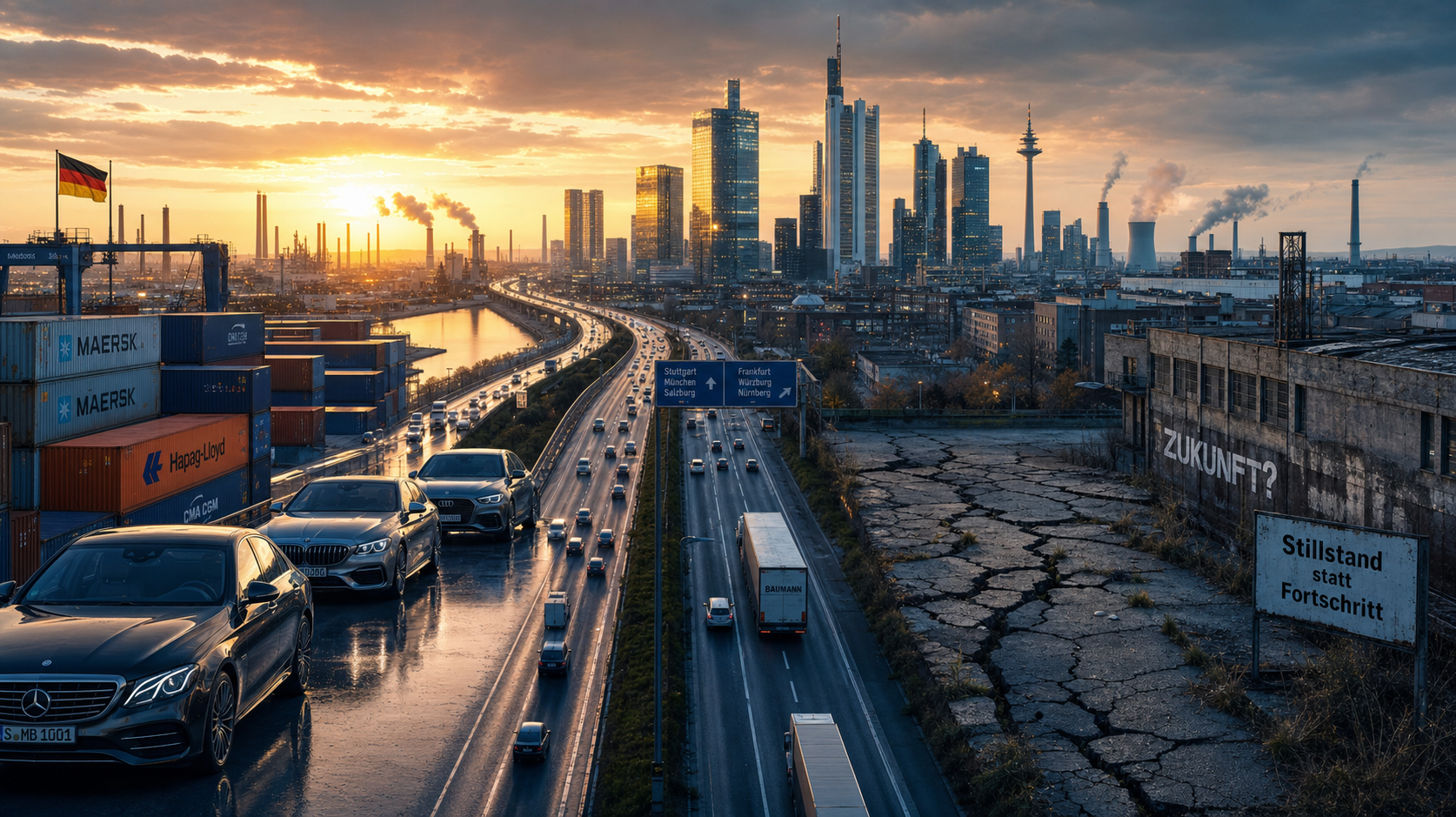
Crash or new beginning? Deceptive prosperity: Why Germany's economy is on the verge of collapse – The bill is yet to come! – Image: Xpert.Digital
The unvarnished truth about Germany's economy: What the economic standstill is really costing us
Management failure and false pride: How German bosses are jeopardizing our future
Germany is in crisis – or at least it feels that way. Gross domestic product is shrinking for the third year in a row, the once-leading automotive industry is faltering, and the discontent of many citizens is erupting in political earthquakes. But a sober look at the figures reveals a paradox: we are complaining at a historically unprecedented level. In his widely acclaimed book "Deceptive Prosperity," economic historian Hartmut Berghoff warns precisely against this discrepancy. While Germany remains the world's third-largest economy, it is increasingly resting on its past successes instead of preparing for the future. An aging, structurally conservative society, political opportunism driven by fear of losing voters, and serious management errors threaten to gradually erode the foundations of our successful model. The following article analyzes the true strengths and overlooked weaknesses of the German economy. He sheds light on the long-term consequences of reunification, the pitfalls of our export dependency, and explains why painful reforms are unavoidable today if we don't want to pay the bitter price for the current stagnation tomorrow.
Between overconfidence and underappreciated strengths: What Germany really achieves
We're stagnating at a high level, but the bill is yet to come
In his book "Deceptive Prosperity," economic historian Hartmut Berghoff presents a comprehensive economic history of the Federal Republic of Germany since 1990. The work analyzes three and a half decades characterized by technological upheavals, crises, and gains in prosperity—and concludes with a diagnosis of the present that gives cause for concern. His findings are neither apocalyptic nor reassuring, but precise: historically speaking, Germany is at an unprecedentedly high level of prosperity, yet it is stagnating on this plateau instead of using it as a springboard for bold modernization.
This diagnosis is supported by hard data. GDP per capita in 2024 was €50,819 – a huge increase compared to the roughly €21,241 in 1992. However, in real terms, i.e., adjusted for inflation, GDP fell again in 2024 by 0.2 percent compared to the previous year – the third consecutive year of recession. The discrepancy between nominal prosperity and real stagnation is the core of the problem Berghoff describes.
However, it would be a mistake to interpret the public discourse surrounding Germany as a purely negative narrative. Germany remains the world's third-largest economy and possesses structural strengths that are systematically underestimated in public discourse: a vibrant research landscape, a globally envied small and medium-sized enterprise (SME) sector, a geographically privileged location at the heart of the European single market with almost 500 million consumers, and an export sector that delivered goods worth approximately €1.56 trillion abroad in 2024. These strengths are real – but they are not a guarantee of success for the future.
The employment miracle and its limits: From boom to new worries
One of the most frequently cited success stories of German economic policy is the development of the labor market after 2005. In that year, Germany had an unemployment rate of over 13 percent – a historically alarming level. Thanks to the Agenda 2010 labor market reforms under Chancellor Gerhard Schröder, which consistently focused on greater flexibility, acceptable job offers, and activation, unemployment fell to around five percent by 2019. Between 2005 and 2020, 5.4 million new jobs were created. This was a remarkable economic policy achievement that is often completely forgotten in the current climate of crisis.
However, a trend reversal is now becoming apparent. The ongoing economic downturn left deeper marks on the labor market in 2024. The unemployment rate rose to an average of 6.0 percent in 2024 – an increase of 0.3 percentage points compared to the previous year. The number of unemployed grew by 178,000 to a total of 2.787 million. In addition, an average of around 320,000 people were on short-time work in 2024, compared to 241,000 in the previous year. By March 2025, the unemployment rate had already reached 6.4 percent. While these figures are still comparatively low in the longer term, the trend is clearly negative – and it reflects structural problems, not just a temporary economic dip.
Export power facing headwinds: Global strength, global dependence
As a major export nation, Germany is among the historical beneficiaries of globalization. Despite recent declines, its export ratio – the proportion of exports to GDP – remains at around 40 percent. By comparison, France, Italy, and Spain have significantly lower figures. In 2024, German exports ranked third worldwide with a total value of approximately €1.56 trillion. The trade surplus for the same year amounted to €239.1 billion.
This success, however, is becoming increasingly fragile. In 2024, German exports fell for the second consecutive year – by 1.0 percent year-on-year after adjusting for calendar and seasonal effects, following a decline of 1.2 percent in 2023. Export growth in 2024 was minus 1.13 percent, while the global average was plus 4.01 percent. The reasons are manifold: dwindling demand from China, US tariff policies under Donald Trump, energy costs that remain at a structurally higher level after the cessation of Russian gas supplies, and increasing competition from state-subsidized industrial production in China – particularly painful in the automotive and mechanical engineering sectors.
The ifo Institute identifies deglobalization as one of four key factors contributing to Germany's economic stagnation. For an economy whose manufacturing sector accounts for roughly 20 percent of its value added—about twice as much as in France—fragmentation of global trade is a matter of survival. Global trade between blocs increasingly centered around the US or China fundamentally challenges the existing business model of export-oriented globalization.
The vulnerability of supply chains has become a central theme in this context. For decades, the principle was to source intermediate products wherever they were most cheaply produced. This strategy yielded short-term cost advantages, but simultaneously created strategic dependencies that proved extremely painful during crises. Securing, structuring, and diversifying supply chains have now become top priorities for German businesses – but the transition will take years.
The export question and its European dimension: Growth at the expense of others?
The classic accusation is that Germany exports not only goods but also unemployment – particularly to Southern Europe, whose trade balances are kept permanently negative by the superior competitiveness of German industry. This accusation is not without merit. A structurally high export surplus signals that Germany extracts more from the European single market than it contributes. In 2024, Germany's foreign trade balance amounted to €239.1 billion – a figure that has been the subject of critical discussion at the European level for years.
Berghoff, however, convincingly argues that the solution cannot lie in curbing German exports. The way forward lies in strengthening the competitiveness of the affected countries, not in weakening Germany's. Greece, for example, has undergone a remarkable economic recovery after a severe crisis and serves as an example that structural reforms are possible even under adverse circumstances. This example also shows, however, that the adjustment process is politically painful and socially costly – and that external discipline through market mechanisms is often more effective than voluntary structural reforms in times of prosperity.
The Treuhand: Between trauma and unrecognized success
Few topics in German economic history are as fraught with controversy as the work of the Treuhandanstalt. This institution, tasked with organizing the economic transformation of the former GDR from 1990 to 1994, privatized 12,500 companies during its four years of existence. From restaurants and medium-sized industrial and service companies to large chemical plants, the entire GDR economy was affected. No comparable privatization task has ever existed – neither in terms of its scope nor its complexity.
The narrative of a "hostile takeover" by the West, which remains prevalent in parts of East Germany, only partially withstands nuanced empirical scrutiny. East Germans benefited significantly from the privatization of small and medium-sized enterprises. Furthermore, many of the regions now considered economically underdeveloped were already structurally weak during the Weimar Republic – the Uckermark and Vogtland were never prosperous economic areas, and similar problems exist in West Germany, such as the Hunsrück, parts of Northern Germany, and the Saarland. Therefore, the structural weakness of some East German regions is only partially a consequence of reunification.
The positive aspects of German reunification are systematically undervalued in public discourse. Between 1991 and 2024, Thuringia recorded the strongest increase in price-adjusted GDP per capita of all German states, at 163 percent. Since 1991, reunified Germany has increased its economic output per capita by a total of 40 percent. Today, the former East German states boast genuine boom regions such as Leipzig, Dresden, Jena, and Potsdam – with a growing startup scene and rising real estate prices. Infrastructure has been modernized with enormous transfer payments, and living standards have converged in record time.
Nevertheless, the suffering of those considered losers of the transformation should not be underestimated. Older workers, former managers of the East German economy, and people who worked in sectors that simply disappeared after 1990 often experienced a dramatic social decline. Millions of jobs were lost. These biographical ruptures explain some of the persistent political alienation in parts of eastern Germany—even if they are not the sole cause of the AfD's rise.
Our EU and German expertise in business development, sales and marketing

Our EU and German expertise in business development, sales and marketing - Image: Xpert.Digital
Industry focus areas: B2B, digitalization (from AI to XR), mechanical engineering, logistics, renewable energies and industry
More information here:
A thematic hub offering insights and expertise:
- Knowledge platform covering global and regional economies, innovation and industry-specific trends
- A collection of analyses, insights, and background information from our key areas of focus
- A place for expertise and information on current developments in business and technology
- A hub for companies seeking information on markets, digitalization, and industry innovations
From the diesel scandal to the e-mobility trap: How management failure cost Germany opportunities
The rise of the AfD as a political seismogram of a divided society
The rise of the AfD is often explained as a primarily East German phenomenon and attributed to the economic weakness of the new federal states. Berghoff rejects both oversimplifications. The AfD is no longer an East German phenomenon – it is a nationwide protest movement with a strong presence in the East, but with significant influence in structurally weak regions of West Germany as well. And the purely economic explanation falls short: Cultural and political factors – perceptions of loss of sovereignty, migration, the war in Ukraine, and systemic failure – play at least an equally important role.
Interestingly, empirical findings show that the sharp East-West divide in AfD election results shrinks considerably once region-specific economic and demographic characteristics are controlled for. Researchers interpret the remaining difference as an expression of culturally shaped values that weigh current events like the war in Ukraine and migration issues differently than West German electorate. This is a nuanced finding that contradicts the simplistic formula "Poor East, therefore AfD.".
The demographic problem: When prosperity breeds conservatism
One of Berghoff's most profound structural analyses concerns the interplay between demographics and the capacity for political reform. Twenty-seven percent of the population is retired – and this group represents 38 percent of eligible voters. This is a mathematical fact with enormous political consequences: those who are retired naturally prioritize securing their achieved standard of living over risky future investments. An aging society tends toward structural conservatism – it chooses preservation over growth.
This mechanism explains why reform policy has become structurally difficult in Germany. A young society is willing to take risks because it will benefit from a better future. An aging society has shortened its future horizon and increased its fear of loss. The political parties register this mood and cater to it – leading to an opportunistic style of politics that systematically postpones unpopular but necessary decisions.
Political leadership under pressure: Between opportunism and reform
Berghoff's sharpest criticism is directed at the political class of the "early Berlin Republic." His main thesis: Apart from Gerhard Schröder's social modernization initiative, an opportunistic, timid style of politics dominated this era. Angela Merkel is described as a paradigm of a reactive, majority-oriented policy that did not solve structural problems but merely managed them.
The contrast with Schröder is illuminating. Agenda 2010 was unpopular, it provoked genuine resistance – and it cost Schröder his office in 2005. Nevertheless, it was economically effective: The labor market reforms laid the foundation for the employment miracle of the following decade and a half. This example illustrates a bitter truth of democracy: Effective reforms often don't pay off in the short term for those who implement them. Posterity benefits, the reformer pays.
In the fall of 2025, Chancellor Friedrich Merz announced an "autumn of reforms," declaring that Germany "simply can no longer afford" the welfare state in its current form. This is a bolder tone than under his predecessors—but announcements and implementation are traditionally two different things in German politics. The SPD chairwoman dismissed Merz's analysis as "bullshit," illustrating the coalition dynamics in which ambitious reform policies are regularly ground down. Berghoff coined a fitting image for such a constellation: The government paralyzes itself because it consists of parties with very different fundamental convictions—compromises are fought for, but a coherent strategy rarely emerges.
Management failure and corporate culture: The neglected inner front
Besides the state and demographics, Berghoff identifies a third group of culprits: the leading elites of German industry themselves. The list of transgressions is long. The diesel scandal at Volkswagen, corruption at Siemens and Daimler, manipulations at Deutsche Bank, numerous cartel cases at the expense of consumers – these cases have not only had legal consequences but have also permanently damaged the social standing of the economic elites. Added to this is the growing decoupling of executive and supervisory board salaries from the incomes of ordinary employees, which is perceived by the public as a symbol of a dysfunctional meritocracy.
The most structurally serious management failure was the German automotive industry's delayed response to electromobility. While Chinese manufacturers invested heavily in battery technology and electric vehicles, and Tesla created a new market segment, Volkswagen, BMW, and Mercedes continued to focus on the internal combustion engine business well into the second decade of the 21st century. The market has since corrected this miscalculation – but the pressure to adapt came late and cost market share that will be difficult to regain. By 2024, the automotive industry was already importing parts and accessories worth €58 billion, increasingly including components that Germany does not manufacture itself.
The Shareholder Value Legacy: How Germany Inc. Reinvented Itself
The 1990s were not only the decade of German reunification, but also the decade of profound transformation of the German economic model. The concept of "shareholder value" penetrated German corporate culture from the Anglo-Saxon world and fundamentally changed how companies were managed and valued. Control became tighter, and the company was no longer viewed as a whole, but rather as a variable portfolio of interchangeable modules. Extensive restructuring took place – with considerable social costs for employees.
Berghoff argues with nuance that this did not signify the demise of the German capitalist model, but rather a restructuring, not a dismantling. The so-called "Deutschland AG"—the network of major banks, insurance companies, and corporations—was indeed dissolved, but essential elements of Rhineland capitalism remained. Collective bargaining survived, albeit in more flexible forms. Trade unions lost strength but remained influential. This hybrid economic order—more market-oriented than before, more socially conscious than the Anglo-Saxon model—is one of the undisputed strengths of the German economic system.
Foreign capital: Between legitimate concern and irrational xenophobia
The debate surrounding foreign financial investors – derisively dubbed "locusts" – was a central economic policy issue in the early 2000s. The fear of losing control and being plundered by international funds of domestic companies was widespread and could be politically mobilized. A more nuanced analysis reveals that while this criticism was sometimes justified, it was more often exaggerated.
There have indeed been cases where financial investors broke up companies, laid off staff, and siphoned off the proceeds. But there have also been many cases where these same investors restructured companies, made them competitive again, and secured jobs in the long term. The fundamental paradox remains: When German companies buy abroad, it is considered strategic foresight. When foreign capital acquires German companies, the question of loss of control arises reflexively. Exceptions are justified—caution is warranted with regard to militarily or strategically relevant goods and infrastructure. But a blanket rejection of foreign capital harms an export-dependent country like Germany more than it helps. Despite all the problems, Germany remains an attractive location for foreign direct investment.
The big reform question: Who pays, and is that fair?
The central dilemma of future reform policy is the question of distribution. Reforms that burden only certain groups fail politically—either at the ballot box or due to a lack of social legitimacy. If working life is extended, this must apply equally to blue-collar workers, white-collar workers, and civil servants. If social benefits are reduced, higher earners must be held more accountable. Otherwise, the feeling arises: "Why us?"—and this feeling is the breeding ground for political alienation.
McKinsey calculated in 2024 that Germany could increase its economic output by almost 50 percent by 2035. GDP per capita rose from around €21,241 in 1991 to €53,519 in 2025 – a nominal increase of more than 150 percent. The prosperity Germany has built up is real. The problem is that it no longer acts as a driving force, but rather as a brake: those who have much to lose risk little. A society that primarily defends its prosperity instead of increasing it has already passed the most dynamic phase of its growth.
Prosperity is not a matter of fate – it must be earned
Germany's strengths are deeply rooted in its structure: export competence, small and medium-sized enterprises (SMEs), research infrastructure, geographical location, and social stability. These strengths justify neither panic nor complacency. They are capital that can be cultivated through prudent policies or squandered through inaction. The level of prosperity Germany has achieved is historically unprecedented – but it is not a natural state; rather, it is the result of decisions, reforms, and investments made over the past decades.
Berghoff's finding is essentially a political one: Germany does not primarily suffer from insurmountable structural deficiencies. It suffers from a lack of political courage and strategy. This could change – if the pressure of the problems becomes great enough to overcome the logic of maintaining the status quo. The question is whether Germany will wait until collapse forces what prosperity prevents. Or whether a generation of political leaders will summon the courage, like Schröder once did, to do what is necessary, even at the cost of their own re-election.





