
A warning to the government: Why Germany's economy is being suffocated in political theater
Xpert Pre-Release

Available in 27 languages 📢
Prefer Xpert.Digital on GoogleⓘPublished on: May 9, 2026 / Updated on: May 9, 2026 – Author: Konrad Wolfenstein
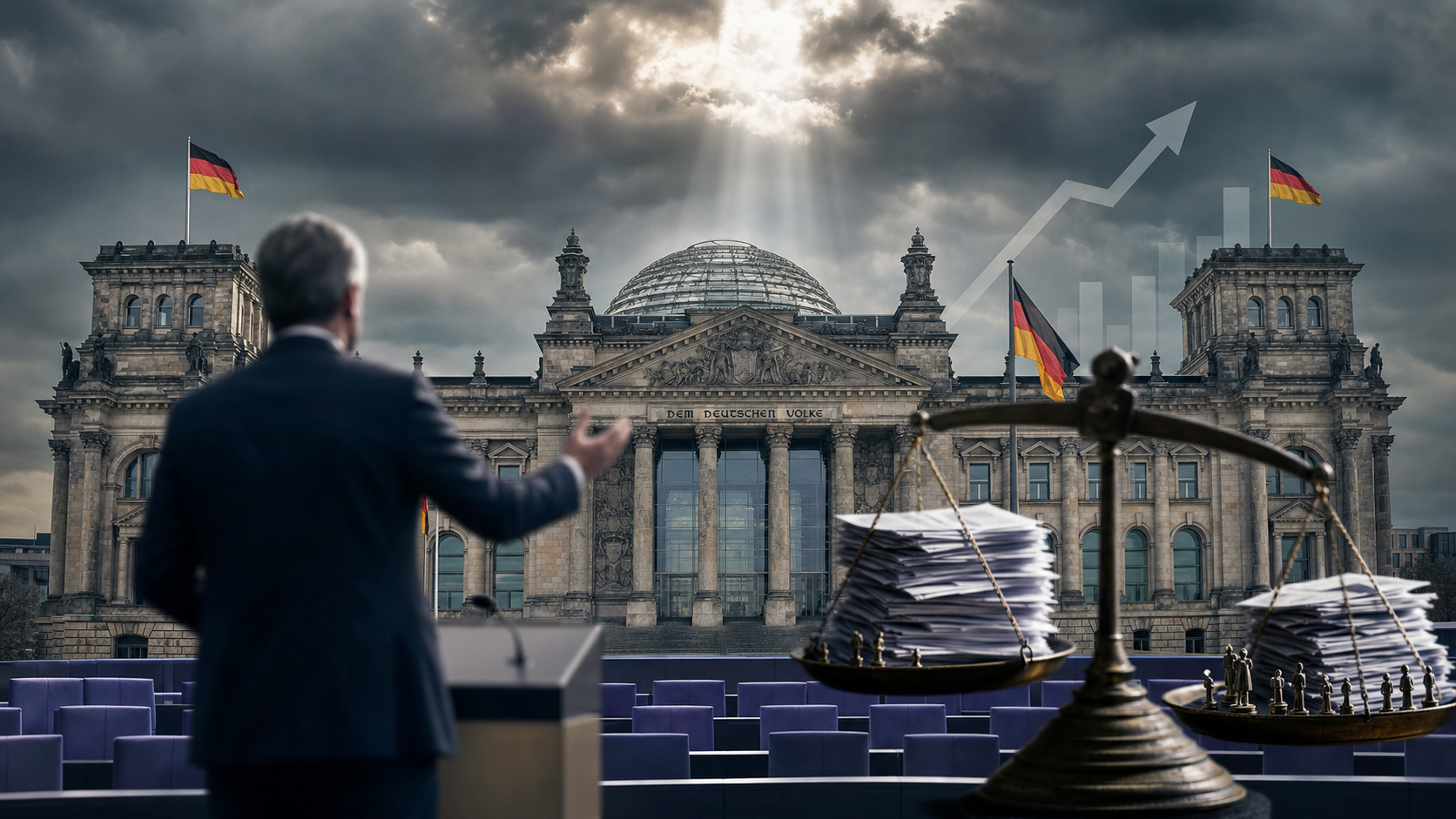
A warning to the government: Why Germany's economy is suffocating in political theater – Image: Xpert.Digital
The fatal zero-sum game: Why mere redistribution will no longer save our country
Record taxes and brain drain: How Germany is driving away its top performers
Pensions, healthcare, taxes: The reform clock is ticking – but Berlin is only arguing
Germany stands at a perilous economic and social crossroads. Although the crises – from a stagnant economy and a crumbling pension and healthcare system to an oppressive tax burden – have been on the table for years, the center-right/center-left coalition government under Chancellor Friedrich Merz remains mired in political patchwork and internal squabbles. Fearing the loss of voters, the coalition avoids genuine structural reforms and resorts to vague compromises. Instead of a desperately needed growth strategy, a paralyzing redistribution debate dominates, not only stifling investment but also increasingly driving Germany's high achievers abroad. This analysis reveals why time is running out in the political theater of Berlin and why the country urgently needs a new, bold narrative of a meritocracy before the creeping decline becomes irreversible.
Related to this:

Germany doesn't need another distribution dispute – it finally needs the courage to grow
Germany is caught in a curious paradox. The economic challenges have been known for years, the necessary reforms are being publicly debated, and the political actors basically know what needs to be done. And yet, too little is happening. The center-right/center-left coalition government under Chancellor Friedrich Merz has been in power since the beginning of 2025, signed a comprehensive coalition agreement, and yet faces a growing impression that daily political life consists more of infighting and delays than decisive policy decisions. This frustrates not only citizens, but also businesses, economists, and increasingly even the coalition partners themselves.
The German economic engine is sputtering. Gross domestic product is stagnating: After two years of recession, the economy grew by a mere 0.2 percent in 2025, according to the Federal Statistical Office – this growth came almost exclusively from consumer spending by private households and the government, while exports declined again, investments remained weak, and the manufacturing sector suffered losses for the third year in a row. The Council of Economic Experts had forecast growth of 0.9 percent for 2026 – a projection that has already been significantly revised downwards by economic research institutes in light of the Iran war and the energy price shock in the spring of 2026.
The anatomy of the coalition dispute
To understand the political state of the German government, it's worth looking at a specific conflict: In April 2026, the dispute between Economics Minister Katherina Reiche (CDU) and Finance Minister Lars Klingbeil (SPD) over relief measures for citizens and businesses in light of the Iran-Iraq War escalated into a public clash. Klingbeil proposed an energy price cap, an accelerated reduction in the energy tax, and a profit tax for oil companies. Reiche responded on live television that the proposals were "costly, ineffective, and constitutionally questionable." Merz urged both sides to maintain order and find common solutions – and the Chancellor's moment ended with an agreement on vaguely "antitrust- or tax-compliant measures" against the oil industry, without a concrete decision.
This is not an isolated incident – it's a symptom. The black-red coalition isn't arguing because it has too many ideas. It's arguing because the competing priorities of both parties inevitably clash with every reform step, and because fear of their own voters – on both sides – leads to decisions being postponed. The CDU/CSU fears tax increases, the SPD fears benefit cuts in the welfare state. The result is a government that leads in lip service but lags behind in implementation.
Something everyone knows, but no one says aloud
The problem is well-known. Every expert on pensions knows that the current system is not financially sustainable in the long term, given demographic changes. The pension system faces the massive challenge of the baby boomer generation, who will transition from contributing workers to receiving pensions in the coming years. In December 2025, the Bundestag passed the federal government's pension package, which aims to stabilize the pension level at 48 percent until 2031 and expand the supplementary pension for mothers – measures that will cost up to 11 billion euros annually until 2031 and even 15 billion euros annually from 2032 onwards. This money has to come from somewhere, and neither the Young Union nor renowned economists believe that this is possible without considerable effort.
The picture is similar when it comes to taxes. The tax burden is at a historic high: at the turn of the year 2025/2026, the combined ratio of taxes and social security contributions to GDP exceeded 42 percent. This burden is increasingly putting Germany at a disadvantage in international competition. At the same time, social security contributions rose again at the beginning of 2025: long-term care insurance to 3.6 percent, and the average supplementary contribution to health insurance to 2.5 percent. Experts predict a further increase in the statutory health insurance contribution rate for 2026.
The German government has taken measures that at least point in the right direction. The tax package from December 2025 is intended to provide tax relief of almost five billion euros in 2026 and a further 6.3 billion euros by 2030. The basic tax allowance increased to 12,348 euros, and child benefit to 259 euros per month. Corporate tax is to be gradually reduced from 15 to 10 percent from 2028 – a measure long overdue to lower the corporate tax burden from its current level of almost 30 percent to below 25 percent. The "active pension" allows retirees who continue working to earn up to 24,000 euros tax-free – a sensible measure to combat the skilled worker shortage.
When courage to impose is lacking: The healthcare system as an ongoing task
When it comes to healthcare, experts have been making the same diagnosis for decades: the system is structurally underfunded, contributions are rising, the quality of care is stagnating, and without fundamental reform, statutory health insurance will become an ever-greater budgetary risk. A reform commission was supposed to present proposals by mid-2026, ranging from benefit cuts to co-payments. Merz has stated that everyone must contribute to financing to ensure fairness. That's the right thing to do – but when it comes to concrete measures, the coalition will either remain silent or argue amongst themselves.
The pattern is clear: grand speeches about reforms, then years of delay, then a half-hearted compromise that truly satisfies no one and merely postpones the problem. What gets lost in the process is public trust – and that, in the long run, is the most expensive price to pay. When citizens feel that political decisions are primarily driven by election campaign calculations and not by objective needs, their willingness to accept even inconvenient demands diminishes. This is the core of the loss of political trust.
Our EU and German expertise in business development, sales and marketing

Our EU and German expertise in business development, sales and marketing - Image: Xpert.Digital
Industry focus areas: B2B, digitalization (from AI to XR), mechanical engineering, logistics, renewable energies and industry
More information here:
A thematic hub offering insights and expertise:
- Knowledge platform covering global and regional economies, innovation and industry-specific trends
- A collection of analyses, insights, and background information from our key areas of focus
- A place for expertise and information on current developments in business and technology
- A hub for companies seeking information on markets, digitalization, and industry innovations
Relief, investment, education: The roadmap for a sustainable upswing
Boosting performance: The misunderstood argument
One of the most productive, yet also most misunderstood, debates in German economic policy revolves around the question of who should be burdened and to what extent. In the public perception, this issue is often discussed as a simple left-right paradigm: on the one hand, redistribution in favor of lower earners, and on the other hand, relief for higher earners. This simplification ignores the complex economic reality.
The person considered a "top earner" in Germany, and thus the focus of political redistribution debates, is often not a CEO with a multi-million-euro salary, but rather a master craftsman with their own business, a freelance engineer, or a self-employed doctor. These individuals bear entrepreneurial risk, create jobs, and pay disproportionately high taxes and social security contributions. If their willingness to work is dampened by rising tax burdens, the entire economy feels the consequences – through reduced investment, lower job growth, and an erosion of tax revenues, which in the long run also affects those whom the welfare state is meant to protect.
The figures speak for themselves: Germany is suffering from an increasing brain drain, meaning the departure of highly qualified professionals to other countries. Factors such as tax burden, bureaucracy, housing costs, career opportunities, and quality of life are having an ever-greater impact on whether qualified professionals stay or leave. Those who fail to treat Germany's attractiveness as a business location as a strategic priority will face a gradual loss of top performers in the long run.
Related to this:

The perverse incentive of the redistribution debate
In a growing economy, redistribution is easier – because new wealth can be distributed without affecting existing positions. In a stagnant or shrinking economy, redistribution becomes a zero-sum game: what one person gains, another loses. Germany has been in an economic downturn since 2023, which was only narrowly halted in 2025 – with growth of 0.2 percent, based almost entirely on consumer spending, while exports and investment continued to weaken.
In this situation, the temptation is great to prioritize the issue of distribution – because it can be politically mobilizing and promises immediate results. However, a policy that prioritizes redistribution without growth ultimately pursues a policy of slow decline. The resources to be distributed must first be generated. And for them to be generated, an economy is needed in which performance, risk, and innovation pay off.
The German government's corporate tax reform, which aims to gradually reduce corporate tax rates from 2028 onwards, is a step in the right direction. However, corporate tax is only one part of the overall burden. International competition for investment, talent, and business locations is not solely based on corporate tax rates, but on the entire package of regulatory density, administrative efficiency, infrastructure quality, and societal openness to innovation. Germany has some catching up to do in all these areas.
The reform clock is ticking: What needs to be decided by summer
Chancellor Merz himself has made the pace of reform a key issue. He set the goal of having all fundamental decisions on taxes, pensions, and healthcare finalized by the parliamentary summer recess in mid-July. This is an ambitious timeline, which, given the dynamics within the coalition, must be considered optimistic. CSU leader Markus Söder even pushed for faster progress, demanding that everything ideally be decided between Easter and Pentecost. State elections are scheduled for September in Saxony, Mecklenburg-Western Pomerania, and Berlin – experience shows that the willingness to reform will decrease afterward, once the political costs of unacceptable measures become more apparent.
The window for bold decisions is therefore narrow. And this very narrowness of the timeframe is the problem: structural reforms that need to be designed for decades are squeezed into the confines of an election calendar and consequently scaled back so as not to alienate too many voters. The result is reforms that cost enough to generate resistance but achieve too little to solve the problem.
Growth isn't magic – but it needs the right conditions
The real alternative to the distribution debate is a growth-oriented approach – and this is not synonymous with neoliberal laissez-faire, but rather with an active economic policy that sets the framework for private investment, reduces bureaucracy, modernizes infrastructure, and strengthens the education and training system. Merz declared 2026 the "year of recovery and growth." The ambition is sound – but the results after more than a year are mixed.
The energy cost relief measures for businesses and consumers, amounting to over €10 billion per year, are real and effective. The reduction in network charges, the abolition of the gas storage levy, and the permanent reduction of the electricity tax for the manufacturing sector are sensible measures that strengthen competitiveness. The increase in the commuter allowance to 38 cents, the reduction of the VAT rate for the hospitality industry to 7 percent, and the investment boost with depreciation allowances of up to 30 percent are further components.
But the real test will be whether these measures lead to actual investment growth and GDP expansion – or whether they fizzle out in the face of external shocks from the Iran war, US tariffs, and the strong euro. Economic research institutes have already significantly revised their forecasts for 2026 downwards. The headwinds are real.
What Germany really needs: The grand narrative of the meritocracy
Behind all the concrete reform debates lies a deeper question: What kind of society does Germany want to be? A model that primarily relies on social security and redistribution will sooner or later reach its limits in an environment of demographic decline and economic stagnation. A model that rewards performance, risk, and entrepreneurial spirit can generate greater prosperity for all in the long term in a globalized competitive landscape—provided that the welfare state fulfills its core function of supporting people in genuine need and ensuring equal opportunities.
The German government is arguing over details, while the big picture is missing. No party in the coalition has yet painted a convincing, coherent picture of a modern German meritocracy that is both economically motivating and socially inclusive. This narrative gap is the real problem – because reforms introduced without a convincing rationale are rejected or ignored. Anyone who wants to ask something of people must show them why.
Public patience is running high: dissatisfaction with the government is running high, factions within the governing parties are regrouping, and centrifugal forces within the coalition are increasing. The coming months will show whether Berlin can find its way out of this political charade. The real pain – in the pension system, in healthcare, in competitiveness – will come whether it is decided upon or not. The difference lies in whether Germany actively shapes it or passively suffers it.





