
Arms boom in Germany: Why security and the economy are no longer separate worlds
Xpert Pre-Release

Available in 27 languages 📢
Prefer Xpert.Digital on GoogleⓘPublished on: April 19, 2026 / Updated on: April 19, 2026 – Author: Konrad Wolfenstein
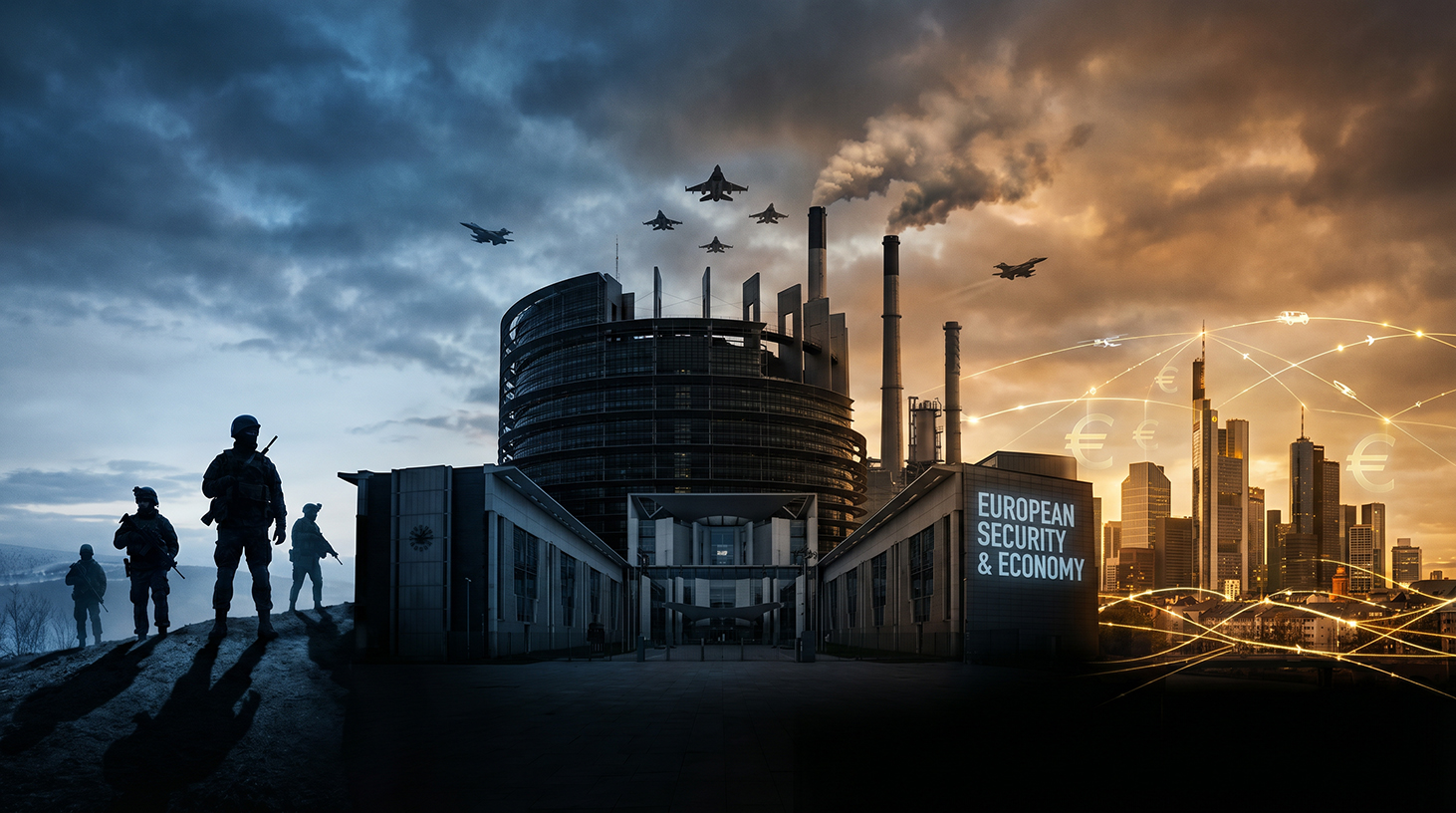
Arms boom in Germany: Why security and the economy are no longer separate worlds – Image: Xpert.Digital
500 billion fund: Why rearmament will be the biggest economic stimulus program of all time
The end of the peace dividend: Why our economy cannot survive without weapons
5 percent for the German armed forces? What the new NATO plan means for the German economy
For decades, security and the economy were considered strictly separate worlds in Germany: geopolitical strategies and the Bundeswehr on one side, export balances, free trade, and industrial development on the other. But the war in Europe, fragile global supply chains, and fierce competition between the superpowers are forcing a radical rethink. Rearmament is no longer just a military necessity, but is becoming the largest economic stimulus program in the history of the modern Federal Republic. With defense spending potentially rising to as much as five percent of GDP in the medium term, the domestic economy is poised to gain hundreds of thousands of new jobs and generate massive growth. At the same time, civilian and military technologies are increasingly merging in the so-called "dual-use" sector. This paradigm shift demonstrates that technological sovereignty and defense capability are now the cornerstones of our economic viability. Anyone who ignores this change risks not only military vulnerability, but also their own prosperity.
From AI to tanks: How the arms industry is transforming our entire economy
The new logic of the 21st century: Armaments are industrial policy
For decades, the conceptual separation of security policy and economic policy was almost institutionalized in Germany. On the one hand, there were the Bundeswehr (German Armed Forces), NATO, and geopolitical abstractions; on the other, export balances, operating results, and industrial promotion. Anyone who tried to connect these two spheres was considered either a militarist or a naive idealist. That era is over. The Russian invasion of Ukraine, the destabilization of global supply chains, superpower competition, and a new American unreliability have forced a fundamental realization: security policy is always also economic policy in its effects—and vice versa. Anyone who ignores this pays a double price: that of military vulnerability and that of economic dependence.
The figures speak for themselves. Since 2024, Germany has clearly met NATO's two percent target and currently spends 2.4 percent of its gross domestic product on defense. At the NATO summit in The Hague in June 2025, the alliance partners committed to increasing defense spending to a total of five percent of GDP by 2035 – 3.5 percent for pure defense expenditures such as materiel, weapons systems, and equipment, and a further 1.5 percent for militarily necessary infrastructure such as railways, roads, bridges, as well as cybersecurity, power grids, and IT projects. This is not an abstract political agreement. It is the largest state-induced economic stimulus program in the history of the modern Federal Republic of Germany.
Defense spending as an economic engine: Convincing figures
The economic implications of this paradigm shift are enormous. A joint analysis by the consulting firm EY-Parthenon and DekaBank shows that over the next ten years, European NATO countries will increase their direct defense spending to 3.5 percent of their gross domestic product, which corresponds to annual expenditures of approximately 770 billion euros. Of the roughly 217 billion euros that will flow annually into the defense sector, Germany will account for about 32 billion euros – almost 15 percent of the total European budget.
This sum alone will trigger significant economic growth in Germany. According to the EY-DekaBank study, this investment surge will secure and create up to 360,000 industrial jobs in Germany and increase GDP by a total of 0.7 percent by 2029. Even more significant is the macroeconomic multiplier effect: Every euro generated by the defense industry, according to the study's calculations, triggers approximately 2.70 euros of additional economic output in Europe – through suppliers, service providers, research institutes, and technological spin-off effects. The Kiel Institute for the World Economy had already predicted at the Munich Security Conference in early 2025 that an increase in EU defense spending from just under two to 3.5 percent of GDP could enable additional economic growth of up to 1.5 percent – provided that the investments flow primarily into European production.
This boom is already evident in company balance sheets. Rheinmetall recorded its highest revenue in history in 2024, at €9.8 billion – an increase of 36 percent compared to the previous year. Airbus Defence and Space increased its revenue to €4.5 billion. Thyssenkrupp Marine Systems achieved revenue of around €2.1 billion, a rise of 16.7 percent compared to the previous year. And defense expert Klaus-Heiner Röhl from the German Economic Institute emphasizes that the real boom is yet to come.
Technological sovereignty as an economic policy goal
But the economic dimension of security policy is not limited to arms contracts and employment figures. It touches upon more fundamental questions of economic viability in a fragmenting world order. The European Strategy for Economic Security, adopted by the European Commission in June 2023, explicitly addresses this connection: Global crises, from COVID-19 and energy crises to geopolitical tensions, have demonstrated that economic dependencies can pose security risks. Supply chains, access to raw materials, semiconductor supply, digital infrastructure – these are no longer purely trade issues, but rather matters of national security.
Germany faces a particularly complex situation. As an export-oriented economy, the German economy is closely intertwined with the US and China and will clearly feel the consequences of a separation of the technology and trade spheres, as the German Council on Foreign Relations (DGAP) notes in an analysis on economic security in times of geopolitical tension. At the same time, the security situation necessitates a fundamental realignment of defense readiness – with substantially higher defense spending, as Michael Hüther from the Cologne Institute for Economic Research emphasizes.
The German Federal Minister for Economic Affairs and his European counterparts thus face a strategic challenge: they must reduce economic dependencies without risking trade isolation. They must build resilience without sacrificing efficiency. And they must direct defense investments in such a way that the funds benefit European economies – and do not primarily flow as transfer payments to American arms manufacturers. Goldman Sachs estimates that additional defense spending over two years has a fiscal multiplier of 0.5 – meaning that 100 euros spent on defense generates 50 euros of additional economic output. This effect increases considerably, however, if the procurement takes place in Europe.
Hub for Security and Defense - Advice and Information

Hub for Security and Defense - Image: Xpert.Digital
The Security and Defence Hub offers expert advice and up-to-date information to effectively support companies and organizations in strengthening their role in European security and defence policy. Working closely with the SME Connect Defence Working Group, it particularly promotes small and medium-sized enterprises (SMEs) that wish to further develop their innovative capacity and competitiveness in the defence sector. As a central point of contact, the Hub thus creates a crucial bridge between SMEs and European defence strategy.
Related to this:
Between business and defense: The era of dual-use innovations
Dual Use: The merging of civilian and military innovation
A particularly strategically important interface between security and economic policy is the world of so-called dual-use technologies – that is, goods, technologies, or software that, due to their technical parameters, can be used for both civilian and military purposes. In November 2025, the European Commission updated Annex I of the EU Dual-Use Regulation, thereby placing numerous new technology areas under control – from quantum computing and semiconductor technologies to additive manufacturing and biotechnology.
Behind this regulatory measure lies a deeper strategic logic. The separation between civilian and military innovation is no longer tenable in the 21st century. The experiences of the Ukrainian drone industry demonstrate how quickly civilian innovations can be transferred into military applications and how much operational learning cycles and production reinforce each other. Companies are increasingly integrating artificial intelligence, commercial manufacturing methods, and start-up models into military applications—a fundamental break with the traditional separation between the civilian and military sectors. For German economic policy, this means that anyone investing in key technologies such as quantum computing, semiconductors, robotics, or autonomous systems is simultaneously pursuing security policy.
This requires a rethink in economic development. The €500 billion modernization fund, which the federal government under Chancellor Friedrich Merz approved after reforming the debt brake, provides the financial framework for this. If used wisely, this capital can not only modernize the German armed forces but also strengthen the technological base of the German economy: through investments in rail infrastructure, bridges, cybersecurity systems, energy networks, and digital infrastructure that serve both military and civilian purposes.
Europe's sovereignty shift: A new geopolitical architecture is emerging
At the European level, there is a growing consensus that the existing security architecture is no longer adequate. In the European Parliament, there is broad agreement that an "arc of instability" has formed around Europe, in which competition and protectionism have replaced cooperation and free trade. The EU High Representative, Kaja Kallas, is working on a new security strategy that covers all dimensions of European security – from hard security and defense to economic security and preparedness. This development is historic. Europe is realizing that its economic strength cannot be defended in the long term without a corresponding capacity for effective security policy.
By 2035, direct defense investments by European NATO states will total almost €2.2 trillion – this is the only way to achieve equipment targets and compensate for the potential loss of American systems. This enormous investment sum also represents the largest economic stimulus program ever adopted by Europe. The growth effects extend far beyond the defense industry: these annual investments generate approximately €40 billion in gross value added within the European defense sector, and an additional €109 billion is triggered along the supply chain and in other sectors.
The geopolitical risk test: What's at stake
The urgency of this transformation is underscored by the current geopolitical risk profile. Three risks stand out in particular, as Stefan Mair of the German Institute for International and Security Affairs (SWP) analyzes: a defeat of Ukraine in the war with Russia, a withdrawal of American security guarantees, and an escalation of the strategic rivalry between the US and China. All three scenarios would have immediate and serious economic consequences for Germany and Europe.
The Bundesbank confirms this assessment in its own research: Rising geopolitical risks in trading partner countries increase the cost and dampen imports and disrupt supply chains. They also promote the fragmentation of global trade, with risks related to China being particularly significant. Germany, as one of the world's leading export economies, is especially affected by this fragmentation. A weakening of the globalized trading system will hit no economy harder than those that rely on open markets and stable supply chains.
From defense readiness to economic resilience
The crucial economic policy conclusion, therefore, is not that military spending is desirable per se. It is more subtle and long-term: A country that can credibly deter foreign powers protects not only its territorial integrity but also its economic interests. It secures trade routes, protects critical infrastructure, maintains access to resource markets, and prevents economic blackmail by authoritarian actors. Europe has consumed the dividends of peace in recent decades—low defense spending, global trade integration, and cheap energy from Russia. These dividends have been exhausted.
The EU budget for 2026 reflects this new reality: Planned spending on security and defense is increasing by almost €200 million to just over €2.8 billion, and around €230 million more is earmarked for migration and border management. These sums may sound modest, but they signal a fundamental reprioritization. As the largest net contributor to the Union, Germany provides almost a quarter of EU funds – and at the same time benefits more from the single market than any other European economy.
The key principle for economic policy in the coming decade is therefore this: Investments in security policy are not mere consumption, but infrastructure for economic success. Anyone who considers roads, railways, and bridges economically relevant must do the same for cybersecurity, defense capabilities, and strategic reserves. The separation of these spheres was a historical luxury that Germany and Europe afforded themselves in the post-Cold War era. In the world of 2026, this luxury has become unaffordable.
Opportunities and risks of the new arms dynamics
It would be incomplete to describe the economic dimension of security policy solely as an opportunity. The risks are real. Massive increases in defense spending can create displacement effects: if public funds flow into armaments, they may be lacking for education, research, climate protection, and social infrastructure. While the fiscal multiplier of defense spending is positive, it is generally lower than that of investments in education or infrastructure. And an overheated arms industry can draw skilled workers away from other productive sectors.
Added to this is the danger of strategic path dependency: economies that increasingly focus their innovation on military applications risk losing their civilian competitiveness. The US serves as a cautionary example here – it possesses overwhelming military strength but is showing increasing weaknesses in civilian industry. Europe and Germany must therefore seriously pursue the dual-use approach: technology investments must be designed to drive both military and civilian innovation. This will ensure that the defense dividend flows back into the broader economy.
The realization that security policy is always also economic policy is not an invitation to the militarization of the economy. Rather, it is a call for sobriety: sobriety towards the naiveté of decades of peace dividends, sobriety towards the temptation of pursuing armaments as an end in themselves, and sobriety towards the complexity of a world in which economic strength and military credibility are mutually dependent. Those who understand this interplay act wisely – those who ignore it will sooner or later pay a heavy price.
Consulting - Planning - Implementation

Markus Becker
I would be happy to serve as your personal advisor.
Head of Business Development
Chairman SME Connect Defense Working Group
Consulting - Planning - Implementation
Konrad Wolfenstein
I would be happy to serve as your personal advisor.
contact me at wolfenstein ∂ xpert.digital
Just call me on +49 7348 4088 965 .





