
German corporations and the innovation crisis: Cost reduction as a strategy? Why German industry is focusing on the wrong lever
Xpert Pre-Release

Available in 27 languages 📢
Prefer Xpert.Digital on GoogleⓘPublished on: March 31, 2026 / Updated on: March 31, 2026 – Author: Konrad Wolfenstein
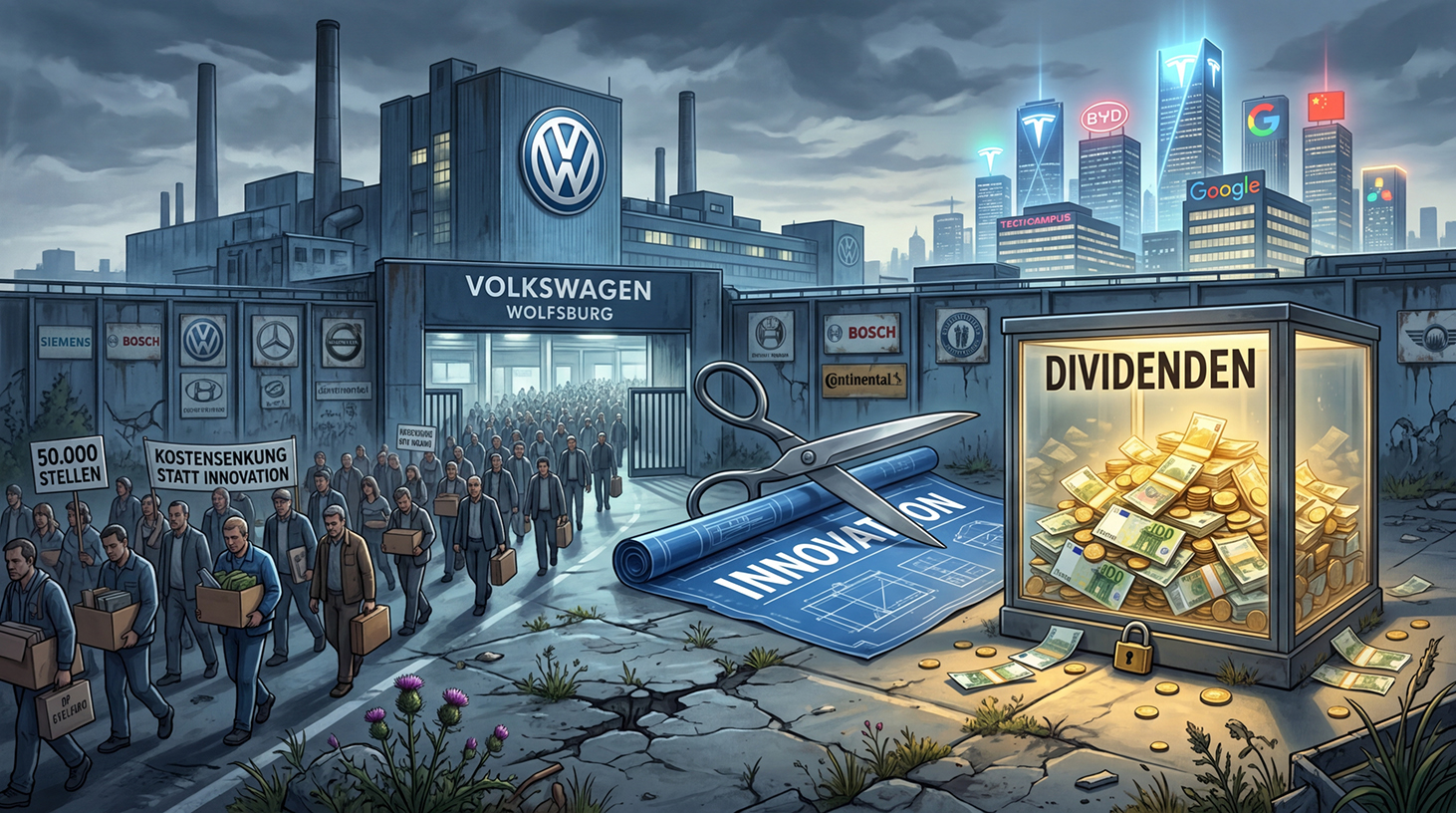
German corporations and the innovation crisis: Cost reduction as a strategy? Why German industry is focusing on the wrong lever – Image: Xpert.Digital
A damning indictment of executive boards: The McKinsey report exposes the paralysis of the German economy
Billions in dividends despite mass layoffs: How German industry is destroying itself
Saving until ruin: Why German corporations are turning the completely wrong screw
Germany's industry is reeling. What is often dismissed in public debate as a temporary economic downturn or an unavoidable consequence of global crises, on closer inspection reveals itself to be a self-inflicted strategic disaster. Record numbers of corporate insolvencies and unprecedented job cuts at traditional corporations like Volkswagen, Bosch, and Continental paint a bleak picture of the economic situation. But instead of meeting the brutal pressure for innovation from China and the USA with courage and investment, German executives are almost reflexively reaching for the familiar red pen. Tens of thousands of jobs are falling victim to austerity programs – shockingly often precisely where the future should be developed: in research and development. While future-oriented projects are being scrapped, billions in dividends are simultaneously flowing into the pockets of shareholders. A damning analysis reveals that the German economy is not suffering from a lack of knowledge, but from a fatal management paralysis. This article sheds light on the structural misstep of German industry and shows why simply cutting costs means a slow, inevitable demise.
Related to this:

While the world innovates, Germany is shrinking itself to health at all costs
Germany is in the midst of an industrial crisis that runs deeper than most public debates are willing to acknowledge. What is downplayed as a reaction to external shocks such as US import tariffs and the collapse of business with China is, in reality, the result of years of strategic missteps in German boardrooms. The figures are clear: in 2025, German industry cut around 124,100 jobs – almost twice as many as in the previous year. The automotive industry alone accounted for roughly 50,000 of these job losses. And the forecasts for 2026 offer no relief.
Related to this:

The extent of the crisis in numbers
At the end of 2025, approximately 5.38 million people were employed in German industry – a decrease of 2.3 percent compared to the previous year. Since 2023, industrial sales have shrunk by almost five percent, and the fourth quarter of 2025 marked the tenth consecutive quarter of declining sales. The consulting firm EY, which compiled this data based on information from the Federal Statistical Office, expects job losses to continue in 2026, with competitive pressure remaining unchanged.
Even more worrying is the insolvency situation. The number of corporate bankruptcies in Germany reached its highest level since 2005 in 2025, with 17,604 cases – according to the Halle Institute for Economic Research, this figure was even around five percent higher than the peak during the global financial crisis of 2009. A total of around 170,000 jobs were affected, a particularly high number of them in the manufacturing sector. Creditreform forecasts up to 24,000 insolvencies for 2026 and sees no change in this trend as long as the political and economic conditions do not fundamentally improve. High energy prices, bureaucratic burdens, and the tax pressure on small and medium-sized enterprises (SMEs) are identified as the main structural causes and no longer merely as cyclical anomalies.
Related to this:

Volkswagen: A symbolic image of a structural crisis
No company embodies the dilemma of German industry better than Volkswagen. The Wolfsburg-based group plans to cut a total of 50,000 jobs in Germany by 2030 – 35,000 in its core VW brand alone, 7,500 at Audi, and 3,900 at Porsche. Operating profit plummeted by approximately 50 percent to €8.9 billion in 2025, while net profit after taxes fell by 44 percent to €6.9 billion. The works council described it as the weakest result since the Dieselgate collapse of 2015/2016.
The company's response is to cut costs. Annual savings of around six billion euros are planned, with total cost reductions of up to 60 billion euros. CEO Oliver Blume emphasized at the presentation of the financial results that the goal is to overhaul a business model that is no longer working. He stressed that increasing efficiency in procurement, development, materials, production, and sales is more important than simply reducing staff. At the same time, 3.2 billion euros will be distributed to shareholders – a dividend yield of just over six percent, even though some of the main plants are only operating at 60 percent capacity. The Porsche-Piëch family alone will receive at least one billion euros in distributions for the 2025 fiscal year.
The real problem: product policy instead of market
The underutilization of VW's plants is not a market failure – it is the result of a strategic misalignment. The company focused on luxury models with higher profit margins, thereby removing more affordable entry-level vehicles from its lineup. This made the offerings unattractive for the German domestic market, dominated by price-sensitive buyers. In its most important export market, China, VW steadily lost market share to state-subsidized domestic electric car manufacturers, who operate with shorter innovation cycles and offer significantly lower prices. The US market is under immense pressure due to import tariffs imposed by the Trump administration. The ramp-up of electromobility was slower than expected, which paradoxically led Porsche to undertake an expensive strategic U-turn away from electric cars and back to combustion engines. This alone cost around €3.1 billion in 2025 and caused Porsche's profits to plummet by more than 90 percent.
There are signs of hope: VW plans to introduce entry-level electric models around the ID. Polo starting at €25,000 in 2026, and electric models specifically developed for the Chinese market are slated to launch. At the same time, around 9,000 new jobs are expected to be created in future-oriented fields such as digitalization, software development, and battery technology. These measures are correct and long overdue – whether they will be sufficient to close the structural gap is another question.
Our EU and German expertise in business development, sales and marketing

Our EU and German expertise in business development, sales and marketing - Image: Xpert.Digital
Industry focus areas: B2B, digitalization (from AI to XR), mechanical engineering, logistics, renewable energies and industry
More information here:
A thematic hub offering insights and expertise:
- Knowledge platform covering global and regional economies, innovation and industry-specific trends
- A collection of analyses, insights, and background information from our key areas of focus
- A place for expertise and information on current developments in business and technology
- A hub for companies seeking information on markets, digitalization, and industry innovations
McKinsey Report 2026: Awareness without Courage – Germany's Interrupted Transformation
The suppliers: When the pain is even greater
When Volkswagen, BMW, and Mercedes suffer, their suppliers suffer even more. Bosch has announced massive cutbacks in several stages: first, 1,500 jobs at the end of 2023, then 1,200 in January 2024, and another 5,500 in November 2024. At the end of September 2025, the savings program was dramatically expanded: by 2030, around 13,000 more jobs are to be eliminated in Germany – in addition to the 9,000 already announced for 2024. Bosch CEO Stefan Hartung publicly stated that further job cuts would be unavoidable. The areas most affected are automated driving and driver assistance systems – precisely those future technologies in which Bosch had invested for years.
Continental announced plans to cut another 3,000 research and development jobs by the end of 2026 – 1,450 of them in Germany, coinciding with the complete closure of its engineering site in Nuremberg. This follows the elimination of 7,150 jobs in its automotive division, including 5,400 in administration and 1,750 in development. ZF, Mahle, and Schaeffler are following similar patterns: job cuts, plant closures, and relocations abroad. Schaeffler alone has eliminated several thousand jobs, while Mahle plans to close numerous European plants.
The pattern is worrying: Job cuts are disproportionately affecting research and development departments – precisely those positions that secure innovation capacity in the medium to long term. Laying off engineers who are supposed to develop tomorrow's products in order to cut costs today means buying short-term profit improvements at the expense of long-term competitiveness.
Related to this:

What McKinsey discovered: Paralysis in the face of crisis
The German analysis of McKinsey's "State of Organizations 2026" report provides the analytical framework for what is already becoming apparent in the figures. Based on a global survey of more than 10,000 executives in 15 countries and 16 industries (over 600 of whom were from Germany), the report reveals a paradoxical paralysis: 77 percent of German executives are experiencing significant geopolitical impacts on their business – but only 26 percent are strategically shifting their budgets and talent towards future-oriented topics such as artificial intelligence.
Patrick Guggenberger, one of the report's authors, describes the diagnosed core paralysis with remarkable precision: The discrepancy between awareness of the pressure to adapt and the actual speed of implementation is particularly pronounced in German companies. Structures and processes stifle rapid reactions, and the speed at which companies develop and launch innovations suffers as a result. German firms tend to try to reduce uncertainty through even more regulations and planning – and it is precisely this tendency to hedge against risk that causes the greatest damage in dynamic markets.
At the same time, the report offers a glimmer of hope: In the field of artificial intelligence, German companies are quite ambitious compared to their international counterparts. A significant number of organizations are already using AI across multiple functions or even organization-wide, and 60 percent of executives have a clear understanding of how AI will change job profiles in the coming years. The problem: Between understanding AI and consistently restructuring, there is a paralyzing gray area.
The structural contradiction: cut costs or invest?
The fundamental question underlying all these developments concerns strategic consensus: Is cost reduction a strategy, or is it an admission of a strategy's failure? The answer is nuanced. In the short term, cost discipline is necessary and sensible in a crisis – no company can sustainably spend more than it earns. However, it becomes problematic when cost reduction replaces strategy instead of complementing it. When research budgets, training programs, and future investments are slashed while dividends are paid out, this is not restructuring – it is the distribution of the last remaining resources before structural dismantling.
The insolvency situation in Germany illustrates that many companies no longer have a strategic choice: they are simply fighting for survival. For those that still have some leeway – and that applies to most of the large corporations – the decision regarding the allocation of capital between shareholder returns and future investments is an explicitly strategic one. The fact that Volkswagen is distributing €3.2 billion to shareholders while simultaneously carrying out mass layoffs is not an accounting contradiction – it is a clear statement about corporate priorities.
Internal combustion engines and electric vehicles: A distracting debate
Volkswagen CEO Oliver Blume is investing considerable political energy in postponing the EU-wide ban on combustion engines until at least 2040, thereby aligning himself with positions held by the CDU and AfD at the EU level. This stance is understandable from the short-term perspective of corporate interests, but it does not solve the fundamental problem. Rising and highly volatile oil prices, fueled by the US attack on Iran, are making gasoline and diesel structurally more expensive and volatile. Ultimately, demand dynamics are not driven by political decisions in Brussels, but by consumers' budgets and the aggressive strategies of Chinese competitors.
The real shortcoming lies not in the purely technological decision of "internal combustion engine versus electric," but in the lack of breadth of the product range. Those who remove the entire lower price segment from their lineup shouldn't be surprised when market penetration declines. E-mobility, affordable combustion engines, and public transport are not mutually exclusive – they serve different customer segments. In a stagnant automotive market, segment breadth is crucial for survival.
What needs to be done: Between insight and action
The basic outlines of the way out of the crisis are known – that is the truly worrying finding. There is no shortage of diagnoses, reports, or consultants who formulate the right recommendations. What is needed are systematic investments in technological innovation, a serious diversification of the product portfolio, shorter decision-making cycles at the executive level, and a clear commitment to the workforce's qualifications as a strategic resource. The public sector can support this through an industrial policy that promotes innovation instead of preserving existing structures, and by significantly reducing bureaucracy in the business environment to create space for dynamism.
What McKinsey describes as the core paradox of the German economy in 2026 is ultimately not a question of intelligence or knowledge: it is a question of the will to change under uncertainty. Those who wait until all risks have been eliminated before acting will be systematically overtaken in a dynamic global competition. The competition in the US and China doesn't wait for planning certainty – it creates facts on the ground. German corporations must learn to do the same before cost reduction becomes the last tool left to them.
Your global marketing and business development partner
☑️ Our business language is English or German
☑️ NEW: Correspondence in your native language!

Konrad Wolfenstein
I and my team are happy to be available to you as your personal advisor.
You can contact me by filling out the contact form here or simply call me at +49 7348 4088 965. My email address is : [email protected]
I'm looking forward to our joint project.
☑️ SME support in strategy, consulting, planning and implementation
☑️ Creation or realignment of the digital strategy and digitization
☑️ Expansion and optimization of international sales processes
☑️ Global & Digital B2B trading platforms
☑️ Pioneer Business Development / Marketing / PR / Trade Fairs
🎯🎯🎯 Data-driven B2B industry hub as a quasi-in-house solution

The quasi-in-house solution: How Xpert.Digital closes operational gaps in B2B marketing and sales – Smart Content-Driven Business - Image: Xpert.Digital
Xpert.Digital is a data-driven B2B industry hub led by Konrad Wolfenstein . The company acts as an external, quasi-in-house solution for industrial partners, closing operational gaps in marketing, content, and sales – without requiring additional resources on the client side.
More information here:










