
The Whale Paradox: Why Germany mourns an animal – and lets its own economy die
Xpert Pre-Release

Available in 27 languages 📢
Prefer Xpert.Digital on GoogleⓘPublished on: April 9, 2026 / Updated on: April 9, 2026 – Author: Konrad Wolfenstein
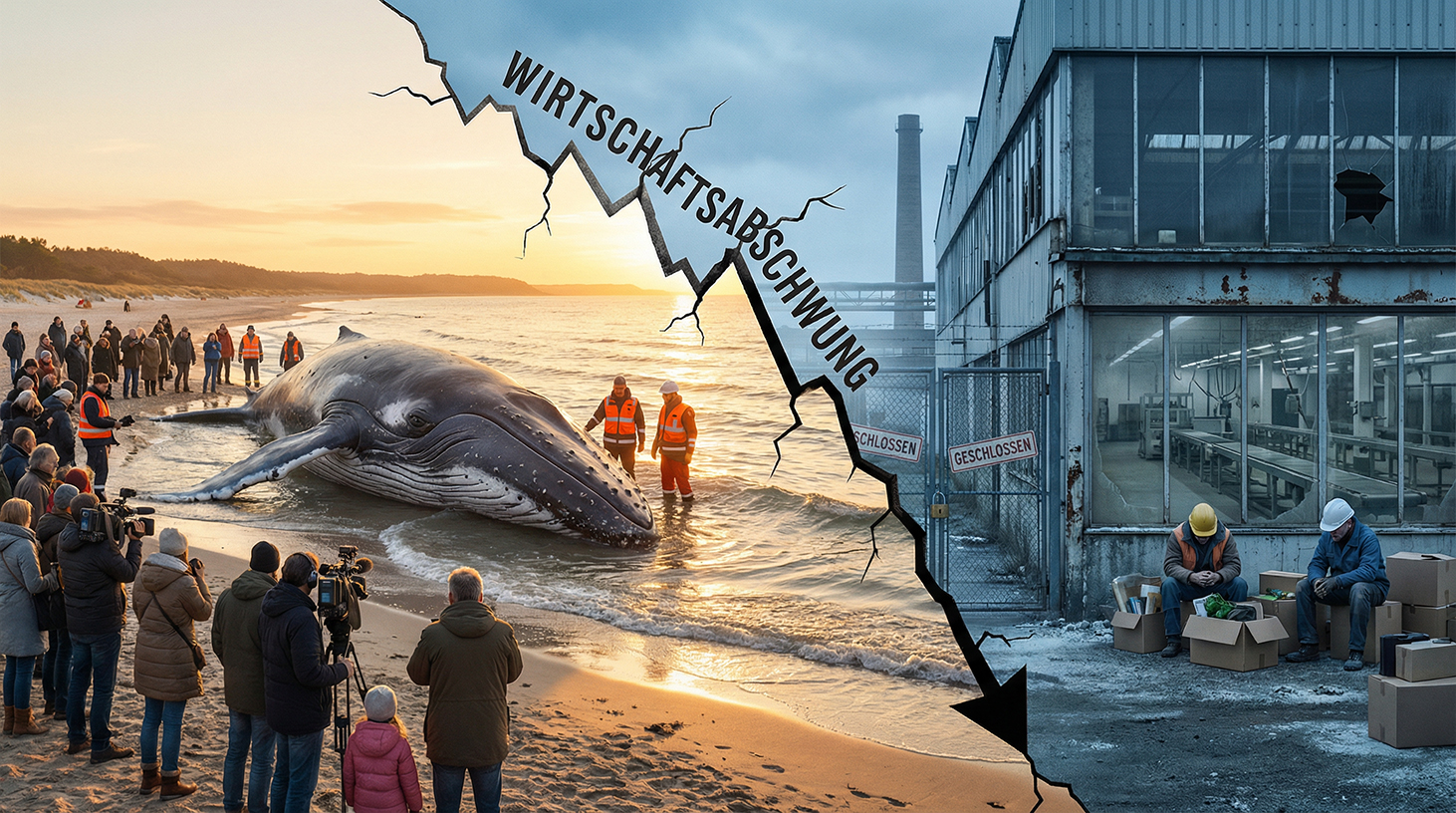
The Whale Paradox: Why Germany mourns an animal – and lets its own economy die – Creative image: Xpert.Digital
Record bankruptcies and job losses: The dangerous psychological phenomenon that is ruining our economy
143,000 jobs lost, but everyone is looking at "Timmy": The fatal blind spot of German politics
The silent death of the middle class: While Germany saves a whale, our industry collapses
It's a contrast that could hardly be more absurd: While all of Germany holds its breath because a humpback whale has stranded on the Baltic coast, a historic economic crisis is unfolding in complete silence in the background. Tens of thousands of industrial jobs are disappearing, traditional medium-sized companies are filing record bankruptcies, and deindustrialization is relentlessly eating away at the backbone of our economy. Yet politics, media, and society are fixated on the fate of a single animal. Why does a whale named "Timmy" mobilize ministers, cameras, and national mourning, while the collapse of German industry is met with, at best, a shrug? The answer to this question is not just a psychological indictment—it reveals a fatal systemic failure that poses a lasting threat to our prosperity and economic sovereignty. It's an indictment of psychological numbness, symbolic politics, and the creeping death of Germany as a business location.
The spectacle on the beach: Why Germany is turning a blind eye to economic decline — and what that says about us
It's April 2026, and all of Germany is holding its breath. Not because of the insolvency figures, which are currently reaching a 20-year high. Not because of the hundreds of thousands of industrial workers who have lost their jobs in recent years. The reason for this collective agitation is a humpback whale that has stranded in the Baltic Sea off the island of Poel and which the media have dubbed "Timmy." An animal that has stopped swimming has stopped Germany thinking.
Mecklenburg-Western Pomerania's Environment Minister Till Backhaus, the longest-serving Social Democrat in his office, seemed to have little else to do in recent weeks. He visited the whale personally, even at Easter, and held regular press conferences in which he described the animal's condition, weighed rescue options, and emphasized that they wanted to support the whale until the very last minute. He categorically ruled out any form of euthanasia, based on recommendations from the International Whaling Commission. When rescue was finally ruled out, aid workers spoke of death threats from outraged citizens who vented their horror on social media and via email. "Of course, I understand that the situation is very emotional for people," said Backhaus—a statement that is itself almost unparalleled in its unintentional irony.
What at first glance appears to be a curious footnote of contemporary history is in reality a symptom. It is the visible sign of a deep-seated perceptual error with far-reaching political, media, and social consequences: Germany is quietly and steadily losing its economic substance—and is looking in a different direction.
The numbers that don't move anyone
A sober assessment of Germany's economic situation reveals no reassuring findings. Gross domestic product (GDP) fell by a revised 0.9 percent in 2023 and by a revised 0.5 percent in 2024—two consecutive years of recession, the likes of which haven't been seen for over two decades. The slight growth of 0.2 percent projected for 2025 is little more than statistical noise and offers little cause for optimism. Economists cautiously suggest that the trough may have been reached, but a genuine recovery will not become visible until 2027 at the earliest, when the planned government investment programs begin to take full effect.
Industry—traditionally the backbone of the German economy—bled heavily during this period. In 2024, German industry lost around 68,000 jobs, a decline of 1.2 percent, according to the Federal Statistical Office. Manufacturers of electrical equipment were particularly hard hit, with a decrease of 3.6 percent, followed by metal products with a decrease of 2.9 percent, and the plastics and automotive industries, each with a decrease of 2.4 percent. The Institute for Macroeconomics and Business Cycle Research (IMK) described this as a "clear sign of deindustrialization." By 2025, industry was losing an average of 392 additional jobs per day—a total of 143,000 jobs. Since the pre-crisis year of 2019, the decline in industrial employment has amounted to around 217,000 jobs, a decrease of 3.8 percent. In the automotive industry alone, around 120,000 jobs disappeared between 2019 and 2025.
The insolvency figures paint an even more drastic picture. In 2024, 21,812 corporate insolvencies were registered—an increase of 22.4 percent compared to the previous year. For 2025, Creditreform reported 23,900 company bankruptcies, the highest number in more than ten years. The Leibniz Institute for Economic Research Halle (IWH) even counted 17,604 insolvencies of partnerships and corporations in 2025—more than in the crisis year of 2009. Around 170,000 jobs were directly affected by insolvencies in 2025 alone. Outstanding creditor claims from corporate insolvencies rose from €26.6 billion in 2023 to €58.1 billion in 2024—a doubling within a single year.
The silent death of the middle class
Behind these macro figures lie stories that go unreported by press conferences and undocumented by cameras. The medium-sized automotive suppliers were hit particularly hard. Between 2019 and 2025, around 120,000 jobs were lost in the German automotive industry. In 2025 alone, the automotive sector lost a net total of around 50,000 jobs. According to the consulting firm Falkensteg, insolvencies in the supplier sector rose to 56 cases among companies with more than ten million euros in annual revenue—an increase of 65 percent compared to the previous year. This means that almost one in six insolvencies in Germany involved an automotive supplier.
An entrepreneur who works as a supplier for the crisis-ridden automotive industry aptly summed up the situation: To avoid economic ruin, one has to work 60 hours a week—driven not by hope, but by pride. This silence is no accident. Small and medium-sized enterprises (SMEs) suffer in silence because they have no press department, no face, no name. Numbers and percentages are all that remain of them—and numbers don't affect anyone.
The conditions under which these companies are struggling are overwhelming. Germany has the highest household electricity prices in the entire European Union, at 39.5 cents per kilowatt-hour (or €39.50 per 100 kilowatt-hours). The picture is even more stark for industry: According to the Bruegel think tank, industrial electricity tariffs in the EU were 158 percent higher than in the US in 2023. Nearly 40 percent of companies in northern Germany see their competitiveness acutely threatened by high energy prices—an increase of six percentage points compared to the previous year. Among industrial companies nationwide, this figure is even higher, at 63 percent, as shown by the 2025 Energy Transition Barometer of the German Chambers of Industry and Commerce (IHK). At the same time, bureaucracy is hindering the green transformation, according to 65 percent of the companies surveyed, while political reliability is lacking.
Geopolitical shifts are intensifying the pressure. Both China and the US are pursuing determined industrial policies to strengthen their domestic production. Germany's core export industries—automotive and mechanical engineering—are caught in a pincer movement from both sides: by Chinese competitors in the premium segment and by American tariffs that erect additional barriers to market access. The German Association of the Automotive Industry is calling for political action—and is receiving polite nods instead of substantive answers.
The psychology of ignored misfortune
The question of why a dying whale evokes more compassion than a dying industry is not a moral one. It is a psychological one—and the answer is well-documented.
The “identifiable victim effect,” first systematically described by psychologists Karen Jenni and George Loewenstein and later further developed by Deborah Small, Paul Slovic, and others, refers to the tendency to provide significantly more help to identifiable individuals or beings than to statistical victim groups. Neuroimaging studies show that presenting identifiable victims—a photo, a name, a story—triggers increased activity in the nucleus accumbens, a brain region associated with positive arousal and decision-making motivation. It is not rational deliberation that drives us to action, but activation: The image of a stranded, named whale directly impacts the brain's emotional centers. A company that quietly goes bankrupt doesn't impact anywhere.
More recent replication studies have questioned the classic "identifiable victim effect" in its original, pure form, suggesting that the effect might be better understood as scale insensitivity—an inability to respond appropriately to the magnitude of the problem. This reformulation doesn't improve the diagnosis, but rather sharpens it: it's not the individual victim who receives too much attention, but rather the mass of those affected who receive structurally too little. Whether 1,000 or 100,000 people are affected makes little emotional difference—the perception doesn't scale with reality.
Paul Slovic described precisely this mechanism as psychological numbing. In his influential essay on mass atrocities and genocide, he summarized it succinctly: A single child who has fallen into a well moves hearts and hands. As soon as the number of victims grows, compassion begins to fade. Statistics, Slovic argued, are human fates with dried tears—they evoke no emotion because they tell no story. Hundreds of thousands of factory workers who lose their jobs are such statistics. They have no face, no voice on prime-time television, no name for journalists to pick up.
The affect heuristic, developed and systematized by Paul Slovic and Daniel Kahneman, provides the overarching framework. Kahneman's model of two thinking systems—the fast, intuitive System 1 and the slow, analytical System 2—clarifies why emotional stimuli crowd out rational assessments. The affect heuristic describes the mechanism by which people replace the actual question (How much societal relevance does this problem have?) with an easier one (How strongly does it affect me?). The actual question, "How threatened is Germany's industrial base?" is unconsciously replaced by the question, "How does the suffering of this whale move me?" The answer to the easier question feels plausible—and the brain registers it as sufficient.
Interestingly, even pointing out this bias rarely leads to its overcoming. Research shows that when people are told about the mechanism of the affect heuristic, they generally don't revise their judgment, but instead begin to rationalize it retrospectively. Psychological self-protection is robust.
Our EU and German expertise in business development, sales and marketing

Our EU and German expertise in business development, sales and marketing - Image: Xpert.Digital
Industry focus areas: B2B, digitalization (from AI to XR), mechanical engineering, logistics, renewable energies and industry
More information here:
A thematic hub offering insights and expertise:
- Knowledge platform covering global and regional economies, innovation and industry-specific trends
- A collection of analyses, insights, and background information from our key areas of focus
- A place for expertise and information on current developments in business and technology
- A hub for companies seeking information on markets, digitalization, and industry innovations
Attention versus reality: How clicks are crowding out industrial policy
Media as amplifiers of emotional selectivity
These psychological mechanisms would be less harmful if the media didn't systematically promote them. Media outlets operating within the digital attention economy optimize for engagement—and engagement is almost always emotional. Outrage, compassion, fear: these reactions can be generated with individual stories, vivid images, and specific names and faces. The stranded whale named Timmy fulfills all these requirements. The gradual decline of German industry does not.
Agenda-setting research has shown since the 1970s that while mass media may not determine what people think, they do have a significant influence on what they think about. A minimum level of coverage is necessary for an issue to even reach the public agenda—without this coverage, the issue simply doesn't exist for large segments of the public. Germany's economic crisis is reported, but it doesn't generate a sustained sense of urgency. It's missing from the headlines that dominate morning conversations. It's missing from the emotional hooks that generate clicks and dwell time.
A study commissioned by the German Trade Union Confederation (DGB), examining the economic policy programming of ARD and ZDF, found that roughly one-fifth of airtime is devoted to economic policy issues—but the quality of the reporting leaves much to be desired. The choice of topics is heavily influenced by current Berlin politics, and the reporting focuses less on the issues themselves than on the political maneuvering. Information density and depth of analysis are lacking—particularly in the area of social policy, which is directly linked to the effects of economic disruptions. Study author Henrik Müller stated that public broadcasting should be more actively fulfilling its role as a counterforce to populist oversimplifications. The fact that it is not doing so is an important institutional observation.
At the same time, trust in these very media outlets is eroding: 34 percent of Germans feel their issues are not represented by the established media. This alienation is not merely a matter of public sentiment—it is also a consequence of agenda-setting that structurally undervalues the lives of the working population.
The policy failure complex
What applies to the media applies even more so to politics. Political action—inevitably in democratic systems—follows public attention. Those who want to be elected must act visibly. And visible action means showing up where cameras are and emotions run high. An environment minister who spends Easter on the beach helping a whale, holding press conferences in the process, is engaging in media politics. He is acting according to the rules of the attention economy—and within these rules, he is even acting rationally.
The real problem lies deeper: The incentive structure of democratic politics rewards the visible, the emotional, the short-term—and penalizes the structural, the abstract, the long-term. An economic policy that saves a medium-sized supplier in Saxony from bankruptcy doesn't make headlines. A reduction in grid fees, a reform of energy taxes, a simplification of approval procedures—all of this is invisible, even if it has an effect.
The demands of German companies are clear and have been documented for years. The DIHK Energy Transition Barometer 2025 shows that 87 percent of companies are calling for a reduction in taxes and levies on electricity prices. 65 percent cite excessive bureaucracy as the biggest obstacle to the green transformation. A study by the management consultancy Bruegel already demonstrated in 2023 that European industrial companies pay 158 percent more for electricity than their American competitors. A competitive industrial electricity price for energy-intensive sectors, a reform of grid fees, and reliable planning have been described as essential for years—and for years, they have not been implemented to a sufficient extent.
Instead, political energy was channeled into visible symbolic politics: press conferences on whale-infested beaches, fundraising appeals for a terminally ill marine mammal, public debates about animal euthanasia. This is not a cynical argument against animal welfare—animal welfare is justified and necessary. It is an argument for proportionality: cognitive and political space is limited. What it fills with one, it lacks with the other.
Structural change or creeping deindustrialization
Some economists interpret deindustrialization as a normal structural process: the transition from an industrial to a service-based society is a natural maturation process for developed economies, as defined by the Gabler Wirtschaftslexikon (Gabler Economics Dictionary). This perspective has merit. However, it falls short if it ignores the nature of the change.
While the service sector created 164,000 new jobs in 2025, thus preventing an even steeper overall decline in the number of employed people, the newly created jobs are, on average, lower paid than the lost industrial jobs. They offer less job security through collective bargaining agreements, less export value creation, and fewer technological spillover effects. Germany risks sliding into a service economy that, while simulating full employment, loses real productive capacity, export strength, and technological expertise.
This process is particularly dangerous because it is slow and diffuse—without a dramatic collapse, without a media-effective warning signal. German automotive suppliers lost around 120,000 jobs between 2019 and 2025, without this ever leading to a national discussion about industrial sovereignty that even came close to the intensity of the whale debate. The consulting firm EY anticipates the loss of at least 70,000 more industrial jobs by the end of 2025—and this finding disappeared into the business pages, while the whale dominated the front pages.
Society's blind spot
The real question is not whether a stranded whale deserves sympathy. Of course it does. The question is what societal choice lies behind a distribution of attention that turns a blind eye to thousands of failing companies while devoting weeks to a single dying animal in the headlines.
Psychological research provides a clear answer: This choice is not a conscious decision—it is the result of mechanisms that systematically mislead the human perceptual system under conditions of media information overload. Psychological numbness, affect heuristics, and the identifiable victim effect are not individual weaknesses—they are collective dispositions that can be amplified or mitigated by political and media influences.
That these mechanisms operate unchecked in Germany is an institutional failure. A public broadcasting service that takes its educational mandate seriously could counteract this—through reporting that makes economic connections vivid, personal, and comprehensible. An entrepreneur who works 60 hours a week to keep his business afloat is just as dramatic a story as a dying whale. It simply needs to be told.
A policy that doesn't solely chase the next headline could create the structural prerequisites for economic resilience: through reliable energy prices, a consistent reduction of bureaucracy, investments in technological expertise, and support for those small and medium-sized enterprises (SMEs) that lack a lobby but form the backbone of Germany's export economy. The €500 billion special fund that the CDU/CSU and SPD are planning for infrastructure investments is a step in the right direction—but its impact will remain limited if the structural locational problems related to energy, bureaucracy, and competitiveness remain unresolved.
Related to this:

The silence of those affected
There is another dimension that is rarely examined analytically: the self-perception of those affected. Entrepreneurs who fail often remain silent. Not out of disinterest, but out of shame and cultural conditioning. Entrepreneurial failure in Germany is still more stigmatized socially than in other economic cultures. In the collective perception, those who have to file for bankruptcy have failed—not the system, not politics, not the framework conditions.
This attitude is not only psychologically dysfunctional. It has economic consequences. It prevents the cumulative experience of many individual fates from becoming a political force. The 23,900 companies that filed for bankruptcy in 2025 have no advocacy group that unites and loudly draws attention to their plight. They disappear individually and quietly—each one an “identifiable victim effect” in the negative sense: a victim without the potential for identification because no media apparatus makes it visible.
DIW research has shown that negative economic reporting reduces people's risk appetite—which in turn inhibits investment, dampens consumption, and exacerbates economic downturns. The relationship between media portrayal and economic reality is therefore not a one-way street. Media outlets that dramatize economic crises can contribute to them. Media outlets that ignore them enable them.
What's really at stake
Germany stands at an economic policy crossroads whose significance outweighs the current business cycle. The loss of industrial expertise is not linearly reversible: when production lines are dismantled, skilled workers are laid off, and knowledge is outsourced, it cannot simply be recalled. The Creditreform report on the insolvency situation in the first half of 2025 explicitly warns of the loss of expertise and know-how as long-term structural damage—far more dangerous than the short-term economic downturn. What is lost takes decades to rebuild—if it can be rebuilt at all.
This isn't just about jobs and GDP growth. It's about Germany's ability to remain economically sovereign. In a world where industrial rivalries between the US and China are intensifying, supply chains are becoming politicized, and technological expertise has become a geopolitical tool, the loss of industrial substance is a national security risk. This sounds dramatic—but the figures don't justify a lesser assessment.
The societal paradox persists: the greater the number of people affected, the weaker the emotional reaction. The more abstract the problem, the less political pressure for action. The quieter the decline, the more invisible it is to the agenda-setters. Psychologically, this paradox is well described. Politically, it is fatal.
The standard of society
This analysis concludes not with polemics against animal welfare, nor with complaints about the heartlessness of society. It presents a sober assessment: A stranded whale named Timmy mobilized more political energy, media resources, and public sympathy within a few weeks than years of structural job losses, an unprecedented wave of bankruptcies, and the gradual erosion of expertise in Germany's industrial core.
This says nothing bad about the people mourning the whale. It says something disturbing about the institutions that amplify their emotions—and push aside the challenges of our time. Media outlets that generate reach through emotion. Politics that create visibility through symbolic actions. And a public whose attention can be manipulated by well-understood psychological mechanisms—as long as no one intervenes.
The answer to this paradox lies not in less empathy for the animal. It lies in more empathy for the silent masses of those affected—and in institutions that structurally enable this empathy instead of structurally hindering it. An entrepreneur who sees his life's work collapse at three in the morning deserves no less attention than a whale stranded in shallow water. He simply doesn't receive it.
That's the real tragedy. And it's entirely self-inflicted.










