
China's fuel pricing policy in the shadow of the Iran war 2026: Secret energy war – The gas pump as a weapon
Xpert Pre-Release

Available in 27 languages 📢
Prefer Xpert.Digital on GoogleⓘPublished on: July 6, 2026 / Updated on: July 6, 2026 – Author: Konrad Wolfenstein
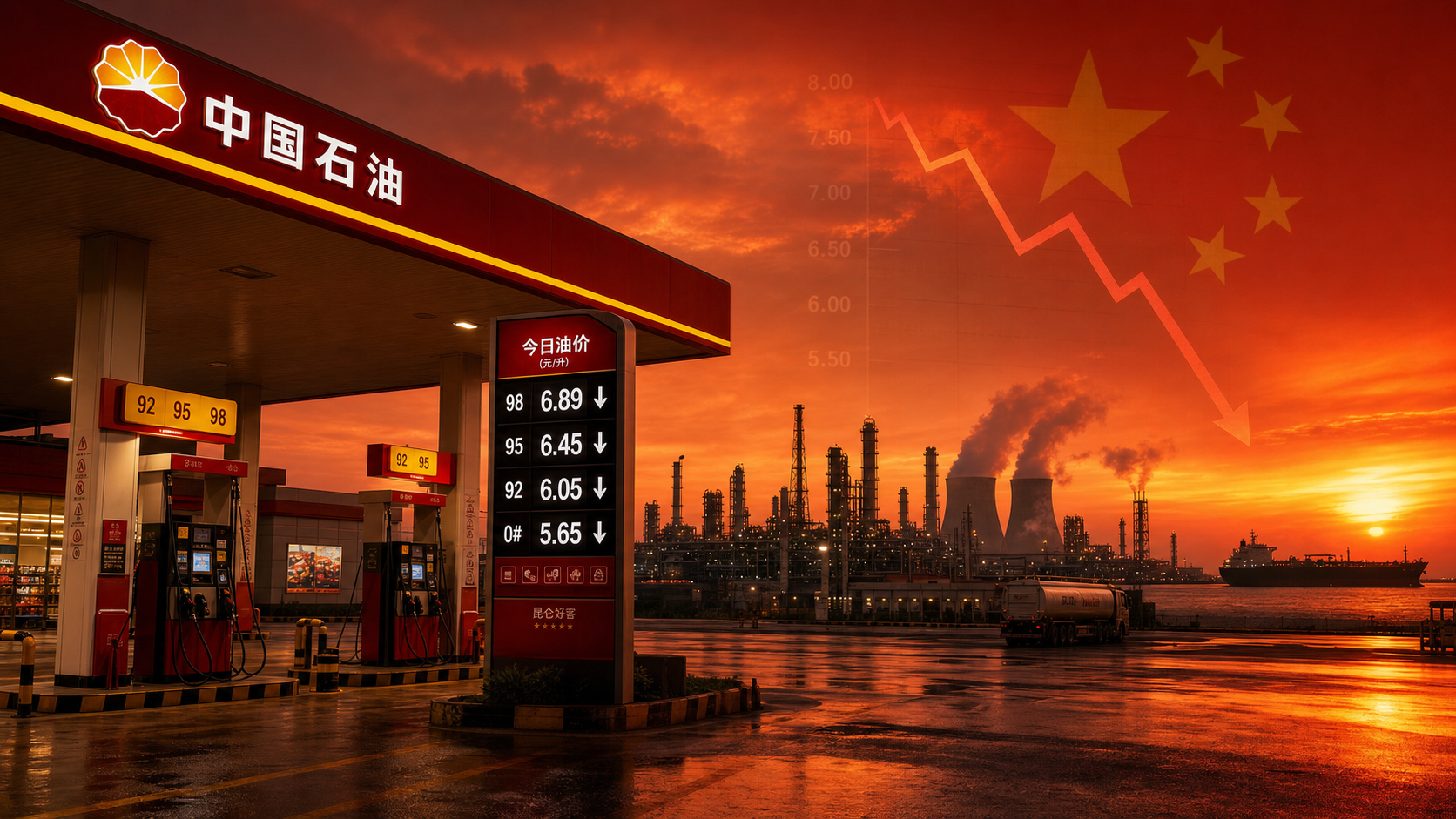
China's fuel pricing policy in the shadow of the Iran-Iraq War 2026: Secret energy war – The gas pump as a weapon – Image: Xpert.Digital
From oil shock to electric car boom: How the Iran war is forever reshaping China's economy
Why American pressure on China is ineffective
Fuel price shock 2026: Why Chinese drivers are the real winners of the conflict
In the summer of 2026, Chinese drivers and logistics companies breathed a sigh of relief: the state planning authority drastically reduced fuel prices. What seemed like a welcome relief for their wallets was, in reality, the culmination of a dramatic geopolitical maneuver. Just a few months earlier, a military conflict between the US, Israel, and Iran had blocked the Strait of Hormuz, sending global energy markets into a panic. For China, the world's largest oil importer, this shock could have meant economic catastrophe. But Beijing didn't react with panic, but with cold calculation: gigantic strategic reserves, state-capped prices, and an unprecedented push toward electromobility cushioned the crisis. Since then, observers and analysts have been asking a crucial question: Was the American military operation in the Middle East actually a covert attempt to cripple China's economy through oil prices? An analysis of how the gas pump became the front line in the battle for global dominance—and why Washington's potential plan backfired.
If Beijing uses the gas pump as a geopolitical instrument – and Washington may have calculated this
In early July 2026, China once again lowered its government-imposed price caps on gasoline and diesel – by 950 yuan per ton of gasoline and 915 yuan per ton of diesel. This was the largest single reduction of the year and the third consecutive one. What at first glance appears to be a routine technical decision by a planning authority is, upon closer inspection, the visible aftermath of a geopolitical earthquake whose epicenter lies in the Strait of Hormuz. To understand this decision, one must go back three months – to the moment when American and Israeli forces attacked Iran, plunging global energy markets into an unprecedented situation reminiscent of the oil shocks of the 1970s.
Chronology of an extraordinary price development
The price of crude oil is one of the few global benchmarks that all economies of the world must simultaneously monitor. When the US and Israel launched extensive airstrikes against Iranian targets on February 28, 2026, the markets reacted immediately: the price of Brent crude rose from around $60 to over $115 per barrel within six days, and reputable analysts no longer ruled out the possibility of a price of $200 per barrel. The reason was structural: around 20 percent of the world's traded crude oil flows through the Strait of Hormuz daily. When Iran began attacking tankers and blocking passage after the attacks, the world's largest shipping companies—including Maersk, Hapag-Lloyd, and MSC—responded by immediately halting their voyages through the strait. The International Energy Agency (IEA) estimated that by the end of March 2026, the conflict had reduced global oil supplies by around 11 million barrels per day.
This shock hit China particularly hard. Before the war, Iran was by far Beijing's most important supplier of crude oil, exporting around 1.38 million barrels of cheaply available oil daily, due to the sanctions. At the same time, roughly 50 percent of China's total oil imports flow through the Strait of Hormuz. When the canal was effectively closed, the world's largest importer of crude oil was suddenly confronted with an acute supply crisis.
The Chinese National Development and Reform Commission's (NDRC) response to soaring global oil prices was calculated and two-pronged. Initially, rising crude oil prices were passed on to consumers, but far less than the government's own pricing formula would have dictated. On March 23, 2026, the mechanism should have triggered an increase of 2,205 yuan per ton of gasoline and 2,120 yuan per ton of diesel – in reality, Beijing only approved increases of 1,160 yuan and 1,115 yuan, respectively. Even in the following week, at the beginning of April, prices were raised again by only 420 yuan instead of the calculated 800 yuan per ton of gasoline. In other words, the Chinese government subsidized the price difference between the global and domestic markets at the expense of state-owned refinery margins – a political decision with enormous fiscal and industrial consequences.
Then the tide turned. After the US and Iran signed a temporary agreement at the end of June 2026 to reopen the Strait of Hormuz for 60 days, and international crude oil prices fell significantly, the NDRC began to reverse its pricing system. On June 4, gasoline prices dropped by 525 yuan and diesel prices by 505 yuan per ton. On June 18, the next reduction followed, by 515 and 495 yuan, respectively. The third and, so far, largest round of cuts took effect on July 5, 2026 – with the aforementioned reductions of 950 yuan for gasoline and 915 yuan for diesel. For car drivers, this last round alone meant savings of about 40 yuan per tank of fuel for a passenger car, and for truck drivers, savings of around 400 yuan.
The price system: State control as an economic policy tool
To understand the significance of this price development, one must understand China's fuel pricing mechanism, which differs fundamentally from Western market models. In Germany, the USA, and the European Union, daily prices are primarily determined by the interplay of crude oil prices, taxes, and supply-demand dynamics at gas stations. In China, however, the National Development and Reform Commission (NDRC) sets maximum prices every ten working days, based on a weighted average of international crude oil prices. If the calculated deviation from the previous price falls below 50 yuan per ton, no adjustment is made. Local authorities can set their own final prices below these upper limits, but are bound by upper limits.
This system fulfills several strategic functions simultaneously. It dampens short-term market volatility, protects inflation-sensitive segments of the population from extreme price spikes, and provides the government with a direct instrument to control industrial production costs. In times of crisis—such as the Iran-Iraq War in 2026—the NDRC can actively slow down or completely suspend price pass-through, which is tantamount to a covert subsidy. This mechanism is structurally designed to absorb short- to medium-term domestic energy shocks, as long as public finances and the profit margins of state-owned enterprises can withstand the pressure.
In practice, during the oil price shock from February to May 2026, this meant that Sinopec, CNOOC, and other state-owned refineries suffered significant losses on refining margins. They purchased expensive crude oil on the strained global market but were not permitted to pass on the full price increases to their customers. Large state-owned companies like Sinopec, as well as independent refineries, therefore reduced their production and maintained this reduced operation into June. This economic tension—losses upstream, protection downstream—is the hidden price that China's economy pays for its price control policy.
China's strategic starting position: reserves, resilience and change
The fact that China was able to cope with this extraordinary burden without plunging its economy into a deep supply crisis is thanks to a strategy that Beijing has been pursuing for years and that goes far beyond simple price subsidies.
The first pillar of this strategy is China's enormous strategic oil reserves. Société Générale and other research firms estimated China's strategic oil reserves at around 1.5 billion barrels at the beginning of 2026 – enough to bridge approximately 200 days of imports. Other estimates suggest around 140 days, while China itself keeps the exact figures secret. The research firm Kpler estimated total national and commercial onshore reserves at around 799 million barrels at the beginning of the year. Particularly noteworthy is the preparation for precisely this scenario: Since the end of 2023, Beijing had quietly instructed state-owned companies to stockpile oil, and analysts at the energy company Energy Aspects reported a target to purchase 140 million barrels for strategic reserves by March 2026. When the crisis hit, the storage facility was therefore not full by chance – it had been systematically filled.
The second pillar is the active reduction of imports and the use of these reserves during the crisis. China reduced its crude oil imports from 11.7 million barrels per day in February 2026 to below 9 million barrels per day at the end of May. Instead, from May onward, refineries withdrew around one million barrels per day from commercial storage. According to an analysis by JP Morgan, China accounted for approximately 74 percent of the total decline in global crude oil imports—an adjustment the analysts considered "disproportionate" and one that helped keep oil prices "remarkably stable.".
The third, and most significant long-term, pillar is the transformation of energy demand through electromobility. In China, consumers are switching from combustion engine to electric vehicles at an unprecedented pace. According to data from the national oil company CNPC, fossil fuel consumption in China already fell by 1.3 percent in 2024 – to 394 million tons, down from 399 million tons in 2023. In July 2024, registrations of electric and hybrid vehicles surpassed those of purely combustion engine vehicles for the first time. CNPC's research institute forecasts a decline in gasoline consumption of 35 to 50 percent by 2035. This means that China's peak oil demand is no longer far off: S&P Global and the EIA expect the peak of total Chinese oil demand to be reached toward the end of the decade. The Iran-Iraq War and its aftermath are accelerating this trend, as every energy crisis reinforces the industrial policy priority of overcoming dependence on oil.
How long can China sustain this?
The question of sustainability is legitimate and not easy to answer because it depends on several variables simultaneously. The most important of these are the duration and severity of the supply disruption at the Strait of Hormuz, the level of the world market price, and the intensity of the domestic economic burden caused by the price cap.
Assuming the Strait of Hormuz would be reopened quickly—which actually happened with the 60-day agreement between the US and Iran in June 2026—the crisis was manageable for China. Analysts consider the reserves sufficient to offset a reduced import rate for several months without having to resort to the strained global market. With a rapid recovery, refineries can gradually replenish their depleted reserves as cheaper oil becomes available again.
The situation would become problematic if the Strait of Hormuz were to remain closed or close again. Even with 1.5 billion barrels of reserves, China cannot forgo imports indefinitely. The exact duration of these reserves is unclear, as China does not publish its reserve data, but estimates of 140 to 200 days refer to the net share of total imports, not to a complete coverage of demand. Furthermore, a prolonged crisis would bring domestic political considerations into play: if state-owned companies have to absorb persistent losses on refinery margins, their willingness to produce will decrease, which, despite price caps, could lead to shortages – as demonstrated by the reduced refinery output in the spring of 2026.
In addition, there exists an important safety buffer that not all analysts sufficiently consider: Russia. Since the invasion of Ukraine and the Western sanctions, China has massively increased its imports of Russian oil, some of which is delivered directly via pipeline (Power of Siberia) or by tanker through the northern sea lanes. These deliveries are largely unaffected by the disruption in the Strait of Hormuz. Furthermore, there are overland corridors through Myanmar and Pakistan, which Beijing has established as a strategic redundancy, even if their current capacity is still limited.
The honest assessment is that China can easily absorb a short-term shock of three to six months with its existing instruments. However, a chronic closure of the Strait of Hormuz for a year or more would pose a serious economic problem for Beijing, resulting in production losses, price pressure, and potentially social tension. That this hasn't happened so far is no accident, but the result of years of strategic preparation.
The geopolitical dimensional equation: Was this an American calculation?
Herein lies the truly explosive question of this analysis. Was the military confrontation between the US (together with Israel) and Iran in the Strait of Hormuz designed to put China under maximum energy pressure?
The question is not new. It has been circulating in political science discussions, geopolitical analyses, and strategic papers since the beginning of the conflict in February 2026. To answer it, it is helpful to separate several levels: the institutionally documented strategy, the economic logic of the measure, and the empirically observable effects.
At the level of official documents, it must first be noted that the US National Defense Strategy of 2026 explicitly identifies China as the primary systemic competitor and envisages strategic measures that extend far beyond the Middle East. From an American perspective, the Iran-Iraq War has been officially justified as an operation to eliminate the Iranian nuclear program. At the same time, it is an analytically verifiable fact that before the war, Iran was China's most important supplier of crude oil – accounting for approximately 13 percent of total Chinese crude oil imports and nearly 94 percent of total Iranian exports to China. Anyone who attacks Iran militarily and thereby destroys its export capacity automatically and inevitably cuts off China's most favorable oil supply channel.
At the level of economic logic, the calculation is even clearer. Analysts at the Jerusalem Center for Public Affairs have described how the American energy strategy functions as a multi-layered system: First, Europe is cut off from cheap Russian gas and made dependent on expensive US LNG. Second, Russia's war financing is weakened through attacks on energy infrastructure and sanctions. Third, energy suppliers close to China, such as Venezuela and Iran, are destabilized or subjugated. Within this framework, the Iran war appears not as an isolated regional conflict, but as the third act of a comprehensive energy strategy. The American doctrine, which builds on Alfred Thayer Mahan's theory of naval control, aims to resolve economic power rivalries by controlling trade routes—without necessarily waging direct land warfare.
However, the observable results paint a more complex picture than that of a successful pressure operation. During the Iran-Iraq War, China exported 22 percent more goods year-on-year, semiconductor exports jumped 73 percent, and car exports surged by up to 67 percent. The attempt to put Beijing on the defensive through energy pressure led, in the short term, to an acceleration of Chinese export diversification and closer ties between the Gulf states and China. Even Trump's own praise for Beijing's mediating role in the conflict suggests that the geopolitical reality was more complicated than a simple pressure scenario. Several US allies—including Canada, Great Britain, France, and Germany—traveled to Beijing after the outbreak of the war to keep economic and diplomatic channels open.
The key takeaway is this: even if the calculation of an energy pressure strategy against China existed, it has not yet proven successful. China has met its energy needs through strategic reserves, reduced imports, and alternative suppliers from Russia, keeping prices down domestically while simultaneously maintaining its economic activity. Using the Strait of Hormuz as leverage against Beijing presupposes that China has no alternative options – and this premise simply isn't true.
Our China expertise in business development, sales and marketing

Our China expertise in business development, sales and marketing - Image: Xpert.Digital
Industry focus areas: B2B, digitalization (from AI to XR), mechanical engineering, logistics, renewable energies and industry
More information here:
A thematic hub offering insights and expertise:
- Knowledge platform covering global and regional economies, innovation and industry-specific trends
- A collection of analyses, insights, and background information from our key areas of focus
- A place for expertise and information on current developments in business and technology
- A hub for companies seeking information on markets, digitalization, and industry innovations
Geopolitical calculation: Did the US want to slow down China through energy scarcity?
The potential purpose: What would the US achieve by exerting energy pressure on China?
If one takes the hypothesis of a conscious American calculation seriously, the question of the strategic goal is worth asking.
The most plausible motive would be a slowdown in China's economic and military power due to rising energy costs. A recession forced by oil price increases, or at least a significant dampening of growth in China, would reduce Beijing's fiscal leeway, limit military investment, and impose losses on state-owned enterprises, which could generate social tensions sooner or later. In a world where the technological and military competitive gap between the US and China is narrowing year by year, Washington has a strategic interest in keeping that gap open.
A second motive could be the acceleration of the dollar's dominance through energy dependence. As long as oil is traded in US dollars and China has to buy oil, Beijing will remain structurally dependent on the dollar zone. A permanently secured oil supply from sanction-free sources would strengthen China's ability to restructure its foreign trade systems around the yuan and digital payment infrastructures, thereby depriving the US of its most important foreign policy leverage of the present day – the financial sanctions weapon via SWIFT. Breaking China's supply security would also prolong the dollar era.
A third, more tactical motive could be to force China into a reactive position: With Beijing preoccupied with energy security, it has fewer resources available for diplomatic and strategic initiatives – in Taiwan, the South China Sea, or with regard to Russia. Energy shortages force a strategic defensive posture.
The weakness of this theory, however, lies in the assumption that American foreign and military policy functions as a completely coherent, long-term planned system. In reality, institutional rivalries, short-term political cycles, and alliance politics are constantly at work in Washington. It is at least as plausible that the Iran war arose primarily from domestic and regional political motives—the desire to destroy the Iranian nuclear program and to serve Israeli security interests—and that the energy dimension was a calculated side effect, not a primary objective.
Domestic economic impacts: Relief with limits
Back to the level of the Chinese domestic economy. What do the three price reductions mean in concrete terms?
For private households, the relief is noticeable, but not spectacular. A reduction of 950 yuan per ton equates to a saving of about 40 yuan – roughly five euros – on a 50-liter tank of gasoline. That's not insignificant, but it's hardly a transformative economic stimulus program. In a country with structurally weak domestic demand and cautious consumers, every cost reduction contributes marginally to purchasing power.
The effect is significantly greater in the logistics and transportation sector. A truck driver saves around 400 yuan per tank of fuel, and since freight transport in China is still largely based on diesel vehicles, falling fuel prices measurably reduce overall operating costs. This has a chain reaction effect on goods prices, manufacturing costs, and ultimately, export competitiveness. At a time when China's domestic demand is subdued and exports are the main engine of growth, any improvement in internal logistics costs represents a genuine economic benefit.
A similar situation applies to industry. Petrochemicals, steel, aluminum, and other energy-intensive sectors benefit from lower energy input costs, even though diesel and gasoline only make up a portion of the relevant energy prices. For the domestic market as a whole, the three consecutive price cuts send a signal that the worst of the price pressure of the first half of 2026 has been overcome and the situation is normalizing.
For oil companies and refineries, the picture is more ambivalent. On the one hand, falling crude oil prices reduce purchasing costs. On the other hand, lower fuel price caps mean narrowing profit margins. State-owned companies like Sinopec and CNPC can cushion this tension through their size and government backing, but independent refineries are coming under real pressure. The political logic remains consistent: The government uses state-owned companies as a buffer to protect the overall economy from price spikes – a deliberate sacrifice at the corporate level for the sake of macroeconomic stability.
Long-term structural shifts: From oil importer to energy transition pioneer
The truly profound lesson learned from the 2026 oil price crisis, however, is not tactical but strategic. China has recognized—and in essence has known for years—that its dependence on imported crude oil defines its strategic vulnerability. Every oil crisis, whether triggered by market mechanisms or geopolitical conflicts, makes this vulnerability more apparent.
The answer is structural change: In direct response to the events of 2026, Beijing is accelerating its energy transition. The share of electric vehicles in the Chinese new car market has surpassed 50 percent, and gasoline demand fell in absolute terms for the first time in 2024. CNPC forecasts that gasoline consumption will fall by 35 to 50 percent by 2035. At the same time, China is electrifying its freight transport at a pace that international observers would have considered impossible just a few years ago – with a growing fleet of electric trucks that, according to industry calculations, are already reducing daily diesel demand by over one million barrels.
From a geopolitical perspective, this structural transformation is the true strategic response to American energy strategy. The less dependent China is on crude oil imports, the more control of the Strait of Hormuz loses its leverage over Beijing. The Iran-Iraq War in 2026 may have been an attempt to use China's energy dependence as leverage – but once the Chinese economy passes its peak in oil consumption in the next decade, this leverage will be permanently diminished.
At the same time, China is intensifying its diversification strategy regarding its supply sources. The expansion of overland pipelines from Russia, the development of Central Asian suppliers, and the investment in alternative maritime routes around the Strait of Hormuz are not short-term reactions, but rather parts of a long-term plan to eliminate strategic dependencies. This makes the calculation of an energy pressure strategy against China less effective year by year.
Global Interactions: China as a Price Anchor of the World Economy
One final dimension deserves attention: China's decision to drastically reduce its crude oil imports during the Iran war and instead draw on reserves paradoxically helped protect the global economy from an even worse energy shock. The world's largest oil importer temporarily became a buffer for the global oil market.
Had China continued to operate at full demand on world markets after the outbreak of the Iran-Iraq War, the price pressure on all other importing countries—from India to Europe to Japan—would have been considerably greater. The JP Morgan analysis, which attributes 74 percent of the global import reduction to China, is not, in this context, a praise of Beijing's altruistic global market responsibility, but rather a description of an unintended externality of a nationally motivated strategy. China used its reserves to protect itself—and, as a byproduct, stabilized the global market.
This connection illustrates how closely intertwined global energy markets and national economic policies have become. The NDRC's decision to cut fuel prices in China by 950 yuan per ton is the visible result of a long chain of events that begins with US military strikes in Iran, continues through the closure of the Strait of Hormuz and a global crude oil price shock, is mitigated by Chinese reserve policies and diplomatic negotiations, and finally arrives at the Chinese fuel pump.
Classification: A balance of strength, not luck
China's triple fuel price cut in early summer 2026 is no trivial matter. It is the final act of a drama in which Beijing, under extreme geopolitical pressure, has demonstrated economic stability and strategic patience. The price cuts signal: the crisis is over, reserves have been used effectively, and the return to normalcy is proceeding in an orderly fashion.
The NDRC's pricing system has proven to be a powerful instrument – not because it is efficient from a market perspective, but because it is politically controllable. In a world where energy prices are increasingly becoming tools in geopolitical disputes, state control over energy prices is not an atavistic reflex of central planning, but a strategic asset.
The question of whether the US also conceived of the Iran war as leverage against China may never be fully resolved. What is clear, however, is that the strategic impact remained limited. China has continued its economic course, accelerated its reduction of its energy dependence, and—if anything—strengthened its position in the global power structure. The real loser in an energy shock that destabilizes the global economy is not a single country, but rather confidence in the stability of global supply chains as a whole. And that is a price everyone pays.
Your global marketing and business development partner
☑️ Our business language is English or German
☑️ NEW: Correspondence in your native language!

Konrad Wolfenstein
I and my team are happy to be available to you as your personal advisor.
You can contact me by filling out the contact form here [email protected]:or simply call me at +49 7348 4088 965. My email address is
I'm looking forward to our joint project.
☑️ SME support in strategy, consulting, planning and implementation
☑️ Creation or realignment of the digital strategy and digitization
☑️ Expansion and optimization of international sales processes
☑️ Global & Digital B2B trading platforms
☑️ Pioneer Business Development / Marketing / PR / Trade Fairs
🎯🎯🎯 Data-driven B2B industry hub as a quasi-in-house solution

The quasi-in-house solution: How Xpert.Digital closes operational gaps in B2B marketing and sales – Smart Content-Driven Business - Image: Xpert.Digital
Xpert.Digital is a data-driven B2B industry hub led by Konrad Wolfenstein . The company acts as an external, quasi-in-house solution for industrial partners, closing operational gaps in marketing, content, and sales – without requiring additional resources on the client side.
More information here:





