
A way out of Asia: Why Bulgaria is becoming the new “extended workbench” of German industry
Xpert Pre-Release

Available in 27 languages 📢
Prefer Xpert.Digital on GoogleⓘPublished on: June 4, 2026 / Updated on: June 4, 2026 – Author: Konrad Wolfenstein
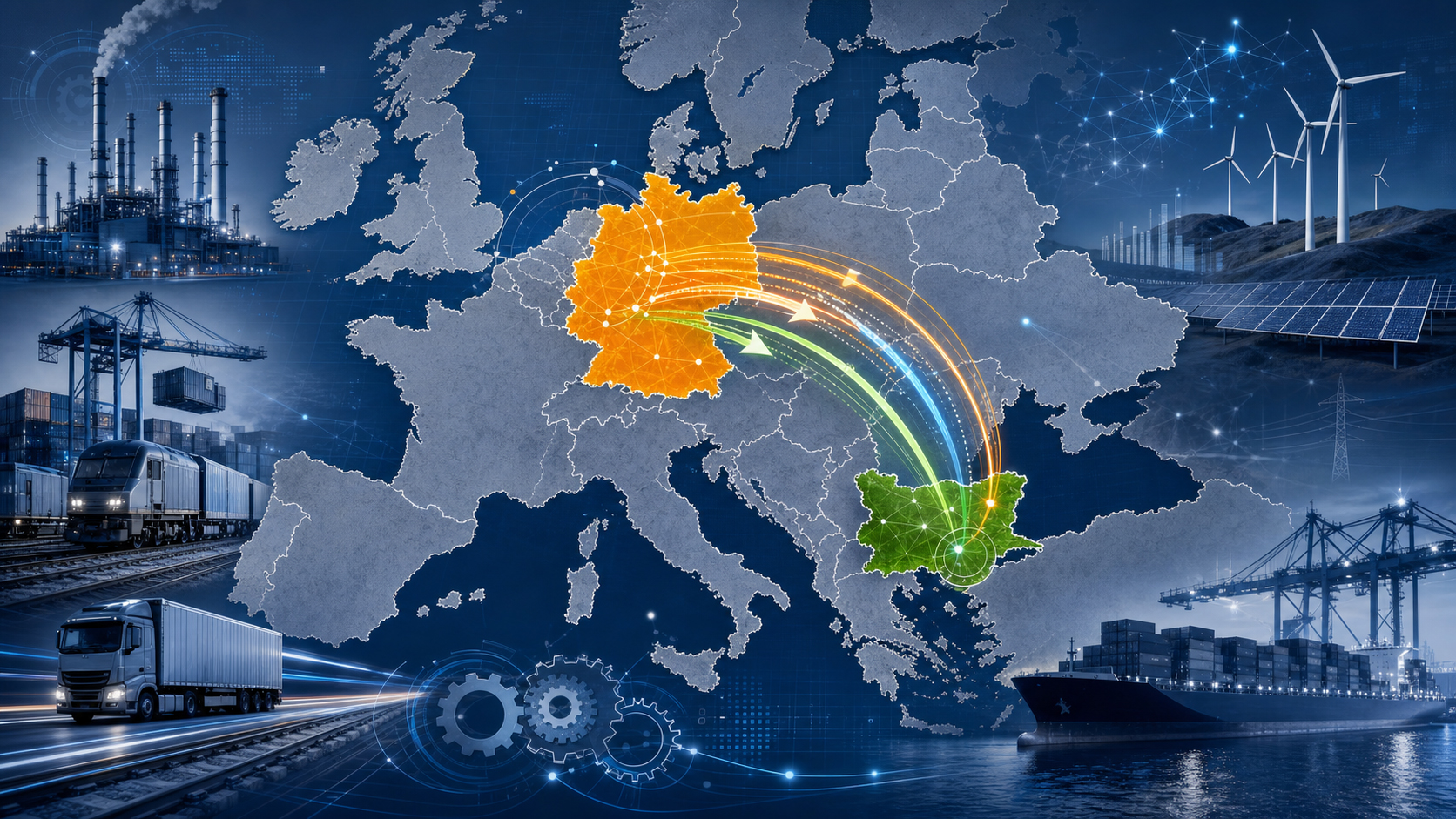
A way out of Asia: Why Bulgaria is becoming the new "extended workbench" of German industry – Image: Xpert.Digital
Fear of deindustrialization? How Bulgaria is actually saving the German economy
10% taxes and low costs: That's why more and more German corporations are relocating to Eastern Europe
Nearshoring instead of China: The clever division of labor plan of Germany and Bulgaria
German industry is under immense pressure: High energy prices, a severe shortage of skilled workers, and the geopolitical risks of long supply chains to Asia are forcing companies to radically rethink their strategies. The solution for more resilient and cost-effective production networks is often closer than expected – right in the heart of the European single market. Bulgaria is currently undergoing a rapid transformation from a low-wage country to a strategic technology and manufacturing partner for the German economy. Whether automotive suppliers, mechanical engineering companies, or electronics manufacturers: More and more corporations are relocating parts of their production to the Balkans. But what might initially appear to be a threatening deindustrialization at Germany's expense, upon closer inspection reveals itself to be a clever and urgently needed European division of labor. When labor-intensive manufacturing steps migrate to Bulgaria, while research, development, and high technology remain in Germany, a genuine win-win situation is created. Learn why Bulgaria, with its 10 percent tax rate, EU legal certainty, and planned introduction of the euro, is the ideal nearshoring location – and how both countries can benefit from this strategic alliance.
Germany and Bulgaria complement each other remarkably well in industry: Germany brings capital, technology, and market access, while Bulgaria offers cost and location advantages for manufacturing within the EU. If both countries strategically plan this division of labor, relocations can increase value creation and resilience across the entire network, instead of ending up as a zero-sum game to Germany's detriment.
Initial situation: Two very different industrialized countries in one value chain
Relocation to Bulgaria: Opportunities for German suppliers and engineers
Germany is a highly developed, capital- and knowledge-intensive industrial location with strong automotive, mechanical engineering, and chemical industries, as well as high productivity, but also high labor and energy costs. Bulgaria, on the other hand, is a smaller, cost-oriented manufacturing and supplier location that has developed strongly towards automotive, electronics, and mechanical engineering production since its EU accession in 2007, and especially in recent years.
The two countries are closely intertwined economically: Germany is Bulgaria's largest trading partner and one of its most important investors, particularly in the automotive, mechanical engineering, and electronics manufacturing sectors. Conversely, Germany is a key market for Bulgarian industrial goods; many Bulgarian factories effectively operate as extended production facilities for German corporations.
Between 2024 and 2025, German exports to Bulgaria increased significantly, particularly in motor vehicles, automotive parts, and machinery, while Bulgarian exports to Germany are highly significant in electrical equipment and metal products. This bilateral industrial trade forms the basis for relocations and nearshoring strategies within the EU – not as an exodus, but as a reorganization of value creation.
Common basis: EU law, single market, Schengen and introduction of the euro
Germany & Bulgaria: How joint clusters create more resilient supply chains
A key structural advantage of the cooperation is that both countries operate within the same regulatory framework of the EU single market. Duty-free trade, harmonized standards, and uniform competition and state aid rules reduce transaction costs for supply chains between German OEMs and Bulgarian manufacturing clusters.
With Bulgaria's accession to the Schengen Area for air and sea borders, the progressive integration of the country into the free movement of persons zone, and its planned adoption of the euro on January 1, 2026, the currency risk is also eliminated, further facilitating investment decisions for production relocations. For German companies, this reduces administrative complexity and simplifies the management of production networks across locations in Germany, Bulgaria, and other EU countries.
Furthermore, German investors indirectly benefit from EU structural funds and cohesion funds that Bulgaria invests in infrastructure, digitalization, and industrial sites – for example, through the Cohesion Fund and the Recovery and Resilience Facility. These public investments create a high-quality business location, from which private investors benefit in the form of efficient logistics, energy supply, and industrial parks.
Cost structure: Bulgaria's wage, tax and operating cost advantages
Perhaps the most visible driver for relocations is the cost structure: Bulgaria has very low labor costs compared to other EU countries, which leads to significant cost advantages, particularly in labor-intensive manufacturing processes. In addition, a corporate tax rate of 10 percent and a flat income tax rate of 10 percent make Bulgaria extremely attractive as a production and holding company location.
Material costs such as rent, electricity, and water are also significantly lower than in Germany, which reduces overall production costs – particularly in energy- and land-intensive industries. For German companies in the automotive, mechanical engineering, electronics, and, to some extent, chemical sectors, this means that parts of the manufacturing process can be organized at considerably lower unit costs within the same currency union and legal framework.
These cost advantages, however, are not an end in themselves, but must be compatible with quality and delivery reliability. Bulgaria's competitive advantage is therefore no longer based on "low wages plus simple assembly," but increasingly on skilled manufacturing with stable processes. For Germany, this opens up the possibility of outsourcing standardized, labor-intensive production steps without losing the ability to integrate them into complex value chains.
Industry profiles: Where the manufacturing sectors specifically complement each other
The most important Bulgarian industries relevant to German relocations are found in the electrical engineering, electronics, mechanical engineering, automotive supply, and metal and chemical industries. Bulgaria has a long tradition in electrical and electronics production; today, sensors, capacitors, transformers, heating, ventilation and air conditioning components, as well as industrial components are manufactured there.
In mechanical engineering, Bulgarian companies supply customers throughout Europe with parts and components, supported by a well-established industrial culture and technical universities that continuously provide skilled workers. Bulgaria's importance in the automotive and supplier industries is also steadily increasing: German automotive suppliers have relocated parts of their production, particularly for components, wiring harnesses, housings, aluminum parts, and electronic modules.
Germany, in turn, primarily exports motor vehicles, vehicle parts, and machinery to Bulgaria – motor vehicles and vehicle parts alone accounted for almost €920 million in the first ten months of 2025, and machinery for around €692 million. This structure demonstrates a clear division of labor: Bulgaria supplies components and semi-finished products, while Germany provides high technology, equipment, and key system components – a classic example of vertical integration within European production chains.
Nearshoring logic: Why Bulgaria is becoming the "extended workbench" of the EU
In the discussion surrounding nearshoring, the focus of German industrial companies is shifting from Asia back to the EU and neighboring regions in order to shorten supply chains and reduce geopolitical risks. Bulgaria is explicitly positioning itself as a nearshoring hub: low costs, EU legal certainty, more predictable delivery times, and cultural proximity to Western Europe.
Trade and industry organizations emphasize that Bulgaria, due to its integration into international value chains, the availability of skilled workers, and the EU funding environment for German companies, is increasingly being considered as a production location. The combination of expertise in automotive, electronics, and mechanical engineering makes it possible to outsource entire production lines or module clusters there – from metal prefabrication to the assembly of electronic components.
Furthermore, Bulgaria benefits from the fact that Romanian sites in some segments are already reaching capacity limits or are less cost-effective, making Bulgaria the next alternative option for outsourcing in Southeast Europe. This creates a network of nearby production sites for Germany, reducing Asian risks while still offering cost and flexibility advantages compared to purely domestic production.
Infrastructure, logistics and supply chains: strengths and weaknesses
A key prerequisite for industrial relocations is efficient infrastructure: transport routes, logistics services, and energy supply. While Bulgaria has made progress in this area, it simultaneously suffers from a backlog of modernization, particularly in the rail and parts of the road network, as well as in port modernization.
At the same time, Bulgaria is enormously important as a transit country within Southeast Europe: it connects EU markets with Turkey, the Middle East, and, to some extent, the Black Sea region. This opens up diverse logistical options for German companies establishing production facilities in Bulgaria – both towards Western Europe and towards growing markets in Southeast Europe and Asia.
Integration into international supply chains is also reflected in business perceptions: companies report shorter delivery times and increased reliability when they integrate Bulgaria into their logistics networks, especially compared to more distant locations in Asia. However, bottlenecks – such as limited rail capacity or insufficiently digitized customs and clearance processes at external borders – remain a risk that must be strategically considered when choosing a location.
Workforce, qualifications and skilled worker migration
Another key factor for industrial cooperation lies in the labor market: Bulgaria has a well-trained technical workforce, particularly in mechanical engineering, electrical engineering, computer science, and natural sciences. Technical universities and universities of applied sciences continuously supply engineers and specialists to industry, who work in large production clusters – for example, in the Plovdiv or Sofia regions.
At the same time, Bulgaria, like many Eastern European countries, suffers from a brain drain, including to Germany. The Bulgarian diaspora in Germany is large and plays an important role in both labor markets. This can be a tangible advantage for German companies if they employ Bulgarian specialists either locally in their Bulgarian plants or at German locations, thereby building cultural and linguistic bridges in their collaboration.
However, competition for qualified workers is increasing noticeably as Bulgaria develops further in the high-tech, automotive, and electronics sectors, and multinational corporations establish manufacturing and R&D facilities there. For German investors, this means that the current cost advantage must be complemented by active talent management, attractive working conditions, and, where appropriate, dual vocational training partnerships in order to build sustainably productive locations.
Tax and funding environment: Bulgaria as a tax-attractive production location
Bulgaria deliberately cultivates a tax-competitive environment: The flat corporate tax rate of 10 percent is among the lowest in the EU, complemented by an equally high personal income tax rate. This provides significant tax advantages, particularly for capital-intensive production facilities, but also for holding and shared service structures.
In addition, there are national investment incentives, such as specially designated industrial zones where infrastructure is centrally provided and permitting processes are accelerated. These zones are explicitly aimed at foreign investors, including German companies in the automotive supply, mechanical engineering, electronics, aerospace components, and chemical sectors.
At the same time, Bulgaria is utilizing EU funding, for example from the Cohesion Fund and from recovery and resilience funds, to advance transport and energy networks, industrial parks, and digitalization – investments from which large-scale industrial projects directly benefit structurally. For German companies, this means that location decisions can be structured in such a way that national Bulgarian incentives and EU funding commitments are intelligently combined with their own investment planning.
Our EU and German expertise in business development, sales and marketing

Our EU and German expertise in business development, sales and marketing - Image: Xpert.Digital
Industry focus areas: B2B, digitalization (from AI to XR), mechanical engineering, logistics, renewable energies and industry
More information here:
A thematic hub offering insights and expertise:
- Knowledge platform covering global and regional economies, innovation and industry-specific trends
- A collection of analyses, insights, and background information from our key areas of focus
- A place for expertise and information on current developments in business and technology
- A hub for companies seeking information on markets, digitalization, and industry innovations
How Bulgaria is becoming a high-tech workshop for German industry
Sectoral examples: Automotive, mechanical engineering, electronics, chemicals
Relocation to Bulgaria: Opportunities for German suppliers and engineers
In the automotive industry, Bulgaria primarily functions as a supplier location: The country produces automotive parts, electronic components, and aluminum parts for vehicle manufacturers in Europe. German suppliers and companies closely associated with OEMs have established plants in Bulgaria that supply components to Germany and other EU countries, creating a close network of industrial links.
In Bulgaria, mechanical engineering companies produce components, assemblies, and sometimes complete machines for the European market. The combination of technical expertise, relatively low labor costs, and geographical proximity makes the country highly attractive to German machine manufacturers. At the same time, Bulgaria itself is a growing market for German machinery and equipment – an effect reinforced by the country's ongoing industrialization.
The electrical and electronics industry has a long tradition in Bulgaria. Today, components for industrial electronics, heating and air conditioning technology, transformers, and microelectronics are manufactured there, among other things. German companies utilize this expertise as a basis for outsourcing production steps, particularly in standardized mass production, where the cost advantages are especially significant. Finally, in the chemical industry, Bulgaria produces export goods such as fertilizers, basic chemicals, and pharmaceuticals, which are exported to various regions of the world thanks to the country's excellent logistics – again with Germany as a key trading partner.
German relocation of industrial sites: Opportunities and risks for Germany as an industrial location
From a German perspective, every relocation of production sites is politically sensitive: Relocated production lines mean less industrial value creation in the short term and potentially job losses domestically. At the same time, however, such relocations offer the urgently needed opportunity to concentrate higher-value activities in Germany, such as research and development (R&D), prototyping, highly automated manufacturing, systems integration, and services.
If production relocations to Bulgaria are structured effectively, they can optimize the cost structure of German companies, stabilize their competitiveness in global markets, and generate economies of scale within the European network. The key lies in which value chain stages are relocated: If only labor-intensive, standardized manufacturing is outsourced, while development, engineering, system integration, and high technology remain domestically, Germany's overall economic position can even be strengthened.
However, risks exist in the possibility of an unbalanced mix of relocations – for example, if higher-value engineering functions or critical technology modules are also established abroad, thereby diminishing Germany's influence as a systems architect. Another risk factor lies in excessive political or societal opposition to relocations, which can trap companies in inefficient structures and ultimately undermine their international competitiveness.
Bulgarian perspective: From extended workbench to technology partner
From a Bulgarian perspective, German relocations bring valuable capital, technology, know-how, and stable export channels to the country – but also carry the risk of remaining permanently stuck in the role of a mere "extended workbench." Bulgaria's strategic ambitions now extend far beyond this: the country aims to position itself as a hub for high technology, R&D, aerospace components, dual-use technologies, and embedded software solutions.
Investments by German companies in highly skilled manufacturing, for example in the aerospace and defense industry or in the field of complex electronic modules, signal this change: Projects with volumes in the tens of millions for high-tech components not only create simple industrial jobs, but also demanding engineering and development positions.
If Bulgaria succeeds in combining this economic development with a targeted expansion of its education and innovation system – for example, through dual vocational training in cooperation with German companies, joint research projects, and an active cluster policy – the country can, in the medium term, evolve from a purely cost-intensive location to an equal technology partner. This, in turn, will strengthen the quality of cooperation in the long term, reduce political tensions, and increase the acceptance of relocations in both societies.
Policy framework: How economic cooperation can be actively shaped
The political framework between Germany and Bulgaria is generally very positive: Long-standing, friendly relations and a strategic partnership within the EU are acknowledged. Numerous initiatives aim to deepen bilateral cooperation in investment, innovation, high technology, and the dual use of technologies.
At the European level, cohesion policy and structural funding create financial incentives to expand industrial clusters in less developed regions, thereby attracting German investors to these areas. At the same time, European industrial and foreign trade strategies are pushing for more resilient supply chains, diversification of sourcing, and a stronger European industrial base – an environment in which Bulgaria, as a complementary location to Germany, is ideally positioned.
However, truly productive cooperation requires more than just investment protection agreements and funding programs: it demands concrete industrial policy concepts that explicitly understand relocation as part of a European industrialization based on the division of labor, and not merely as individual cost-cutting decisions by companies. These include, among other things, industry agreements, innovation partnerships, joint training programs, and coordinated cluster development.
Similarities: Where Germany and Bulgaria operate in a structurally similar way
Despite all the economic differences, there are also commonalities that facilitate mutual exchange: Both countries are heavily industry-based, with industry playing a very significant role relative to GDP in Bulgaria, and industry still forming the strong backbone of Germany's export economy. Both economies are export-oriented and deeply integrated into European and global value chains.
Moreover, both countries face comparable transformation challenges: digitalization, the decarbonization of industry, adaptation to new supply chain logics, and the fight against demographic pressure. Germany is grappling with an acute shortage of skilled workers, high costs, and regulatory density; Bulgaria is struggling with the emigration of skilled workers, a backlog of infrastructure modernization, and an insufficiently diversified industrial landscape.
Both countries have a vibrant technical education landscape with a deeply rooted engineering tradition, making them ideally suited for joint programs – from dual vocational training to university collaborations. Both systems can learn a great deal from each other: Germany in accelerating approval processes and cost flexibility, and Bulgaria in quality assurance, building innovation systems, and complex engineering.
How both countries can mutually benefit each other economically
To ensure that relocations do not lead to a one-sided sell-off, but rather to a mutually beneficial outcome, several strategic levers can be identified:
- Relocation of standardized, labor-intensive manufacturing steps to Bulgaria while simultaneously upgrading the German locations towards R&D, prototyping, highly automated manufacturing, system integration and services.
- Establishment of joint clusters in Bulgaria, in which German OEMs, suppliers and local companies cooperate closely, intelligently networked with German engineering centers and development departments.
- Expansion of dual education and training programs that combine German quality standards with the Bulgarian talent base in order to secure qualified specialists directly on site in the long term.
- Targeted use of EU funding for joint projects – for example, for the modernization of infrastructure, the decarbonization of industrial parks or the digitization of supply chains between Germany and Bulgaria.
- Development of R&D and innovation cooperation, particularly in the fields of high technologies, aerospace, dual-use technologies and AI-supported production systems, to gradually move Bulgaria out of its purely manufacturing role.
In this way, Germany can leverage urgently needed cost advantages without losing its industrial substance, while Bulgaria gains industrial depth, added value and technological competence – a genuine win-win situation based on the division of labor, which ideally strengthens the entire European industry in global competition.
Strategic perspective: From bilateral project to European industrial architecture
If one considers the interaction between Germany and Bulgaria not only bilaterally, but as an integral part of a European industrial architecture, it becomes clear that a pioneering model for resilience based on the division of labor is emerging. Core countries with high technology and capital density, such as Germany, perfectly complement manufacturing locations with high costs and large areas, such as Bulgaria, Romania, or other countries in Central and Southeastern Europe.
Against the backdrop of global de-risking strategies towards China, the massive disruption of supply chains during the pandemic, and increasing geopolitical tensions, such an architecture can be crucial for securing Europe's industrial base in the long term. Bulgaria serves as an exemplary model of how a country with a relatively small economy can assume a disproportionately large role in the European industrial network through integration into complex value chains, targeted location policies, and cooperation with a major player like Germany.
For Germany, it has long since ceased to be merely about reducing costs. It is about maintaining strategic control over its own value chains by keeping critical modules and system expertise within the country, while relocating cost-sensitive but not safety-critical production stages to reliable partner countries. In this way, relocation transforms from a dreaded symbol of deindustrialization into an effective instrument of an active, European-integrated industrial policy.
🎯🎯🎯 Data-driven B2B industry hub as a quasi-in-house solution

The quasi-in-house solution: How Xpert.Digital closes operational gaps in B2B marketing and sales – Smart Content-Driven Business - Image: Xpert.Digital
Xpert.Digital is a data-driven B2B industry hub led by Konrad Wolfenstein . The company acts as an external, quasi-in-house solution for industrial partners, closing operational gaps in marketing, content, and sales – without requiring additional resources on the client side.
More information here:
Your global marketing and business development partner
☑️ Our business language is English or German
☑️ NEW: Correspondence in your native language!

Konrad Wolfenstein
I and my team are happy to be available to you as your personal advisor.
You can contact me by filling out the contact form here [email protected]:or simply call me at +49 7348 4088 965. My email address is
I'm looking forward to our joint project.










