
Capital-efficient success: The clever European strategy of Chinese corporations
Xpert Pre-Release

Available in 27 languages 📢
Prefer Xpert.Digital on GoogleⓘPublished on: August 14, 2026 / Updated on: August 14, 2026 – Author: Konrad Wolfenstein
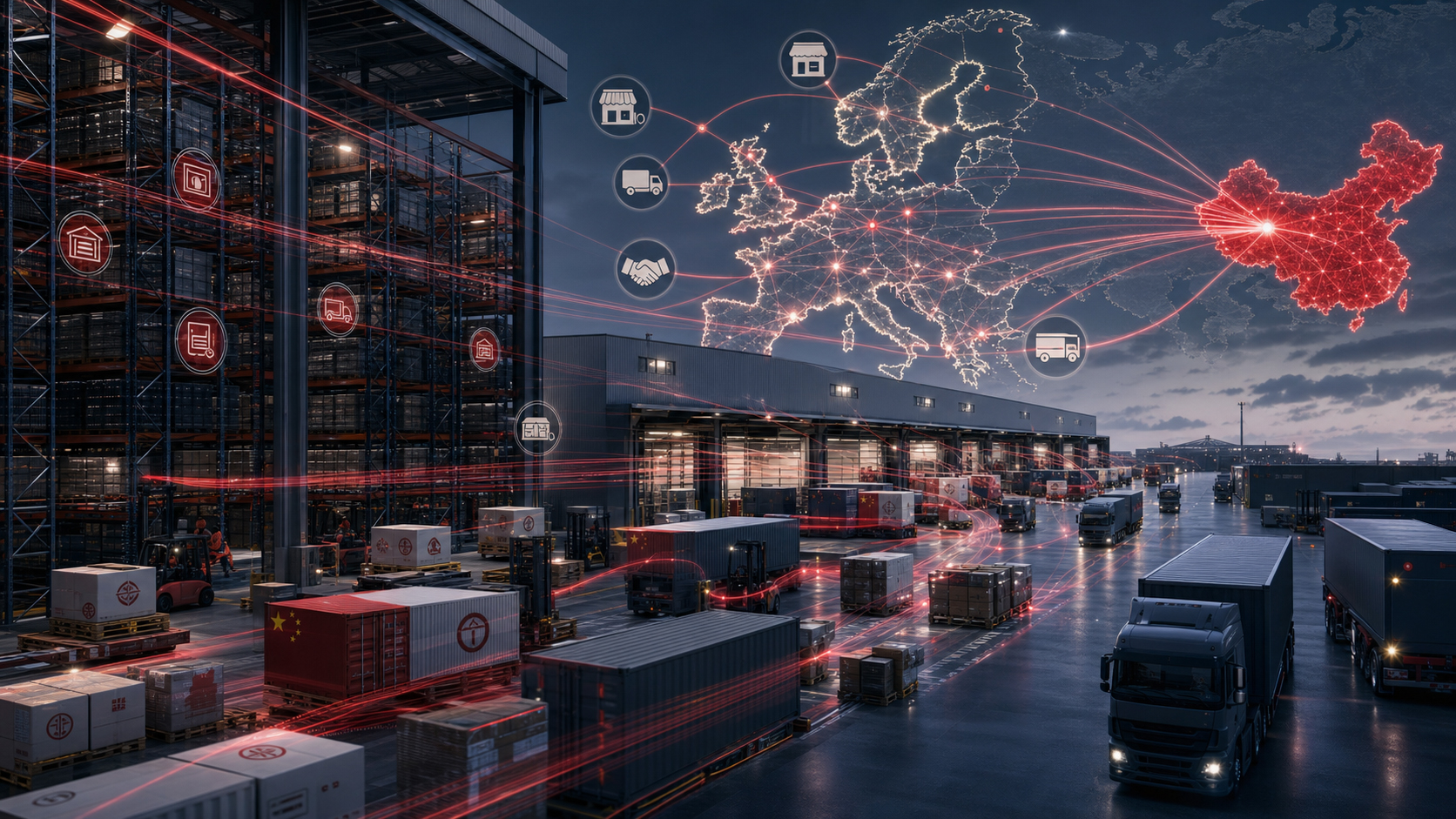
Capital-efficient success: The clever European strategy of Chinese corporations – Image: Xpert.Digital
From distribution partner to in-house management: The logical course change for BYD, JD.com & Co.
The concept changes once a market share reaches 5 percent: How Chinese brands scale their European sales
Start low-risk, invest massively: The two phases of China's competitive strategy
When Chinese companies enter the European market, they often do so surprisingly discreetly at first glance – and seemingly at the expense of local retailers. Instead of building expensive, independent distribution networks, manufacturers from China consistently utilize the established infrastructure of European distributors. These distributors bear the full financial and legal risk, while China expands its market share in a capital-efficient manner. But anyone who believes this dependency is a sign of structural weakness is sorely mistaken. The examples of industry giants like BYD or the e-commerce behemoth JD.com reveal a radical strategic shift, often overlooked by policymakers: The partnership model is not a permanent state of affairs, but a Trojan horse. As soon as a market proves lucrative, the former European pioneers are ruthlessly sidelined or simply acquired. This analysis illuminates the inner workings of Chinese-European trade, uncovers dangerous gaps in political data, and shows why European entrepreneurs must finally recognize their statutory product liability as a powerful negotiating tool before its window of opportunity closes completely.
The underestimated lever: How European trade can negotiate on equal terms in the China business
Why the supposedly powerful Chinese investor is often just a guest in foreign infrastructure – and why that is currently changing
A look at the actual market practices of Chinese companies in Europe reveals a finding that, at first glance, sounds like a bold assertion: China has not established its own sales and marketing infrastructure in large parts of the continent, but instead consistently utilizes the existing network of wholesalers, purchasing cooperatives, specialist retailers, and regional distributors. While enormous sums are flowing into production in Beijing, many companies lack the capital, the will, or both for an independent market presence in Europe. Anyone who examines this finding in detail encounters a field full of contradictions, exceptions, and transitional phenomena. This is precisely what makes it so revealing. It is neither entirely wrong nor unequivocally right. It describes a real, empirically verifiable mechanism in a specific market segment, but becomes a misjudgment as soon as it is applied to the entire Chinese strategy in Europe. The real substance lies in the dynamics: What currently appears to be the dependence of Chinese companies on European distribution partners turns out, upon closer inspection, to be a transitional stage of a much more ambitious strategy.
A look inside the engine room of Chinese-European SME business
In the industrial B2B sector, particularly in photovoltaics, energy storage, electronics, and component suppliers, this observation accurately reflects reality. Anyone negotiating with Chinese manufacturers of solar modules, inverters, or battery storage systems today encounters a clear, almost standardized pattern. They seek distribution partners who operate on a purely success-based commission model. Financing, warehousing, installation, spare parts logistics, and often even the entire marketing effort remain with the European partner or directly with the end customer. The Chinese manufacturer supplies the core technology at competitive prices but assumes none of the expensive, long-term investments required to truly develop a market. The result is a paradoxical situation: The Chinese side profits from every module sold without investing a single cent in fixed costs for showrooms, service personnel, warranty processing, or advertising budgets in the target market.
This situation can be readily explained from an economic perspective. The Chinese domestic market is characterized by brutal price competition and massive overcapacity, which structurally compresses margins in virtually all export-oriented sectors. Companies that can barely achieve adequate returns domestically cannot and do not want to tie up additional capital abroad, the return of which remains uncertain until a new market has proven viable. Added to this is the political uncertainty caused by European trade protection measures and stricter review mechanisms for foreign direct investment, which further encourages a cautious, capital-conserving market entry strategy. This is not a weakness, but rather a rational calculation by an actor who concentrates their scarce resources where market entry is effectively blocked without a local presence, and keeps them to a minimum everywhere else.
A telling example of this logic is the role of German and European specialist wholesalers in the solar market. A Czech distributor specializing entirely in the distribution of Chinese solar modules was recently recognized as the fastest-growing company in Europe. Nearly ninety percent of all photovoltaic systems imported into Germany now originate in China, while European distributors, such as large specialist wholesalers, handle the entire market development process, including processing manufacturer warranties in the event of complaints. This situation vividly illustrates the extent to which European value creation has become dependent on Chinese production, even though China itself has not invested any significant capital in the European distribution network. European wholesalers are thus both the true beneficiaries and the primary risk bearers of this business model.
Capital-efficient success
What appears from the outside to be a deliberate, coldly calculated restraint is, upon closer inspection, in many cases simply an economic necessity. For numerous Chinese SMEs, capital-efficient market development is not a strategic choice among several equally viable options, but rather the only remaining one. The reason lies in the Chinese domestic market itself, which has long since become one of the toughest competitive environments in the world. In the photovoltaic industry, for example, module prices on the Chinese domestic market are the equivalent of around ten to thirteen US cents per watt, while even lower margins are achieved in distribution channels within China itself. At such price levels, after material costs, energy costs, and the competitive pressure from dozens of rival manufacturers, there is hardly any room left for profits, let alone for reserves suitable for building a costly foreign infrastructure.
This situation is not a fringe phenomenon, but structural. Between January and November of one year alone, Chinese car dealerships recorded industry-wide losses of over US$24 billion, triggered by a ruinous price war fueled by the manufacturers themselves to defend their domestic market share. As a result, around one-tenth of all Chinese car dealerships were forced to close, and another quarter significantly missed their sales targets. Given such distortions in the domestic market, it is hardly surprising that many manufacturers simply lack the liquid assets to simultaneously finance their own showrooms, warehouses, service centers, and marketing campaigns in Europe. The money, often touted as virtually inexhaustible in public discourse, is, in the operational reality of many Chinese medium-sized businesses, already consumed by fierce competition at home before it could even be available for international expansion.
Against this backdrop, the willingness to collaborate with European distribution partners on a purely success-based commission basis appears in a different light. It is not primarily a tactic for risk outsourcing in the sense of a superior negotiating strategy, but often the only form of internationalization that a low-margin manufacturer can afford. The European side bears the entrepreneurial risk not because it is being taken advantage of, but because the Chinese side, in many cases, simply could not bear this risk, even if it wanted to. Only when a company like BYD has built up sufficient capital reserves through sustained success both domestically and internationally does the picture change, and the enforced restraint transforms into a deliberate, financially viable offensive to take over its own distribution channels. Domestic competition in China is therefore not merely background noise, but the real explanation for why this capital-conserving model was the only viable route into the European market for so many suppliers.
The turning point, which is often overlooked in public perception
While this picture is accurate for small and medium-sized enterprises (SMEs), it becomes incomplete when applied uncritically to large, well-capitalized Chinese corporations. This is precisely the crucial objection to a blanket application of the findings. Anyone who still assumes that China fundamentally forgoes its own distribution infrastructure in Europe has overlooked one of the most significant strategic shifts of the past two years: BYD's abandonment of precisely the model that forms the basis of the initial findings.
BYD is the most instructive case because the company actually launched according to the described scheme. In Germany, sales began in 2022 through the Hedin Mobility Group as the general importer; in Switzerland, the Emil Frey Group assumed this role; and in Belgium and Luxembourg, the importer Inchcape. BYD supplied the vehicles, while the local partners bore the entire entrepreneurial risk of the market launch, from site selection and customer consulting to spare parts supply. However, by mid-2024, sales figures had fallen significantly short of the originally agreed targets. Instead of the initially targeted 100,000 vehicles by 2026, actual sales were far below that. And it was precisely at this point that BYD executed a U-turn, which can serve as a blueprint for the future strategy of ambitious Chinese manufacturers.
In August 2024, BYD announced its acquisition of the German general importer. The newly founded BYD Automotive GmbH took over Hedin's German import company, including management, sales team, and spare parts business, for a double-digit million-euro sum. Hedin itself was downgraded from general importer to a simple authorized dealer with just three locations. The reason for this move was clear: BYD wanted to retain control over pricing, brand management, customer data, and response times, rather than relinquishing them to an external partner with its own economic interests. The figures that followed are impressive. At the beginning of 2025, BYD had just 26 sales and service locations in Germany. By the summer of 2026, this number had already reached 200, with the stated goal of 350 locations by the end of the year. Simultaneously, internalization was extended to other markets: In Belgium and Luxembourg, BYD ended its collaboration with the previous importer, Inchcape, in 2026 to take over distribution there as well.
This development does not fundamentally refute the initial findings; it significantly clarifies them. BYD did not abandon the importer model simply because it suddenly had access to previously lacking capital. The company always possessed this capital; the investment in the Hungarian plant in Szeged alone amounts to approximately four billion euros. BYD abandoned the model because it became clear that an external distribution partner, pursuing its own interests and controlling customer relationships, hindered the strategic goals of a Chinese global market leader. This is the real warning that can be drawn from the BYD case. For many Chinese corporations, the model with external distribution partners is not a permanent state, but rather a transitional phase that lasts only as long as the market risk appears too high and their own standing too uncertain. Once the market has proven viable, internalization follows, and with it disappears the negotiating power that European partners possessed in the initial phase.
The underestimated lever: Whoever is liable has power
At this point, it is worth examining an aspect that remains systematically under-represented in the public debate surrounding China's European strategy, even though it is the real key to understanding the current power dynamics: European product liability. Under German product liability law, any European company that imports a product from a third country and places it on the market in the European Union is considered a quasi-manufacturer. This means full, strict liability for the manufacturer, regardless of fault, whether the actual defect originated in a Chinese, Vietnamese, or Turkish factory. This regulation has existed for decades, but it has been significantly strengthened by the new European regulation on general product safety, which has been directly applicable in every member state since December 2024.
According to this regulation, if the actual manufacturer is not established in the European Union, the importer automatically becomes the responsible party vis-à-vis the market surveillance authorities. Specifically, this means that the European distributor of a Chinese manufacturer must conduct an internal risk analysis, retain technical documentation for at least ten years, affix their own contact details to the product, establish a publicly accessible communication channel for complaints, and report safety issues within seventy-two hours. Violations can result in fines and the loss of listings on trading platforms. These obligations are not a mere bureaucratic footnote; they represent the real economic leverage available to European distributors, and in practice, they are far too rarely used proactively.
The crucial point is this: If a European wholesaler or importer bears full legal responsibility for the safety of a product sourced from a Chinese manufacturer who has neither its own branch nor reliable contacts in Europe, then this European partner possesses a significant, yet largely untapped, negotiating position. They could demand binding commitments regarding spare parts availability, warranty processing, technical documentation, and minimum marketing contributions before even entering into a distribution partnership. In practice, however, this rarely happens to this extent. Most European distributors and purchasing cooperatives accept the success-based commission models of Chinese suppliers without systematically factoring their own liability into price negotiations. From an economic perspective, this is a missed opportunity, because whoever bears the full entrepreneurial and legal risk should also demand a corresponding share of the margin or at least binding safeguards.
This is precisely where the practical difference lies between a general assertion of bargaining power, as is frequently expressed in public debate, and a concrete, readily applicable lever. Bargaining power is an abstract concept. The legally enshrined manufacturer's liability under the Product Liability Act and the status as a responsible person under the new Product Safety Regulation are concrete, immediately tangible legal instruments that European companies can and should actively use in contract negotiations with Chinese manufacturers. Anyone who understands this connection recognizes that the European side is by no means powerless in this situation, but has simply not yet made sufficient use of its own structural position.
Our global industry and economic expertise in business development, sales and marketing

Our global industry and economic expertise in business development, sales and marketing - Image: Xpert.Digital
Industry focus areas: B2B, digitalization (from AI to XR), mechanical engineering, logistics, renewable energies and industry
More information here:
A thematic hub offering insights and expertise:
- Knowledge platform covering global and regional economies, innovation and industry-specific trends
- A collection of analyses, insights, and background information from our key areas of focus
- A place for expertise and information on current developments in business and technology
- A hub for companies seeking information on markets, digitalization, and industry innovations
The strategy behind Chinese takeovers in European trade
Where reality goes beyond the initial observation
Besides the automotive sector, two other recent developments illustrate where initial observation reaches its limits once a Chinese company possesses sufficient capital, strategic patience, and a clear objective. The first case concerns the consumer electronics retail sector and is of a magnitude that has so far been underestimated in public perception. The Chinese e-commerce giant JD.com has initiated the acquisition of the Ceconomy Group, the parent company of the MediaMarkt and Saturn retail chains. This involves more than a thousand stores in eleven European countries with approximately fifty thousand employees, representing an acquisition volume of around €2.2 billion. German approval was granted in June 2026, and a final decision from the European Commission under the new regulation on subsidies to third countries is expected in October 2026.
This deal marks a fundamental departure from the model of capital-efficient market entry. JD.com isn't simply buying the services of a distribution partner; it's acquiring the entire physical and digital retail infrastructure of one of Europe's largest electronics retailers in a single step. The logic behind it is compelling: instead of waiting years for European retailers to list sufficient quantities of Chinese products, JD.com is taking over the entire shelf space. Observers of the transaction expect that over the next 18 to 36 months, the product range will be reduced from around 500,000 items to a core assortment of approximately 150,000, with Chinese private-label brands such as Haier, TCL, Hisense, Xiaomi, Huawei, Oppo, and Vivo receiving preferential shelf space. Simultaneously, the online platform Joybuy will be merged with Ceconomy's digital business to create an integrated European retail platform. Should this deal be approved by the European Commission, it would set a precedent of considerable importance, as it would demonstrate that Chinese companies are quite prepared not only to use European distribution infrastructure, but to take it over completely as soon as a strategic point of access presents itself.
The second borderline case is the Chinese household appliance manufacturer Haier, whose European strategy stands in striking contrast to the pattern of capital-efficient market entry. Over six years, Haier has invested around two billion euros in Europe, establishing research and development centers, production facilities, and service centers in Italy, Romania, the Czech Republic, France, and Hungary. The company now employs over seven thousand people in Europe and collaborates with approximately 2,700 suppliers. This production and development infrastructure is complemented by its own distribution and customer service network, which, according to the company, was necessary to ensure proximity to customers in each country. With a revenue of 4.5 billion euros and a market share of 8.8 percent in the European household appliance market in 2024, Haier impressively demonstrates that Chinese companies in sectors with sufficient margins and long-term strategic priority are indeed willing to invest substantial equity capital in building a complete, independent European market presence, including sales and service.
These two cases together reveal an important pattern: Reluctance to build domestic infrastructure is evident where Chinese companies operate in highly competitive, low-margin segments and perceive tying up capital abroad as a risk with an uncertain return. It is not evident where margins are sufficiently high to justify investment, as in the case of Haier, or where a single strategic acquisition provides immediate, focused market access to an established distribution network, as in the cases of JD.com and Ceconomy. The automotive industry, with the example of BYD, falls somewhere in between: Initial market entry was capital-efficient, but once the market's strategic potential was confirmed, it was replaced by massive subsequent investments in independent infrastructure.
The clock is ticking: Why the window of opportunity for Europe is limited
From these three case studies, an overarching temporal logic can be derived that is of considerable practical importance for European companies. As long as a Chinese manufacturer's market share in a specific European segment remains below approximately five percent, continuing with the capital-saving partner model remains the most economically sensible option for that company. The risk of developing its own costly infrastructure only becomes worthwhile when it becomes clear that a market promises substantial sales and economies of scale in the long term. Only in this phase do European distribution partners actually possess the relative bargaining power that underpins the initial finding. They can negotiate terms, threaten to switch to competing products, and leverage their role as an indispensable link to the European end customer.
However, as soon as a Chinese supplier recognizes that a market is crossing a critical threshold, the calculations change fundamentally. This is precisely what happened with BYD in Germany. Paradoxically, the initially disappointing sales figures under the importer model triggered the internalization, not prevented it. BYD concluded from the weak results that an external partner was not acting quickly and aggressively enough, and therefore took control itself. Thus, if market shares are below five percent, this does not necessarily mean permanent restraint; it can just as easily be the precursor to a determined takeover of the entire value chain once strategic priority increases at the Chinese corporate headquarters.
For European distributors, wholesalers, and purchasing cooperatives, this presents a clear, yet uncomfortable, call to action. The window of opportunity in which they can leverage their structural power as an indispensable gateway to European end customers is limited and shrinks with every percentage point increase in market share gained by the Chinese partner. Anyone currently maintaining a comfortable, profitable commission-based relationship with a Chinese manufacturer should be aware that the very success of this partnership could trigger its eventual termination. The more successfully the European partner establishes the Chinese manufacturer in its own market, the more attractive it becomes for the manufacturer to take over this distribution structure – either through acquisition, as in the case of Hedin and BYD, or through the parallel development of its own capacities, which gradually displace the existing partner.
Data gaps as a structural problem of European politics
Another aspect that has received too little attention in the public debate concerns the astonishing knowledge gap at the governmental level that accompanies this entire dynamic. In response to a parliamentary inquiry regarding Chinese involvement in the German automotive industry, the German government had to admit in the summer of 2026 that it possessed no systematic information whatsoever on how many jobs Chinese car manufacturers had created in Germany and Europe since 2020, what proportion of these were in high-value sectors such as research, software development, or battery technology, and what the situation was regarding collective bargaining agreements, co-determination, and working conditions at the new locations. This structural lack of transparency is indicative of the overall diffuse information situation, which equally fosters both euphoric interpretations of the Chinese investment wave and alarmist warnings, without either side being able to base its claims on reliable facts.
This data gap has direct practical consequences. If neither European nor national policymakers possess reliable figures on the actual value-added depth of Chinese investments, then the basis for a coherent industrial policy response is also lacking. It remains unclear to what extent development, software architecture, and core components remain anchored in China despite local final assembly, leaving Europe primarily with the role of an extended workbench with a lower value-added depth. Paradoxically, this lack of transparency fosters precisely the pattern that forms the starting point of this analysis: As long as no one systematically records the extent to which European distributors bear the entrepreneurial risk of entering the Chinese market, the political pressure to correct this imbalance—for example, through binding transparency obligations or stronger enforcement of existing product liability regulations—remains low.
China's strategy in Europe: Why European distributors must use their liability as leverage
Drawing a conclusion from all these observations, the constellation described at the outset cannot be categorically confirmed or refuted; it must be differentiated and placed within a clear temporal context. For medium-sized B2B businesses outside the capital-intensive key sectors, it applies with considerable precision. European wholesalers, distributors, and purchasing cooperatives here do indeed bear the full entrepreneurial risk, while Chinese manufacturers profit from sales success without building substantial infrastructure of their own. For the capital-intensive leading sectors, especially electromobility, this description serves only as a snapshot of a transitional phase, which, as the BYD case vividly demonstrates, is systematically concluded with increasing market share and growing strategic interest. And for selected, particularly well-capitalized players like Haier or JD.com, this reticence was never a defining characteristic; here, China has invested from the very beginning in an independent, fully controlled market presence.
The real danger for Europe, therefore, lies not in any perceived self-flagellation per se, but in the combination of a limited timeframe, a lack of political understanding of the actual distribution of added value, and a structural reluctance among European distribution partners to aggressively leverage their own liability position as a negotiating tool. Any European partner cooperating with a Chinese manufacturer today should be aware of the historical sequence already emerging in several industries: first, the use of existing distribution structures for low-risk market entry; then, the gradual development of their own customer relationships and brand data within the existing partnership; and finally, once the market has proven its strategic importance, either the acquisition of the distribution infrastructure itself or the parallel development of their own network, displacing the existing partner. At each stage, the European partner bears the greatest residual legal and financial risk without necessarily participating in the value creation that arises from their own market development efforts.
For European entrepreneurs, trade associations, and policymakers, this results in a clear recommendation for action that goes far beyond mere observation. While performance-based commission models with Chinese manufacturers may seem rational from their perspective, from a European point of view they are only viable if they are complemented by binding contractual commitments regarding spare parts availability, warranty processing, minimum marketing contributions, and a clear commitment to data sovereignty over their own customer relationships. The legally enshrined manufacturer's liability should not be seen as a burdensome bureaucratic obligation, but rather as the strategic asset that it truly is. Finally, European players who are currently benefiting from the relative reticence of Chinese corporations should use this limited window of opportunity to invest in their own brand, customer loyalty, and value creation before the economic logic that currently works in their favor irrevocably reverses as market share increases.
📈🚀 From visibility to trust 👀🤝 Your scalable path with Xpert.Digital

From visibility to trust: Your scalable path with Xpert.Digital - Image: Xpert.Digital
In industrial B2B, sustainable business relationships rarely emerge overnight. They develop step by step – through visibility, professional relevance, recurring touchpoints, and growing trust. Xpert.Digital's 4-stage model addresses precisely this: It offers a structured path that begins with a manageable entry point and can evolve into deeper collaboration in business development if needed.
Instead of relying on loud marketing promises, this model puts the relationship at the forefront. Companies start with clearly defined, easily calculable measures and then decide, based on their own experience, how far they want to expand the collaboration. A key factor for this undisturbed trust-building process: The platform completely avoids annoying advertising ads, so the editorial focus remains solely on the companies' expertise.
More information here:
Consulting - Planning - Implementation

Konrad Wolfenstein
I would be happy to serve as your personal advisor.
You can contact me at wolfenstein∂xpert.digital or
Just call me on +49 7348 4088 965 .










