
Jiu-Jitsu instead of boxing: Learning to win from the best – What Europe and Germany should learn from Apple's AI strategy
Xpert Pre-Release

Available in 27 languages 📢
Prefer Xpert.Digital on GoogleⓘPublished on: May 31, 2026 / Updated on: May 31, 2026 – Author: Konrad Wolfenstein
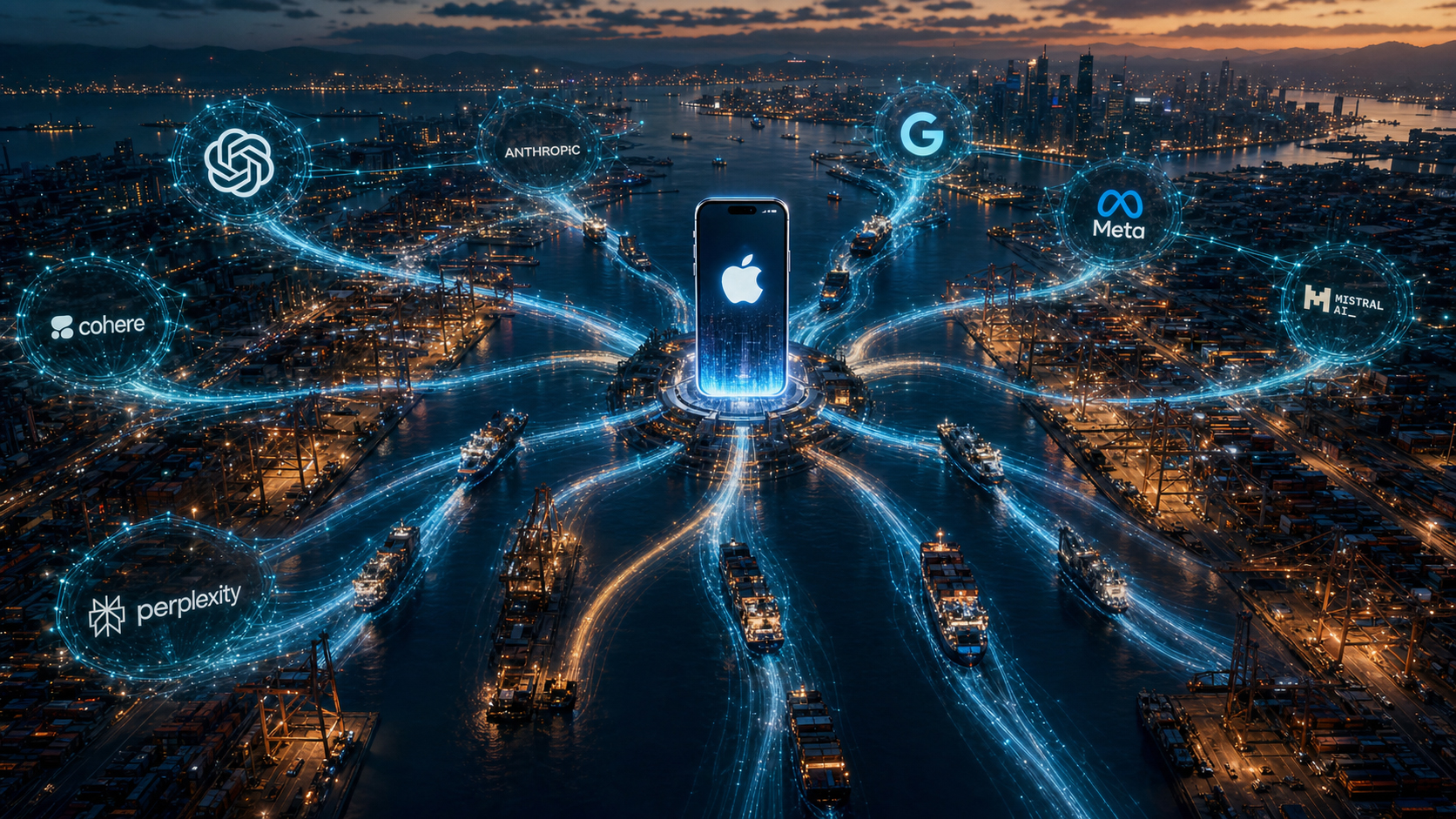
Jiu-Jitsu instead of boxing: Learning to win from the best – What Europe and Germany should learn from Apple's AI strategy – Image: Xpert.Digital
Apple's ingenious AI move: Why the tech giant isn't competing – and yet still wins
The battle for the lock screen: Why the platform, not the best AI model, decides
Europe's untapped leverage: How Apple's strategy is becoming a blueprint for our industry
At first glance, it appears to be a technological capitulation: Apple, the world's most valuable company, is foregoing the development of its own gigantic AI language model, leaving this stage to rivals like Google and OpenAI. But anyone who interprets this move as a weakness is overlooking one of the most brilliant strategic maneuvers in recent economic history. While competitors are engaged in a ruinous, multi-billion-dollar arms race for the best server farms and algorithms, Apple is building something far more powerful: the port where all these ships must dock.
By controlling 2.5 billion devices, Apple dominates the "last mile" to the customer. The tech giant from Cupertino has understood that in the AI economy, victory doesn't go to the one with the smartest model, but to the one who controls access to the user. It's a masterclass in strategic "jiu-jitsu"—using the opponent's power without wasting your own.
This very realization has explosive relevance for Europe, and especially for Germany as a business location. For years, the continent has seen itself as a victim of dominant US platforms in the digital world and has primarily reacted with regulation. But Apple's strategy points to a completely new path. Europe, too, possesses enormous, untapped platform power: industrial data, B2B networks, and mechanical engineering infrastructure. It's time to stop being a mere data provider and instead design the architecture of the next digital era itself. Whoever owns the platform dictates the rules.
Those who don't fight, win – Apple's quiet revolution as a blueprint for a continent without a model
The apparent retreat that isn't one
In January 2026, Apple and Google confirmed in a joint statement what many observers had already suspected: The next generation of Siri would no longer be based on Apple's proprietary Foundation Models, but on Google's Gemini technology. This multi-year partnership encompasses not only language models but also cloud infrastructure. Apple described Google's technology as the "most powerful foundation" for future Apple intelligence features. At first glance, this sounds like a defeat: A company that for decades stood for technological independence is relinquishing the core competency of the most important technological development of the coming decade.
This superficial interpretation, however, overlooks the crucial point. Apple is not retreating, but rather undergoing a strategic repositioning based on a profound understanding of the power structures within the platform economy. The company has grasped that in the emerging AI economy, the fundamental question of power is not who builds the smartest models, but who controls access to end users. This realization has far-reaching implications that extend well beyond Cupertino – and are of strategic importance for Europe, and Germany in particular.
The arms race, in which Apple is not participating
To understand Apple's decision, one must first grasp the scenario from which the company has refrained from participating. The major AI providers—OpenAI, Google DeepMind, Anthropic, and MetaAI—are engaged in an escalating capital arms race, the dynamics of which are reminiscent of historical industrial races. Amazon, Microsoft, MetaAI, and Alphabet plan combined capital expenditures of around $700 billion for 2026, a significant portion of which is earmarked for AI data centers and hardware. Microsoft alone recorded record spending of approximately $35 billion in the first quarter of fiscal year 2026, with annual projections in the range of $95 to $100 billion. MetaAI plans to operate data centers with over one million GPUs by 2026. Google is expected to invest more than $110 billion in infrastructure in 2026.
In contrast, Apple has planned investments of around $14 billion for fiscal year 2026, focused on private cloud computing and the integration of external models. This figure is not a sign of weakness, but rather the expression of a radically different logic. OpenAI devotes a large portion of its resources to operating gigantic computing farms: Training GPT-3 alone already consumed 1.287 million kilowatt-hours of electricity. GPT-4 consumed 16.5 times that amount. For the next generation of models, which are to be trained in the Stargate data centers, daily consumption of more than 10 million kilowatt-hours is projected. Global energy consumption for AI training and inference doubled in 2025 compared to the previous year and now exceeds 150 terawatt-hours per year.
This arms race has the structure of a classic prisoner's dilemma: No single player can opt out without falling behind in the short term – and yet all participants pay an immense price. Apple has turned its back on this game.
The port, not the ship: The new architecture of power
Apple's strategy can best be described with a topographical image: The company isn't building a ship that will travel faster than all the others. It's building the harbor without which no ship can anchor.
What this means in concrete terms is illustrated by the current system architecture: From 2026 onward, Siri will no longer function as a standalone AI model, but rather as an intelligent router that forwards user requests to the most powerful services. Gemini will handle the majority of complex requests as the new basis for Apple's Foundation Models. ChatGPT remains integrated and is used when local models are insufficient. Other models, such as Claude, can also connect. Apple itself operates the Foundation Models framework in the background – small, highly optimized models that run directly on the device on Apple Silicon, are available offline, and enable free AI inference.
The result is a multi-provider ecosystem in which Apple controls the architecture, the privacy layer, and the user interface, while external providers handle the computationally intensive heavy lifting. The strategic elegance of this structure lies in the fact that Apple is not tied to a single AI provider. The company can switch models as better ones become available, thereby increasing its negotiating power with all providers simultaneously. The agreement with Google regarding Gemini was explicitly described as non-exclusive.
The private cloud computing infrastructure plays a crucial role here: Gemini models don't run in Google's public cloud, but on Apple's own servers. Apple orchestrates access, controls the data flow, and protects user privacy – thus keeping the data used out of the model builders' training pipelines. From a user's perspective, this is a significant advantage; from a strategic perspective, it's another layer of control.
The economic mathematics of the harbor builder
The financial logic behind Apple's strategy is striking in its asymmetry. Apple is estimated to pay Google around one billion US dollars annually for access to Gemini. Google, in turn, pays Apple up to 20 billion US dollars annually to keep Google Search as the default in Safari. This asymmetry is no accident, but rather the result of Apple's distribution moat: access to Apple's user base is worth more than the best AI technology in the world, because without this access, no model can reach people.
Apple will have 2.5 billion actively used devices worldwide as of early 2026. This is an installed base unmatched by any other technology company, and it has grown by over 60 percent since 2020, from 1.5 billion to 2.5 billion devices. In 2025, Apple achieved a 20 percent global market share in the smartphone market, displacing Samsung for the first time, with shipment growth of 10 percent, the highest among the top five manufacturers. In the first quarter of 2026, Apple maintained this leading position with a 21 percent market share.
Apple is building a services engine of growing profitability on this hardware distribution. In fiscal year 2025, services revenue exceeded $100 billion for the first time, with a gross margin of 75.7 percent. The App Store averages 850 million weekly users in 175 countries. The number of paid subscriptions surpassed one billion for the first time. Apple's overall gross margin rose to 48.2 percent in the first quarter of fiscal year 2026.
The architecture is thus clear: The hardware creates the reach, the services monetize it, and the AI integration keeps users in the ecosystem – without Apple itself having to bear the costs of the AI arms race.
Jiu-Jitsu instead of boxing: The principle of force redirection
There's a concept from Japanese martial arts that describes Apple's strategy with remarkable precision: Jiu-Jitsu, literally "the gentle art," is based on the idea of using and redirecting the opponent's force instead of countering it with one's own. Whoever takes over the attacker's momentum doesn't have to expend any energy themselves—and yet wins.
That's precisely what Apple is doing in the AI market. OpenAI, Anthropic, Google, and Meta are burning through billions to build the world's most powerful language models. They do so in the belief that the superior model will win the market. Apple lets them compete, selects the best result, and places it behind its own screen. The model providers have a choice between two options: They can be present on Apple's platform but pay the price of dependence on Apple's distribution terms—or they forgo access to 2.5 billion devices, which would amount to commercial suicide in an AI economy that relies on scalability.
This power structure has an almost inevitable consequence: Even if a model is technically superior, it won't win the market if it doesn't appear on the user's screen. In a world where AI is becoming increasingly ambient and invisible—embedded in operating systems, messaging apps, email clients, and smartphones—the lock screen is more important than any algorithm. The decision of whether users even interact with a particular model isn't made in the data center, but on the user interface. And that interface belongs to Apple.
This also explains why, despite its obvious weaknesses in Foundation model development, Apple is structurally in a position of strength. The model providers aren't in charge – they're in the shop window. And that shop window belongs to Cupertino.
When strength meets strength: The European parallel
What does this have to do with Europe and Germany? At first glance, one could argue that Apple's strategy can only be copied by a company that already has a similar installed base. That's correct – and precisely why the lesson Europe must learn is not one of form, but of principle.
Europe was in a long period of strategic underestimation. It viewed US technology companies and Chinese platforms as overwhelmingly powerful and primarily responded with regulation – the Digital Markets Act, the AI Act, the GDPR. These measures are not without value; they set global standards and protect consumers. But regulation alone is not an economic strategy. It draws boundaries, it doesn't open up markets.
What Europe has failed to systematically analyze for years is that both the US and China need Europe more than is commonly assumed. Trade volume between the EU and China amounts to $800 billion annually, almost as much as between the EU and the US. The EU has stated that it has mapped global supply chains and found that China and the US rely on European technologies, machinery, and chemicals in key sectors – to a greater extent than is publicly known. The EU intends to leverage these "reverse dependencies" more strategically.
Apple has understood why its market is so valuable to others – and has developed a business model based on that. Europe needs to follow the same line of reasoning for itself.
Our EU and German expertise in business development, sales and marketing

Our EU and German expertise in business development, sales and marketing - Image: Xpert.Digital
Industry focus areas: B2B, digitalization (from AI to XR), mechanical engineering, logistics, renewable energies and industry
More information here:
A thematic hub offering insights and expertise:
- Knowledge platform covering global and regional economies, innovation and industry-specific trends
- A collection of analyses, insights, and background information from our key areas of focus
- A place for expertise and information on current developments in business and technology
- A hub for companies seeking information on markets, digitalization, and industry innovations
The last mile of industry: Why Europe must control the crucial interfaces
Europe's underestimated leverage: The market as a strategic resource
Europe is a single market of 450 million people with one of the highest per capita incomes in the world. This market is of vital importance to every global technology company. Neither OpenAI nor Google, neither ByteDance nor Alibaba can afford to forgo the European market – any more than an AI provider can afford to forgo Apple's platform.
This means Europe has leverage. The only question is whether and how it will be used. Apple's strategy shows the way: Instead of trying to build the superior AI model, Europe should ask which infrastructure, interfaces, and access points it controls or could control – and use them strategically.
Europe's real strengths lie in areas often overlooked in the digital discourse. In industrial automation and embedded software, European companies like Siemens, Bosch, SAP, and Trumpf are global market leaders. Industrial manufacturing, logistics, and mechanical engineering are sectors where physical AI applications—AI in production, supply chain, and maintenance—are not optional gimmicks but rather core to value creation. Here, the relationship between data generation and data utilization is not yet dominated by US or Chinese platforms.
The European Commission has established an initial framework with its "Apply AI" strategy. It targets ten key sectors, from mobility and mechanical engineering to energy, and explicitly promotes a "Buy European" approach for the public sector. While this approach is fundamentally sound, it comes too late and operates too much at the level of political declarations of intent rather than at the level of concrete market architecture.
What Germany must make of this
Germany faces a specific challenge: It is the largest economy in the EU, possesses an exceptional industrial base – and yet has missed the transition to the platform economy over the last decade. No German or European company holds a leading position in consumer-facing digital platforms. No German company operates an app store infrastructure used by hundreds of millions of users daily. No German company controls an AI interface through which other providers distribute their models.
This reality is not irreversible – but it requires a way of thinking that has been too rare in German economic policy: thinking in terms of platform architectures rather than products. Apple no longer sells a product in the traditional sense. Apple sells a world – an ecosystem in which hardware, software, services, and now also third-party AI intelligence merge into a seamless user experience that makes switching costs so high that a user leaving becomes a psychological and logistical burden.
Germany cannot reproduce this model using the same means. But it can adapt the principle: positioning its own strengths – industrial data, production expertise, engineering knowledge, SME networks – as an infrastructure upon which others must build, thereby becoming not only beneficiaries of value creation, but also its architects.
In concrete terms, this means that German and European companies must view their industrial data not as a raw material to be handed over to American or Chinese AI companies, but as a strategic resource that generates negotiating power. Data on manufacturing processes, quality controls, machine condition, and supply chain flows are only valuable to an AI provider if they have access to it. And this access is not a given – it is negotiable.
The danger of drawing the wrong conclusions: Why protectionism is no substitute for strategy
At this point, an important nuance is needed to avoid a common misconception. Apple's strategy is not protectionist isolation – it's smart market design. Apple isn't excluding AI providers, but rather creating conditions under which access to its ecosystem is attractive yet regulated. The model doesn't work through exclusion, but through the force of gravity: a company with 2.5 billion devices doesn't need to force anyone – it simply needs to master the architecture.
In recent years, Europe has developed a tendency to respond to technological lags with regulation. The Digital Markets Act forces Apple and Google to be more transparent, which makes sense from a competition perspective. The AI Act sets global minimum standards for AI security. The GDPR has been adopted worldwide. These are successes. But they are successes played defensively. An economic strategy that only sets rules without building its own market power is like a referee who isn't allowed to play.
The difference between regulation and strategy is fundamental: regulation protects what already exists. Strategy creates what does not yet exist. Europe needs both – but the balance has shifted too heavily towards regulation in recent years. When the EU declared that it has identified China and the US as dependent on Europe in key areas, this is the approach that needs to be developed further: strategically developing, not merely defending, its own indispensability.
The Chinese government has repeatedly demonstrated its ability to use trade dependencies as leverage. This is not an invitation to imitate Chinese industrial policy, but rather a reason to soberly assess one's own negotiating position – and not naively underestimate it.
From supplier to architect: The strategic rethink
What Europe and Germany should do specifically can be summarized in a central strategic shift: from supplier of technological inputs to architect of digital ecosystems.
Apple was long a device supplier. The company recognized that suppliers are interchangeable – and systematically maneuvered itself into the position of architect, determining the rules of the game. Today, Europe provides industrial data, engineering services, regulatory markets, and research capacities. These inputs are valuable. But they are not yet being strategically used as architectural building blocks that set conditions for other players.
There are concrete starting points: A European industrial AI ecosystem, based not on American models but on European-controlled interfaces, could emerge in sectors such as mechanical engineering, logistics, and energy, where the data is already in European hands. The German government presented an AI strategy in 2018 under the slogan "AI made in Germany," which focuses on research, technology transfer to industry, and international cooperation. This strategy now needs to be supplemented with platform logic—specifically, the question of who owns the interfaces through which AI actually reaches users.
The EU's "Apply AI" strategy is a step in the right direction by establishing AI factories, AI gigafactories, and digital innovation hubs that will serve as gateways to the AI innovation ecosystem. However, these structures must evolve beyond funding institutions and become genuine platform architectures that build market power.
The principle behind the principle: Whoever owns the infrastructure wins the era
Apple's AI strategy, reduced to its essence, is a return to a very old economic principle: Whoever controls the infrastructure through which other market participants must deliver their services has structural power – regardless of who delivers the best individual service.
Nineteenth-century railway companies earned more from transporting farmers and industrialists than the farmers and industrialists themselves. Early capitalist banks profited from every commercial transaction without trading themselves. Twenty-century telephone network operators profited from every call that passed through their lines. In each of these cases, the infrastructure operator's position was more profitable and stable than that of the infrastructure's best user.
The AI economy of the 2020s and 2030s reproduces this pattern in digital form. The question is not: Who builds the best model? The question is: Whose infrastructure must the best model pass through to reach the user? In the consumer sector, Apple's answer is clear: its devices. In the industrial sector, this question remains open – and that is precisely the opportunity that Europe has so far failed to fully exploit.
AI providers have long believed that the best model would automatically be the most powerful. Apple's strategy demonstrates that this is a misconception: In a world of nearly equivalent models, distribution is the deciding factor. And distribution isn't just reach, but also trust, habit, integration, and ecosystem membership. For hundreds of millions of people, the iPhone isn't just a device—it's the gateway to digital life. Owning that gateway doesn't require being the best chef. It simply requires owning the best restaurant.
The last mile as a key resource
The metaphor of the "last mile" originally comes from logistics and refers to the section of the supply chain closest to the end customer – and which is often also the most expensive, complex, and difficult. In the digital economy, the last mile is the lock screen, the operating system, the app that stands between the AI model and the user.
Whoever controls this last mile controls the user experience, trust, data, and ultimately, monetization opportunities. Apple has built this last mile through decades of consistent product development, ecosystem building, and brand trust. In the industrial sector, an analogous last mile exists: the embedded software in machines, the interfaces of automation systems, the SCADA systems in power plants, and the ERP systems in manufacturing facilities. European companies are deeply entrenched in this area.
The strategic question that Germany and Europe must ask themselves is: How can this technical foundation be transformed into a platform architecture that dictates to others – including AI providers – the conditions under which they can reach the industry? Anyone who takes this question seriously and answers it has followed the same line of reasoning that Apple followed in the field of AI between 2019 and 2026.
The greatest risk is underestimating oneself
Apple's history in the AI age teaches us one crucial lesson: the greatest risk for a powerful player isn't external attack—it's underestimating its own capabilities. Apple could have continued its AI efforts, invested billions in computing, and tried to compete with OpenAI and Google on their turf. Instead, the company recognized its own strengths, reassessed them, and strategically repurposed them.
For decades, Europe has downplayed its own strengths, underestimated its markets, exaggerated its dependencies, and overlooked its leverage. The first lesson from the Apple model is not a technological recipe, but a mental reversal: instead of asking what Europe lacks, ask what Europe possesses that others desperately need. And then build an architecture that transforms this possession into market power.
Apple pays roughly one billion US dollars annually for Gemini – and receives 20 billion from Google for access to its users. This asymmetry is not a matter of luck. It is the result of strategic clarity about one's own position within the system. Europe can develop this clarity. The resources are there. What's missing is the decision to build the port – instead of continuing to wait for someone else to send the ships.
🎯🎯🎯 Data-driven B2B industry hub as a quasi-in-house solution

The quasi-in-house solution: How Xpert.Digital closes operational gaps in B2B marketing and sales – Smart Content-Driven Business - Image: Xpert.Digital
Xpert.Digital is a data-driven B2B industry hub led by Konrad Wolfenstein . The company acts as an external, quasi-in-house solution for industrial partners, closing operational gaps in marketing, content, and sales – without requiring additional resources on the client side.
More information here:
Your global marketing and business development partner
☑️ Our business language is English or German
☑️ NEW: Correspondence in your native language!

Konrad Wolfenstein
I and my team are happy to be available to you as your personal advisor.
You can contact me by filling out the contact form here simply call me at +49 7348 4088 965. My email address is [email protected]:or
I'm looking forward to our joint project.










