
DefTech boom in Germany: The radical master plan for Germany's defense capabilities – from taboo to billion-dollar magnet
Xpert Pre-Release

Language selection 📢
Published on: March 2, 2026 / Updated on: March 2, 2026 – Author: Konrad Wolfenstein
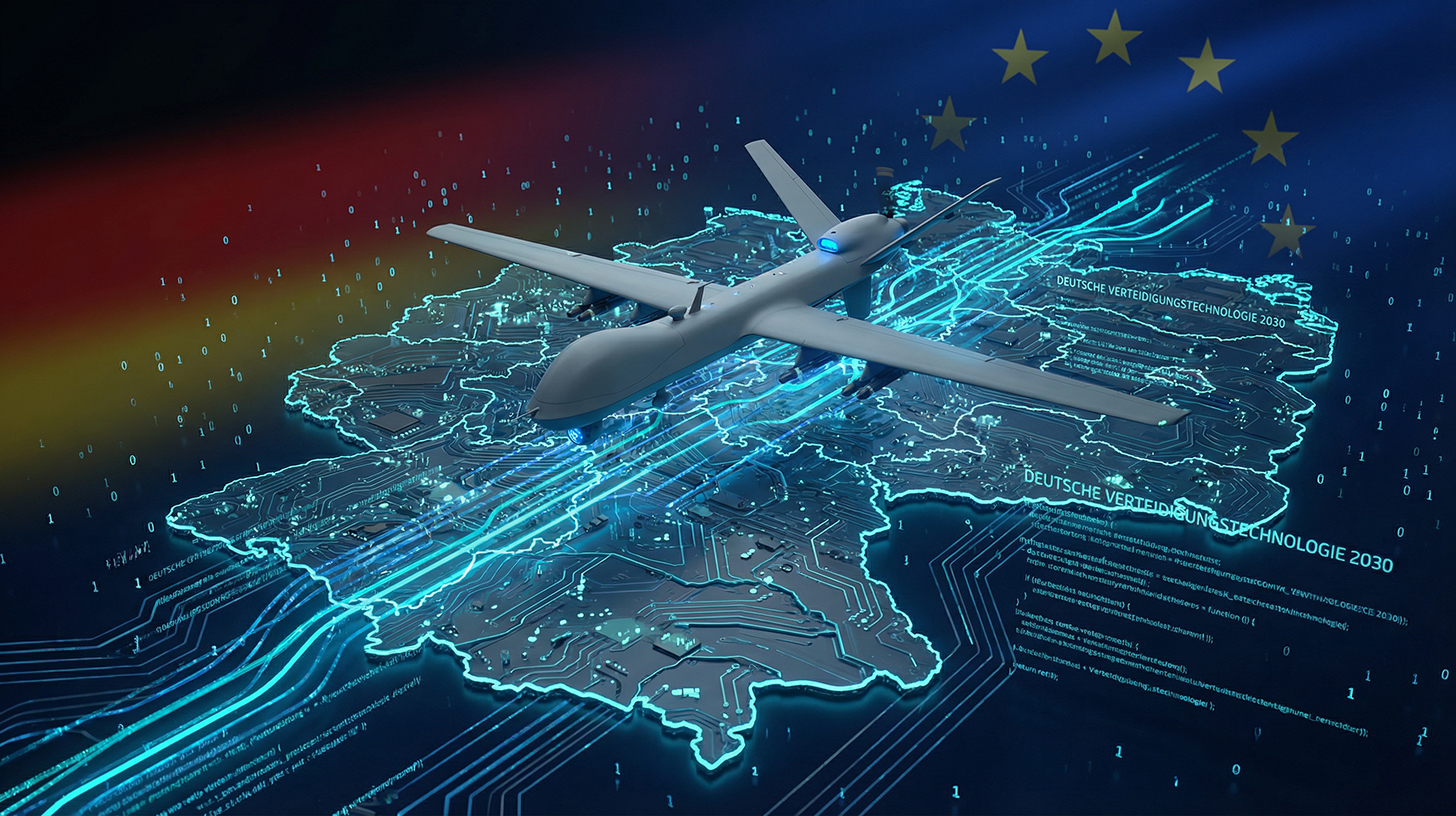
DefTech boom in Germany: The radical master plan for Germany's defense capabilities – from taboo to billion-dollar magnet – Image: Xpert.Digital
"One billion for innovations": The master plan intended to save Germany's defense capabilities
Flight from the USA: Why Europe's tech founders suddenly prefer to stay in Germany
For a long time, defense technology was considered a moral taboo in Germany – today it's a veritable magnet for billions of euros. Geopolitical crises and the new security policy reality have triggered an unprecedented boom: The so-called DefTech (Defense Technology) sector has transformed itself in record time into one of the most dynamic segments of the German startup ecosystem. As the current *DefTech Report 2026* by the digital association Bitkom impressively demonstrates, startups in this field now account for a whopping 17 percent of all German venture capital. Immense sums are flowing into young companies that aim to secure Europe's digital sovereignty with artificial intelligence, autonomous drones, and networked sensors. With pioneers like Helsing and Quantum Systems, Germany has already produced true billion-euro heavyweights – so-called unicorns – and locations like Munich are developing into leading technology hubs on the continent.
But this meteoric rise is encountering a major structural obstacle: German bureaucracy. While investors are boldly providing capital, public perception is shifting, and founders are increasingly turning their backs on the US, the cumbersome procurement system of the German Armed Forces is noticeably slowing technological progress. Lengthy tendering processes, tailored to large corporations, are often existential threats for startups and prevent innovative solutions from quickly reaching the armed forces. The industry is now sounding the alarm, demanding a radical rethink, accelerated fast-track procedures, and a fixed multi-billion-euro budget for innovation. Because the battle for Germany's technological and strategic independence is no longer decided solely by brilliant software, but above all by government speed.
Related to this:

Software, drones and the fight for Europe's digital sovereignty – The DefTech sector as the strategic life insurance of the Federal Republic of Germany
In Germany, defense technology has transformed within just a few years from a taboo, fringe topic to one of the most dynamic segments of the entire startup ecosystem. The DefTech Report 2026 by the digital association Bitkom, published ahead of the Munich Security Conference in February 2026, paints a picture of a sector at a critical turning point: technologically innovative, increasingly well-funded, but still institutionally hampered by a procurement system that cannot keep pace with the speed of technological innovation.
The financing explosion: From niche investment to heavyweight
Perhaps the most impressive figure in the DefTech Report 2026 concerns capital allocation: In 2025, DefTech and dual-use startups accounted for seventeen percent of the total venture capital volume in Germany, despite representing only around two percent of all deals. DefTech's share of total venture capital volume in Germany has more than tripled since 2019, rising from 2.9 percent to 10.7 percent.
This concentration of capital in a few, but high-volume, funding rounds reflects a market dynamic typical of sectors transitioning from niche to mass markets. Capital no longer follows a broad distribution across many small bets, but rather concentrates on a handful of companies deemed to have the potential to become platform or category winners.
In this context, it is not surprising that in 2025 alone, half of the new German unicorns—startups with a valuation of more than one billion euros—came from the defense or dual-use sector. Germany plays a leading role in DefTech funding in Europe, both in absolute and relative terms. With cumulative venture capital funding of two billion dollars since 2019 and 1.5 billion dollars since 2024 alone, Germany is significantly ahead of the UK, Southern Europe, and France.
The Unicorn Factory Munich: Helsing and Quantum Systems
Munich has established itself as a central location for the German DefTech ecosystem, driven primarily by the spectacular developments at Helsing and Quantum Systems. Helsing, founded in 2021 by Torsten Reil, Niklas Köhler, and Gundbert Scherf, has transformed itself from an ambitious AI startup into a European decacorn in just four years. In June 2025, the company raised €600 million in a Series C funding round, achieving a valuation of €12 billion, placing it among the five most valuable privately held technology companies in Europe. To date, Helsing has raised a total of approximately €1.4 billion.
Helsing develops AI software for the defense sector, which, among other things, supports soldiers in assessing combat situations and optimizes military target selection. The software is already in real-world use, including in Ukraine. In 2023, the company received a contract from the German government to equip the Eurofighter for electronic warfare and is supplying the AI infrastructure for the European Future Combat Air System.
Quantum Systems, the drone manufacturer from Gilching near Munich, achieved unicorn status in May 2025 with a €160 million funding round. The Series C round was led by Balderton Capital, with participation from HENSOLDT, Airbus Defense and Space, Bullhound Capital, HV Capital, and Peter Thiel. With total funding of €310 million and a valuation of over $1 billion, Quantum Systems is the second defense unicorn from Germany.
Related to this:

Defensive capability: A ruthless self-diagnosis
The DefTech Report 2026 also includes a frank assessment of Germany's defense capabilities by those best placed to judge them: the founders who develop technologies specifically for this purpose. 76 percent of the DefTech founders surveyed rate Germany's defense capabilities as low, and a further 11 percent as very low. Overall, 87 percent thus consider Germany's defense capabilities inadequate.
Compared to the previous year, however, there has been a marginal improvement. The proportion of particularly critical assessments (very low) has more than halved, from 25 percent to eleven percent. At the same time, eleven percent, significantly more than the four percent in the previous year, rate the defense capability as high. The respondents thus perceive that something is happening, but the path to a substantially strengthened defense capability remains long.
Bitkom President Ralf Wintergerst emphasized the point: the urgency is too often not yet palpable. Germany cannot wait years for changes; it needs rapidly deployable solutions. Defense capabilities today also include data, artificial intelligence, and networked systems. Software-defined defense must be the guiding principle of German defense policy.
The procurement dilemma: The biggest obstacle
Around ninety percent of the surveyed founders consider the introduction of new tendering and procurement channels, such as fast-track procedures, to be essential. 76 percent rate their relevance as very high, and another 14 percent as high. The complex and lengthy processes remain a major hurdle, especially for young DefTech companies.
The problem is structural. The Federal Office of Bundeswehr Equipment, Information Technology and In-Service Support (BAAINBw) operates according to procedures tailored to cooperation with large, established defense companies. Lengthy tenders, complex procurement procedures, and multi-stage review processes are manageable for large companies with corresponding administrative resources, but pose an existential threat to startups with limited personnel and finite funding.
Related to this:

Less than a third of the surveyed founders report having been directly commissioned by the German Armed Forces, for example via the Federal Office of Bundeswehr Equipment, Information Technology and In-Service Support (BAAINBw) (21 percent) or in connection with aid to Ukraine (8 percent). 33 percent of the founders have not been directly commissioned at all. 28 percent are involved only through project-related work such as joint studies, without acting as a direct contractor.
Bitkom is therefore calling for a consistent acceleration and simplification of the awarding of contracts for innovative solutions. Fast-track procedures require clear lines of responsibility to operate independently of existing standard procedures. SaaS framework agreements should be designed to make it easier for startups to offer their solutions quickly and easily. In addition, a central marketplace for DefTech solutions is being demanded.
Hub for Security and Defense - Advice and Information

Hub for Security and Defense - Image: Xpert.Digital
The Security and Defence Hub offers expert advice and up-to-date information to effectively support companies and organizations in strengthening their role in European security and defence policy. Working closely with the SME Connect Defence Working Group, it particularly promotes small and medium-sized enterprises (SMEs) that wish to further develop their innovative capacity and competitiveness in the defence sector. As a central point of contact, the Hub thus creates a crucial bridge between SMEs and European defence strategy.
Related to this:
From taboo to beacon of hope: Why defense technology is becoming socially acceptable in Germany
The budget demand: One billion for innovation
87 percent of the surveyed founders support increased funding from the defense budget for the procurement of innovative solutions. 60 percent rate the relevance as very high, and another 27 percent as high. Bitkom's demand is specific: an annual procurement volume of at least one billion euros for innovative solutions through a dedicated budget line. In the medium term, the share of innovative procurement should be set at at least one percent of the defense budget.
This demand is not only relevant from the perspective of startups, but also grounded in macroeconomic logic. Reliable public procurement significantly reduces the investment risk for private investors. If venture capital investors know that a DefTech startup has a predictable market within the German Armed Forces, their willingness to provide venture capital increases. A binding budget commitment for innovative procurement thus acts as a lever that mobilizes many times more private capital.
Related to this:

The Ukraine factor: Testing under real-world conditions
A particular aspect of the DefTech ecosystem concerns cooperation with Ukraine. Sixty-five percent of respondents rated political support for German-Ukrainian cooperation as highly to very highly relevant. Testing technologies under real-world operating conditions accelerates further development and increases operational readiness to a degree that is unattainable in simulated test environments.
Ukraine effectively functions as a real-time laboratory for defense technologies. Drones, AI-powered reconnaissance, networked sensors, and cyber defenses are being tested there under conditions that put all theoretical assumptions to the test. For German DefTech startups, cooperation with Ukraine offers the opportunity to validate their technologies against real-world conditions and gain insights that cannot be obtained in any laboratory test.
Related to this:

The shift in economic landscape: Germany is gaining, the USA is losing
One of the most notable shifts in the DefTech Report 2026 concerns the location preferences of founders. 49 percent would choose Germany if they were to start a business again, an increase of ten percentage points compared to the previous year. In contrast, the attractiveness of the USA has declined dramatically: only eight percent would now start a business there. Last year, at 25 percent, that figure was three times higher. Other EU countries are gaining in importance, reaching 24 percent. Overall, this means that around three-quarters of those surveyed would again choose to start a business in Germany or another EU country.
This decline in the attractiveness of the US as a location for European DefTech startups is directly related to the changing transatlantic dynamics. The protectionist trade policies of the Trump administration, the tightened export and technology controls, and the general uncertainty about the future direction of American foreign and security policy have led European founders to increasingly focus on a European orientation.
The societal shift: DefTech is becoming socially acceptable
A significant cultural shift is evident in the perceived appreciation of DefTech founders. At 65 percent, almost two-thirds of founders now feel socially and politically recognized for their work. Last year, at 41 percent, this figure was less than half. The proportion of those who feel unappreciated has fallen from 34 percent to 19 percent.
This shift reflects a profound change in societal consciousness. The decades-long German stance that defense technology is a morally dubious field is giving way to a more pragmatic view that understands security as a prerequisite for freedom and prosperity. The rhetoric of a turning point in history has left its mark, even if the institutional implementation of these insights lags considerably behind.
Industrial cooperation: Startups and SMEs as a tandem
Eight out of ten of the surveyed founders rate political support for collaborations between DefTech startups and established companies as relevant or highly relevant. Industries such as automotive suppliers and mechanical engineering contribute expertise in mass production and engineering knowledge that are essential for scaling DefTech innovations.
This brings us full circle to the crisis in the automotive industry. Suppliers, under pressure due to declining orders from the automotive sector, possess precisely the manufacturing capacity and technical expertise that DefTech startups need to scale their innovations. The startups provide the innovation, the suppliers the production infrastructure. It's a symbiosis that makes economic sense and should be politically supported.
The Bundeswehr Innovation Center, opened by the Federal Ministry of Defense and connecting stakeholders from science and industry with military practice, is a step in the right direction. However, its potential will only be realized if test campaigns in key technologies are continuously expanded and the synergies between existing innovation actors, such as the Cyber Innovation Hub and the Cyber Agency, are systematically utilized.
Europe's DefTech map: Germany as a leading power
In a European comparison, Germany has established itself as by far the most active DefTech location. With two billion dollars in cumulative venture capital funding since 2019, Germany is far ahead of the United Kingdom with 465 million dollars, Southern Europe with 428 million dollars, and France with 335 million dollars. The share of DefTech in total national venture capital funding in Germany has been 10.7 percent since 2024, compared to 4.4 percent in the UK and 1.2 percent in Southern Europe.
Munich has established itself as the European counterpart to the American DefTech hubs. The combination of an excellent technical university, an established aerospace industry, and a growing pool of AI talent creates an ecosystem that offers ideal conditions for DefTech startups. With Helsing and Quantum Systems, the greater Munich area is already home to two of Europe's most valuable defense startups.
The regulatory policy agenda: What needs to happen now
The recommendations of the DefTech Report 2026 can be summarized in three key levers which, taken together, have the potential to transform the German DefTech landscape from a promising ecosystem into a functioning industrial base.
First, procurement must be fundamentally reformed. Fast-track procedures with clear responsibilities, SaaS framework agreements, and a central marketplace for DefTech solutions are not luxury demands, but prerequisites for ensuring that the technological innovation emerging in startups actually reaches the armed forces.
Secondly, the defense budget must include binding targets for innovative procurement. The requested one billion euros annually for innovative solutions is a modest amount compared to the total volume of defense spending, but it would send a disproportionately strong signal to the venture capital market.
Thirdly, cooperation between startups, the German Armed Forces, and established industry must be systematically strengthened. The German Armed Forces' Innovation Center provides an institutional framework for this, which must be consistently equipped with resources, decision-making authority, and political support.
The strategic dimension: Technological sovereignty as a matter of existence
The significance of the DefTech sector extends far beyond defense policy in the narrow sense. Autonomous drone systems, software-based defense, networked sensors, and AI-supported situational awareness are technologies that can also be used in civilian applications such as disaster relief, border surveillance, and critical infrastructure protection. Dual-use is not a marketing phrase, but a technological principle that is increasingly blurring the lines between military and civilian innovation.
In a world where geopolitical alliances are becoming less reliable and technological dependencies are posing a strategic risk, the ability to develop and produce defense-relevant technologies domestically is a matter of survival. Germany possesses the technological know-how, the capital, and the industrial foundation to meet this challenge. What is lacking is the institutional speed to bring these resources together and translate them into deployable solutions.
The DefTech founders surveyed by Bitkom are ready. Three-quarters of them would start a business in Germany or Europe again. They feel increasingly valued and recognize the opportunities available. What they expect from politicians and institutions is not more money, but more speed. In a world where technological superiority determines security and prosperity, this is not an unreasonable demand.
Consulting - Planning - Implementation

Markus Becker
I would be happy to serve as your personal advisor.
Head of Business Development
Chairman SME Connect Defense Working Group
Consulting - Planning - Implementation
Konrad Wolfenstein
I would be happy to serve as your personal advisor.
contact me at wolfenstein ∂ xpert.digital
Just call me on +49 7348 4088 965 (Munich) .





