

America's industrial rebirth – or just a mirage?
Xpert Pre-Release

Available in 27 languages 📢
Prefer Xpert.Digital on GoogleⓘPublished on: July 13, 2026 / Updated on: July 13, 2026 – Author: Konrad Wolfenstein
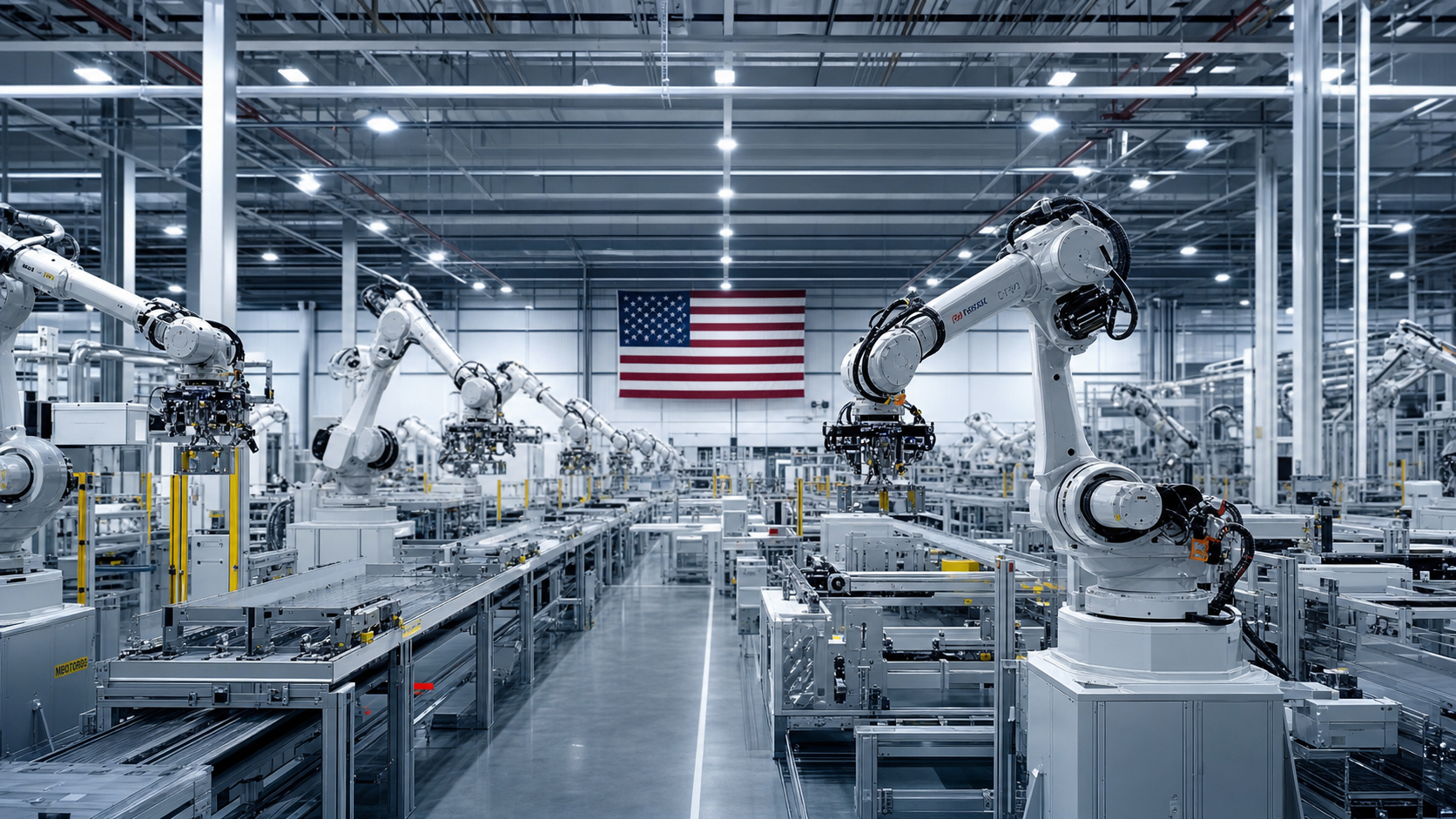
America's industrial renaissance – or just a mirage? – Image: Xpert.Digital
Billions are poured in, factories are built, but jobs remain elusive: The shocking paradox of US reindustrialization
Automation instead of job miracles: Who really wins in the new industrial boom in the USA?
Mexico as a beneficiary: How the US is tricking itself in the industrial boom
The United States is celebrating its industrial renaissance – but appearances are deceiving. While record sums of government subsidies are flowing into the construction of gigantic semiconductor plants and politicians are proclaiming a triumphant return of US manufacturing from Asia, a sober look at the data reveals a shocking paradox. The apparent industrial boom, on closer inspection, turns out to be a highly complex and error-prone transformation. Construction projects are exploding, yet the number of industrial jobs is declining. Skilled workers are in short supply everywhere, dilapidated power grids are groaning under the energy demands of the new high-tech factories, and instead of the American middle class, it is often neighboring Mexico that ultimately benefits most. This article takes an unflinching, data-driven look behind the scenes of US reindustrialization and shows why the much-vaunted "reshoring" threatens to become the most expensive economic policy mirage of our time without a fundamental structural solution to the homegrown problems.
Between aspiration and reality: What reshoring actually achieves
For years, the United States has been cultivating a narrative of industrial renaissance. Presidents, commerce secretaries, and industry associations proclaim the triumphant withdrawal of US manufacturing from Asia, coupled with record subsidies, record investments, and a national determination to transform the country back into a manufacturing nation. However, a gap exists between the official narrative and economic reality, a gap that seems to widen with every new data point.
Anyone who reads the figures beyond the press releases will encounter a picture full of contradictions: Factory construction is booming like it hasn't in decades—and at the same time, the number of employees in the manufacturing sector is declining. Hundreds of billions of dollars in government subsidies are flowing into semiconductor factories—and these are being delayed year after year. Companies are announcing record levels of reshoring plans—while the share of Asian imports in the US consumer goods supply is increasing again. The so-called reshoring comeback is real, but it is not what it claims to be. It is a structural transformation of US industry that is both fascinating and sobering—and one that will be fundamentally misunderstood without a thorough, ideology-free analysis.
The foundation: What three decades of deindustrialization left behind
To understand the implications of the current situation, one must first grasp the extent of the industrial decline the United States has suffered over three decades. The manufacturing sector's share of US GDP fell from over 21 percent in the late 1970s to less than 10 percent today. Manufacturing employment plummeted from 22 percent of the total workforce to under 8 percent. This is not a mere statistical footnote, but rather describes a fundamental restructuring of the American economy.
This development was particularly dramatic in the semiconductor industry. While the US held a 37 percent share of global semiconductor production capacity in 1990, this had plummeted to around ten percent by 2022. For over three decades, American corporations like AMD, Nvidia, and Qualcomm deliberately opted for the so-called fabless model—outsourcing capital-intensive mass production to Taiwanese and South Korean contract manufacturers to ease the burden on their own balance sheets and maximize their profit margins. This was rational from a business perspective. It was geopolitically reckless.
When the COVID-19 pandemic shook global supply chains and the chip shortage temporarily paralyzed the automotive industry, electronics manufacturers, and numerous other sectors, the damage wrought by decades of strategic shortsightedness became starkly apparent. McKinsey's 2026 report, "Ramping up manufacturing in America?", quantifies the extent of this dependency with chilling precision: The US imports roughly three trillion dollars' worth of manufactured goods annually, of which approximately 25 percent are classified as particularly vulnerable—due to their geopolitical concentration, strategic importance, or supply chain exposure. Five percent of all imports—primarily computers and electronics products—meet all three criteria simultaneously.
The investment wave: Spectacular figures, sobering reality
The political response to this realization was massive—literally. With the CHIPS and Science Act of 2022, the Biden administration mobilized approximately $52.7 billion in direct federal funding, $39 billion of which was earmarked for building manufacturing capacity. Private investment commitments triggered by the CHIPS Act funding now exceed $600 billion in some 130 projects across 28 states. Annualized manufacturing investment rose to approximately $90 billion by 2024—a huge leap from the pre-2020 average of less than $7 billion.
The Reshoring Initiative reports that a total of 244,000 jobs were announced in 2024 through reshoring and foreign direct investment, and that more than two million such announcements have been recorded cumulatively since 2010. However, a closer look at these figures reveals the cracks in the picture: the 244,000 announced jobs are announcements—not actual jobs. Between a corporation's press release and the first employee starting work at a manufacturing plant, there are often years, sometimes more than a decade.
The most sobering document in this context is Kearney's annual reshoring index. The 2025 edition, which the consulting firm titled "The great reality check," fell by 311 basis points, slipping back into negative territory after two years of positive growth. The reason: The manufacturing import ratio rose by nine percent because imports from 14 low-wage Asian countries grew faster than domestic U.S. manufacturing output. U.S. manufacturing grew by just one percent—half the growth of total domestic consumption of manufactured goods.
Phantom jobs: When concrete doesn't lead to employment
Perhaps nowhere is the paradox of US reindustrialization more evident than in the discrepancy between construction investment and employment growth. From December 2024 to December 2025, the US manufacturing sector lost nearly 70,000 jobs, according to data from the Bureau of Labor Statistics. Industrial job postings plummeted by 60 percent from their peak in 2022, while factory construction spending reached historic highs.
This is not a contradiction—it is the logical consequence of the kind of industry that is actually being built. In 2016, roughly three percent of all factory construction spending went to electronics assembly, particularly semiconductor factories. By 2025, that figure will reach 60 percent. These highly automated manufacturing facilities don't need assembly line workers. They need process engineers, cleanroom technicians, and control specialists—a category of workers that is structurally underrepresented in the U.S. The Adidas example illustrates this phenomenon: When the sportswear manufacturer brought parts of its production back from Asia, the automated factory created just 160 jobs—compared to over a thousand in a typical Asian sewing factory with comparable output.
The paradox becomes even more pronounced when construction-phase employment is taken into account. While the megaprojects of the CHIPS Act have created roughly one million construction jobs, these are inherently temporary. Once the building is completed, the majority of this employment disappears. What remains is a state-of-the-art, capital-intensive facility that requires comparatively little personnel. The construction boom under the Biden administration boosted annual factory construction spending from $75.5 billion (2021) to $235.6 billion (2024)—while under Trump, spending fell by 6.7 percent from Q4 2024 to Q3 2025, a trend that is likely to continue.
The skills shortage: America's self-created obstacle
What transforms US reindustrialization from an infrastructure investment into an existential challenge is the structural shortage of skilled labor—a problem the US has created for itself over decades. In March 2025, according to the Federal Reserve Bank of St. Louis, nearly 450,000 manufacturing jobs remained unfilled in the US. Carrier Global CEO David Gitlin put it succinctly: for every twenty advertised manufacturing positions, there is, on average, only one qualified applicant.
Deloitte and the Manufacturing Institute predict that around 2.1 million manufacturing jobs in the US could remain unfilled by 2030. The average annual income of a US manufacturing worker is now over $102,000, including benefits—so a lack of pay is not the central problem. The real problem is structural: Three decades of deindustrialization have not only caused factories to disappear—they have also eroded the professional culture, training pathways, and social prestige of industrial jobs. Only about three percent of American engineering graduates pursue careers in chip manufacturing.
In the semiconductor sector, this shortage is dramatically acute. A recent analysis by McKinsey, SEMI, and the National Science Foundation estimates the potential skills gap in the US semiconductor industry at around 157,000 qualified positions by 2030. 104,300 engineers are needed for process and plant support—but the available pool of young talent can only fill 16,300 positions. This shortage is not a theoretical scenario—it has already materialized: In 2023, TSMC was forced to postpone the start of its Arizona factory to 2025 because of a lack of qualified personnel to install the high-precision equipment. The company had to send hundreds of Taiwanese technicians to the US and apply for special visas from the US State Department.
The Intel debacle in Ohio is the most dramatic symbol to date of this structural failure. The semiconductor project in New Albany, originally budgeted at $20 billion, was announced with the promise of starting production by the end of 2025. After multiple delays, the current timeline for commissioning the first module is 2030—and for the second, 2031 or 2032. The project has already consumed 9.4 million man-hours, moved 248,000 truckloads of earth—and, as of mid-2026, has yet to produce a single chip.
The energy grid: The underestimated barrier to reindustrialization
In addition to the shortage of skilled workers, a second structural obstacle is becoming increasingly apparent: the dilapidated and overburdened energy infrastructure of the USA. The US power grid is facing an unprecedented surge in demand that is overwhelming the planning capacities of utilities and regulators. The International Energy Agency (IEA) reports that electricity consumption by data centers increased by 17 percent in 2025—AI-focused facilities grew even significantly faster. BloombergNEF forecasts that data center power procurement will reach 106 gigawatts by 2035—a jump of 36 percent compared to the previous estimate.
The consequences for the grid are already measurable. In the PJM Interconnection—the largest power grid in the US—capacity auction prices have risen by over 800 percent year-over-year. In Chicago, utilities have submitted requests for 40 gigawatts of power—forty times the power demand of all existing Chicago data centers. Transformers currently have lead times of four to five years; US electricity costs have increased by nearly 30 percent in the last five years. For companies considering US locations as part of reshoring projects, power supply is increasingly becoming the critical bottleneck—and many are choosing locations in Mexico instead, where infrastructure and energy access are easier to secure.
Our US expertise in business development, sales and marketing

Our US expertise in business development, sales and marketing - Image: Xpert.Digital
Industry focus areas: B2B, digitalization (from AI to XR), mechanical engineering, logistics, renewable energies and industry
More information here:
A thematic hub offering insights and expertise:
- Knowledge platform covering global and regional economies, innovation and industry-specific trends
- A collection of analyses, insights, and background information from our key areas of focus
- A place for expertise and information on current developments in business and technology
- A hub for companies seeking information on markets, digitalization, and industry innovations
Why Mexico benefits from US reshoring: Political volatility as an investment risk – Why companies hesitate
The nearshoring paradox: When the neighbor benefits, not the home market
One of the greatest unspoken ironies of current US trade policy is that the massive shift away from Asia is not, to a significant extent, resulting in a relocation to America—but rather to Mexico. Foreign direct investment (FDI) in Mexico amounted to $32.9 billion in the first nine months of 2024, a six percent increase over the same period the previous year. In 2025, FDI flowed to Mexico to a staggering $40.8 billion, and US manufacturers producing from Mexico achieved total cost savings of 20 to 30 percent compared to relocating production entirely back to the US.
Industrial corridors like Nuevo León and the Bajío region are experiencing exploding demand for industrial real estate. The USMCA agreement makes Mexican production logistically attractive for the American market: short transport routes, synchronized supply chains, and duty-free market access under certain conditions. Kearney's 2025 Reshoring Index explicitly illustrates this dynamic: Neither Mexico nor Canada could maintain the growth rate of previous years, which is why the US increasingly relied on those low-wage Asian countries it had originally intended to replace—imports from Asia increased by ten percent, or around $90 billion.
Political instability as a brake on investment
A structural problem that often receives little attention in European media coverage is the toxic planning uncertainty resulting from the US's zigzag course in industrial policy. Subsidies, tariffs, and incentive programs change with each administration. The Intel Ohio project illustrates this paradigmatically: On the one hand, Intel secured $1.5 billion in CHIPS Act funding—on the other hand, President Trump described the CHIPS Act as a "horrible, horrible thing." These contradictory signals from Washington unsettle medium-sized and small companies that lack sufficient lobbying resources to demand planning certainty.
The Reshoring Initiative found in its 2024 report that tariffs were cited as a motive for reshoring 454 percent more often than in the previous year—while government subsidies were cited 49 percent less frequently as a motive, due to the expiration or reduction of existing programs. Tariff policy as the primary investment incentive is a weak foundation: it can be revoked, escalated, reversed, or mitigated through trade negotiations at any time. For companies making 50-year investment decisions—the typical return on investment for a semiconductor factory—this policy volatility is structurally ruinous. Kearney's report clearly states the core warning: good intentions and political rhetoric alone are not enough to sustain reshoring momentum.
Where the comeback has real substance: The strategic exceptions
It would be analytically dishonest to dismiss the reshoring phenomenon as a mere illusion. There are areas where reshoring is achieving real, measurable, and significant long-term progress. In the semiconductor sector, despite all the delays, investments are historically significant. TSMC is building a complex in Arizona with up to twelve semiconductor and packaging facilities, for which total investments of up to $265 billion have been announced. Micron is planning a $100 billion memory chip factory in New York. In battery technology and electric vehicles, subsidies from the Inflation Reduction Act have triggered substantial investments; the defense industry and the aerospace sector deliberately remain on American soil for geopolitical reasons.
McKinsey's report also identifies a structural bright spot: If US factories could be brought back to their historical peak capacity utilization, an additional $660 billion in manufacturing output could theoretically be generated—equivalent to more than two-fifths of the current US trade deficit. Transportation equipment ($280 billion potential), metals ($80 billion), and wood and paper products ($60 billion) in particular offer significant theoretical potential. However, these sectors are not where national vulnerability is greatest. In the electronics sector, even full utilization of all existing capacity would only replace about five percent of current imports.
The cost of complete transformation: An astronomical calculation
McKinsey's analysis also makes clear what a true, complete reindustrialization of the US would cost: roughly two trillion dollars in investments in production capacity and upstream supply chains—around six percent of GDP. And that's just the financing side. The US would also need entirely new supplier networks near the factories. The highly developed ecosystems in Hsinchu (Taiwan) and Hwaseong/Pyeongtaek (South Korea) were built up over decades: high-purity gases, chemicals, wafers, photomasks, ultrapure water systems—all concentrated in close proximity to the manufacturing facilities. New US sites would have to build these networks from scratch. Buildings and equipment can be acquired with capital; the decades of know-how in process stabilization and yield optimization cannot be bought.
McKinsey sums it up succinctly: financing is the comparatively easier part. Specialized expertise, the necessary infrastructure, sufficient energy, and approved construction projects—these are the real bottlenecks. The fact that buildings stand but no chips are being produced, as in the case of Intel Ohio, is not an isolated incident. It is the systemic pattern of a reindustrialization process that repeatedly undermines itself with its own prerequisites.
The statistics trap: When announcements are sold as facts
A methodological problem that must always be considered when evaluating US reshoring is the systematic tendency toward over-optimism in the available data sources. The Reshoring Initiative, one of the most frequently cited sources, draws its data primarily from press releases and media reports about announced relocation projects. What is announced is not necessarily realized. What is realized is not necessarily operating at full capacity.
A FactCheck.org review exposed the administration's statistical sleight of hand: The surge in factory construction spending from $75.5 billion (2021) to $235.6 billion (2024) occurred entirely under the Biden administration—driven by the CHIPS Act and post-COVID reshoring. Under Trump, factory construction spending fell 6.7 percent from Q4 2024 to Q3 2025. The administration's oft-cited "41 percent increase" refers to a baseline comparison that incorporates the entire Biden investment surge. The American Institute of Architects projects a further four percent decline for 2026. For outside analysts and investment decision-makers, this tendency to write history by announcement represents a structural risk that makes independent data evaluation essential.
Automation, inequality, and the silent redistribution of profits
The transformation of US manufacturing toward highly automated, capital-intensive production has a societal dimension that receives too little attention in economic policy debates. Research from the Royal Economic Society shows that while the use of robots promotes reshoring activities, it benefits only highly skilled workers. If one additional robot is deployed for every 1,000 employees, reshoring activity increases by approximately 3.5 percent. Skilled workers benefit through employment and wage growth. Low-skilled, routine workers, on the other hand, do not benefit—they are structurally replaced or displaced.
This means that the kind of reshoring America is engaging in is not the jobs miracle that political narratives suggest. The Reshoring Initiative estimates that 88 percent of the jobs announced for 2024 will be in high- or medium-tech sectors—generally jobs for engineers and technicians, not for unskilled assembly line workers. This development has no easy solution: Automation is necessary if US manufacturing is to remain competitive with Asian mass production—because labor costs in the US are structurally higher. Without automation, there is no business case for reshoring. But with automation, there is no employment miracle for the working middle class. This is the real, uncomfortable dilemma of American industrial policy.
McKinsey's conclusion: What real strategic priorities would mean
McKinsey's concluding assessment of the reshoring outlook for the US is sobering, but not hopeless: Without a transformation of its industrial foundation, the US will remain permanently vulnerable with regard to strategically critical products. The answer does not lie in a complete reshoring of all goods—that would be neither economically feasible nor sensible. The answer lies in strategic prioritization: Which products are so critical, so concentrated in their origin, and so geopolitically exposed that the macroeconomic costs of dependence justify the investment costs of reshoring?
Answering this question requires a combination of detailed product analysis, honest cost assessment, and political continuity—qualities that are all in short supply in the current American industrial policy debate. What the US is actually experiencing can thus be summarized as a real but selective reindustrialization in strategically important high-tech sectors, accompanied by a spectacular wave of investment, the fruits of which, to a considerable extent, do not translate into jobs for the working population but rather into capital investments, construction, and engineering positions—while labor-intensive production increasingly migrates to Mexico or other low-wage regions. The term “reshoring lie” doesn’t quite capture the essence of the matter—because there are real projects, real investments, and real strategic advances. But “reshoring overreaction” would be a fair diagnosis: The US is building a different industry from the one that disappeared—technologically superior, more capital-intensive, but also more fragile, with fewer workers, and more dependent on political cycles that can change every four years.
Your global marketing and business development partner
☑️ Our business language is English or German
☑️ NEW: Correspondence in your native language!

Konrad Wolfenstein
I and my team are happy to be available to you as your personal advisor.
You can contact me by filling out the contact form here [email protected]:or simply call me at +49 7348 4088 965. My email address is
I'm looking forward to our joint project.
☑️ SME support in strategy, consulting, planning and implementation
☑️ Creation or realignment of the digital strategy and digitization
☑️ Expansion and optimization of international sales processes
☑️ Global & Digital B2B trading platforms
☑️ Pioneer Business Development / Marketing / PR / Trade Fairs
🎯🎯🎯 Data-driven B2B industry hub as a quasi-in-house solution

The quasi-in-house solution: How Xpert.Digital closes operational gaps in B2B marketing and sales – Smart Content-Driven Business - Image: Xpert.Digital
Xpert.Digital is a data-driven B2B industry hub led by Konrad Wolfenstein . The company acts as an external, quasi-in-house solution for industrial partners, closing operational gaps in marketing, content, and sales – without requiring additional resources on the client side.
More information here:










