
America's mountain of debt is becoming a systemic risk: Empires don't die from bankruptcies, but from inflation
Xpert Pre-Release

Available in 27 languages 📢
Prefer Xpert.Digital on GoogleⓘPublished on: January 16, 2026 / Updated on: January 16, 2026 – Author: Konrad Wolfenstein
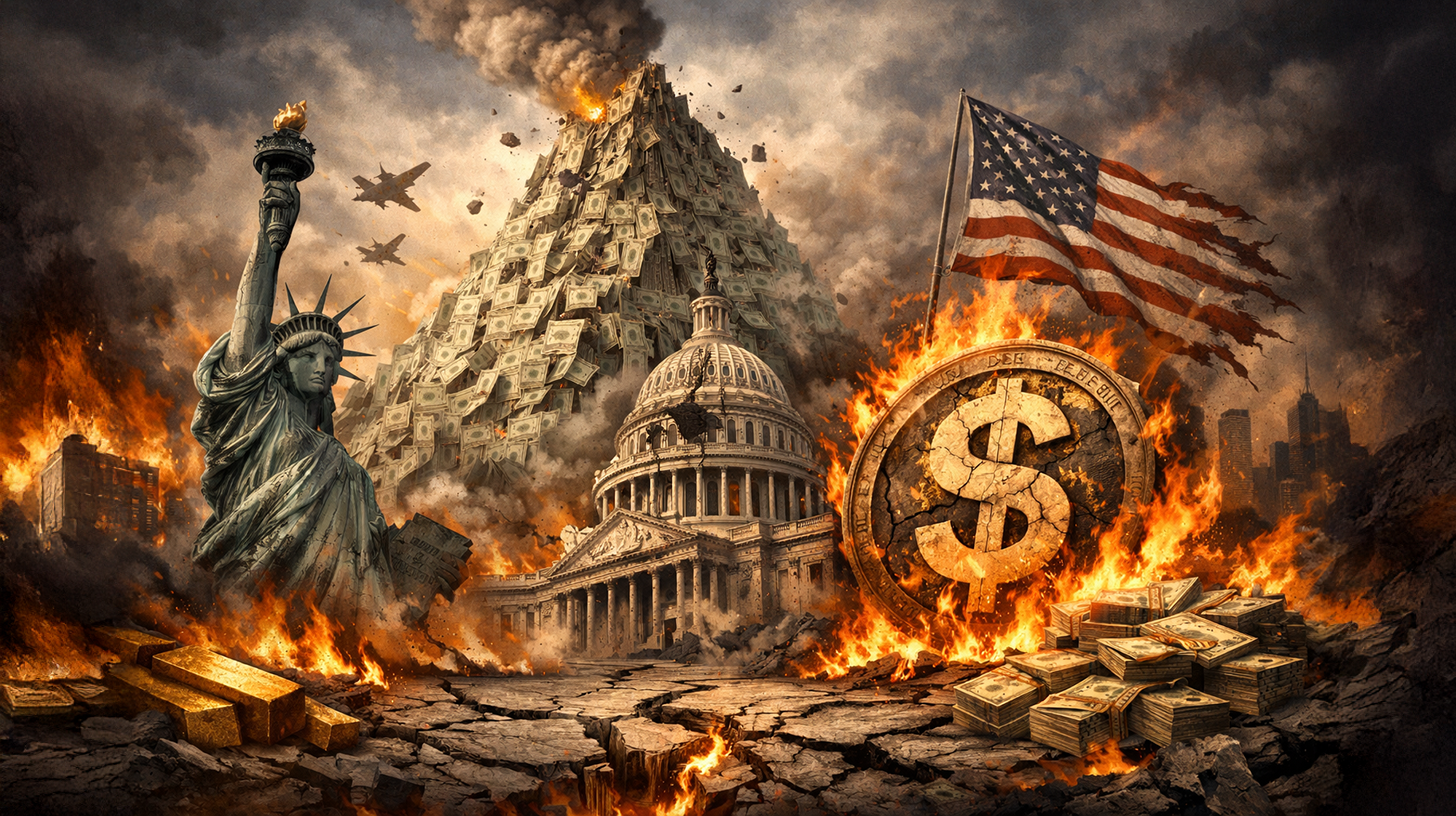
America's mountain of debt is becoming a systemic risk: Empires don't die from bankruptcies, but from inflation – Image: Xpert.Digital
Nobel laureate and investment legend agree: America's debt trap is unsolvable – and the markets are massively wrong
The creeping expropriation has long since begun – The silence of the financial markets: Why experts fear that the real crash has only been postponed
The United States is heading toward a financial crisis unprecedented in peacetime: With $38.4 trillion in debt and interest payments exceeding its gigantic defense budget for the first time, the superpower stands at a crossroads. Financial legend Ray Dalio and Nobel laureate Joseph Stiglitz both warn that the solution will not be austerity, but rather a gradual devaluation of the currency.
It's a sum that defies imagination: Every second, the American national debt grows by more than $70,000. What was long considered a theoretical problem for distant generations has arrived in the here and now. In fiscal year 2025, the US will have to spend almost 20 percent of its total tax revenue just to service its creditors' interest payments—money that will be lacking for investment, education, or infrastructure. While politicians in Washington argue about tariffs and hope to "grow out" of the crisis, leading economists paint a bleak picture of reality.
Both Ray Dalio, founder of the world's largest hedge fund Bridgewater, and Joseph Stiglitz, one of the most prominent critics of pure capitalism, despite their differing views, arrive at the same disturbing conclusion: the US is trapped in a debt spiral from which there is no painless escape. Dalio draws parallels to the collapse of past empires and warns of an "economic heart attack," while Stiglitz criticizes the naivety of the bond markets, which still massively underestimate the risk of a massive shock.
But the real danger is not outright sovereign default. History teaches us that highly indebted world powers choose a different path: the devaluation of their debts through inflation. This process of "creeping expropriation" has long since begun and is affecting savers and investors worldwide. The following analysis illuminates the development of a crisis that must not exist—and explains why gold and tangible assets could become the last bastion of wealth preservation in this new era of financial constraints.
Suitable for:

When 38 trillion dollars become a burden for a superpower – and experts agree that austerity is no longer a solution
The United States is sitting on a mountain of debt totaling $38.4 trillion. This figure grows by $6.12 billion every day, $255 million every hour, and more than $70,000 every second. What sounds like abstract accounting is, in reality, the creeping decline of what was once the undisputed economic power of the Western world. Ray Dalio, one of the most successful fund managers in history, is now warning of a systemic collapse. Joseph Stiglitz, Nobel laureate in economics, speaks of a debt trap that is still being dramatically underestimated by the markets. Both experts, who rarely agree otherwise, share a grim prognosis: This debt will not disappear through austerity. It will be reduced through currency depreciation—at the expense of those who still save, invest, or have invested their retirement savings in dollars.
The creation of a debt crisis that must not exist
In December 2025, the US national debt officially reached $38.4 trillion. Within just one year, the debt burden had increased by $2.23 trillion. As recently as October 2025, the national debt had stood at $38.09 trillion. The acceleration is dramatic: Outside of pandemic years, it had previously taken two months to exceed the $1 trillion mark. Today, it happens much faster.
The debt-to-GDP ratio stands at 124.3 percent. The Congressional Budget Office projects this ratio will rise to 118.5 percent by 2035—a figure that is misleading because it doesn't account for the dynamics already evident today. If alternative scenarios were considered, in which the US Supreme Court questions the legality of many tariffs or tax cuts are made permanent, the debt-to-GDP ratio would reach 134 percent in 2035. In that case, America would be not far from Japan's situation—but without the stabilizing factors that have allowed Japan to operate with a ratio exceeding 230 percent for decades.
The real problem isn't the absolute amount of debt. It's the interest payments. In fiscal year 2025, the US paid $970 billion in interest on its national debt. In effect, interest payments on public debt exceeded the $1 trillion mark for the first time. This amount now surpasses total defense spending. It accounts for 19 percent of all tax revenue. Put another way: For every dollar the government takes in, 19 cents go toward interest payments alone – before a single teacher is paid, a road is built, or a retiree receives any care.
Just five years ago, in 2020, the average interest rate on US national debt was 1.58 percent. Today it stands at 3.38 percent. That may sound like a small difference. But with a debt burden of $38 trillion, every single percentage point adds up. The Budget Office projects that annual interest payments will rise to $1.8 trillion by 2035. In scenarios that factor in permanent tax cuts and the loss of tariff revenue, interest payments could climb to $2.2 trillion by 2035. At that point, one-sixth of all government spending would be used solely to service debt.
Suitable for:

Three-quarters of the problem lies outside political control
The dilemma of American fiscal policy becomes particularly clear when one examines the structure of government spending. Eighty-three percent of total spending growth through 2035 is projected to fall into three categories: social security, healthcare programs, and interest payments. These categories are considered "mandatory spending"—that is, expenditures mandated by law that do not require annual congressional approval.
Social Security accounts for 28 percent of spending growth. Its share of GDP is projected to rise from 5.2 percent in 2025 to 6.0 percent in 2035. The system is consistently running at a loss. The trust funds that pay pensions are expected to be depleted by 2035. After that, only 83 percent of the promised benefits could be paid out—unless Congress intervenes. But any reform would mean either higher taxes or lower pensions, both of which are extremely unpopular politically.
Medicare and Medicaid, the government-run health insurance programs for older and lower-income Americans, account for 32 percent of healthcare spending growth. Medicare alone is responsible for 22 percent. Healthcare spending is projected to rise from 5.8 percent of GDP to 6.7 percent by 2035. A crisis of confidence is also looming: Medicare's funding is expected to be depleted by 2036. At that point, the program might only be able to cover 89 percent of healthcare costs.
The third pillar of growth is the interest payments themselves: 22 percent of spending growth is attributable to debt servicing. Interest payments will rise from $950 billion in 2025 to $1.8 trillion in 2035 – assuming that interest rates do not increase further and markets remain stable.
The so-called discretionary budget—that is, everything that must be flexibly approved annually, from education and infrastructure to research—now accounts for only about a quarter of the budget. Even if Congress were to cut this area to zero, the structural deficit would remain. The US could abolish its entire military, close all universities, and stop building highways—and would still have to take on hundreds of billions of dollars in new debt every year.
Dalio's historic warning: Empires do not fail through bankruptcy, but through inflation
Ray Dalio isn't a professional pessimist. The 76-year-old founded Bridgewater Associates, the world's largest hedge fund, with $154 billion in assets under management. He weathered the 2008 financial crisis with profits because he had foreseen the systemic collapse. His book on the great cycles of history, published in 2021, describes the rise and fall of world powers over the centuries. The patterns he identifies are clear: states that accumulate excessive debt rarely go bankrupt outright. Instead, they devalue their currencies.
Dalio draws historical parallels to the hyperinflation of the Weimar Republic in 1923, when the dollar's value climbed to 4.2 trillion marks. He points to the end of the Bretton Woods system in 1971, when President Nixon abandoned the dollar's peg to gold because US gold reserves had shrunk from 20,000 to 8,333 tons. Since then, the dollar has lost 83 percent of its purchasing power. A dollar from 1971 is now worth only 17 cents.
Dalio describes the typical progression of a debt crisis: Initially, states finance growth, the military, and social programs through loans. This works as long as the economy grows and lenders have confidence. At some point, however, the debt becomes too high, the interest burden too heavy, and the political conflicts too entrenched. At this point, according to Dalio, governments resort to a combination of artificially low interest rates and printing money. The central bank buys government bonds, lowers interest rates below the inflation rate, and ensures that the real debt burden shrinks—at the expense of everyone who holds assets in that currency.
This pattern has repeated itself time and again throughout history. In the early 1970s, inflation in the US was over 10 percent, while interest rates were artificially suppressed. It was only Paul Volcker, the chairman of the Federal Reserve, who halted the spiral by raising interest rates to 20 percent – thereby triggering a severe recession. Unemployment skyrocketed, companies went bankrupt, but inflation collapsed. Volcker had restored the currency's credibility by being willing to accept short-term pain. This worked because the debt burden was still manageable at the time. Today, it is no longer.
Dalio warns of a dead end: Politicians are relying on the markets to remain calm. The markets are hoping that politicians will act in time. Such situations rarely resolve themselves in a controlled manner. Crises develop gradually – until they suddenly become visible. In an interview, Dalio said that the US debt mountain will lead to an economic heart attack in the near future. His analogy is drastic, but apt: A heart attack doesn't come out of nowhere. The vessels become clogged over years. The symptoms are ignored. And when the collapse comes, it is often too late.
Stiglitz's criticism: The markets have not yet grasped the danger
Joseph Stiglitz, Nobel laureate in economics and one of the most vocal critics of current economic policy, formulated his warning more soberly, but no less emphatically. At a conference in Italy in September 2025, he explained that the bond markets were massively underestimating the true financial challenges facing the US. At that time, the interest rate on 30-year US Treasury bonds had briefly reached the psychologically important 5 percent mark – a level last seen in 2007, before the financial crisis.
Stiglitz is particularly critical of the Trump administration's naive notion that it could plug the exploding budget deficit with tariff revenue. Tariffs, Stiglitz argues, are like a pipe dream. Companies will restructure their supply chains to circumvent the high taxes. It's like gravity: companies will always find the route with the lowest tariffs. Tariff revenues may be high in the short term, but in the medium term they will plummet. The result: the financial situation of the US will be significantly worse than current forecasts suggest.
The figures bear out Stiglitz's assessment. The US budget deficit currently stands at over 6 percent of economic output and could rise to 7 percent. Jason Furman, a former economic advisor to President Obama, confirmed that the Trump administration essentially cemented an already problematic debt trajectory. The massive package of tax and spending bills will increase the deficit by $4.6 trillion over the next ten years. The tariffs Trump imposed in return are expected to generate $2.7 trillion in revenue—but only if the courts don't overturn them.
In August 2025, a federal appeals court declared large portions of Trump's tariffs illegal. The court ruled that the president had exceeded his authority by abusing emergency legislation to impose trade duties. The case is now before the Supreme Court. Should the court rule against the administration, Washington could be ordered to pay hundreds of billions of dollars in refunds. In that scenario, the deficit would grow even faster, the debt-to-GDP ratio would rise even more steeply, and the interest burden would become even heavier.
Stiglitz also warns of the global political consequences of this policy. The US, through its military intervention and threats against countries like Colombia, Cuba, and Venezuela, has introduced new uncertainty into the global economy. Should Trump continue his aggressive course, the world would inevitably head towards an economic order without US leadership. Countries that have relied on the dollar as their reserve currency would seek alternatives. And the markets would eventually react—not with a dramatic crash, but with a gradual shift that suddenly accelerates.
Our global industry and economic expertise in business development, sales and marketing

Our global industry and business expertise in business development, sales and marketing - Image: Xpert.Digital
Industry focus: B2B, digitalization (from AI to XR), mechanical engineering, logistics, renewable energies and industry
More about it here:
A topic hub with insights and expertise:
- Knowledge platform on the global and regional economy, innovation and industry-specific trends
- Collection of analyses, impulses and background information from our focus areas
- A place for expertise and information on current developments in business and technology
- Topic hub for companies that want to learn about markets, digitalization and industry innovations
The calm before the storm: What happens when the sleeping guardians of the financial market awaken?
The bond market as a sleeping guardian
The fact that the government bond markets have not yet rebelled is puzzling to many observers. In the 1990s, there was the term "bond vigilantes"—those investors who protested against inflationary policies by selling bonds and thus driving up interest rates for the government. When the Clinton administration accumulated large deficits in the early 1990s, interest rates on ten-year US Treasuries rose from 5.2 to over 8 percent. The government had to cut spending. Interest rates fell back to 4 percent.
Today, this discipline no longer seems to be working. The interest rate on ten-year government bonds fluctuates between 4.3 and 4.5 percent, even though the debt-to-GDP ratio has reached historic highs. Nervousness in the bond market has fallen to its lowest level in three and a half years. The markets don't seem worried. But why?
One reason is global demand. Despite all the problems, US Treasury bonds remain the easiest to trade and safest investment on global financial markets. Over $910 billion worth of US securities are traded daily. Central banks worldwide hold $12.54 trillion in dollar reserves. The dollar accounts for 57.8 percent of global currency reserves. The euro, the only significant alternative, accounts for 20.8 percent.
The second reason is the role of the US Federal Reserve (Fed). Between 2020 and 2022, the central bank purchased approximately $4.76 trillion worth of government bonds as part of its monetary policy. These purchases artificially suppressed interest rates and created artificial demand. Although the Fed has since ended this policy and reduced its holdings since June 2022, the reminder that the central bank can intervene in an emergency calms the markets.
The third reason is the lack of genuine alternatives. European government bonds are hardly more attractive, and the eurozone is grappling with its own problems. Chinese bonds are difficult for Western investors to access. Gold yields no interest. And private investments like stocks or corporate loans are more volatile. Thus, the dollar remains the currency to which people flee – even as the underlying data continues to deteriorate.
But this balance is fragile. Ray Dalio describes it as a stalemate: Policymakers assume the bond markets won't collapse. Markets assume policymakers will act in time. Both sides have reasons to postpone the crisis. But at some point, one side will lose its nerve first. And when that happens, things can escalate very quickly.
Suitable for:
The gradual loss of the dollar as the leading currency
Parallel to the growing debt burden, the global monetary order is changing. The dollar is slowly but steadily losing ground. Ten years ago, the American currency still accounted for roughly 67 to 70 percent of global currency reserves. Today, it's 57.8 percent. Forecasts from financial institutions predict that this share could fall to 52 percent by 2035. Sixty-three percent of global asset managers consider it realistic that the dollar will lose its role as the sole world reserve currency within the next ten to fifteen years.
The reasons for this development are manifold. One of them is the use of the dollar as a political weapon. When Iran was excluded from the international payment system SWIFT in 2012, its oil revenues collapsed. When Russia was cut off from SWIFT in 2022 after invading Ukraine, the US and its allies froze Russian reserves amounting to roughly half of the total. These measures were effective—but they had an unintended side effect: countries worldwide began to reconsider their dependence on the dollar.
Russia now conducts 90 percent of its trade within the BRICS countries in national currencies. China and India have signed trade agreements that use the yuan and the rupee, respectively, instead of going through the dollar. Brazil and China signed an agreement in 2023 to settle trade in yuan and real. Saudi Arabia, which for decades sold oil exclusively in dollars, is now considering accepting other currencies. In 2023, one-fifth of all oil transactions were already settled in currencies other than the dollar—something that would have been unthinkable just a few years ago.
The BRICS countries are working on their own payment system to serve as an alternative to SWIFT. So far, no fully unified system exists, but Russia's and China's own networks already offer functioning alternatives. China has introduced its digital yuan, and Brazil is working on a digital real. The expansion of the BRICS group to include countries like Indonesia and the United Arab Emirates opens up additional possibilities for users of these systems.
It would be wrong to claim that the dollar is on the verge of collapse. Its dominance is based not only on the economic power of the US, but also on the size and tradability of American financial markets, political stability, and decades of built-up trust. But the decline has begun. And every new sanction, every new threat, every new demonstration of American financial power accelerates this process.
The creeping expropriation has long since begun
While politicians debate tax cuts and economists argue about deficits, the real redistribution is already happening – quietly, invisibly, and highly effectively. Since 1971, the end of the gold standard, the dollar has lost 83 percent of its purchasing power. Someone who saved one hundred dollars in 1971 can now only buy what would have cost 17 dollars back then. Inflation has eaten away the rest.
This trend doesn't affect everyone equally. Those who hold their wealth in real estate, stocks, or gold have been able to escape devaluation—or even profit from it. Between 1989 and 2022, a household in the wealthiest 1 percent gained an average of $8.35 million in wealth. A household in the bottom 20 percent gained less than $8,500. Today, the wealthiest 1 percent owns nearly half of all stocks in the US. The poorer half of the population owns just 1.1 percent.
Real wages for American workers have barely changed since the 1970s. Adjusted for inflation, the average hourly wage today has the same purchasing power as in 1978. The peak was in January 1973, at the equivalent of $23.68 in today's purchasing power. The minimum wage, which was $9.58 then in today's purchasing power, is now worth about $7.25 in real terms. Had it kept pace with productivity, it would have to be over $18.
The concentration of wealth has intensified dramatically. In 1970, the top tenth of the income scale earned 6.9 times as much as the bottom tenth. By 2016, this factor had risen to 8.7. The wealth of the richest 1 percent reached a record $52 trillion in the second quarter of 2025—an increase of $4 trillion in a single year. The top tenth now holds 67 percent of total household wealth.
This gap isn't opening by chance. It's the result of a monetary policy that systematically drives up asset values while eroding the purchasing power of wages. Between 2020 and 2021, the money supply (cash and deposits) increased by 27 percent—the largest increase since records began in 1959. The Federal Reserve bought $4.76 trillion in Treasury securities. This new money didn't flow into workers' pockets, but into the financial markets. Stocks rose, real estate prices skyrocketed. Those with assets got richer. Those without saw their savings dwindle.
Dalio's recipe: Gold, inflation-protected bonds, and broad diversification
Given these prospects, Ray Dalio recommends a clear strategy. Investors should hold approximately 15 percent of their portfolio in gold. In Dalio's view, gold is one of the few investments that performs well when the traditional parts of a portfolio decline. At an economic forum in October 2025, he explained that gold is an excellent hedge because most other assets depend on credit. When confidence in the solvency of states diminishes, gold rises.
Besides gold, Dalio recommends inflation-linked US Treasury bonds (TIPS). These bonds protect real value because their payout is tied to the inflation rate. When prices rise, so do the returns. Dalio's second key element is diversification: investors should ideally use around 15 independent investment sources. Not one big bet, but many small ones moving in different directions. And one more piece of advice that will likely resonate with many private investors: short-term trading is a zero-sum game where most end up losing money.
Dalio points to the 1970s as a historical precedent. At that time, the dollar's gold standard was abandoned, inflation soared above 10 percent, and real interest rates remained negative (lower than inflation) for years. Investors who focused solely on the paper value of their money suffered massive losses. Only those who invested in tangible assets like gold or real estate were able to preserve their purchasing power. Dalio believes we are currently in a similar phase – only with the crucial difference that today the debt burden is much higher and political room for maneuver is far more limited.
The historical parallels are unmistakable
History offers little comfort to countries caught in such a debt spiral. The Weimar Republic financed the aftermath of World War I through massive money printing. In November 1923, one dollar cost 4.2 trillion marks. Money lost its function as a medium of exchange. People paid with wheelbarrows full of banknotes. Those with savings were ruined overnight. Those with debts were rid of them. Social order collapsed. The political consequences were devastating.
The United States in the 1970s offered a milder version of the same pattern. President Nixon ended the gold standard in 1971 because US gold reserves were rapidly dwindling. Other countries, most notably France, had begun exchanging their dollar holdings for gold. The US faced a choice: either abandon its gold reserves or devalue the dollar. Nixon chose devaluation. The dollar lost significant value against other currencies. Inflation soared. Paul Volcker, the new head of the Federal Reserve, put an end to this in 1979 by raising interest rates to 20 percent. The economic crisis was brutal, but inflation was defeated.
The difference lies in the starting point. In 1979, the US debt-to-GDP ratio was around 30 percent. Today it stands at 124 percent. Back then, the government could afford to pay high interest rates because the absolute debt burden was low. Today, raising interest rates to 10 percent or more would be financial suicide. The interest payments would explode, and the budget would become unsustainable. The remedy of the past would kill the patient today.
Japan demonstrates that high debt ratios can be sustainable for decades – under certain conditions. Japanese debt stands at approximately 235 percent of its economic output. However, 88 percent of this debt is held domestically, almost half of it by the central bank. Interest rates are near zero. The population has a high level of confidence in the stability of the system. This social cohesion makes the burden bearable.
The US does not have these conditions. A significant portion of its debt is held abroad. Interest rates are not at zero, but at over 3 percent – and rising. Public trust in institutions is eroding. Political polarization has reached a level reminiscent of the 1930s. In such an environment, it is difficult to implement the painful reforms needed to stabilize the finances.
The illusion of a painless solution
Politicians on both sides of the political spectrum cling to the hope of a painless solution. Some are banking on economic growth, which they believe would automatically lower the debt-to-GDP ratio. But even under optimistic assumptions, the debt burden is growing faster than the economy. Others are relying on tariffs and reshoring production to generate revenue and reduce dependence on imports. But as Joseph Stiglitz warns, tariff revenues are unreliable and easily circumvented.
The Trump administration's massive tax and spending package is the latest example of this illusion. The legislation cuts taxes, increases spending, and hopes to fill the gap with tariffs. But even if all the tariffs remain legal, they would generate $2.7 trillion over ten years—while the legislation itself costs $4.6 trillion. The math doesn't add up. And if the Supreme Court overturns the tariffs, the shortfall will only grow.
The real question isn't whether the debt will be reduced. The question is how it will be reduced—and at whose expense. Historically, there are three ways: First, harsh spending cuts and tax increases. This only works if the population is willing to tighten their belts and politicians have the courage to make unpopular decisions. In the current US political landscape, that's hard to imagine. Second, economic growth so strong that it automatically reduces the debt burden. This, too, is unrealistic as long as the underlying problems—an aging population, stagnant productivity, and growing inequality—remain unresolved. Third, inflation. If prices rise and wages keep pace, the real value of the debt shrinks. The creditors foot the bill.
Ray Dalio and Joseph Stiglitz agree: The third way is the most likely. Not because it's the best, but because it's the simplest. Inflation is a silent tax that doesn't require a majority in Congress. It primarily affects those without a lobby: savers, retirees, and people with stable incomes. The political costs are low as long as inflation doesn't spiral out of control. And as long as the central bank is willing to play along, it can continue.
The end of an era
Since 1945, American hegemony has rested on three pillars: military superiority, economic dynamism, and the role of the dollar as the world's reserve currency. The first two pillars are already weakened. The third is beginning to falter. The dollar will not disappear overnight. The system is too complex, the inertia too great, the alternatives too weak. But the direction is clear.
What Ray Dalio describes as the cycle of empires is nothing other than the mechanics of rise and fall. States rise because they are productive, innovative, and disciplined. They fall because they become arrogant, wasteful, and divided. The USA has completed the first phase. The second is underway.
For investors, this means a fundamental reassessment. The assumption that US Treasury bonds are the safest investment in the world no longer holds true without reservation. The assumption that the dollar will retain its purchasing power has been refuted. The assumption that the central bank can control inflation without destroying the economy is questionable.
Joseph Stiglitz puts it bluntly: There should have been a major crash long ago. The fact that it hasn't happened isn't because the risks have disappeared. It's because the markets haven't yet priced in those risks. Eventually, they will. And then it will become clear whether Ray Dalio's comparison to an economic heart attack was merely rhetorical exaggeration—or a precise diagnosis.
The next few years will be crucial. Either the US manages to turn things around – through painful reforms, political courage, and social consensus. Or the debt spiral continues, inflation returns, interest rates rise, and the creeping expropriation continues. In both scenarios, the same people ultimately pay the price: those who have no choice but to protect their assets because they have none. And those who believe they are safe in government bonds and savings accounts – while the purchasing power of their savings shrinks year after year, silently and inexorably.
Your global marketing and business development partner
☑️ Our business language is English or German
☑️ NEW: Correspondence in your national language!

Konrad Wolfenstein
I would be happy to serve you and my team as a personal advisor.
You can contact me by filling out the contact form or simply call me on +49 7348 4088 965 (Munich) . My email address is: wolfenstein ∂ xpert.digital
I'm looking forward to our joint project.
☑️ SME support in strategy, consulting, planning and implementation
☑️ Creation or realignment of the digital strategy and digitalization
☑️ Expansion and optimization of international sales processes
☑️ Global & Digital B2B trading platforms
☑️ Pioneer Business Development / Marketing / PR / Trade Fairs
🎯🎯🎯 Benefit from Xpert.Digital's extensive, five-fold expertise in a comprehensive service package | BD, R&D, XR, PR & Digital Visibility Optimization

Benefit from Xpert.Digital's extensive, fivefold expertise in a comprehensive service package | R&D, XR, PR & Digital Visibility Optimization - Image: Xpert.Digital
Xpert.Digital has in-depth knowledge of various industries. This allows us to develop tailor-made strategies that are tailored precisely to the requirements and challenges of your specific market segment. By continually analyzing market trends and following industry developments, we can act with foresight and offer innovative solutions. Through the combination of experience and knowledge, we generate added value and give our customers a decisive competitive advantage.
More about it here:










