
No numbers, no clue? America's economy flying blind: Why missing data could now trigger a global crisis
Xpert pre-release

Available in 27 languages 📢
Prefer Xpert.Digital on GoogleⓘPublished on: October 16, 2025 / Updated on: October 16, 2025 – Author: Konrad Wolfenstein
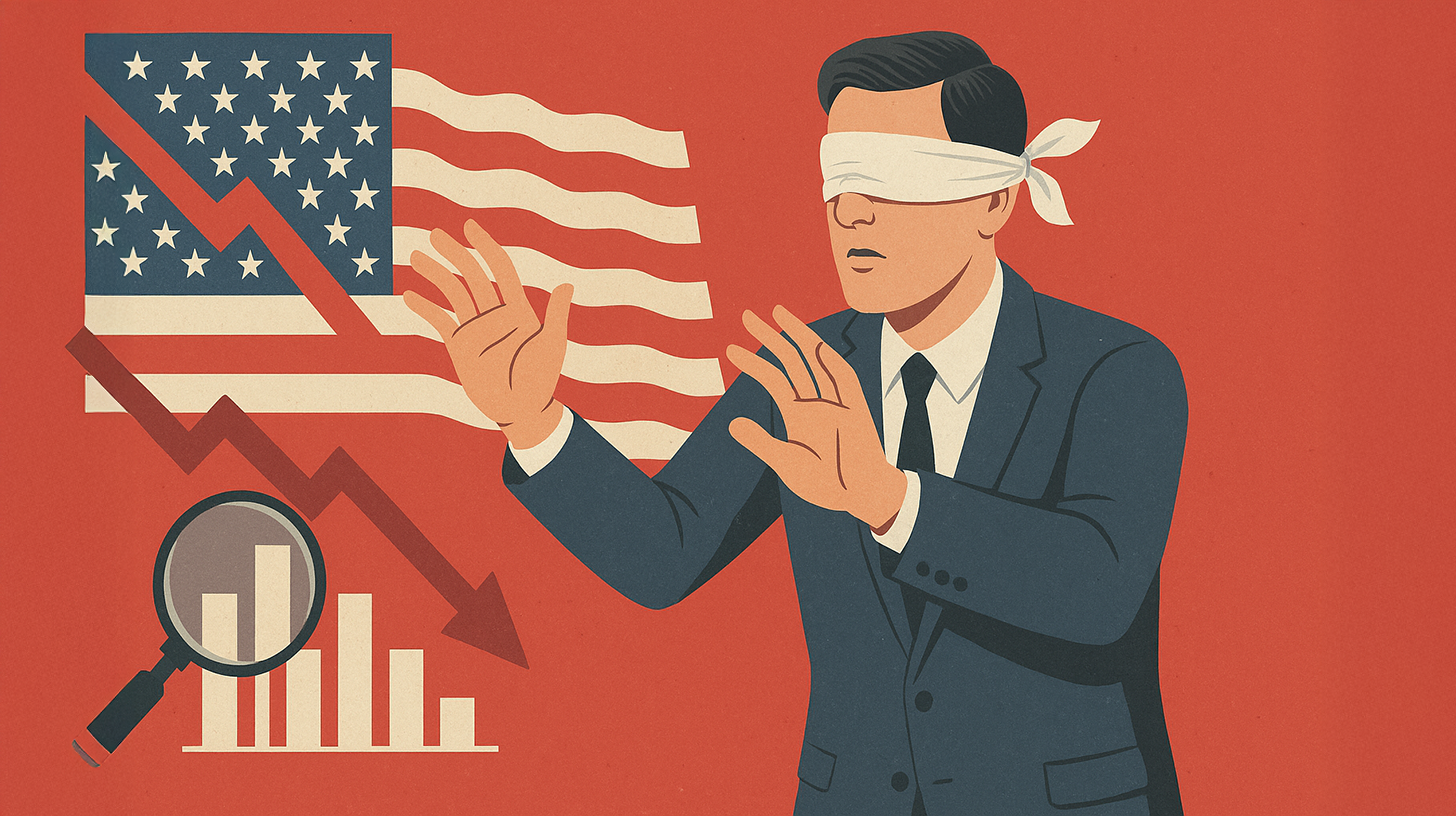
No numbers, no clue? America's economy flying blind: Why missing data could now trigger a global crisis – Image: Xpert.Digital
Political chaos in the USA: The shutdown paralyzes economic analysis at an inopportune time
Standstill in Washington, panic on Wall Street: What happens when the most important economy loses its data?
The world's largest economy is in a precarious situation. While economists, central bankers, and investors desperately search for reliable information on the state of the American economy, one of its most important data sources remains blocked. The US federal government shutdown, which has been ongoing since October 1, 2025, has brought the release of critical economic data to a standstill and raises a fundamental question: How do you steer an economy when you don't know where it's headed?
This information gap hits the United States at a particularly inopportune moment. The labor market is showing clear signs of weakness, while tariff-related inflationary pressures are pushing up prices. The Bureau of Labor Statistics, which normally provides accurate monthly data on employment and inflation, has had to suspend its publications. The Consumer Price Index, scheduled for October 15, has been postponed to October 24, and the September labor market report has been canceled without replacement.
This analysis examines the multifaceted consequences of this self-inflicted information crisis. It illuminates the historical roots of government shutdowns, explains the complex mechanisms of the data crisis, analyzes the current impact on the economy and markets, presents concrete case studies, discusses critical controversies, and ventures a look ahead to possible developments. It will become clear that this shutdown is more than a political stalemate: It is a dangerous experiment with economic stability in an already fragile phase.
The Anatomy of American Budget Crises
Government shutdowns are not a new phenomenon in the American political landscape. Since 1980, the United States has experienced 20 funding gaps, 11 of which resulted in actual business interruptions. However, the frequency and intensity of these crises have changed, reflecting the increasing polarization of American politics.
The roots of the problem lie in the Antideficiency Act, a law that prohibits federal agencies from operating without authorized appropriations. What was originally intended as a fiscal discipline measure became an instrument of political showdowns. The longest shutdown in US history lasted a full 35 days, from December 2018 to January 2019, and cost the American economy at least eleven billion dollars, three billion of which were permanently lost.
However, the current shutdown differs from its predecessors in several respects. First, it affects approximately 1.4 million federal employees, of whom approximately 750,000 have been furloughed and another 650,000 are working without pay. Second, it hits the economy at a particularly vulnerable stage. While previous shutdowns often occurred during more economically stable times, the US economy is currently struggling with a toxic mix of weak labor market growth and persistent inflation.
Third, this shutdown is characterized by unprecedented political hardening. The dispute is not about individual budget items or project funding, but about fundamental questions of healthcare and presidential spending powers. Democrats insist on extending expanded health insurance subsidies under the Affordable Care Act, which expire at the end of 2025. These subsidies currently provide affordable health insurance to over 22 million Americans. Republicans, on the other hand, favor a "clean" continuation resolution without additional spending and promise to negotiate the healthcare issues later.
Historically, shutdowns last an average of eight days, with a median of four. The current shutdown has already exceeded the two-week mark and shows no signs of being resolved anytime soon. Forecast markets indicate that the lockdown could last 30 days or longer.
The mechanics of data eclipse
To understand the magnitude of the current situation, one must grasp the complex infrastructure of American economic statistics. The Bureau of Labor Statistics, the Bureau of Economic Analysis, and the Census Bureau form the backbone of economic data collection in the United States. These agencies collect, process, and publish a dense network of information on employment, inflation, consumer spending, retail sales, housing starts, and dozens of other indicators every month.
The shutdown interrupts this data flow at several critical points. First, the data collection itself stops. Surveys of households and businesses are suspended, and price surveys in stores are canceled. Then, data processing is halted. The few remaining employees are insufficient to calculate the complex statistical models that transform raw data into reliable economic indicators. Finally, publication is suspended. Even data already collected remains locked away by the authorities.
The impact varies depending on the data category. The monthly employment report, usually published on the first Friday of the month, is considered the "gold standard" of labor market data. It is based on two separate surveys: a household survey of approximately 60,000 households and an establishment survey of approximately 145,000 employers. The complexity of this data collection means that delayed reports are difficult to catch up on.
The Consumer Price Index follows a similarly complex process. BLS staff collect approximately 80,000 prices each month in 75 urban areas for thousands of goods and services. The shutdown meant that for September, only month-end prices could be collected, not across the entire month. This leads to distortions in the data and complicates comparisons with previous months.
The Federal Reserve, which relies on this data to make its interest rate decisions, faces a dilemma. Fed Chairman Jerome Powell admitted that the central bank has sufficient information for its upcoming meeting at the end of October, but warned that if the shutdown continues, "we're going to start missing that data, especially for October." The Fed must now navigate its monetary policy at a time when it must balance two opposing risks: the threat of further labor market weakness against persistent above-average inflation.
The gap in the official data forces analysts to turn to alternative sources. The automated data processing company ADP publishes its own employment figures, but these are considered less comprehensive. The Federal Reserve Bank of Cleveland operates an "inflation nowcasting" model that uses daily oil and weekly gasoline prices to generate current inflation estimates. Private data providers such as Homebase, Indeed, and the University of Michigan Consumer Sentiment Survey provide fragments of the overall picture.
But these alternatives have serious weaknesses. They only cover parts of the economy, use different methodologies, and are often more volatile than official statistics. Paul Donovan, chief economist at UBS, warned that in the absence of official data, Wall Street could rely on "rumors" and unreliable surveys. There is a risk that markets will react to distorted or incomplete information, thereby generating additional volatility.
Stagflation and uncertainty
The American economy was already in a precarious situation before the shutdown. Now, the information gap is dramatically exacerbating the uncertainty. At the center of this is a worrying development: the signs of burgeoning stagflation, that toxic mix of economic stagnation and rising prices that economists and politicians alike fear.
Labor market data from August and September, released before the shutdown, painted a bleak picture. Only 22,000 new jobs were created in August, and revisions showed that jobs were actually lost in June. The ADP report for September, released during the shutdown, revealed a decline of 32,000 private-sector jobs—the sharpest drop since March 2023. While the unemployment rate is historically low at 4.1 percent, it has risen by 0.3 percentage points since October 2024.
At the same time, inflation continues to weigh on American households. Consumer prices rose by 2.9 percent year-on-year in August, the highest level since January. The core Consumer Price Index, which excludes volatile energy and food prices, was 2.9 percent in August, well above the Federal Reserve's 2 percent target. The main drivers of this inflation are tariff-related price increases on goods, particularly motor vehicles, which are considered "ground zero" for the impact of tariffs.
The Federal Reserve faces the difficult task of navigating these conflicting signals. In September, it lowered its benchmark interest rate by 0.25 percentage points to a range of 4.0 to 4.25 percent. Analysts expect a further cut of 0.25 percentage points at its meeting in late October. But Powell repeatedly emphasized that "there is no risk-free path as we navigate the tension between our employment and inflation goals."
Harvard economist Jason Furman succinctly summarized the dilemma: "The whiff of stagflation is growing stronger. Given the current situation, the Fed has limited options." If the Fed cuts interest rates too aggressively to support the labor market, it risks a revival of inflation. If it keeps interest rates too high to combat inflation, it risks an acceleration of the economic slowdown.
The shutdown significantly exacerbates this challenge. Without current data on employment and inflation, the Fed must make its policy based on outdated or incomplete information. Kenneth Kuttner, economics professor at Williams College, put it succinctly: "This is probably the worst time for the Fed to be flying blind. The economy could be at a tipping point."
The economic costs of the shutdown itself add to these problems. Economists estimate that each week of the shutdown reduces gross domestic product by approximately 0.1 to 0.25 percentage points. The Congressional Budget Office calculated that the 35-day shutdown of 2018-2019 reduced GDP by 0.1 percentage points in the fourth quarter of 2018 and by 0.2 percentage points in the first quarter of 2019, resulting in permanent losses of approximately three billion dollars.
The current shutdown could be even more costly. Real Economy by RSM Economics warned that after the first missed paycheck for federal workers, the impact would increase "nonlinearly." The 1.4 million affected federal employees represent about 1 percent of the US workforce, but their reduced spending is triggering a chain reaction through the economy. Retailers are seeing lower sales, leading to layoffs or reduced hours, which in turn further dampens consumption.
Concrete effects in reality
The abstract numbers and macroeconomic trends are manifesting in concrete hardships for millions of Americans. Two case studies particularly vividly illustrate the diverse impacts of the shutdown: the situation of federal employees and the situation in the healthcare sector.
The first case concerns the Washington Metropolitan Area, where the concentration of federal employees is highest. The furlough of 145,000 federal employees and 112,500 federal contractors is costing the regional economy $119 million daily, or 7.3 percent of the region's total economic output. This reduced GDP in the Washington, D.C., metropolitan area alone by over $2.8 billion during the last major shutdown.
The impact isn't limited to the Capital Region. In Prince George's County, Maryland, where over 60 percent of federal employees are African American, local restaurants are reporting empty tables, mortgage lenders are fielding desperate calls from furloughed workers, and daycare centers are losing customers. The Federal Reserve found that 37 percent of American households are unable to cover an unexpected $400 expense without selling something or borrowing money. Given an average weekly loss of $1,662 for the 1.4 million affected federal employees, it's clear that most are unable to pay their regular bills.
Food insecurity is measurably increasing. Food banks in Washington, D.C. and Northern Virginia reported an increase in visitors of about 10 percent, with most of the additional clients being federal employees and contract workers. The impact is also hitting the travel industry: During the last shutdown, many air traffic controllers and TSA employees began calling in sick, leading to widespread delays across the country.
The second illustrative case concerns the healthcare sector and health insurance subsidies. At the center of the shutdown dispute are expanded subsidies under the Affordable Care Act, which expire at the end of 2025. These subsidies helped keep health insurance costs affordable for millions of Americans during the COVID-19 pandemic.
Without an extension of these subsidies, premiums for subsidized policyholders would rise by an average of 114 percent, from $888 to $1,902 annually, according to the Kaiser Family Foundation. In twelve states, premiums would more than double. For a typical family of four earning $60,000, the monthly premium would rise from approximately $410 to $880—an additional burden of over $5,600 per year.
The timing exacerbates the problem. The open enrollment period for health insurance begins on November 1 in most states. Consumers will soon be able to see their 2026 premiums, and the dramatic increases could deter many from enrolling. About 24 million people were insured through ACA marketplaces in 2025, twice as many as in 2021 before the expanded subsidies. About 92 percent of these insured benefit from subsidies.
The political arithmetic is brutal. According to the Congressional Budget Office, a permanent extension of the expanded subsidies would cost the federal budget approximately $350 billion between 2026 and 2035. Republicans argue that this is too expensive and also subsidizes wealthier households that can afford insurance. Democrats counter that the subsidies reduce medical debt, lower the number of uninsured people, and ultimately save lives.
Our US expertise in business development, sales and marketing

Our US expertise in business development, sales and marketing - Image: Xpert.Digital
Industry focus: B2B, digitalization (from AI to XR), mechanical engineering, logistics, renewable energies and industry
More about it here:
A topic hub with insights and expertise:
- Knowledge platform on the global and regional economy, innovation and industry-specific trends
- Collection of analyses, impulses and background information from our focus areas
- A place for expertise and information on current developments in business and technology
- Topic hub for companies that want to learn about markets, digitalization and industry innovations
Data slump and Fed dilemma: The economic consequences of the shutdown
Blame and system weaknesses
The shutdown crisis reveals deeper structural problems in the American political system. The direct responsibilities are disputed, but the underlying dysfunctions are obvious.
Republicans control both the House of Representatives and the Senate and provide the president—theoretically a position of strength. Nevertheless, they have failed to get a funding bill through the Senate because they cannot secure the 60 votes needed to overcome a filibuster. The Republican offer of a "clean" continuation resolution until November 21 has been rejected nine times in the Senate, most recently by a vote of 55 to 45—enough for a simple majority, but not the required supermajority.
The Democrats, for their part, consistently blocked the Republican proposal, insisting on the immediate inclusion of health insurance subsidies in any funding agreement. Their counterproposals, which would have extended the measure until the end of October with expanded health spending of $1 trillion, also failed. Only Senator John Fetterman of Pennsylvania repeatedly broke from the Democratic line and voted for the Republican proposal.
The Trump administration exacerbated tensions with unprecedented measures. President Trump announced that he might permanently lay off the furloughed employees instead of rehiring them after the shutdown as usual. Russell Vought, the director of the Office of Management and Budget, signaled that the shutdown presented an opportunity to permanently downsize the federal apparatus. Trump himself called the shutdown an "unprecedented opportunity" to target "democratic agencies."
Ethical and legal concerns exacerbated the controversies. Government websites and email autoresponders blamed "the radical left" for the shutdown—actions that ethics experts called likely illegal, violating the Anti-Lobbying Act and possibly the Hatch Act. The Department of Education forcibly altered employees' out-of-office messages to blame Democrats, without allowing employees to remove the partisan messages.
Trump posted an AI-generated deepfake video depicting Senator Chuck Schumer and House Minority Leader Hakeem Jeffries in an offensive manner, further poisoning the atmosphere. These tactics mark an escalation from previous shutdowns, in which federal agencies maintained at least the appearance of partisan neutrality.
The structural problems run deeper. The United States is unique among developed democracies in its vulnerability to government shutdowns. Other countries with parliamentary systems experience government crises but not business interruptions, as the government is automatically overthrown if it fails to pass the budget. The American system of checks and balances, in contrast, creates the possibility of persistent deadlocks without clear resolution mechanisms.
The reliance on time-limited programs like the expanded ACA subsidies exacerbates the problem. Lawmakers chose limited durations to control costs, but this approach now forces Congress to repeat the same debate year after year. When extension deadlines coincide with larger funding disputes, critical benefits can expire—not because lawmakers consciously decided to end them, but because broader budget conflicts leave no room for compromise.
Jamie Dimon, CEO of JPMorgan Chase, warned of a wider loss of trust. In a BBC interview, he stated that the US had become a "less reliable" ally on the world stage. The International Monetary Fund, in its World Economic Outlook of October 14, explicitly warned of the dangers of political interference in technocratic institutions: "Intensified political pressure on political institutions could undermine hard-won public confidence in their ability to fulfill their mandates. Pressure on technocratic institutions charged with data collection and dissemination could also undermine public and market confidence in statistics from official sources, significantly complicating the tasks of central banks and policymakers."
Scenarios and turning points
The future of the shutdown and its economic consequences remain highly uncertain. Several scenarios are conceivable, each with different implications for the American and global economy.
The optimistic scenario calls for an agreement within the next week. Historically, shutdowns have lasted a median of only four days, and political pressure—missed paychecks, closed national parks, poor poll numbers—has often led to quick resolutions. If this shutdown ends similarly, the economic damage would be minimal and largely reversible. Furloughed employees would return and receive their back pay, delayed spending would be caught up, and data releases could resume relatively quickly.
However, current political dynamics point to a more stubborn stalemate. Height Securities estimates the probability that the shutdown will extend into next week at over 50 percent. Forecast markets point to a duration of 30 days or more. Senator Lisa Murkowski diagnosed a "lack of trust" between the parties as a key obstacle. Without this trust, both sides will remain entrenched in their positions.
A medium scenario envisions a shutdown lasting four to six weeks. In this case, the economic costs would rise significantly. RSM Economics estimates that the impact on GDP would increase from an initial 0.1 percent per week to 0.25 percent per week once paychecks stop arriving. A one-month shutdown could therefore cost about 1 percent of GDP. The unemployment rate could rise toward 4.5 to 4.7 percent, especially if businesses dependent on federal spending lay off employees.
The data gap would be particularly problematic in this scenario. The Federal Reserve would have to make its interest rate decisions in October and possibly December based on severely limited information. Jerome Powell indicated that this was feasible, but warned of increasing difficulties with a prolonged shutdown. The quality of the economic data for October and November would be permanently compromised because important surveys could not be conducted or could only be conducted partially.
The pessimistic scenario envisions a shutdown lasting several months or only being temporarily resolved before a new crisis erupts. The current Republican offer provides funding only until November 21. Even if that deadline is met, the next budget crisis looms imminently. In this scenario, the American economy would potentially slide into recession. Business investment, already declining, would collapse further. Consumer spending, previously surprisingly resilient, would collapse under the weight of declining employment and rising uncertainty.
The international repercussions in this scenario would be significant. The Bank of Japan and other central banks around the world rely on US economic data to manage their own economies. BOJ Governor Kazuo Ueda called the data gap a "serious problem" and hoped for a speedy resolution. A Japanese policy official called it "a joke" that Fed Chairman Powell described his policy as "data-dependent" while no data was available.
Catherine Mann of the Bank of England Policy Committee noted that while the controversies surrounding US data and the Fed's independence do not directly affect BOE policy debates like trade policy shifts, they are nevertheless undermining confidence. Adam Posen, president of the Peterson Institute for International Economics and a former BOE member, warned that the shutdown is contributing to "general skepticism about US governance and US reliability," which ultimately affects reserve management, currency decisions, and the outlook for volatility.
In the long term, this crisis could lead to structural changes. Reliance on private data sources could increase even after the shutdown ends. Analysts at Charles Schwab speculated that alternative data sources could remain popular alongside official releases, given heightened concerns about the effectiveness of government data and low response rates for many survey-based data points.
The political landscape could also shift. If the shutdown becomes particularly painful, this could increase public support for structural reforms—such as automatic continuation resolutions or changes to the filibuster rules in the Senate. Conversely, a prolonged shutdown without clear accountability could further deepen political apathy and distrust in institutions.
The dangerous simultaneity of crisis and blackout
The US shutdown in October 2025 represents more than just another episode of political dysfunction in Washington. It is a dangerous experiment with economic stability at a particularly inopportune time. The American economy is already navigating the pitfalls of emerging stagflation—weak growth with persistent inflation—and now it is being deprived of the informational basis essential for proper management.
Historical analysis shows that while shutdowns are recurring phenomena, their costs are not trivial. The 35-day shutdown of 2018-2019 cost the American economy $11 billion, with $3 billion in permanent losses. The current shutdown has already exceeded the two-week mark and shows no signs of being resolved soon, suggesting potentially higher costs.
The mechanical impact on data availability is uniquely severe. Previous shutdowns often hit the economy during more stable periods or involved less critical data releases. The current shutdown hits an economy at a tipping point, depriving policymakers of reliable information at the very time they need it most. The Federal Reserve must make interest rate decisions that balance inflation control with labor market support, without the usual monthly updates on employment and prices.
The tangible impacts on millions of American households are already being felt. Federal employees are missing paychecks, local economies are suffering from reduced spending, and the threat of doubling health insurance premiums for over 20 million people hangs like a sword of Damocles over the healthcare system. These human costs add up to macroeconomic effects that extend far beyond the directly affected sectors.
This critical analysis reveals deeper systemic weaknesses. The unprecedented politicization of government agencies, the instrumentalization of economic data for partisan messaging, and the loss of trust between political camps signal a dangerous erosion of institutional norms. International observers note these developments with concern, and the International Monetary Fund explicitly warns of the dangers of political interference in technocratic institutions.
Future scenarios range from a quick agreement with limited damage to a months-long stalemate that could push the American economy into recession. The most likely outcome probably lies somewhere in between: a shutdown lasting several weeks, causing measurable but not catastrophic economic costs, followed by a short-term solution that merely postpones the core conflicts until the next budget crisis.
What this crisis ultimately reveals is a fundamental tension in the American political system. The ability to maintain basic government functions should not depend on tactical maneuvering in budget negotiations. The production of reliable economic statistics is a public good that should be above partisan infighting. When these basic functions become the pawn of political disputes, it threatens not only short-term economic stability but also long-term trust in the institutions upon which modern economies depend.
Jerome Powell succinctly expressed the dilemma: "There is no risk-free path for policy as we navigate the tension between our employment and inflation goals." This statement applies not only to monetary policy, but to all American economic policy during this critical phase. The decisions of the coming weeks will determine whether the world's largest economy navigates smoothly through this turbulent period or whether the self-inflicted information darkness leads to more serious misjudgments whose costs will reverberate for years to come.
The situation is reminiscent of a metaphor analysts have repeatedly used: The American economy is flying blind through a storm. The storm—the stagflationary tendencies, the tariff-induced price shocks, the labor market weakness—is real and dangerous enough. The fact that the pilots are now also losing their instruments makes an already precarious situation potentially catastrophic. Whether the landing is successful or ends in a crash will be decided in the coming weeks. The only thing that is certain is that the shutdown has measurably increased the likelihood of a bad outcome.
Your global marketing and business development partner
☑️ Our business language is English or German
☑️ NEW: Correspondence in your national language!

Konrad Wolfenstein
I would be happy to serve you and my team as a personal advisor.
You can contact me by filling out the contact form or simply call me on +49 7348 4088 965 (Munich) . My email address is: wolfenstein ∂ xpert.digital
I'm looking forward to our joint project.
☑️ SME support in strategy, consulting, planning and implementation
☑️ Creation or realignment of the digital strategy and digitalization
☑️ Expansion and optimization of international sales processes
☑️ Global & Digital B2B trading platforms
☑️ Pioneer Business Development / Marketing / PR / Trade Fairs
🎯🎯🎯 Benefit from Xpert.Digital's extensive, five-fold expertise in a comprehensive service package | BD, R&D, XR, PR & Digital Visibility Optimization

Benefit from Xpert.Digital's extensive, fivefold expertise in a comprehensive service package | R&D, XR, PR & Digital Visibility Optimization - Image: Xpert.Digital
Xpert.Digital has in-depth knowledge of various industries. This allows us to develop tailor-made strategies that are tailored precisely to the requirements and challenges of your specific market segment. By continually analyzing market trends and following industry developments, we can act with foresight and offer innovative solutions. Through the combination of experience and knowledge, we generate added value and give our customers a decisive competitive advantage.
More about it here:










