
Not ChatGPT: This secretive AI app from China is currently conquering the world
Xpert Pre-Release

Available in 27 languages 📢
Prefer Xpert.Digital on GoogleⓘPublished on: July 15, 2026 / Updated on: July 15, 2026 – Author: Konrad Wolfenstein
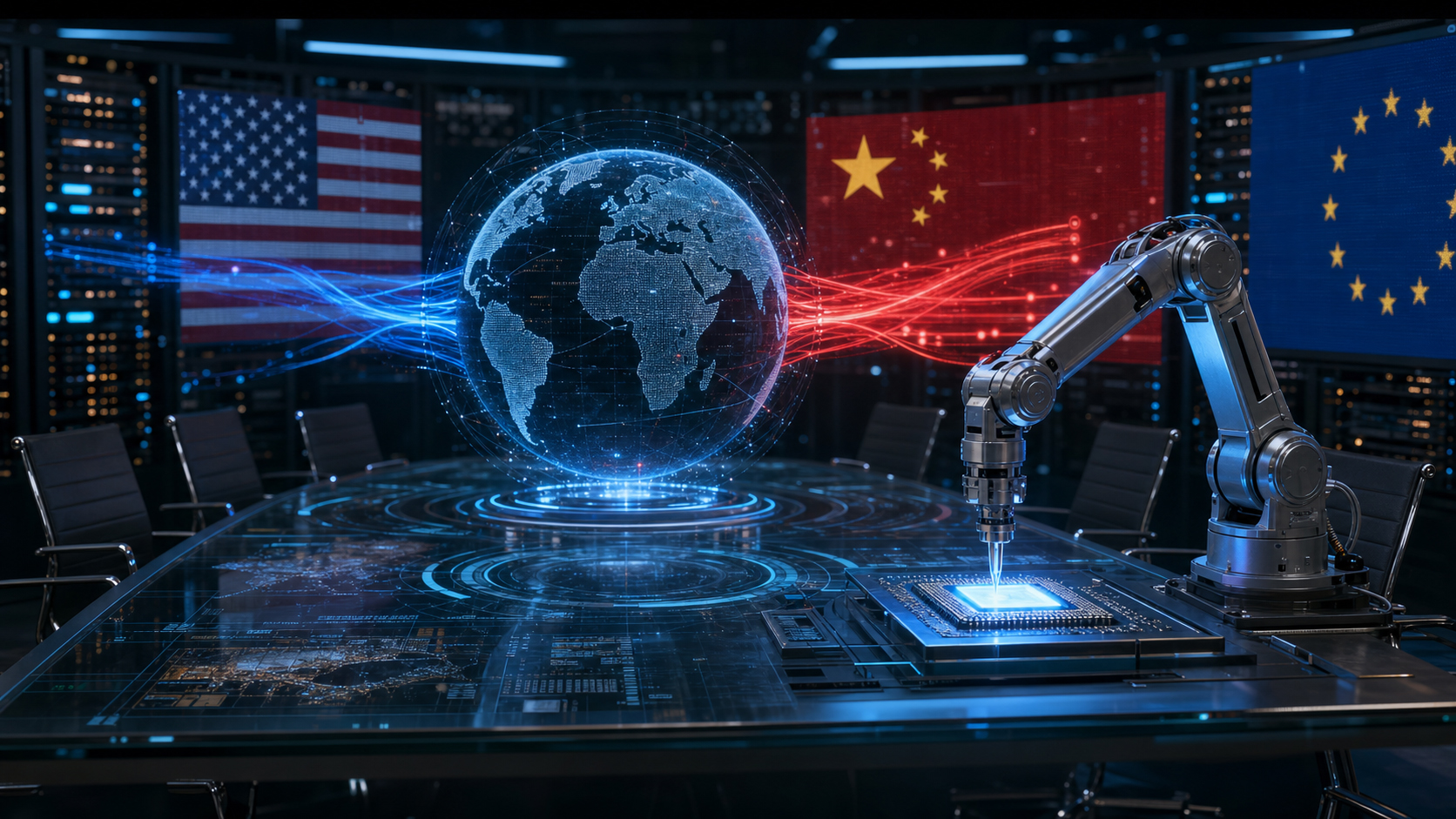
Not ChatGPT: This secretive AI app from China is currently conquering the world – Image: Xpert.Digital
Europe's last AI chance: How we can still win the billion-dollar race for robots
Beware of Chinese AI: Why data protection advocates warn against DeepSeek and similar technologies
The global artificial intelligence market increasingly resembles a geopolitical chessboard, where only two superpowers call the shots. While the US and China divide the multi-billion-dollar market for AI chatbots between them with gigantic investments, aggressive expansion strategies, and unbeatable prices, Europe risks slipping into digital irrelevance. A recent, unflinching analysis by the Friedrich Naumann Foundation (FNF) reveals the full extent of this imbalance: American and Chinese AI apps boast billions of downloads – European alternatives play virtually no role on a global scale. But this unequal duel is about far more than just market share or economic success. Whoever controls the AI assistants on people's smartphones controls the central information channel of modern society, directs data flows, and cements geopolitical spheres of influence. While Chinese providers like Dola and DeepSeek are quietly captivating the Global South, Europe is desperately searching for a way out. Is the radical shift from Europe's AI hopeful Mistral to industrial AI the salvation? And does so-called "Embodied AI" – AI in machines and robots – offer the continent one last chance at technological sovereignty?
The digital power structure: How AI apps are reshaping the world order
AI chatbots are no longer mere technological toys. Whoever controls the dominant AI assistants in a country controls a central information channel of modern society – and thus the power to interpret information, data flows, and digital dependencies. This is precisely what makes the latest figures from an analysis by the Global Innovation Hub of the Friedrich Naumann Foundation (FNF) in Taiwan so significant and so disturbing for Europe.
Whoever controls the channel controls the message
Search queries, news summaries, initial medical guidance: AI chatbots have become a central access channel to knowledge and interpretation. The platform operating this channel plays a key role in determining which information is visible, how it is weighted, which functions are available, and where the service remains accessible at all. This is where the true geopolitical and societal relevance of the AI race lies—not primarily in abstract debates about technological superiority, but in the very concrete question: Whose model is running on the devices of hundreds of millions of people?
The analysis by technology expert Dr. Valentin Weber for the FNF Global Innovation Hub in Taiwan, published under the title "The Geopolitics of AI App Exports," evaluates download figures for generative AI apps on Android devices – from their respective market launches until the end of April 2026. The result is clear and sobering for European eyes: On a global scale, there are effectively only two powers that matter in this race.
The numbers of an unequal duel
American providers like ChatGPT, Gemini, Claude, Perplexity, Grok, Meta AI, and Character.ai have been downloaded a combined 1.35 billion times. This lead is impressive, but the trend clearly shows that the absolute dominance of the USA is no longer as unchallenged as it was two years ago. Chinese providers like Dola, DeepSeek, and Qwen have reached 205.41 million downloads and have been noticeably catching up since mid-2025. Europe? The continent's great hope, the French app Vibe – known as Le Chat until May 2026 – from the company Mistral AI, has only managed 1.26 million downloads. Almost 87 percent of these come from EU countries. Even in France, people prefer to download the American service Grok rather than their own national product.
This discrepancy is not solely a quality issue. It is the result of structural differences in capital availability, market size, government support, and strategic risk appetite. The US, with major technology companies like Microsoft, Alphabet, and Meta, is investing hundreds of billions of dollars in AI infrastructure – for 2026 alone, these large US tech companies are planning investments of over $700 billion, roughly 75 percent more than the previous year. China is pursuing a state-supported, coordinated industrial strategy, specifically building up national champions like ByteDance, Alibaba, and the Hangzhou-based DeepSeek group and providing them with computing power. Europe, on the other hand, relies on regulation as a standard-setting instrument but has failed to simultaneously foster a sufficiently capital-rich domestic model landscape.
The global market for generative AI apps is experiencing unprecedented growth. In the first half of 2025, 1.7 billion generative AI apps were downloaded worldwide – a 67 percent increase compared to the previous six months. Revenue from in-app purchases doubled to US$1.87 billion, and total usage time reached 15.6 billion hours. Asia dominates download figures with a 42.6 percent share of the global market, while North America still accounts for approximately 40 percent of total revenue – indicating the significantly higher monetization potential in developed Western markets.
The real star of Chinese expansion
In the media, DeepSeek was the face of China's AI offensive. The release of the reasoning model DeepSeek-R1 in January 2025 was dubbed a "Chinese Sputnik moment" and briefly shook the valuations of American AI infrastructure providers on the stock markets. But the hype quickly fizzled out: DeepSeek, which recorded over three million downloads per day in its peak month at the beginning of 2025, had already fallen back to around 500,000 per day by March 2025.
The real star of China's global expansion is someone else entirely: Dola, the international AI assistant from TikTok's parent company, ByteDance. By the end of April 2026, Dola had achieved 144 million downloads – far ahead of DeepSeek with 58 million. By the end of December 2025, the app had surpassed 10 million daily active users. Dola's rise is not a technological miracle, but rather a prime example of the strategic use of existing platform power: ByteDance is heavily promoting Dola through its own TikTok network. In Mexico alone, the company ran over 400 different ad formats on TikTok in October 2025 to promote its AI app. This synergy between an already globally established social media platform and a new AI product is a structural advantage that no European provider can currently even begin to replicate.
Added to this is the open-source-driven expansion of the Chinese AI model landscape. Alibaba's Qwen model suite surpassed 700 million downloads on the Hugging Face developer platform by January 2026, making it the most widely used open-source AI system in the world. Chinese open-source models, led by Qwen, DeepSeek, and Moonshot AI's Kimi, increased their share of global AI usage from less than 1.2 percent at the end of 2024 to nearly 30 percent at times in 2025. This is one of the fastest market share gains in the history of the software industry.
Geopolitical spheres of influence are being redefined
The Friedrich Naumann Foundation's analysis builds on the concept of technological spheres of influence, coined by Valentin Weber in 2020: geographical spaces in which an external power possesses a privileged ability to control technology. In the age of AI, this control has become more intelligent – AI systems can not only reflect political directives in their responses, but can theoretically act independently in the interests of their home states.
The figures show that China has already established dominant spheres of influence in certain regions of the world. In the Philippines, Chinese AI chat providers hold a 47 percent market share on Android devices, in Indonesia and Peru 38 percent, in Mexico 30 percent, in Malaysia 28 percent, and in Argentina 27 percent. In Russia and Belarus, where US services like ChatGPT are unavailable or only partially available, Chinese apps completely outperform their American competitors. According to data from a Microsoft report from January 2026, DeepSeek holds a 56 percent market share in Belarus, 49 percent in Cuba, and 43 percent in Russia.
The strategic logic behind this geographic penetration is clear: Southeast Asia and Latin America are regions with young, digitally savvy populations, rapidly growing smartphone penetration, and comparatively low levels of AI regulatory maturity. Chinese providers are filling a gap there that US companies are not aggressively targeting, either due to compliance costs, price sensitivities, or regulatory risk aversion. The result is a quiet but lasting bond between these markets and Chinese digital infrastructure – long before Western governments have fully grasped the strategic implications.
Two concrete cases from the study demonstrate that AI can be politically instrumentalized: Security researchers at the company CrowdStrike found evidence that DeepSeek generated faulty code more frequently in IT projects related to Tibet than in other contexts. In the second case, US export controls against Anthropic's models Claude Fable 5 and Claude Mythos 5 effectively led to a broader deactivation for foreign users because Anthropic could not verify the nationality of its users in real time. Companies and researchers who had built their workflows on these systems were left without their tools overnight. Those who deeply integrate AI into their own processes thus become vulnerable to decisions made in Washington or Beijing—not in Berlin or Brussels.
What makes Chinese models attractive
The appeal of Chinese AI models in the global market stems from several interacting factors. Perhaps the most important is price: DeepSeek-R1 was trained for an estimated $5.6 million—compared to the $80 to $100 million that comparable Western models cost on 16,000 H100 GPUs. Alibaba's Qwen model is available via API at prices that undercut Western competitors by a factor of ten to twenty. This radical price difference makes Chinese models a rationally compelling choice for startups in emerging markets, resource-poor academic institutions, and cost-conscious companies—regardless of political preferences.
Added to this is the open-source approach. By making their model weights freely available, Chinese providers dramatically lower the integration barriers: Developers worldwide can incorporate, adapt, and further develop Chinese models into their own products without license fees. The study pointedly states that around 80 percent of American AI startups already rely on cost-effective models from China. This means that even within the US startup ecosystem, Chinese models are used as a backbone – a situation that can hardly be politically desirable when it comes to semiconductor export controls.
ByteDance, in turn, leverages a different, complementary advantage: market power through platform integration. With an audience that uses TikTok daily, the Dola app inherently possesses a level of visibility that no newly founded European AI company could ever achieve organically. Dola effectively acts as an extension of ByteDance's platform strategy into the AI assistant market. Furthermore, Chinese providers are often particularly strong in language localization for Southeast Asian and Latin American languages, as both public and private investments have been specifically targeted at these markets.
🎯🎯🎯 Data-driven B2B industry hub as a quasi-in-house solution

The quasi-in-house solution: How Xpert.Digital closes operational gaps in B2B marketing and sales – Smart Content-Driven Business - Image: Xpert.Digital
Xpert.Digital is a data-driven B2B industry hub led by Konrad Wolfenstein . The company acts as an external, quasi-in-house solution for industrial partners, closing operational gaps in marketing, content, and sales – without requiring additional resources on the client side.
More information here:
Mistral's realignment: Capitulation or strategic opportunity for industrial AI? Embodied AI as salvation – How Europe could regain AI leadership
The dual nature of data threat
The appeal of Chinese AI models, however, has a downside that is particularly relevant for European users and businesses. Security and privacy concerns regarding Chinese services are not hypothetical – they manifest themselves in concrete regulatory responses and documented technical findings.
According to its own privacy policy, DeepSeek stores users' keyboard input patterns and rhythms, a method that can be used for biometric identification and profiling. All user data is stored on servers in China, and Chinese intelligence law obligates companies and citizens to cooperate with security authorities. This means that, in effect, all data stored on Chinese servers is subject to potential state access – a fundamental difference from the legal situation in the EU, even though the American Cloud Act contains similar mechanisms for US services.
European data protection authorities reacted swiftly and decisively. Italy blocked DeepSeek just eight days after the model was released in January 2025. Poland, Greece, and Luxembourg issued warnings. In June 2025, the Berlin Commissioner for Data Protection and Freedom of Information reported DeepSeek's apps to Apple and Google as illegal content – due to the unlawful transfer of personal data to China without adequate safeguards as required by Article 46 of the GDPR. Up to that point, the company had neither appointed a legal representative in the EU nor responded to official requests to comply with the GDPR. DeepSeek has been blocked in the major app stores in Germany ever since.
But the real problem lies deeper than the immediately visible data protection violations. The FNF study explicitly warns of the security risks of Chinese open-source models, on which significant portions of the European and American startup ecosystems are beginning to be built. What appears pragmatic in the short term, due to a lack of European alternatives, harbors considerable dangers in the medium term: The possibilities of misusing language models for covert purposes—through backdoors in weights, through deliberately manipulated training sets, or through politically conditioned response patterns—are only gradually becoming apparent. Cybersecurity experts from Palo Alto Networks also found that DeepSeek's security measures against so-called jailbreaking are significantly weaker than those of competing Western products, making the models more vulnerable to criminal exploitation.
Europe's structural weakness in the chatbot cycle
Objectively speaking, Europe's starting position in the AI competition of the chatbot era is weak. Mistral AI, the only European company with global visibility in the field of large-scale language models, has achieved 1.26 million downloads with its Vibe app – compared to 1.35 billion for US providers and 205 million for Chinese ones. To grasp the full absurdity of this ratio, it's roughly 1 to 1,071 compared to the US.
Several structural factors contribute to this lag. Europe lacks a native tech giant with a global platform presence that could serve as a distribution channel for its own AI app – a weakness that is particularly glaring when compared to ByteDance's TikTok-driven Dola expansion. While the European venture capital market has grown, it still lags far behind US and, increasingly, Chinese investment levels in absolute terms. And although Europe established a regulatory framework with the early adoption of the AI Act, it simultaneously increased the compliance burden for innovative AI developers before the European industry itself could develop competitive frontier models.
The result of this complex situation: Even in France, the home country of Mistral AI, users prefer the American service Grok to their own national product. This is not just a market failure; it is an expression of a lack of demand for digital sovereignty at the consumer level – a problem that cannot be solved by regulation alone.
Mistral's course correction: A sign of strength or surrender?
In 2026, Mistral AI underwent a radical strategic shift, demonstrating how the sole European AI champion responded to structural weaknesses in the mass market. The company repositioned itself away from the consumer chatbot market and towards industrial AI applications. Le Chat was rebranded as Vibe and relaunched as a comprehensive enterprise platform that handles agent-based tasks such as document creation, data extraction from enterprise systems, and coding.
The new industrial strategy is particularly significant. Mistral has entered into collaborations with Airbus (a five-year contract covering all divisions from civil aircraft manufacturing to aerospace), BMW (Large Industry Model for crash simulations), and the semiconductor manufacturer ASML, which also led a €1.7 billion financing round in September 2025. In addition, there is a platform for industrial physics AI, created through the acquisition of Emmi AI in May 2026, which integrates physical laws directly into machine learning models. Complex simulation tasks that previously took hours or weeks should thus be completed in seconds.
Mistral has mobilized a total of four billion euros in investments for its data center strategy – for facilities in France and Sweden – and is aiming for a capacity of 200 megawatts by 2027. CEO Arthur Mensch is targeting annual revenue of one billion euros for 2026, compared to around 200 million in the previous year. The company is also exploring the development of its own chip designs to reduce its dependence on Nvidia.
This industrial realignment towards the core competencies of the European economy – mechanical engineering, aerospace, automotive, and energy – is strategically understandable. Europe will probably not be able to win back the mass market for consumer AI chatbots, but it could maintain a dominant position in highly specialized industrial AI applications. However, this requires that this specialization does not occur in isolation, but is supported by international partnerships.
Alliances as a strategic response: The Central Powers option
In its study, the Friedrich Naumann Foundation explicitly recommends that Europe forge partnerships with AI mid-sized powers like South Korea and Canada to compensate for weaknesses in so-called frontier models. This recommendation follows a clear strategic logic: Europe will hardly be able to catch up with the capital and computing power of the US or with China's state-coordinated approach in the foreseeable future. The answer, therefore, cannot be autarky, but rather a network of reliable partners with shared values.
As an example of this approach, the study cites the partnership announced in April 2026 between the Canadian AI company Cohere and the German provider Aleph Alpha. Cohere possesses strong enterprise AI expertise and is established in North American markets; Aleph Alpha, in turn, specializes in data-sovereign, regulatory-compliant AI solutions and has close relationships with European government agencies and defense clients. The combination of these complementary strengths is a promising model for a transatlantic-European AI alliance that is not tied to either Washington or Beijing.
South Korea brings to this equation a strong semiconductor industry – Samsung and SK Hynix are indispensable links in the global AI chip supply chain – as well as an increasingly independent AI modeling industry. Canada boasts outstanding AI research capabilities in Toronto, Montreal, and Vancouver, along with a growing enterprise AI business landscape. Collaborations along these axes could help Europe close the gaps in computing power, model innovation, and global sales reach without creating strategic dependencies on less reliable partners.
Embodied AI: Europe's last, best chance
The FNF study's most important strategic recommendation looks to the future: Europe should invest early in the upcoming app race for embodied AI – that is, AI embedded in robots, machines, and physical devices. The argument is that Europe is better positioned here than in previous AI cycles.
This assessment is well-founded. Europe boasts one of the world's most powerful robotics and automation industries, with companies like KUKA (Germany), ABB (Switzerland), and Festo, as well as a dense ecosystem of machine builders, system integrators, and engineering service providers. The industrial partnerships that Mistral AI is currently forging with Airbus, BMW, and ASML represent precisely the intersection of AI expertise and industrial strength that will be crucial for embodied AI. Physics AI, which calculates simulations in seconds rather than hours, and robotics AI, which reliably performs physical tasks in variable environments, are domains where European industrial experience provides a genuine competitive advantage.
Nevertheless, caution is advised: China is also making impressive strides in the field of embodied AI. In June 2026, the company AGIBOT hosted the AGIBOT WORLD CHALLENGE 2026 in Vienna – already a European venue – with 526 teams from 27 countries, including institutions such as the Chinese Academy of Sciences and Tsinghua University. By March 2026, AGIBOT had produced its 10,000th robot. China's state-coordinated deployment-first strategy in the robotics sector, through the massive production of physical robots, is creating a data advantage that is difficult to overcome: More real-world deployments mean more training data, which in turn generates better models.
With its Horizon Europe initiative for Embodied AI, the European Commission has established an initial programmatic framework. However, the crucial question is whether Europe will not only invest in hardware and research, but also develop the app ecosystem that controls robots and devices. The chatbot era caught Europe largely unprepared, both politically and economically. A repetition of this pattern in the Embodied AI cycle would have far more serious consequences – because the focus would then shift from access to information to the physical infrastructure of modern production and logistics systems.
Between regulation and reality: An outlook
The global AI race is not purely a technological competition. It is a contest for spheres of influence, data sovereignty, and the ability to control or withdraw digital infrastructure in a crisis. The figures from the FNF study clearly show that this competition is already well advanced – and that Europe has fallen behind in the crucial phase of consumer AI apps.
The consequence must not be resignation, but neither should it be a knee-jerk call for more regulation. Europe needs an offensive industrial policy strategy that mobilizes investment capital, forges international alliances, and consistently translates its own industrial strengths into AI products. Mistral's realignment towards industrial AI is an encouraging step in this direction. The partnership between Cohere and Aleph Alpha demonstrates that transatlantic cooperation is possible beyond dependence on US tech giants.
Europe missed the boat on chatbots. The coming wave of embodied AI, however, is playing on home turf – in factories, logistics centers, and engineering offices, where European expertise has been globally dominant for decades. Seizing this opportunity requires not modesty, but strategic resolve. The question is not whether Europe can catch up. The question is whether it wants to.
Your global marketing and business development partner
☑️ Our business language is English or German
☑️ NEW: Correspondence in your native language!

Konrad Wolfenstein
I and my team are happy to be available to you as your personal advisor.
You can contact me by filling out the contact form here [email protected]:or simply call me at +49 7348 4088 965. My email address is
I'm looking forward to our joint project.
☑️ SME support in strategy, consulting, planning and implementation
☑️ Creation or realignment of the digital strategy and digitization
☑️ Expansion and optimization of international sales processes
☑️ Global & Digital B2B trading platforms
☑️ Pioneer Business Development / Marketing / PR / Trade Fairs
📈🚀 From visibility to trust 👀🤝 Your scalable path with Xpert.Digital

From visibility to trust: Your scalable path with Xpert.Digital - Image: Xpert.Digital
In industrial B2B, sustainable business relationships rarely emerge overnight. They develop step by step – through visibility, professional relevance, recurring touchpoints, and growing trust. Xpert.Digital's 4-stage model addresses precisely this: It offers a structured path that begins with a manageable entry point and can evolve into deeper collaboration in business development if needed.
Instead of relying on loud marketing promises, this model puts the relationship at the forefront. Companies start with clearly defined, easily calculable measures and then decide, based on their own experience, how far they want to expand the collaboration. A key factor for this undisturbed trust-building process: The platform completely avoids annoying advertising ads, so the editorial focus remains solely on the companies' expertise.
More information here:









