
The Industrial Accelerator Act – the brilliant EU plan against China? Whoever dominates 40% of the world is only allowed to keep 49% here
Xpert Pre-Release

Available in 27 languages 📢
Prefer Xpert.Digital on GoogleⓘPublished on: April 27, 2026 / Updated on: April 27, 2026 – Author: Konrad Wolfenstein
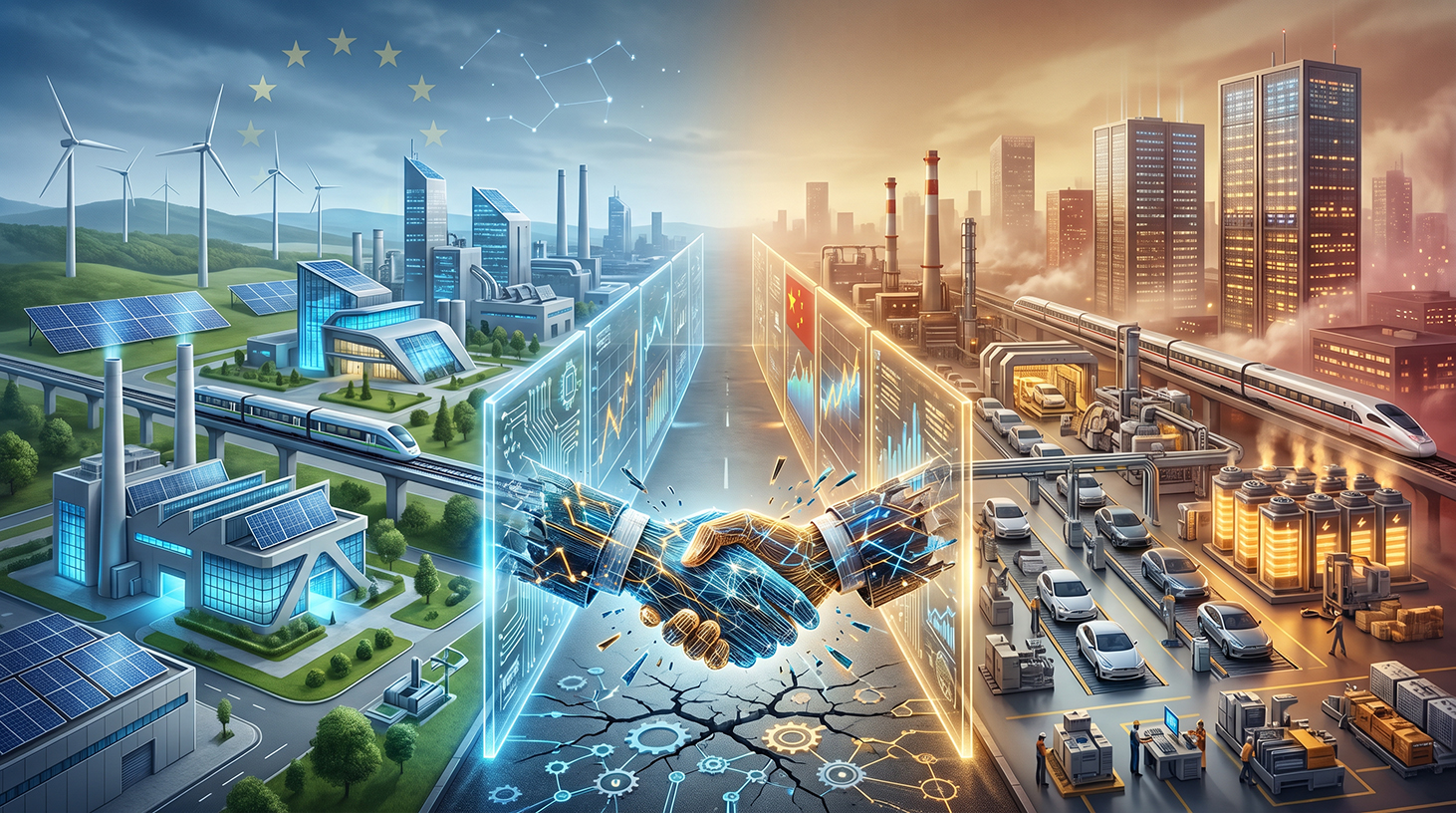
The Industrial Accelerator Act – the ingenious EU plan against China: Whoever dominates 40% of the world is only allowed to keep 49% here – Image: Xpert.Digital
Beijing openly threatens retaliation: Is the economic war with the EU escalating?
The 40% trick and the 49% rule: This is how Europe's new "anti-China law" works
The European Union is getting serious: With the new Industrial Accelerator Act (IAA), Brussels is planning an unprecedented industrial policy breakthrough to break free from its crushing dependence on China. Officially declared a general funding program for future-oriented industries such as e-mobility, solar energy, and critical raw materials, the law, on closer inspection, reveals itself to be a tailor-made "Lex China." Anyone who wants to dominate the European market in the future will have to share technology, conduct research in Europe, and cede control to European partners. But Beijing sees through the EU's strategic maneuver—and is openly threatening retaliation. Is the global economy facing a new, massive trade war that could jeopardize Europe's green transformation?
“Lex China” revealed: The radical new EU rules for foreign investors
If Brussels changes the rules of the game, Beijing will draw the red line
On March 4, 2026, the European Commission presented the draft of the so-called Industrial Accelerator Act (IAA) – a law that aims to strengthen Europe's industrial base, secure jobs in strategic sectors, and reduce dependence on non-European supply chains. What was celebrated in Brussels as a breakthrough in industrial policy triggered immediate resistance in Beijing: On April 24, 2026, the Chinese Ministry of Commerce officially expressed concerns and openly spoke of possible countermeasures should the EU adopt the draft law unchanged. Rarely before has a European industrial policy initiative provoked such a swift and pronounced geopolitical reaction.
This conflict is far more than a routine trade policy dispute. It marks a turning point in the economic relationship between the EU and China – a relationship that for decades was characterized by pragmatic compromise, but is now increasingly dominated by strategic mistrust and structural asymmetry. The IAA should not be viewed in isolation, but rather as part of a broader European realignment, which the Draghi report of September 2024 outlined conceptually.
A law that specifically targets China – without naming it
The Industrial Accelerator Act is, on paper, a general industrial development law. It targets four strategic sectors: batteries, electric vehicles, photovoltaic systems, and critical raw materials. Its central instrument is a novel FDI (foreign direct investment) regime that applies when a foreign investor comes from a country that controls more than 40 percent of global production capacity in one of the aforementioned sectors and seeks an investment exceeding €100 million.
This is precisely where two central mechanisms of the law interlock, forming the very core of the EU strategy:
1. The 40% trick (The trigger / The target)
This refers to a country's global market share. EU law states that the strict new rules only apply to investors from countries that control more than 40 percent of the world's production capacity in sectors such as solar or batteries.
Why is this a "trick"?
According to international trade rules, the EU is not actually allowed to discriminate against any single country. If the law were to state: "This law applies to Chinese companies," the EU would immediately face legal action. By instead stating: "It applies to all countries with over 40% global market share," it avoids naming specific countries. However, since only China exceeds this 40% threshold for solar modules (>80%) and batteries, it is de facto a law that targets China exclusively.
This is clearly evident in the market data: The Chinese battery market for electric vehicles grew by 40.4 percent in 2025 to 769.7 gigawatt-hours, further solidifying China's dominance in global battery production. And when it comes to critical raw materials, China is responsible for more than 60 percent of global production and around 90 percent of refining capacity. The fact that countries like the USA, Canada, and the UK are on a list of partners exempt from certain restrictions, while China is not, makes the thrust of the law unmistakably clear.
2. The 49% Rule (The Consequence / The Loss of Control)
This refers to the distribution of power within a company in Europe. If an investor falls under the aforementioned 40% rule (i.e., if they are Chinese, for example), they cannot simply build their own, 100% self-controlled factory in Europe. The law requires them to find a European partner (a so-called joint venture). In this company, the foreign investor may then hold a maximum of 49 percent of the voting rights.
What is the goal?
The 49 percent rule ensures that the Chinese investor is in the minority in Europe. Control and strategic decisions (with at least 51 percent) must remain with the European partner.
3. In summary
The 40% rule is the legal loophole used to filter out Chinese companies. The 49% rule is the requirement to legally disarm these companies in Europe and transfer control to European partners.
Those who do not wish to accept this joint venture condition essentially have only one option: to conclude licensing agreements for their intellectual property rights in favor of European companies. Additional hurdles also apply: mandatory annual expenditures for research and development in the EU amounting to at least 1 percent of the company's gross turnover are required. At least 50 percent of the workforce must be EU employees – a condition that is explicitly non-waivable. Finally, the investor must present a strategy for sourcing at least 30 percent of their inputs from EU suppliers.
The overarching goal set by the Commission for the IAA is nothing less than increasing the share of industry in EU GDP from the current 14.3 percent to 20 percent by 2035. At the same time, public procurement law is to be restructured: the "Made in Europe" principle is to become a mandatory requirement for public contracts in strategic sectors.
Our EU and German expertise in business development, sales and marketing

Our EU and German expertise in business development, sales and marketing - Image: Xpert.Digital
Industry focus areas: B2B, digitalization (from AI to XR), mechanical engineering, logistics, renewable energies and industry
More information here:
A thematic hub offering insights and expertise:
- Knowledge platform covering global and regional economies, innovation and industry-specific trends
- A collection of analyses, insights, and background information from our key areas of focus
- A place for expertise and information on current developments in business and technology
- A hub for companies seeking information on markets, digitalization, and industry innovations
EU versus China: Is the new IAA fair climate protection or hidden protectionism?
China's criticism: Between legitimate objections and strategic calculation
The Chinese Ministry of Commerce responded to the draft law with a three-pronged criticism encompassing legal, economic, and political dimensions. First, the IAA violates existing international agreements. Second, it structurally discriminates against Chinese investors. Third, the law jeopardizes the very green transformation process in Europe that it purports to serve.
The first objection, the legal one, is the strongest in formal terms. The Chinese Ministry of Commerce accuses the EU of violating the WTO's most-favored-nation principle with the IAA. This principle, one of the cornerstones of the multilateral trading system, stipulates that trade advantages granted to one WTO member must, in principle, also benefit all other members. By explicitly subjecting countries with more than 40 percent of global production capacity to stricter rules, the IAA, according to the Chinese interpretation, creates a discriminatory category that effectively targets China and only China.
Ironically, the European Commission itself questioned the WTO's most-favored-nation principle in February 2026. EU Trade Commissioner Maroš Šefčovič argued that the world of 1995, when the WTO rules were established, and the world of today, in which China's share of global GDP has grown from 5-6 percent to around 20 percent, are simply not comparable. Beijing countered with its own position paper at the WTO, declaring the most-favored-nation principle an indispensable foundation of the rules-based trading system. A remarkable situation: China, which has itself been criticized for years for selective protectionist measures, is positioning itself here as a defender of open multilateral trade rules – a rhetorical maneuver with considerable strategic intent.
The second objection, the economic one, concerns the specific investment conditions. Chinese companies wishing to invest in European battery or solar factories would, according to IAA regulations, have to license technologies, relinquish majority stakes, conduct research in Europe, and hire almost half of their employees from the EU. These conditions, according to the Chinese Ministry of Commerce, massively increase uncertainty for Chinese companies in Europe and effectively act as an investment barrier. The Chinese Chamber of Commerce to the EU added that such a structure could deny Europe access to China's established supply chains and thus slow down its own decarbonization – an argument that, while driven by self-interest, is not entirely unfounded.
The third objection, the political one, targets the EU's credibility in trade matters. Beijing accuses Brussels of using climate protection as a guise to pursue protectionism and distort fair competition. While countermeasures have been threatened, they have not been specified. Given the escalating dynamics of recent years – China has already retaliated against EU anti-dumping duties on electric cars, which ranged from 7.8 to 35.3 percent – this threat is by no means rhetorical.
Europe's structural dependency: The real foundation of the conflict
To fully understand the IAA and China's reaction, one must consider the economic reality underlying the dispute: Europe is deeply structurally dependent on Chinese technologies, raw materials and production capacities – precisely in those sectors that are crucial for the green transformation.
China holds more than 80 percent of the global production and manufacturing capacity for solar modules, including intermediate products such as polysilicon, wafers, and cells. In 2024, China exported solar modules with a record capacity of approximately 236 gigawatts – a 13 percent increase over the previous year. In 2024 alone, over 300 gigawatts of new solar capacity were installed in China, representing 55 to 60 percent of the global total. The world's leading solar module manufacturers – Jinko Solar, LONGi Green Energy, JA Solar, Trina Solar, and Canadian Solar – are all Chinese companies and together account for almost half of the global market volume.
Your contact for raw materials ⛏️ Global sourcing 🚢🌐 & trading 📦

Konrad Wolfenstein
I would be happy to serve as your personal advisor.
Konrad Wolfenstein
Email: [email protected]
Our global industry and economic expertise in business development, sales and marketing

Our global industry and economic expertise in business development, sales and marketing - Image: Xpert.Digital
Industry focus areas: B2B, digitalization (from AI to XR), mechanical engineering, logistics, renewable energies and industry
More information here:
A thematic hub offering insights and expertise:
- Knowledge platform covering global and regional economies, innovation and industry-specific trends
- A collection of analyses, insights, and background information from our key areas of focus
- A place for expertise and information on current developments in business and technology
- A hub for companies seeking information on markets, digitalization, and industry innovations










