
Take action yourself: Why energy autonomy is the best economic self-defense for households and small and medium-sized enterprises
Xpert Pre-Release

Available in 27 languages 📢
Prefer Xpert.Digital on GoogleⓘPublished on: May 4, 2026 / Updated on: May 4, 2026 – Author: Konrad Wolfenstein
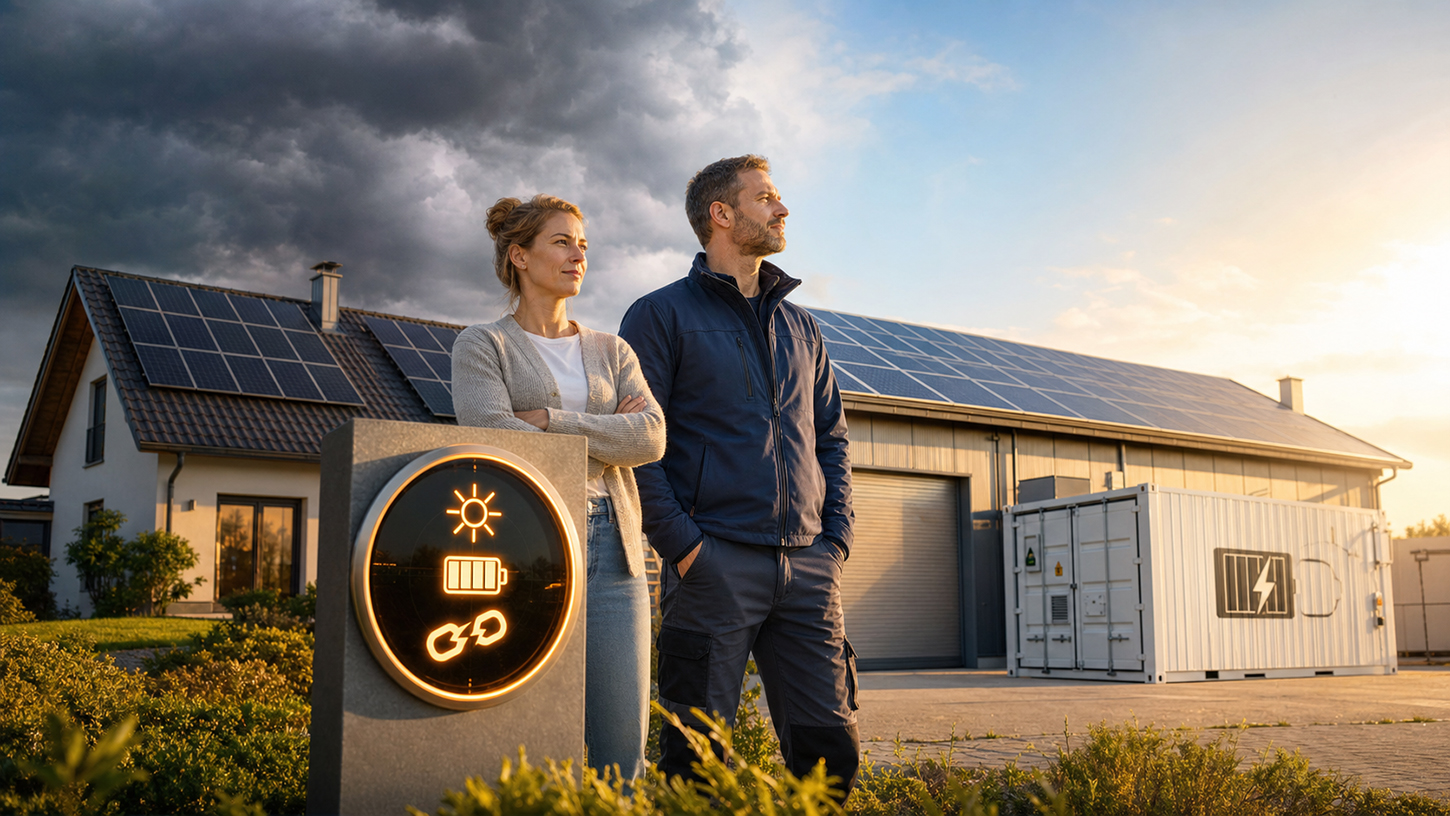
Take action yourself: Why energy autonomy is the best economic self-defense for households and small and medium-sized enterprises – Image: Xpert.Digital
A warning to small and medium-sized businesses: Why unpredictable electricity costs threaten the entire business model
From passive payer to self-sufficient: Why financial independence begins on your own roof
Energy prices 2026: Anyone still relying on politicians is doomed
The acute energy crisis may have disappeared from the daily headlines, but the structural threat to wallets and balance sheets remains. Anyone who still believes that politicians, grid operators, and global markets will ensure permanently low and stable electricity prices in the long term is relinquishing control over their own finances. Whether for private households or medium-sized businesses, energy is no longer a simple ancillary expense to be considered once a year during a cursory price comparison. It has become a strategic matter of survival and a decisive factor for financial resilience.
The following article unflinchingly demonstrates why the path out of dependence doesn't lie in political promises of relief or simply hoping for falling stock prices. The solution lies in intelligent investment in your own energy autonomy. From passive consumer to active prosumer: Learn why photovoltaics, storage, and load management are far more than just prestigious ecological projects – and why planning security is the real key to returns in volatile times. Discover how economic self-defense truly works in the modern energy system and why autonomy is no longer a luxury, but economic common sense.
Related to this:

Energy independence instead of desperate trust and hope
Germany's energy economy has reached a point where political reassurances, media routines, and short-term promises of relief are no longer sufficient for many households and small and medium-sized enterprises. The real economic question is no longer whether energy prices will fluctuate again, but rather who is structurally protecting themselves against these fluctuations and who remains at their mercy. For informed citizens, property owners, tradespeople, manufacturing companies, and energy-intensive businesses, security of supply is thus becoming a form of economic self-defense.
The provocative, yet economically justifiable perspective is therefore this: Anyone who continues to rely on politicians, energy suppliers, or mainstream media to ensure stable energy prices in 2026 is confusing public communication with actual cost control. Planning certainty arises not from announcements, but from investments in self-sufficiency, efficiency, load management, storage, and contractual safeguards. Autonomy is not an ideological project, but a risk management tool against price volatility, grid costs, geopolitical shocks, and regulatory uncertainty.
Why the call for independence makes economic sense
The debate about energy independence is often framed in moral, political, or technological terms. In reality, it is primarily a question of microeconomic resilience. Households and businesses don't respond to abstract narratives about the energy transition, but rather to monthly bills, investment horizons, borrowing costs, and uncertainty about the coming years. This is precisely why the concept of autonomy is gaining importance: it describes the ability to control a portion of one's own cost structure instead of leaving it entirely to external markets and political decisions.
This shift is rational. The Federal Statistical Office continues to report high electricity and gas price levels in a long-term comparison, even though the extreme fluctuations of the 2022 crisis have partially subsided. The German Association of Energy and Water Industries (BDEW) also demonstrates that the electricity price for households is not solely determined by energy procurement, but is significantly influenced by network charges, levies, taxes, and regulatory components. Therefore, anyone who simply hopes for falling market prices underestimates the structural cost drivers, which remain high even with declining procurement prices or can have varying regional impacts.
For informed citizens, this means, in practical terms: The traditional consumer who compares tariffs once a year is at an economic disadvantage in the new energy system. The prosumer, the consumer who simultaneously produces, stores, controls, and reacts flexibly, is better positioned. This applies even more strongly to small and medium-sized enterprises (SMEs). Companies that treat energy merely as a minor expense underestimate its impact on margins, pricing, competitiveness, and investment freedom.
The real core of the problem lies in the cost structure
Many public debates act as if the electricity price is primarily a market price. This is an oversimplification. In Germany, the final price of electricity is the result of a complex system encompassing procurement, distribution, grid fees, metering costs, levies, taxes, and regulatory decisions. This very structure makes the price difficult to predict and hard for consumers to control. This is especially true in regions with high grid fees or during periods when additional investments in grid infrastructure are passed on to consumers.
Therefore, what is economically crucial is not only the absolute level of the electricity price, but also its lack of strategic controllability. Those who depend entirely on externally supplied kilowatt-hours have only limited influence over their costs. Conversely, those who cover part of their electricity demand themselves, shift loads over time, use storage intelligently, or couple consumption and generation not only reduce their operating costs but also gain optional flexibility. In uncertain markets, optionality is an asset.
For households, this means that a photovoltaic system with storage is not merely an environmentally friendly purchase, but also a safeguard against rising energy costs and political volatility. For medium-sized businesses, it means that energy procurement, on-site power generation, load profile analysis, and contractual structuring are evolving from peripheral technical issues to integral parts of corporate strategy. The question is no longer whether to manage energy, but whether one can afford not to.
Private households: From passive payer to active energy player
For private households, the economic logic is particularly clear. Anyone who owns property and has a suitable roof can generate a portion of their electricity consumption themselves with photovoltaics at predictable marginal costs. According to current market overviews and profitability analyses, many systems still pay for themselves, especially if a significant portion of the solar power is consumed on-site. While the amortization period depends heavily on investment costs, self-consumption rate, storage capacity, roof orientation, and financing conditions, the fundamental principle remains the same: self-consumption replaces expensive grid electricity and increases predictability.
Especially in single-family homes, this changes the household model. Energy used to be an external input; now it can become part of a private investment. The roof becomes a productive surface, storage a flexibility reserve, and the combination with a heat pump or electric vehicle multiplies the self-consumption rate. This shifts the equation: it's not just the feed-in tariff that counts, but the avoided, expensive kilowatt-hour from the grid.
A typical example is a four-person household living in a detached house with a heat pump and an electric car. Without on-site power generation, this household is disproportionately vulnerable to electricity price increases because two key needs – heating and mobility – are electrified. With a well-sized photovoltaic system, battery storage, and intelligent control, a significant portion of this increased consumption can be absorbed internally. This doesn't eliminate every cost component entirely, but it reduces dependence on the most volatile part of the system: externally sourced electricity for end users.
Why storage can still pay off despite all objections
The discussion surrounding battery storage is often oversimplified. Critics rightly point out that storage increases the investment and doesn't always offer optimal amortization when considered in isolation. This observation is correct, but it's too simplistic. What's economically relevant isn't just the stand-alone return on investment of the storage system, but its impact on the overall system, including self-consumption, load shifting, emergency power capability, tariff optimization, and the perceived benefit of security.
In an energy system with highly fluctuating feed-in from renewables, regionally varying grid fees, and sometimes very different market prices, the value of flexibility increases. Storage is precisely the instrument for this. It stores surplus electricity at midday, increases the use of self-generated power in the evening, and can offer additional benefits in the future when combined with dynamic tariffs, controllable appliances, and smart meter infrastructure. This doesn't mean that every household should immediately install maximum storage capacity. However, it does mean that the evaluation of a storage system must be broader than just a static payback period.
For many citizens, another point is also crucial: autonomy has economic value, even if it is often underestimated in traditional profitability calculations. Those who are less vulnerable to price spikes, supply chain disruptions, or political interventions possess real crisis resilience. In recent years, this resilience has not been an abstract luxury, but a concrete economic factor.
SMEs: Energy has long since become a leadership issue
In German SMEs, energy is still too often treated as a secondary operational category. This is dangerous. For many businesses – from metalworking companies to food production facilities and logistics centers – energy consumption directly determines unit costs, pricing, competitive position, and investment flexibility. When energy costs become unpredictable, not only does the profit and loss statement become more volatile, but the entire business model becomes more fragile.
This is particularly critical for companies with long-term customer contracts, high upfront costs, or limited pricing power. A medium-sized company that calculates orders months in advance cannot simply pass on sudden spikes in electricity or gas prices. Margins are then destroyed not operationally, but externally. Anyone who fails to develop an energy strategy in such a situation is effectively carrying an open price risk on their balance sheet.
That's precisely why self-sufficiency in small and medium-sized enterprises (SMEs) isn't a trendy add-on, but often a rational anchor for stability. Roof surfaces on production halls, warehouses, and logistics centers often offer considerable potential for PV systems. Combined with load profile analysis, energy management, storage, potentially heat recovery, and supplementary power purchase agreements, external energy procurement can be systematically reduced, at least partially. This doesn't create complete energy independence, but it does result in a significantly more robust cost structure.
Concrete examples from medium-sized businesses
A classic example is a metalworking company with a high daily load profile. Such companies consume a significant portion of their energy precisely when photovoltaic systems are generating electricity. This improves the profitability of on-site power projects because direct use is usually more attractive than simply feeding excess power into the grid. If additional processes can be shifted, such as compressed air, refrigeration, charging infrastructure, or specific production steps, load management can further enhance the benefits.
A second example is logistics or retail properties. Large roof areas, a constant electricity demand for lighting, IT, conveyor technology, cooling, and charging points, as well as relatively predictable load profiles, make these buildings ideal candidates for on-site power generation. Adding a storage system not only increases self-consumption but also reduces the strain caused by peak loads. For companies with tight margins, this isn't a side effect, but a genuine driver of profitability.
A third example concerns bakeries, food processing plants, or other businesses with early start times and high heat or electricity demands. Here, pure PV is not always ideally suited to the load profile, but precisely for this reason, intelligent system planning becomes crucial: Combinations of PV, storage, cooling management, and, if necessary, a heat pump or supplementary supply contract can reduce dependency, even if they don't enable complete self-sufficiency. Economic progress lies not in perfection, but in the gradual reduction of external vulnerability.
Our EU and German expertise in business development, sales and marketing

Our EU and German expertise in business development, sales and marketing - Image: Xpert.Digital
Industry focus areas: B2B, digitalization (from AI to XR), mechanical engineering, logistics, renewable energies and industry
More information here:
A thematic hub offering insights and expertise:
- Knowledge platform covering global and regional economies, innovation and industry-specific trends
- A collection of analyses, insights, and background information from our key areas of focus
- A place for expertise and information on current developments in business and technology
- A hub for companies seeking information on markets, digitalization, and industry innovations
Four steps towards energy policy resilience for businesses and families
Why planning security is often more important than the last point of return
Many investment calculations make a mistake: they assume that the highest calculated return on investment is automatically the best business decision. However, for households and small and medium-sized enterprises (SMEs), the opposite is often true. A slightly lower calculated return can be economically superior if it reduces the variance of future costs. Planning certainty itself has financial value because it influences cost calculations, creditworthiness, bid preparation, and the pace of investment.
Therefore, power purchase agreements, direct supply models, and longer-term structured electricity supply contracts are also attractive for SMEs. Not every company can or wants to generate its own electricity, but many can structure their procurement more intelligently. Practical reports from industry, chambers of commerce, and trade publications show that SMEs are increasingly seeking hybrid solutions: a combination of self-sufficiency, secure external procurement, and flexibility management. This mix reduces vulnerability to extreme market phases.
Private households face a similar balancing act. The most economically advantageous solution is not always the one with the shortest formal amortization period, but rather the one with the best balance between cost savings, property value retention, comfort, security of supply, and future viability. Anyone planning to electrify their home in the coming years, for example with a heat pump or electric car, should consider the energy issue not in isolation, but as a systemic decision.
Related to this:

Remaining dependence on fossil fuels remains a risk to prosperity
Those who view energy independence solely as a private matter are missing the point. Despite progress in renewable energies, Germany remains dependent on fossil fuel imports in relevant sectors, and thus on geopolitical, price, and infrastructural risks. It is precisely this residual dependence that ensures shocks in global markets, political conflicts, or disruptions in supply chains can continue to have a significant impact on households and businesses.
The economic consequence is a structural risk to prosperity. If a country obtains energy not only at high prices but also with insecurity, location costs, risk premiums, and investment reluctance increase. For companies, this means: capital is deployed more selectively, production is more likely to relocate, and investments in Germany must compete with international alternatives. For citizens, it means: consumption budgets, wealth accumulation, and housing costs come under greater pressure, even if the headlines currently appear less alarmist than during the acute phase of the crisis.
This does not lead to fatalism, but rather to a shift in priorities. Focusing on local production, efficiency, and flexible demand may not solve the entire macroeconomic problem, but it does improve one's own position within the system. In an economy with high external uncertainty, decentralization is attractive not only technologically, but also from a regulatory and economic perspective.
Citizen energy is more than just romance
Citizen-owned energy is an often underestimated area situated between individual autonomy and central infrastructure. Energy cooperatives, local community projects, and cooperative models are not only socially viable but also economically attractive. They activate local capital, increase acceptance, distribute added value regionally, and create participation opportunities for people who do not have their own roof space or a large investment budget.
Especially for apartment buildings, smaller communities, or mixed-use neighborhoods, such models can be economically viable. They bridge the gap between a home with a solar roof and a completely passive rental household. At the same time, they can involve regional small and medium-sized enterprises (SMEs), for example, through planning, installation, operation, or investment. This creates a decentralized economic area in which energy is not only consumed but also organized and monetized locally.
What's economically interesting here isn't just the kilowatt-hour itself, but the question of ownership. Those who own generation infrastructure or participate in its profits shift their role in the energy system. They go from being mere end payers to co-owners of productive infrastructure. This is more economically relevant for a stable middle class than many public debates suggest.
The state can provide relief, but not replacement
Government relief, subsidized loans, and regulatory adjustments can facilitate investments in energy independence. However, they do not replace individual decision-making. The German government points to relief measures for households, while subsidy and loan programs, for example in the areas of photovoltaics, building renovation, or efficiency measures, can support investments. This lowers barriers to entry, but does not eliminate the fundamental economic question: those who do not develop their own strategy remain dependent despite the available subsidies.
This is precisely the difference between aid and a solution. Aid reduces acute strain. A solution changes the cost structure. A subsidy, loan, or temporary price cap may provide short-term relief, but long-term sovereignty only arises when households and businesses systematically reduce or better secure their external energy purchases. Anything else remains crisis management.
Therefore, the expectation that politics can permanently guarantee cheap energy, high security of supply, rapid transformation, and low burdens for everyone is also problematic. In reality, there are conflicting objectives. Precisely because these conflicts of objectives do not disappear, private and company-sponsored retirement planning is economically sound. Anyone who waits for the system to eventually function flawlessly delegates their own vulnerability to actors whose interests, timelines, and priorities do not align with their own.
What private households can do now
For private households, energy autonomy doesn't begin with cutting-edge technology, but with a sound prioritization. First and foremost is transparency regarding one's own consumption: those who don't know load profiles, heating requirements, hot water usage, charging habits, and typical peak loads can easily make the wrong investment. Only then should a decision be made about the appropriate combination of photovoltaics, storage, heat pump, smart meter, energy management, and, if applicable, e-mobility.
An economically viable entry point often involves first identifying the most productive levers. For many single-family homes, this is a photovoltaic system with high self-consumption potential. For other properties, efficiency may be the primary focus initially, for example through insulation, heating optimization, or replacing outdated appliances. Those who are already electrified or plan to electrify soon benefit particularly from a systemic approach, as this allows for the integrated planning of electricity, heating, and mobility.
For homeowners' associations and multi-family buildings, shared models are also gaining importance. Where individual roofs cannot be used for individual purposes, tenant electricity or shared solutions can create new opportunities. Not every model is easy to regulate, but the direction is clear: even beyond the classic single-family home, the possibilities are growing to move away from the role of the mere end consumer.
What the middle class should do now
For medium-sized businesses, a robust energy strategy begins with data discipline. Without load profile data, consumption patterns, process analysis, and knowledge of their own pricing structure, investment decisions remain too vague. Companies should therefore treat their energy consumption with the same seriousness as liquidity planning or material costs. This means: measuring, segmenting, simulating, and prioritizing.
Building on this, the strategic question arises: which mix best suits the company's operational structure? For some businesses, installing their own rooftop PV system is the obvious first step. For others, a structured procurement contract (PPA), peak load optimization, or energy storage makes more economic sense. The right answer depends on the load profile, access to capital, available space, shift work, and the planning logic of the business model. One-size-fits-all solutions are unreliable here.
Organizational anchoring is also crucial. Energy must not be wasted between technology, purchasing, and management. In volatile times, it is a top priority or at least a strategic cross-cutting issue. Companies that understand this early on not only gain cost advantages but also achieve entrepreneurial stability in an environment that many competitors continue to treat as mere background noise.
The sober counter-position and why it only partially holds water
A fair analysis must also consider the objections. Not every roof is suitable, not every household has capital or property, and not every business can flexibly manage its load. Furthermore, interest rates, investment costs, regulatory changes, or technical miscalculations can worsen profitability. Anyone who sells energy autonomy as a universal miracle solution is arguing irresponsibly.
The point that complete self-sufficiency remains unrealistic for many actors in Germany is also valid. Even well-equipped households and businesses usually remain connected to the grid and thus part of a larger supply system. However, the economically relevant point is not absolute independence, but reduced dependence. Even partial self-sufficiency, combined with efficiency and better procurement, can significantly reduce vulnerability.
This is precisely the difference between technological utopia and economic common sense. No one needs to become completely self-sufficient for the concept to make sense. It is enough to shift a significant portion of one's own risks from the realm of uncontrollable external factors into the realm of one's own decision-making. This is not a panacea, but a tangible gain in sovereignty.
Why the time for simply listening is over
The pointed premise – not to listen to mainstream media and politics, but to ensure independence, autonomy, and planning security – is economically plausible only if it is understood not as a blanket rejection of the media or the state, but as a call for independent risk management. Public communication can inform, reassure, or mobilize. However, it cannot stabilize the electricity price in one's own home, nor can it secure a company's profit margins. This task ultimately remains decentralized.
Mature citizens don't act sovereignly by reflexively rejecting every political statement. They act sovereignly by separating announcements from sound economic decisions. Those who recognize and mitigate their vulnerabilities are less dependent on headlines, election results, crisis meetings, or short-term stimulus packages. In this sense, energy autonomy is not a form of protest, but an expression of enlightened self-responsibility.
The same logic applies to small and medium-sized enterprises (SMEs), only in a more stringent form. Entrepreneurial freedom depends not only on taxes, bureaucracy, and skilled labor, but also on the extent to which central input costs are shielded from direct control. Those who strategically manage their energy resources won't achieve a perfect world, but they will gain a more robust position in the real one. And under the conditions of the 2020s, that already represents a significant competitive advantage.
The crucial shift in perspective
Perhaps the most important economic insight is this: energy is no longer merely a cost factor to be procured, but a manageable component of one's own asset, investment, and business strategy. For private households, this means rethinking home ownership, technology, and consumption. For small and medium-sized enterprises (SMEs), it means separating energy from operating costs and treating it as strategic infrastructure.
Those who adopt this shift in perspective evaluate investments differently. It's no longer just about when an investment will theoretically pay for itself. It's also about risk reduction, liquidity stability, resilience to crises, competitiveness, and ownership of productive infrastructure. In times of increasing uncertainty, this broader perspective is not a luxury, but a sign of economic maturity.
Therefore, the pointed conclusion is justified: Not blind optimism, but sober self-empowerment is the sensible response today to an energy system that is becoming more modern, but not automatically more predictable. Those who plan, invest, and structure gain independence step by step. Those who simply wait remain customers of a system whose risks they pay for but cannot control.





