
Work no longer pays off? Why Germany is plummeting – and Singapore is booming
Xpert Pre-Release

Available in 27 languages 📢
Prefer Xpert.Digital on GoogleⓘPublished on: May 17, 2026 / Updated on: May 17, 2026 – Author: Konrad Wolfenstein
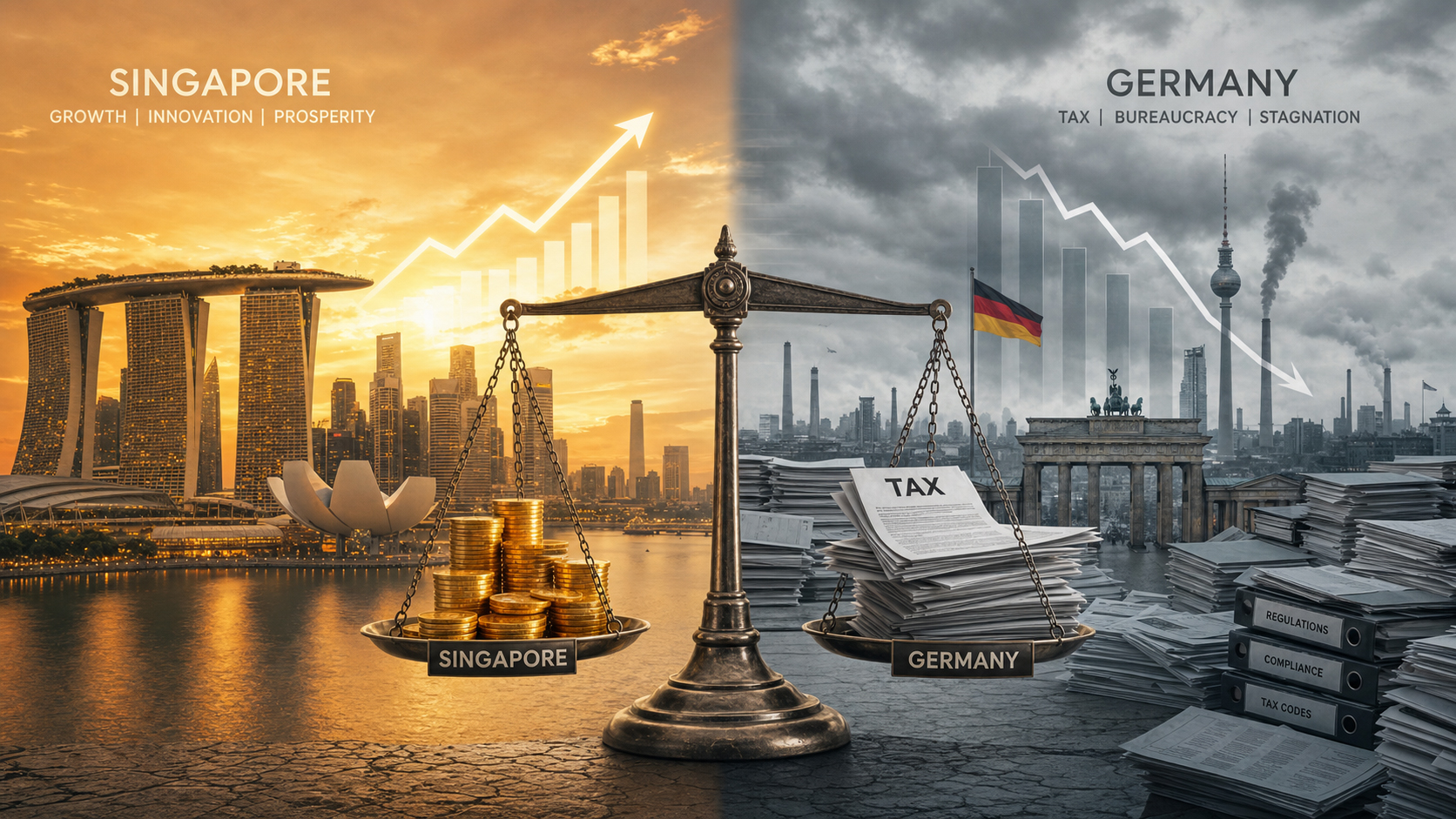
Work no longer pays off? Why Germany is plummeting – and Singapore is booming – Image: Xpert.Digital
The hard worker is the fool: How our tax system punishes the middle class
42% tax on income above €68,000: Why Germany's best skilled workers are leaving the country
Tax trap instead of prosperity: The fatal debt paradox of German politics
Germany is stuck in an economic and regulatory dead end. While emerging nations like Singapore shine with dynamic growth, targeted investments, and low taxes, the willingness to work hard in Germany is stifled by an unprecedented tax burden. Those who work hard and want to achieve more are systematically penalized in the Federal Republic: a top tax rate that already affects the extended middle class, exorbitant social security contributions, and excessive bureaucracy are making overtime increasingly unattractive. The result is disastrous – a creeping brain drain of highly qualified professionals, stagnant growth, and a state that, despite record revenues, is sliding ever deeper into a debt trap. The following text ruthlessly analyzes why German tax policy has become a massive competitive risk, what we can learn from Singapore's success story, and what radical reforms are now needed to avert this downfall. Because prosperity is not created through redistribution, but through achievement.
Related to this:

Rewarding performance instead of punishing it: Why Germany's tax policy is becoming a location risk
When work no longer pays off – the quiet farewell to the meritocracy
Germany finds itself in an economic policy dead end, a situation laid bare with alarming clarity in stark figures. In 2025, the German economy grew by a meager 0.2 to 0.3 percent – a sign of life after two consecutive years of recession, but one that offers little cause for complacency. At the same time, Singapore's economy expanded by 5.0 percent, with a particularly strong final quarter of 6.9 percent year-on-year – and this in a globally uncertain environment. Comparing these two economies is more than mere statistical analysis. It leads directly to the heart of a fundamental question of economic policy that Germany urgently needs to answer: Do we want to continue penalizing performance – or finally recognize it as the foundation of our prosperity?
Numbers that don't lie: A comparison between Germany and Singapore
Anyone comparing the tax systems of both countries will be astonished. The top personal tax rate in Singapore is 24 percent – and this only applies to annual incomes exceeding one million Singapore dollars. In Germany, the top tax rate of 42 percent kicks in at a taxable income of €68,481 in 2025 – meaning for those who would be colloquially described as "well-paid" but by no means "rich." Those earning more than €277,825 also pay the so-called "wealth tax" of 45 percent. On top of this, there's a solidarity surcharge for higher incomes and church tax, so the total tax burden can exceed 50 percent in some cases.
But income tax alone is not the only problem. Germany regularly ranks second in OECD comparisons in terms of the total tax burden on labor. According to OECD data, a childless single person with an average income pays 47.9 percent of their gross income to the state in the form of taxes and social security contributions. The OECD average is 34.9 percent – meaning Germany is almost 13 percentage points above the average for industrialized countries. Only Belgium burdens its employees more heavily. The total social security contribution rate in Germany is 41.9 percent and has almost doubled since the 1970s: in 1970 it was still at 26.5 percent.
Singapore, on the other hand, has no capital gains tax, no inheritance tax, no wealth tax, and no dividend tax. The corporate tax rate is 17 percent, but thanks to numerous allowances and incentive schemes, the effective rate is often significantly lower. The territorial principle means that only income earned in or remitted to Singapore is taxed. The result is a tax system that specifically attracts—rather than deters—capital, talent, and entrepreneurial initiative.
Related to this:

International comparison of work: Who toils for whom?
A second data point, which is hard to beat in terms of immediacy, concerns hours worked. In Singapore, full-time employees worked an average of 43.1 hours per week in 2025. Extrapolated to a working year – taking into account vacation and public holidays – this equates to approximately 2,100 to 2,200 hours worked annually. In Germany, the average weekly working time for all employed persons in 2024 was only 34.3 hours. Full-time employees work around 40 hours per week, but due to one of the most generous vacation policies in the world and numerous public holidays, they end up with around 1,400 to 1,500 hours actually worked by the end of the year. This makes Germany one of the countries with the shortest effective annual working hours among all the nations studied.
It would be an oversimplification to attribute this difference solely to cultural differences or differing philosophies of life. Research shows that tax and contribution systems significantly influence the willingness to work overtime, take on additional employment, or simply invest more effort in one's career. When the system is designed in such a way that an ever-increasing portion of every additional euro earned flows to the state, people react rationally: they work less. This is not a moral failing, but a fundamental economic principle that has been documented in the literature on labor supply elasticity for decades.
The Inland Revenue Authority of Singapore (IRAS) greets its taxpayers with the phrase: “Thank you for contributing to nation-building!” This difference in communication style is no coincidence, but rather part of a social contract: The state signals appreciation for productive work instead of burdening it with ever-increasing taxes. In Germany, on the other hand, a rhetoric has become established in parts of the political discourse that views economic success with suspicion and describes high earners as “privileged”—as if they had not earned their wealth, but as if it had simply fallen into their laps.
The debt paradox: More money, less growth
In 2025, Germany's national debt rose by €144 billion to €2.84 trillion. The debt-to-GDP ratio climbed from 62.2 to 63.5 percent. The federal budget projected total expenditures of €502.5 billion, with net borrowing of nearly €82 billion in the core budget. Adding the multi-billion euro loans from special funds for the armed forces and infrastructure, the total new debt amounted to more than €140 billion – the second-highest figure in the history of the Federal Republic. While the €500 billion special fund for infrastructure and climate protection was approved, economists have simultaneously demonstrated that parts of this fund simply replace regular budget allocations instead of actually financing additional investments.
This will dramatically increase the interest burden and, consequently, the structural budgetary constraints of the coming years. Interest payments, which were around €30 billion in 2025, are projected to rise to over €50 billion from 2028 onward. Every euro spent on interest payments is a euro less available for education, infrastructure, research, and innovation. The classic Keynesian logic—incurring debt during a crisis to stimulate demand—may be justified in certain economic situations. However, what Germany has been experiencing for almost two decades is not a short-term demand problem, but a profound supply-side weakness: excessively high costs, over-regulation, insufficient performance incentives, and a structural loss of investor confidence.
The paradox that emerges is striking: despite ever-increasing government spending, the economy is barely growing or is even shrinking. The social spending ratio – that is, social expenditure as a percentage of gross domestic product – recently reached 31.2 percent. Germany has built one of the most expensive welfare states in the world and is financing it to an increasing extent with debt. At the same time, it is considered one of the OECD countries whose social and tax systems most undermine the willingness to work.
The Laffer Curve and the Principle of Motivation: More Than Theory
The Laffer curve, named after the US economist Arthur Laffer, describes the relationship between tax rates and tax revenue: at a tax rate of zero, there is no revenue; at 100 percent, there is also no revenue, because no one would work anymore. Between these extremes, there is a maximum beyond which higher tax rates no longer increase revenue but decrease it – because they destroy incentives to work, drive out capital, and promote undeclared work. Empirical research debates precisely where this peak lies and arrives at different results depending on the methodology and country.
The crucial point, however, is not whether the Laffer curve provides a precise threshold at which tax cuts exactly pay for themselves. What is crucial is the underlying principle: taxes are not neutral. They change behavior. They influence whether someone seeks a salary increase or prefers more leisure time. Whether an entrepreneur expands or shifts their capital to a more tax-friendly country. Whether a highly qualified professional stays in Germany or takes the plunge and moves to Singapore, Switzerland, or the USA. The business world—unlike some political debates—takes incentives seriously.
The newspaper Die Welt once aptly put it: "In Germany, the hard worker is the fool." This is not satirical exaggeration, but a sobering description of a system whose tax structure systematically reduces the returns on overtime and additional commitment. The Kiel Institute for the World Economy has already pointed out that net wages, and thus taxes and social security contributions, play a crucial role in the international competition for top talent.
Brain Drain: The Silent Flight of Human Intelligence
One of the most consequential and least discussed consequences of German tax and social policy is the increasing emigration of highly qualified professionals. On average, around 180,000 well-educated Germans leave the country each year to work abroad. Only about 129,000 of them return. Gabriel Felbermayr, former president of the Kiel Institute for the World Economy, has even spoken of half a million high-achievers that Germany could lose within ten years.
The reasons for this emigration are well-documented in studies. A Prognos study commissioned by the Federal Ministry for Economic Affairs and Energy surveyed 1,400 Germans living abroad. Tax burden was explicitly cited as the second most common reason for emigration, at 38 percent, closely followed by bureaucracy at 31 percent. This is therefore not a vague sense of unease, but a clearly articulated reaction to specific economic policy conditions. Those who work hard, earn a good living, and compare their situation abroad find that in many parts of the world, they retain more of what they have earned.
This development has dramatic consequences for the tax base. Highly qualified professionals and high-income entrepreneurs contribute disproportionately to tax revenue. When they leave the country, revenues fall – while the costs of the welfare state continue to rise. Furthermore, the same factors that drive away high earners also deter top foreign talent from coming to Germany. The ZEW Mannheim notes that, in international comparison, Germany is increasingly transforming from a high-tax country to a top-tax country, while other industrialized nations are lowering their taxes.
Our EU and German expertise in business development, sales and marketing

Our EU and German expertise in business development, sales and marketing - Image: Xpert.Digital
Industry focus areas: B2B, digitalization (from AI to XR), mechanical engineering, logistics, renewable energies and industry
More information here:
A thematic hub offering insights and expertise:
- Knowledge platform covering global and regional economies, innovation and industry-specific trends
- A collection of analyses, insights, and background information from our key areas of focus
- A place for expertise and information on current developments in business and technology
- A hub for companies seeking information on markets, digitalization, and industry innovations
From city-state to economic model: What makes Singapore different
Singapore's success model: What's really behind it?
Singapore's success is no accident. Since gaining independence in 1965, the city-state has pursued a consistent strategy, shaped by the People's Action Party under Lee Kuan Yew, to build an economic model based on openness, a drive for excellence, institutional quality, and deliberately low taxes. The country boasts the third-highest GDP per capita in the world when adjusted for purchasing power parity. Transparency International ranks it among the least corrupt countries in Asia and fifth globally. The World Bank considers it one of the easiest places to run a business.
Singapore's economic success is not based on natural resources – the country has hardly any. It is based on its people, the quality of its institutions, and the targeted attraction of capital and talent. Low corporate taxes, no capital gains tax, no inheritance tax, and a streamlined, predictable tax system attract companies, investors, and highly skilled professionals from around the world. Singapore's port is the second largest in the world by cargo tonnage. The ratio of foreign trade to GDP is one of the highest globally, averaging around 400 percent between 2008 and 2011.
It would be dishonest to present Singapore as a blueprint that could be applied to Germany. Singapore is an authoritarian city-state with specific geopolitical, demographic, and historical circumstances. Political freedoms are limited, and social control is high. Germany is a long-established liberal democracy with a broad understanding of the welfare state and a social security infrastructure built up over decades. These differences are real and significant. Nevertheless, certain principles of economic policy—particularly the design of incentive structures—can be discussed and evaluated independently of the political system.
Related to this:

What location competition really means
Germany is in global competition for capital, companies, and skilled workers – whether it likes it or not. The IMD World Competitiveness Ranking 2023 placed Germany only 27th out of 64 countries surveyed in terms of "policy efficiency," a drop of six places compared to the previous year. Bureaucratic costs for businesses have increased by €14 billion since 2011. Unit labor costs have risen significantly more sharply since 2015 than the G7 average, while productivity growth has stagnated. Germany is among the countries with the highest industrial electricity prices within the G7.
Combined, these factors create a structural competitive disadvantage, resulting in declining corporate investment – precisely at a time when digital and ecological transformations require significant capital flows. Ireland has lowered its effective corporate tax rate to 12.5 percent, establishing itself as a European investment magnet, while Germany, despite repeated reform discussions, continues to have effective corporate tax rates exceeding 30 percent. These low-tax jurisdictions not only attract capital – they set a benchmark against which Germany must measure itself.
The Economic Council of the CDU (Christian Democratic Union) succinctly summarizes the situation: The tax burden on companies is too high, making Germany increasingly unattractive compared to other European locations. A comprehensive reform is necessary to safeguard competitiveness. This assessment aligns with the findings of the ZEW (Centre for European Economic Research), the Foundation for Family Businesses, and numerous other research institutions.
The moral debate and its economic costs
A key problem in the German tax debate lies in its moralistic overtones. Income taxes are often discussed primarily from the perspective of fairness: those who earn more should also pay more – progressively and without regard to motivational effects. This concept of fairness is not inherently wrong; the principle of taxation according to ability to pay is a fundamental tenet of modern tax systems. It contributes to social cohesion, finances public goods, and enables a society in which no one is left alone in times of need, whether due to illness, old age, or unemployment.
The problem arises when this concept of justice is treated as absolute and economic efficiency considerations are simply ignored. This leads to a tax policy that primarily views performance as a source of revenue to be generated, rather than as a social good worthy of protection and promotion. The next step is the implicit equation of prosperity with moral guilt – an attitude that is actually cultivated in some political circles and is not only factually incorrect but also economically toxic.
A society that penalizes performance with ever-increasing taxes while simultaneously largely compensating for inactivity through a dense network of social transfers creates distorted incentives. This doesn't mean demonizing social security—on the contrary, a functioning social system is a sign of civilizational progress. But it must be financially sustainable, and it must not be designed in such a way as to undermine the productive base from which it is financed. No country has ever achieved lasting prosperity through ever-increasing taxes, levies, and debt.
What reform does Germany really need?
The debate in Germany often revolves around the question: How high should the top tax rate be? That's the wrong question. The right question is: How do we design a tax system that motivates performance, rewards work, attracts investment, and finances the welfare state on a sound footing?
First, a substantial increase in the threshold at which the top tax rate of 42 percent applies would be an immediately effective measure. The fact that it kicks in at a taxable income of just €68,481 in Germany is unparalleled in comparable economies internationally. In countries like Switzerland, the USA, or Singapore, a comparable rate only applies to significantly higher incomes.
Secondly, social security contributions must be structurally reformed. The total tax burden of almost 42 percent on social benefits alone represents a serious competitive disadvantage and also sends the wrong signal regarding employer decisions and job creation. Decoupling labor costs from the financing of universal social benefits—through greater tax funding of benefits that are not insurance-based—would reduce the burden on labor and capital.
Thirdly, a fundamental realignment of public finances is needed, shifting away from consumption-based spending and towards productive investments. The interest burden on debt accumulated over years is already consuming significant portions of the budget that could be invested in education, infrastructure, or digitalization. Experience shows that special funds and debt packages, such as those recently adopted by Germany, often fail to generate genuine additional investment but merely redistribute regular budget funds.
Fourth – and this is the most politically uncomfortable realization – Germany needs a societal debate about the relationship between performance, recognition, and remuneration. As long as economic success is primarily seen as grounds for higher taxes and societal suspicion, the country will continue to lose high achievers – to Singapore, Switzerland, the USA, and many other locations that do not punish performance but recognize and reward it as the foundation of prosperity.
Location policy is not clientelistic policy
The frequently raised accusation that the demand for tax relief for high earners and high achievers is nothing more than special-interest politics in favor of the wealthy misunderstands the structural logic of modern economies. It's not about doing the rich a favor. It's about creating a system in which the most productive members of society have an incentive to develop their productivity – for the benefit of all.
A society that drives away entrepreneurs, skilled workers, innovators, and investors year after year through its tax system initially harms these individuals—but ultimately itself. Lower taxes on performance are therefore not a favor to the privileged, but an investment in a country's attractiveness as a business location, its innovative capacity, and a long-term tax base. Singapore's rise from a poor developing country to one of the world's wealthiest nations within six decades is the most impressive practical experiment to date in demonstrating this theory.
This does not mean abandoning social justice. But it does mean a return to the principle that prosperity is not created through redistribution, but through productive effort – and that the task of sound tax policy is to enable and reward this effort, rather than discouraging it through ever-increasing taxes. Germany has the institutional, scientific, and economic resources to pursue this path. What is lacking is the political courage to understand effort not as a problem, but as a solution.





