
Hard work vs. immediate aid: Why frustration with new immigrants is growing among the guest worker generation
Xpert Pre-Release

Available in 27 languages 📢
Prefer Xpert.Digital on GoogleⓘPublished on: April 18, 2026 / Updated on: April 18, 2026 – Author: Konrad Wolfenstein
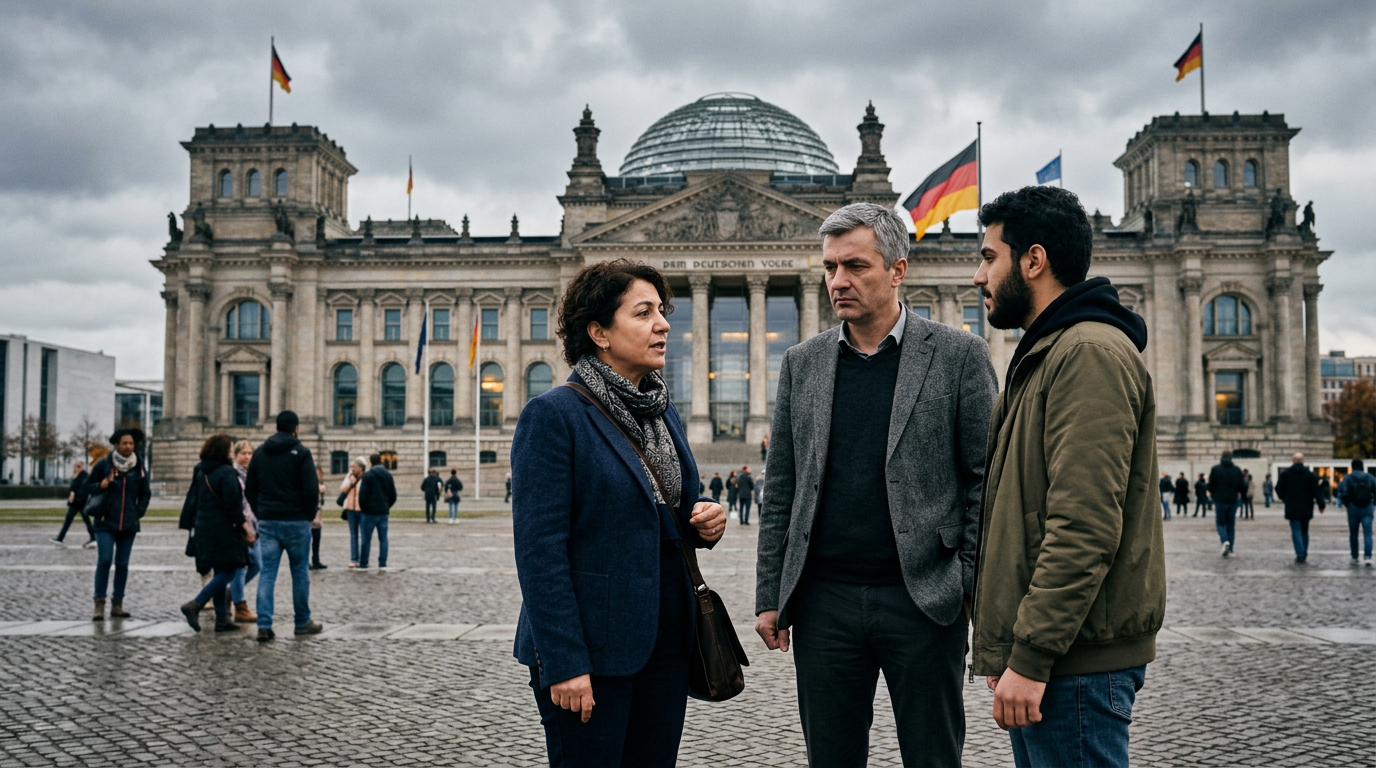
Hard work vs. immediate aid: Why frustration with new immigrants is growing among the guest worker generation – Creative image: Xpert.Digital
Social dynamite: This is why established immigrants feel unfairly treated by the German state
Surprising study results: How second-generation immigrants really think about asylum policy
“The others get everything for free”: Why integrated migrants criticize the citizen's income for asylum seekers
It is a social and political phenomenon that is often overlooked or taboo in public debate: Sharp criticism of German asylum and social policy is increasingly coming not only from the established majority society, but also from people with a migration background themselves. Those who came to Germany as guest workers, ethnic German repatriates, or refugees in previous decades, painstakingly acquired the language, and had to fight hard for their place in the labor market, often view the system today with a profound sense of injustice. When new immigrants and asylum seekers receive comprehensive state aid, such as the basic income, without having made any prior contributions, many established migrants perceive this as a devaluation of their own life's work. This discrepancy between their own, often arduous, integration experiences and the perceived unconditional state aid for newcomers harbors massive social dynamite. It is changing political landscapes, driving voters to parties critical of migration, and forcing politicians to completely renegotiate the concept of merit-based justice within the welfare state. The available data, the sociological background, and the alarming warning signals from the communities paint a clear picture.
Citizen's income debate: Why people with a migration background are specifically demanding stricter rules
Paradoxical voter migration: How dissatisfaction with asylum policy is driving migrants into the arms of the AfD
A growing social phenomenon in Germany is the criticism from naturalized migrants, second- and third-generation immigrants, and people with a migration background regarding the way the German state treats asylum seekers, new immigrants, and recipients of basic income support without prior contributions to the social security system. This criticism stems from a sense of justice shaped by their own integration experiences: those who have spent years working, acquiring language skills, and adapting to society perceive state transfers without corresponding contributions as systemically unjust. This phenomenon is empirically documented, politically sensitive, and often insufficiently differentiated in public debate.
Data situation: Citizen's income, asylum benefits and migration background
Statistical starting point
The debate surrounding social benefits for migrants is dominated by concrete figures that carry significant weight in the public perception. At the end of October 2024, 63.5 percent of the approximately 4 million employable recipients of basic income support in Germany had a migration background – in absolute numbers, 2.54 million people. According to the official definition, people with a migration background are all those who themselves, or whose parents, were born without German citizenship.
According to the Federal Employment Agency, in 2025, of the total €46.6 billion spent on citizen's income, €21.7 billion went to needy individuals with foreign citizenship, while German citizens received €24.9 billion. In some federal states, such as Hesse (76.4%), Baden-Württemberg (74.1%), and Hamburg (72.8%), the proportion of citizen's income recipients with a migration background is even higher.
Important clarification: Asylum seekers are not entitled to citizen's income during their asylum procedure, but instead receive the lower benefits under the Asylum Seekers' Benefits Act (AsylbLG) – currently €455 per month for single individuals compared to €563 in citizen's income. Recognized refugees, on the other hand, have the same entitlements as German citizens if they are in need.
Integration successes and their limits
A frequently overlooked nuance: A significant proportion of citizen's income recipients with a migration background are already employed but cannot live on their wages alone and must supplement their income. Approximately 800,000 citizen's income recipients (of all nationalities) are employed but earn too little. Furthermore, over 2 million recipients are not immediately available for the labor market for various reasons – such as health limitations or a lack of childcare.
The slow labor market integration of refugees is a structural problem: In 2023, almost half of all participants in integration courses failed to reach the B1 language level. The costs for integration courses more than doubled, rising from €586 million in 2022 to €1.23 billion in 2024. Since 2015, a total of €6.4 billion has been spent on integration courses.
The sense of justice of established migrants
Personal integration experience as a benchmark
The phenomenon of criticism among established migrants can be explained sociologically: people who themselves or whose parents came to Germany under often difficult conditions, had to acquire language skills, experienced discrimination in the labor market and paid contributions into the social system for decades, often measure new arrivals against their own standards.
In interviews, media reports, and reader comments, the same theme repeatedly emerges: those who themselves had to struggle for years perceive immediate state support for new immigrants as unequal treatment. This feeling is particularly prevalent among groups who came as "economic migrants" or as ethnic German repatriates and did not receive the immediate and comprehensive support to which today's asylum seekers are entitled.
The phenomenon among Russian Germans
Ethnic Germans from Russia (late repatriates) constitute the largest contiguous group among eligible voters with a migration background in Germany, numbering around 2.4 million. This group has developed a striking political shift towards the AfD.
A key motivation: Many ethnic Germans from Russia believe that refugees from the Arab world were received more warmly and receive state benefits that they themselves had to fight hard for. The prevailing sentiment is: "We had to prove ourselves, while the others get everything for free." This narrative is reinforced by cultural values—work ethic, family tradition, and religious roots in Christianity—which are perceived as incompatible with asylum and social policies seen as too permissive.
The post-election survey for the 2025 federal election shows that among ethnic Germans from Russia, the AfD is now almost as popular as the CDU/CSU, while the Greens are far behind among these voters.
Germans of Turkish origin and critical voices
Even within the Turkish-origin community, which has traditionally leaned towards left-leaning parties, critical voices towards recent immigrants can be found. In the 2025 federal election, the BSW and AfD performed better among voters with a migration background than in previous elections.
German-Turkish journalism provides qualitative evidence for this: Authors like Ilgin Seren Evisen (Cicero) address the fact that many German-Turks share the criticism of uncontrolled immigration – not as a rejection of migration in general, but as a demand for performance-oriented thinking and social responsibility. The demand is: Those who come should integrate – just as their own parents' generation did.
Critical intellectuals with a migration background
Prominent figures with their own migration background have become public figures in the migration-critical debate:
- Ahmad Mansour (Palestinian-Israeli psychologist): has been warning for years about failed integration policies, Islamism and the consequences of uncontrolled immigration; receives both awards and hostility for his positions.
- Seyran Ateş (a lawyer of Turkish origin): already criticized political failure in combating parallel society structures in 2007 and demands consistent integration requirements.
- Cem Özdemir addressed misogyny among newly immigrated men from the Middle East, sparking a debate in which many German-Turks explicitly found themselves on his side.
Our EU and German expertise in business development, sales and marketing

Our EU and German expertise in business development, sales and marketing - Image: Xpert.Digital
Industry focus areas: B2B, digitalization (from AI to XR), mechanical engineering, logistics, renewable energies and industry
More information here:
A thematic hub offering insights and expertise:
- Knowledge platform covering global and regional economies, innovation and industry-specific trends
- A collection of analyses, insights, and background information from our key areas of focus
- A place for expertise and information on current developments in business and technology
- A hub for companies seeking information on markets, digitalization, and industry innovations
Why migrants criticize the basic income — a new understanding of justice
Specific criticisms of political practice
Performance-based justice and social contribution
The core criticism is this: The German social security system was designed as a contribution-based insurance system, into which people pay for decades before drawing on benefits in case of need. These conditions do not apply to asylum seekers and recognized refugees. CDU politician Jens Spahn described the steadily increasing proportion of migrants receiving the basic income as "social dynamite" and warned that the population would not accept the continued rise in the number of people with short-term residency receiving the basic income in the long run.
Interestingly, this discourse is not limited to right-wing parties: In 2025, two SPD district administrators from Thuringia demanded that asylum seekers and foreigners from non-EU countries should receive social benefits as interest-free loans – with the explicit aim of avoiding a “debate fueled by envy towards migrants.” The model envisioned debt forgiveness upon rapid employment, similar to the BAföG student loan system.
Perceived unequal treatment in the social system
A particular point of contention is that people who have worked and contributed to the system for decades – including naturalized migrants – often receive less or hardly more in old age or in the event of unemployment than recent immigrants without any contribution history. This imbalance is perceived as a fundamental violation of the principle of justice, which also underpins one's own integration history.
Furthermore, the differences in benefits between asylum seeker benefits (455 euros) and citizen's income (563 euros) are blurred in the public perception. Many citizens – including those with a migration background – are unaware that differentiated regulations exist. The debate about Ukrainians receiving citizen's income (instead of asylum seeker benefits) has further highlighted this inequality.
Refusal to integrate as a provocative, sensitive issue
Established migrants are particularly sensitive to perceived unwillingness to integrate among newcomers. Those who have themselves been victims of discrimination in the job market, who were denied interview invitations because of their name, and yet still achieved success, perceive reports of denied employment or failed language courses as a personal provocation.
Iris Amirsedghi, an Iranian teacher of integration courses, told Euronews: "A significant portion of the students in the courses are not capable of integration." Despite high failure rates in language tests, social benefits continue to be granted.
Empirical findings: What studies show
SVR Integration Barometer 2024
The 2024 Integration Barometer of the Expert Council on Integration and Migration (SVR), the most comprehensive survey to date with over 15,000 respondents, presents a differentiated picture:
- The Integration Climate Index (IKI) stands at 66.3 points (out of 100) – slightly below the previous year's value of 68.5.
- People with a migration background rate the integration climate as almost unchanged at 70.3 points.
- People without a migration background have become more skeptical, with a decrease of 3.2 points to 64.9 points.
- One in three people – both with and without a migration background – now perceives refugees as a threat to prosperity: The figures are very close, with 36.8% (people with a migration background) compared to 38.5% (people without).
This convergence of attitudes is the real novelty: Skepticism towards the economic contribution of refugees is increasing in both population groups.
Bertelsmann study “Welcome culture in times of crisis” (2024)
The Bertelsmann Foundation notes that increased skepticism towards migration in Germany is not primarily due to a negative attitude towards people, but rather to concerns about the economic and social capacity for successful reception and integration. The distinction between abstract political questions and personal experiences is crucial here: 78% perceive a welcoming culture towards labor and educational migrants, but significantly fewer do so towards asylum seekers.
Political preferences of people with a migration background (BpB 2026)
The Federal Agency for Civic Education analyzes that the 2025 federal election revealed the most significant differences between population groups: the AfD and BSW performed better than ever before among voters with a migration background. Among voters of Russian-German descent, the AfD's support is now comparable to that of the CDU/CSU.
Political reactions and their consequences
Stricter migration policies
The political reaction to the public criticism was significant. The black-red coalition stipulated the following in their coalition agreement:
- The citizen's income will be transformed into a "new basic income for job seekers".
- Ukrainian refugees who entered after April 1, 2025, will no longer receive citizen's income, but rather benefits under the Asylum Seekers' Benefits Act.
- The possibility of naturalization after three years (traffic light reform 2024) has been extended again to five years.
Furthermore, the Federal Ministry of the Interior restricted access to voluntary integration courses from 2026 onwards for cost reasons – a step that is criticized by integration experts as counterproductive.
The debate about pull factors
Experts on the Bundestag's Committee on Labor and Social Affairs emphasized that the level of social benefits is not decisive for migration patterns. Empirical studies have failed to demonstrate a clear "pull effect" due to high levels of social benefits. Nevertheless, the perception persists among the population – including established migrant groups – that Germany's level of social benefits makes immigration more attractive than is socially acceptable.
Impact on social cohesion
CDU parliamentary group leader Jens Spahn explicitly warned that the rising proportion of migrants receiving basic income support would become a "social powder keg" that threatens social peace. At the same time, the Federal Agency for Civic Education reported that 64% of staff in local integration centers find the increasingly critical atmosphere more difficult to manage.
Structural causes of the criticism
Different immigration routes and their asymmetries
A key problem is the structural asymmetry between different migration pathways. Guest workers of the 1960s and 70s arrived without social security, worked under difficult conditions, and gradually built up their entitlements. Ethnic German repatriates of the 1990s, while receiving naturalization, had to attend language courses, obtain qualifications, and prove they had employment. Today's asylum seekers, on the other hand, receive comprehensive basic support from day one – a difference that established migrants perceive as unjust.
Communication failure of politics
Political discourse often fails to acknowledge the contributions of integrated migrants, while simultaneously perpetuating the narrative of uncritically accepting all asylum seekers. This leads to people who have paid into the system for decades developing a feeling of being systematically overlooked – a feeling that transcends ethnic and national origin.
Competition in the job and housing markets
New immigrants compete primarily with foreigners already living in the country in the labor market – which can further exacerbate existing wage gaps and employment risks for established migrants. In the housing market, where discrimination against people with a migration background is already widespread, immigration intensifies shortages that disproportionately affect low-income groups – including many established migrants.
Classification and societal relevance
No contradiction in itself
Criticism of asylum and social policy by people with a migration background is not a contradiction, but rather an expression of the principle of justice that they themselves have internalized in their integration process. They do not criticize migration per se, but rather the lack of reciprocity: those who receive should – as far as possible – also contribute.
The SVR Integration Barometer 2024 sums it up perfectly: Over 60% of respondents – with and without a migration background – expect a positive long-term economic contribution from the refugees they have accepted. The skepticism is not directed at the acceptance of people themselves, but rather at the political handling of integration failures and the lack of emphasis on individual responsibility.
Political instrumentalization
The AfD recognized early on that positions critical of migration also resonate within migrant communities, and it deliberately exploits this. The BSW adopts this narrative from a left-wing welfare state perspective: "A strong welfare state only functions if not everyone can immigrate into it.".
Differentiation as a key
The public debate tends to contrast two positions: an unconditional welcoming culture on the one hand, and a blanket rejection of migration on the other. The reality for naturalized migrants lies in between: they support immigration under clear conditions, but demand equal treatment, merit-based criteria, and state control – demands that are not taken seriously by established politicians.
The growing criticism from Germans with a migration background regarding the political treatment of asylum seekers and recipients of basic income support without a prior contribution history is a serious societal signal. It stems not from xenophobia, but from their own experiential knowledge of integration as a process of achievement. Empirical findings show that the differences in attitudes between people with and without a migration background regarding economic skepticism towards refugees are diminishing. Politics and society are called upon to listen to these nuanced voices – instead of either ignoring the debate or exploiting it for political gain. A social system that is consistently perceived as unjust loses its social acceptance – across all segments of the population.










