
Tesla and SpaceX lose $456 billion: Why investors are revaluing Musk's companies
Xpert Pre-Release

Available in 27 languages 📢
Prefer Xpert.Digital on GoogleⓘPublished on: November 6, 2026 / Updated on: November 6, 2026 – Author: Konrad Wolfenstein
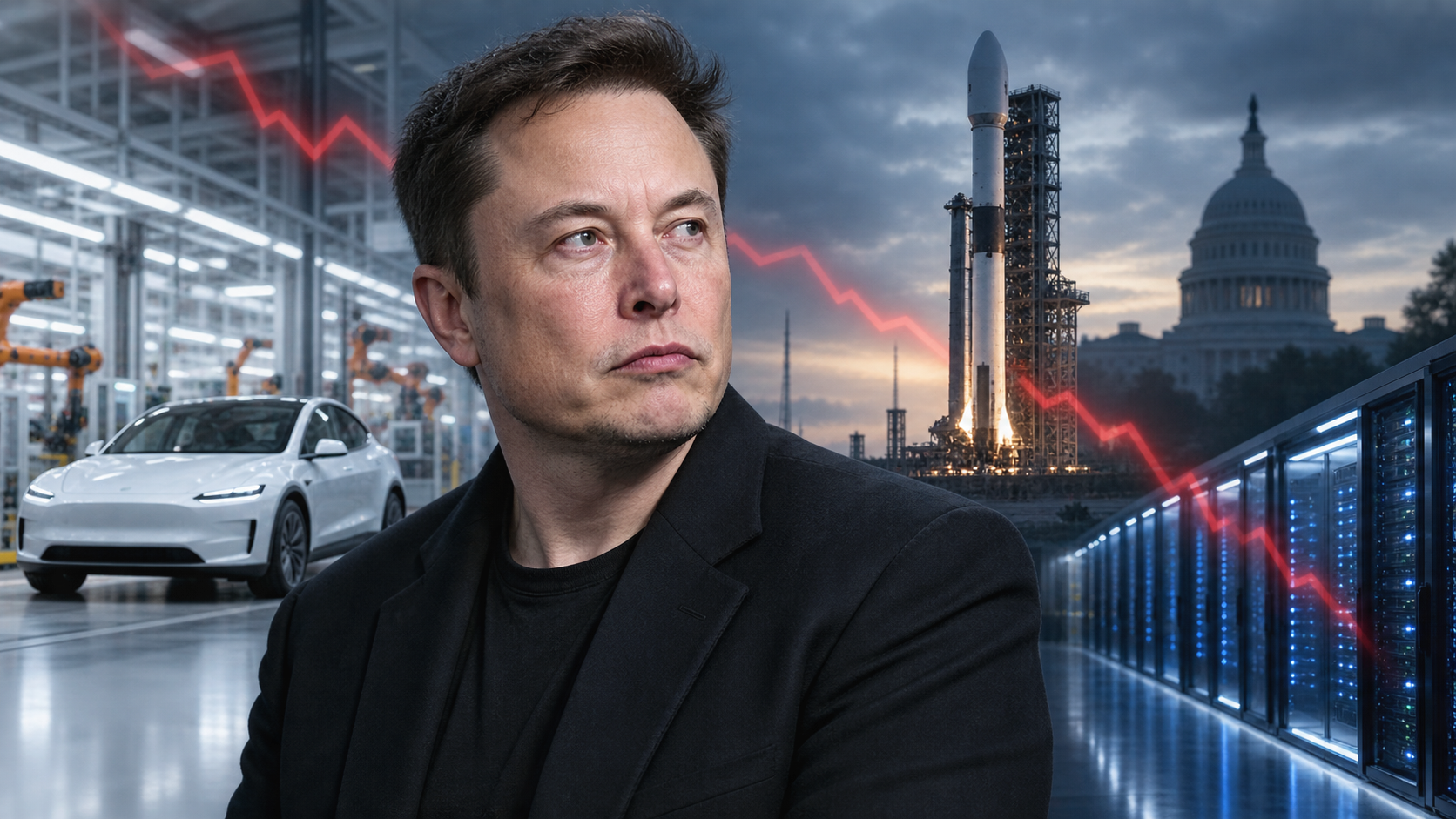
Tesla and SpaceX lose $456 billion: Why investors are re-evaluating Musk's companies – Creative image on the topic, with AI: Xpert.Digital
Tesla and SpaceX stocks plummet: How politics, the AI boom, and infrastructure fears interact
Musk under pressure: Why political risks suddenly matter more for Tesla and SpaceX
From founder bonus to risk discount: Why investors are viewing Musk's companies more critically
Tesla and SpaceX have lost a combined $456 billion in market capitalization within two trading days. The slump follows the US midterm elections and coincides with a broad sell-off in technology and AI stocks. However, the price drop cannot be explained solely by politics or exclusively by the reassessment of the technology sector: Investors are also questioning both companies' dependence on Elon Musk, their high investment needs, and the availability of electricity and infrastructure for their future plans. Considerations of a potential merger between Tesla and SpaceX also raise new questions. What does this loss actually mean – and how can we tell whether it's a temporary correction or a deeper problem?.
Those who make political proximity their business model shouldn't be surprised by political setbacks
The combined market capitalization loss of Tesla and SpaceX by approximately $456 billion within two trading days is more than just a spectacular figure. It demonstrates how quickly the valuation of promising technologies can change when political support, infrastructure availability, and corporate control are all simultaneously called into question. Following the US midterm elections on November 3, 2026, several uncertainties converge at Elon Musk's company: shifting majorities in Washington, a change in political power in Texas, growing reservations about new data centers, and doubts about the feasibility of a potential merger between Tesla and SpaceX.
However, interpreting the stock price drop solely as a political settling of scores with Musk would be an oversimplification from an economic perspective. Equally inadequate would be dismissing it as a mere fluctuation in overvalued tech stocks. In reality, the situation is driven by an industry-wide reassessment of artificial intelligence, company-specific dependencies, and the question of what price investors are willing to pay for an exceptionally strong concentration of economic power in the hands of a single individual.
The crucial question, therefore, is not whether Tesla and SpaceX are technologically less capable after two weak days on the stock market. The crucial question is whether their previously assumed growth trajectories still appear achievable with the same speed, the same costs, and the same political backing. It is precisely these expectations that are being renegotiated on the stock market.
What the loss of $456 billion actually means
Within the two trading days following the election, Tesla lost approximately $216 billion in market capitalization, and SpaceX about $240 billion. On Thursday, their share prices fell by roughly 11 and 9 percent, respectively. This magnitude illustrates how heavily both companies are driven by expectations for their future performance.
A fundamental distinction is necessary here: A decline in market capitalization does not equate to a corresponding outflow of funds from the companies' coffers. Neither Tesla nor SpaceX spent $456 billion on operating costs within two days. Nor did their factories, technical facilities, and development teams simply vanish. What has decreased is the price investors are willing to pay for ownership stakes in these companies.
Market capitalization is calculated from the share price and the number of shares outstanding. Therefore, even trading in a relatively small portion of the available shares can significantly alter the calculated valuation of the entire company. The statement that hundreds of billions of dollars have been destroyed describes a loss in valuation, not the physical destruction of corresponding production capacity.
Nevertheless, this process is not without economic consequences. A lower share price can make raising new equity capital more expensive, weaken the attractiveness of share-based compensation, and complicate acquisitions where company shares are used as payment. Furthermore, it alters the risk perception of business partners and employees. Thus, what initially appears to be a purely financial discount can, over time, develop into a real restriction of entrepreneurial options.
Two different companies find themselves under the same political shadow
Despite their shared dominant entrepreneur, Tesla and SpaceX should not be considered to have identical business models. Tesla combines industrial production with future expectations related to software and AI. SpaceX stands for space travel, communications infrastructure, and other technologically ambitious expansion projects. Cost structures, customer relationships, development cycles, and regulatory touchpoints differ significantly.
These very differences make the simultaneous downward pressure on the share prices revealing. It suggests that investors are not solely evaluating individual sales markets or specific product problems. Rather, they are considering a common risk factor: the strong connection between both companies and Musk's personality, his political decisions, and his far-reaching investment plans.
This can reverse a previously advantageous relationship. In favorable market phases, a successful entrepreneur transfers trust from one company to another. Technological breakthroughs in one area may then increase the willingness to attribute high chances of success to other projects as well. However, if the key figure comes under political or strategic pressure, the same transfer effect can work in the opposite direction.
For a dispassionate assessment, two levels must therefore be distinguished: the operational quality of each individual company and the additional premium or discount resulting from joint management. The current share price decline suggests that investors are placing greater emphasis on this second level. However, it does not prove that both operational business models have been weakened to the same extent.
Why a change in political power immediately alters the assessment
Stock markets don't just react when new laws are passed or projects are actually halted. They already process changes in probability. If investors anticipate longer approval processes, more intensive investigations, or higher infrastructure costs after an election, they can already value future profits lower today.
The Democratic victories in the House of Representatives and the Senate are changing the political landscape for Musk. Added to this are the wins of Gina Hinojosa in the Texas gubernatorial election and James Talarico in the Texas Senate election. Texas is particularly relevant because both Tesla and SpaceX are headquartered there.
However, an election victory does not automatically translate into a unified economic policy. Institutional processes lie between election night, taking office, and concrete decisions. A new Congress does not begin its work immediately the day after the election. Similarly, a new governor does not mean that all local permits or energy policy decisions are suddenly subject to a single political body.
The stock market nevertheless translates this complex reality into an immediately tradable price. This regularly leads to overreactions in both directions. Political proximity may be overvalued in good times, while political distance can trigger an excessively sharp discount after a change of power. A sound analysis must therefore distinguish between justifiable risk mitigation and premature certainty.
Political spending is no insurance against a loss of power
Musk's political activities during the 2026 election cycle amounted to approximately $445.7 million, according to available data. The vast majority of this support was for Republican candidates. While this figure is substantial, it should not be confused with the significantly larger losses in his stock market value. Similarly, it would be inaccurate to conclude, without further evidence, that he spent billions on political activities during this election cycle.
What's economically interesting is not so much the isolated amount of donations, but rather the concentration of political positioning. Those who visibly commit to a party can benefit, if that party is successful, from easier access to decision-makers and greater alignment with economic policy goals. However, this same approach also increases dependence on election results.
This is not a simple correlation between payment and political favor. Democratic institutions, legal boundaries, public scrutiny, and differing interests within parties preclude such a mechanical analysis. Nevertheless, investors can interpret close political ties as part of the business environment.
Following a change of power, the question arises whether previously assumed advantages were permanent or merely tied to a specific political constellation. This becomes particularly problematic when the market has tacitly treated political support as a stable prerequisite for long-term business plans. In such cases, a concrete sanction is not even necessary. The mere loss of perceived security can trigger a significant valuation decline.
The technology sell-off refutes the simple narrative of personal downfall
The developments at Tesla and SpaceX did not occur in an otherwise calm market. The Nasdaq-100 lost around 6.4 percent on Thursday, and the Philadelphia Semiconductor Index fell by about 12 percent. According to the underlying market data, this was the steepest daily decline for both indices since March 16, 2020. Companies like Dell and Seagate also came under significant pressure. Nvidia lost approximately $447 billion in market capitalization that day.
These comparative figures are crucial. They show that a significant part of the movement coincided with a broader reassessment of the technology sector. Musk's political positioning explains neither the entire weakness of the semiconductor industry nor all concerns about data center expansion.
At the same time, the comparison doesn't easily allow us to calculate what proportion of the losses were politically caused. An 11 percent drop in Tesla's share price and a 6.4 percent decline in the Nasdaq-100 don't automatically equate to a special political loss of 4.6 percentage points. Business models, valuation levels, and typical price fluctuations differ too significantly for that. Furthermore, large technology companies are themselves components of the indices against which they are being compared.
A clear distinction would require longer time series, suitable comparable companies, and an examination of further price-sensitive news. The more reliable conclusion is narrower: Tesla and SpaceX were under considerable pressure, while at the same time a particularly pronounced industry-wide sell-off was taking place. Both factors must be considered together.
The real weakness of the AI boom is its physical foundation
The discussion surrounding artificial intelligence is often dominated by software, models, and computing power. However, from an economic perspective, a less spectacular foundation also determines growth: timely access to electricity, grids, suitable land, cooling technology, and reliably usable infrastructure.
A data center is therefore not simply a building with powerful processors. It is part of a regional energy and utility system. Even if capital and chips are available, a project can fail due to a lack of grid connections, lengthy construction processes, or inadequate cooling. The bottlenecks are often local, while investment plans are formulated globally.
This creates a fundamental tension. Technology companies evaluate locations based on speed, cost, and scalability. Municipalities and utility companies, on the other hand, must consider the impact of additional large consumers on existing users, infrastructure investments, and regional resources.
The economic challenge is not whether to allow or prevent growth in principle. It's about making the true system costs visible and distributing them. As long as this question remains unresolved, every announced expansion could trigger new political conflicts. For companies with highly ambitious AI plans, the ability to resolve infrastructure conflicts is therefore becoming a core strategic competency.
When electricity and water become a source of social conflict over distribution
New data centers promise investment, tax revenue, and demand for technical services. At the same time, they can place additional burdens on electricity supply, land use, and water management. Which effects outweigh the others depends on the location, the technical design, and the agreed financing terms.
When it comes to electricity, annual consumption isn't the only crucial factor. The simultaneous power demand, the availability of reserve capacity, and grid expansion are also relevant. A project might theoretically draw sufficient energy but still create new bottlenecks in the regional grid. Therefore, long-term procurement contracts don't automatically replace the need for the physical provision of additional capacity.
Water requirements also need to be differentiated. Cooling systems vary considerably. Not every data center uses local water resources in the same way. Air cooling, different fluid circuits, and site-specific solutions all affect the load. Therefore, blanket statements about consistently identical water consumption would be misleading.
Cost distribution is a particularly sensitive political issue. If households expect higher costs while a large technology provider receives preferential connection terms, acceptance decreases. Conversely, transparent agreements on network expansion, water usage, and cost sharing can mitigate conflicts. The economic viability of a location therefore depends not only on technical indicators but also on comprehensible rules.
Why a delay can be more expensive than a new tax
For high-growth technology companies, time is an independent production factor. If a data center is completed later than planned, it's not just individual construction costs that are affected. The use of already acquired hardware, the development of new applications, and the start of potential revenue can also be impacted.
A simplified example illustrates the relationship. If a plant is intended to generate additional cash-generating surpluses from a certain point in time, a later start reduces its current economic value. At the same time, financing costs can continue to accrue. Already hired specialists and prepared technical components may have to be paid for for a longer period without the anticipated contribution to productivity.
Added to this is the risk of technological obsolescence. In a market with short innovation cycles, a hardware generation that is deployed late may be less competitive than originally expected. Competitors also don't necessarily wait for the same locations or approvals.
Therefore, a political conflict can become economically relevant without ever leading to a permanent ban. Even additional uncertainty about a date alters investment calculations. For investors, the crucial factor is how sensitive expected profits are to such shifts. The more heavily the valuation relies on rapidly rising returns, the greater the potential discount.
Our US expertise in business development, sales and marketing

Our US expertise in business development, sales and marketing - Image: Xpert.Digital
Industry focus areas: B2B, digitalization (from AI to XR), mechanical engineering, logistics, renewable energies and industry
More information here:
A thematic hub offering insights and expertise:
- Knowledge platform covering global and regional economies, innovation and industry-specific trends
- A collection of analyses, insights, and background information from our key areas of focus
- A place for expertise and information on current developments in business and technology
- A hub for companies seeking information on markets, digitalization, and industry innovations
Democratic majorities and their impact on corporate strategies
Texas is important, but not the only location factor
The political developments in Texas hold significant symbolic and business importance for Tesla and SpaceX. However, it would be wrong to equate the entire infrastructure of both companies with this state. Tesla operates a supercomputer cluster there; SpaceX, on the other hand, also has relevant data center locations in Mississippi and Tennessee.
This geographical distinction is important because permits, networks, and resources are organized on a location basis. A change in government in Texas does not automatically affect every project outside the state. Similarly, the location of a company's headquarters does not automatically imply jurisdiction over all of its facilities.
This creates a trade-off for corporate strategy. Spatial concentration can accelerate development work, pool personnel, and facilitate technical coordination. Conversely, greater geographical distribution reduces dependence on individual supply areas or political conflicts.
Diversification, however, comes at a cost. Additional locations require management capacity, infrastructure, and coordinated operational processes. Furthermore, data transmission, security requirements, and proximity to other development areas can be relevant. Therefore, relocating is not automatically the economically sound solution. What's needed is a robust architecture that combines efficiency with sufficient resilience.
Space data centers are an option, but not an immediate solution
The debate surrounding political obstacles to data centers is drawing additional attention to a particularly ambitious project: computing power in space. For SpaceX, this prospect is among the future expectations that factor into the company's valuation. Musk himself pointed to the increased appeal of such concepts after the election.
Economically, a distinction must be made between strategic options and readily available short-term alternatives. An orbital data center would not simply be a terrestrial building in an unusual location. Energy supply, heat dissipation, communication, radiation exposure, maintenance, and replacement of defective components would all have to be addressed as an integrated system.
Heat dissipation is particularly important. Although space is cold, it doesn't offer the same cooling mechanisms as the atmosphere. Waste heat must be released in a technically controlled manner. Added to this are the costs of transporting the necessary hardware and infrastructure into the intended orbit.
This means the concept can open up interesting long-term application possibilities, even if it doesn't yet represent an economically superior solution for all current data center needs. Investors should view such projects as uncertain development options. Conversely, if they were simultaneously priced in as a secure source of growth and as an immediate hedge against political risks, a problematic double counting of future benefits would occur.
Government relations are both a basis for business and a control risk
Political changes carry additional weight at SpaceX because the company works closely with government institutions. This creates a different risk profile than for a provider whose demand stems primarily from millions of independent private customers.
State-government relations can enable long-term planning and support technologically advanced developments. At the same time, they increase the importance of transparency, security requirements, conflicts of interest, and parliamentary oversight. This oversight is not, in itself, evidence of disadvantage, but rather an inherent part of the institutional environment.
For investors, the crucial question is whether this will result in genuinely economically relevant changes. A public hearing has a different impact than a change in funding allocation. A review of existing relationships does not automatically mean their termination. Similarly, a critical political statement does not necessarily constitute a legally valid restriction.
Furthermore, practical interests limit the scope of political action. Where a company provides crucial technical capabilities, abrupt interventions can also jeopardize governmental objectives. This interdependence argues against the idea of a simple political switch that could arbitrarily turn a complex technology company on or off.
Democratic majorities do not automatically mean a standstill
The notion that democratic election victories necessarily lead to a unified front against Musk's companies is too simplistic. Within the same party, differing positions on industrial development, energy supply, environmental protection, and technological competitiveness can exist.
This is also reflected in the reaction of James Talarico. The newly elected senator from Texas expressed a generally positive view of Tesla and SpaceX and signaled his willingness to collaborate on technological innovation. At the same time, other Democratic politicians have significant reservations about additional data centers.
These differences are economically significant. They create room for negotiation, but also make developments less predictable. A company can receive federal support for a technology field and yet still face considerable objections to a specific project at the local level.
A successful strategy would therefore require less partisan polarization and more a precise handling of individual conflicts of interest. Jobs, infrastructure costs, resource consumption, and security issues must each be addressed specifically. The ability to cooperate with differing political majorities is not a minor communication factor in a democratic system, but rather an advantage for economic stability.
A potential merger must offer more than just a convincing narrative
Early discussions about a potential merger between Tesla and SpaceX add another dimension to the reassessment. Proponents argue that a shared structure could more closely link technological development, AI investments, and strategic resources. However, the potential merger is neither a finalized nor a fully defined process.
An economic justification would therefore have to demonstrate specifically what additional advantages arise from joint ownership. Shared interests, the same leading entrepreneur, and similar visions for the future are insufficient. What would be decisive are demonstrable cost savings, better investment decisions, or additional revenues that would not be achievable to the same extent without the merger.
This raises a fundamental question: What kind of collaboration actually requires a merger? Joint development projects, long-term supply relationships, or technical collaborations can sometimes be organized between legally separate companies. A merger would have to offer a demonstrable added value compared to such alternatives.
This is countered by integration costs and added complexity. Different business models require different control parameters. Industrial vehicle production, aerospace development, and communications infrastructure do not follow the same economic rhythm. A common corporate structure does not eliminate these differences, but must manage them organizationally.
The most difficult merger issue concerns the distribution of opportunities and risks
Even if a merger were strategically advantageous, the valuation of both companies would remain a key point of contention. In a share-financed merger, the exchange ratio determines what stake the existing shareholders will receive in the new company.
Strong price fluctuations make such a determination difficult. If temporarily depressed market prices are used, one group of owners may feel disadvantaged. If, instead, long-term future models are used, the results depend heavily on assumptions about growth, profitability, and technological prospects.
Furthermore, Musk's unique position must be taken into account. When one person wields significant influence on both sides, conflicts of interest must be handled with particular care. A strategically compelling vision is no substitute for fair evaluation and independent review.
The political dimension should also be carefully considered. A critical congress can initiate investigations and increase public pressure. However, it does not alone decide on all the legal requirements for a merger. Which reviews actually become relevant depends on the specific structure and the business areas affected. Political opposition may complicate the process, but it is not equivalent to an automatic prohibition.
Why a larger corporate group wouldn't automatically be safer
A merger might give the impression that different business areas would stabilize each other. However, this effect only occurs if their risks are actually sufficiently independent of one another.
This is precisely where doubts exist in the present case. Both companies are closely associated with Musk. Both are partly valued based on ambitious technological future expectations. Both face capital-intensive investment decisions and depend on political acceptance in different ways.
Pooling such risks under one roof does not necessarily lead to diversification. Instead, it can result in a greater concentration of shared dependencies. Problems in one area could then affect the financing or perception of other areas.
Additionally, the question arises regarding internal financing flows. A large corporate group can allocate capital flexibly. However, this also means it can finance long-term projects that are difficult to verify with funds from other business units. For shareholders, it is therefore crucial whether individual activities are evaluated transparently and whether investments are prioritized according to clear economic criteria. Size alone is neither proof of synergy nor protection against poor decisions.
The founder's bonus can turn into a control discount
Musk is not merely an interchangeable leader for Tesla and SpaceX. His public presence, his technological ambitions, and his ability to mobilize capital and attention are all part of the perception of both companies.
This strong identification can create significant advantages. It facilitates a long-term narrative, attracts talented employees, and can accelerate decision-making. At the same time, it increases key person risk: Too many expectations then depend on the same person consistently setting the right priorities.
Political polarization exacerbates this problem. Personal statements can influence the public perception of several companies simultaneously. Political conflicts thus more quickly translate into economic conflicts, even if the operational teams remain unchanged.
Stable corporate governance therefore requires more than simply implementing a founder's strategy. It demands independent oversight, robust succession and representation structures, and clearly defined boundaries between personal interests and corporate decisions. The larger and more complex a corporate group becomes, the more crucial these institutional safeguards become. A company's long-term value also depends on its ability to function reliably without the constant personal intervention of its founder.
High ratings are sensitive to small changes in expectations
The economic mechanism behind abrupt share price declines often lies in the timing of expected profits. If a large portion of a company's perceived value is based on earnings expected in the distant future, even minor changes to these assumptions can significantly impact its current value.
Two effects interact here. First, later or lower returns may be expected, for example due to delayed infrastructure development. Second, investors may demand a higher risk premium because political, technical, or organizational uncertainty increases.
Both factors reduce the present value of future cash flows. Especially for companies with extensive future options, this combination can cause significant share price fluctuations without the ongoing business having changed accordingly within a few days.
For Tesla and SpaceX, the quality of expectations is therefore crucial. Which projects already have solid economic foundations? Which require further technological breakthroughs? Which depend on political decisions or substantial additional capital? If these categories are not separated, a positive overall narrative can mask very different risks for a long time. A market shock then forces a subsequent differentiation.
Which key figures are more meaningful now than the next headline?
For future developments, it is less important whether individual stocks recover some of their losses in a single day. Operational and financial developments over several reporting periods are more meaningful.
At Tesla, the key factor is how profitability, investment needs, and the economic exploitation of new technologies develop in relation to one another. Additional AI expenditures only create lasting value if they generate benefits that justify their costs. A high investment sum alone is not proof of success.
At SpaceX, existing activities and new development options must also be assessed separately. Technological advances are relevant, but they do not replace the questions of capital requirements, economic scalability, and reliable revenue.
Across companies, available liquidity, free cash flow, new financing commitments, and the utilization of additional infrastructure also deserve attention. Equally important are project milestones actually achieved. An announced facility, a secured location, an operational grid connection, and a productively used data center represent different stages of development from an economic perspective.
The more clearly these differences become visible, the less investors have to rely on political assumptions or personal confidence.
Three possible development paths instead of a supposedly certain forecast
A favorable scenario would be conceivable if political conflicts prove negotiable, infrastructure projects progress largely according to plan, and companies increasingly back up their investments with economic results. In this case, part of the risk discount could disappear again.
A moderate scenario would involve a prolonged period of higher costs and slower expansion. Business models would remain fundamentally viable, but the previously anticipated growth rate would have to be reduced. Even such a normalization could have significant consequences for highly valued stocks.
An unfavorable outcome would arise if several factors coincide: prolonged infrastructure delays, weaker returns, increased financing needs, and additional conflicts over corporate governance or a potential merger. In such a case, a valuation adjustment could become a real economic problem.
None of these paths can be reliably deduced from just two trading days. The crucial factor is the conditions under which each scenario would unfold. A sound analysis should identify these conditions, rather than automatically interpreting a sharp price drop as a buying opportunity or as proof of a sustained decline.
The new benchmark is economic resilience
The sell-off of Tesla and SpaceX reveals a fundamental shift: Technological ambition alone is not enough to justify consistently exceptional valuations. Available infrastructure, transparent use of capital, institutionally sound leadership, and the ability to operate under shifting political majorities are also essential.
Political connections can be helpful in the short term. However, they are no reliable substitute for a business model that functions even without preferential access to decision-makers. Likewise, spectacular future projects do not replace a clear distinction between already generated revenues and still uncertain opportunities.
The rationale, therefore, is neither that Musk's companies have lost their future after this stock market crash, nor that the political changes are meaningless. Rather, the burden of proof is increasing. Tesla and SpaceX must demonstrate more clearly which parts of their valuation are supported by operational performance and which depend on favorable assumptions.
The crucial long-term question, therefore, is not whether Musk wins the next political showdown. It is whether his companies become so economically and organizationally robust that they are not dependent on its outcome.
🎯🎯🎯 Data-driven B2B industry hub as a quasi-in-house solution

The quasi-in-house solution: How Xpert.Digital closes operational gaps in B2B marketing and sales – Smart Content-Driven Business - Image: Xpert.Digital
Xpert.Digital is a data-driven B2B industry hub led by Konrad Wolfenstein . The company acts as an external, quasi-in-house solution for industrial partners, closing operational gaps in marketing, content, and sales – without requiring additional resources on the client side.
More information here:
Your global marketing and business development partner
☑️ Our business language is English or German
☑️ NEW: Correspondence in your native language!

Konrad Wolfenstein
I and my team are happy to be available to you as your personal advisor.
You can contact me by filling out the contact form here [email protected]:or simply call me at +49 7348 4088 965. My email address is
I'm looking forward to our joint project.