
Porsche vs. Tesla: Profits on the road, trillions in the air: Porsche earns money from the car – Tesla sells the future along with it
Xpert Pre-Release

Available in 27 languages 📢
Prefer Xpert.Digital on GoogleⓘPublished on: October 19, 2026 / Updated on: October 19, 2026 – Author: Konrad Wolfenstein
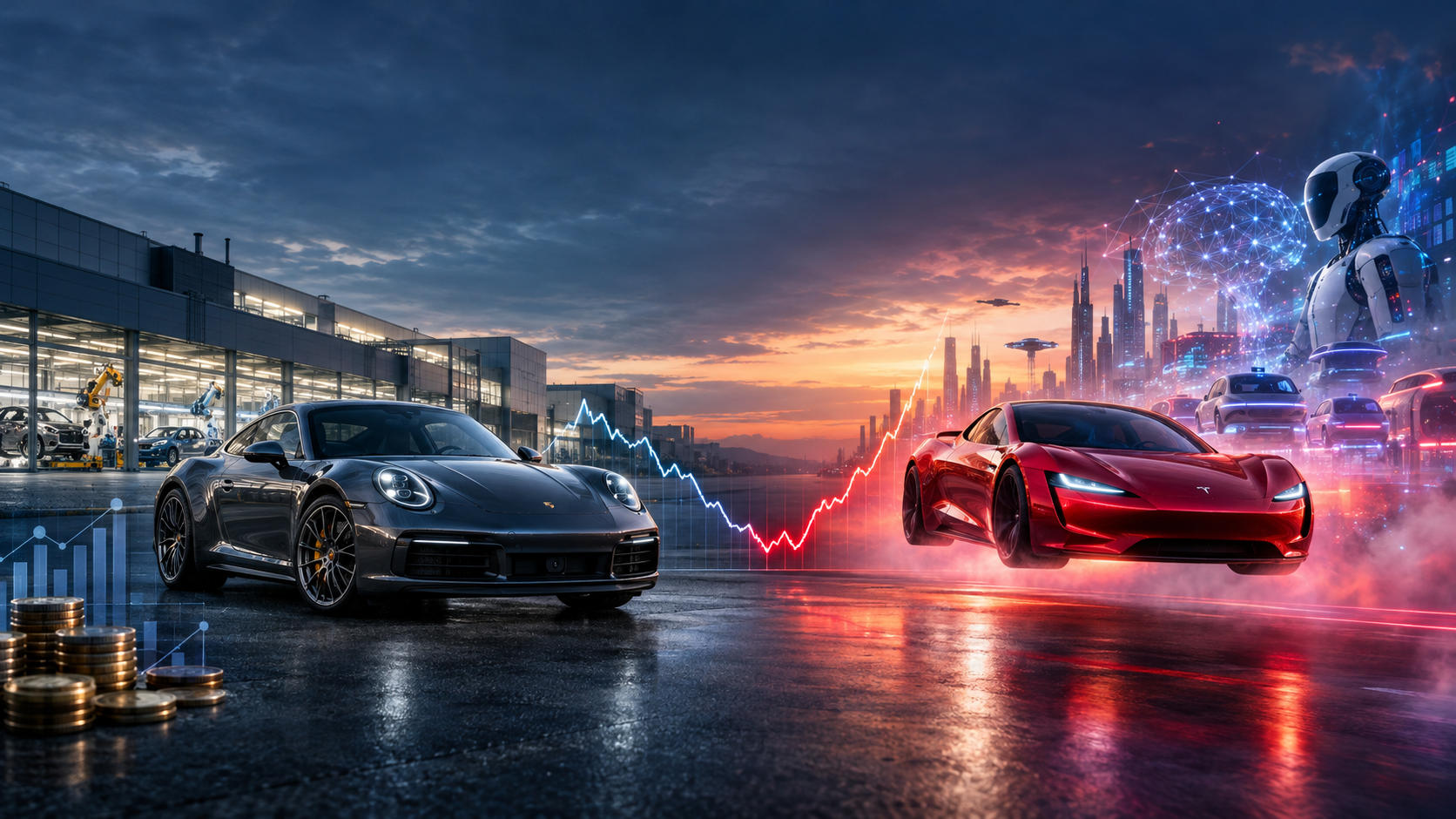
Porsche vs. Tesla: Profits on the asphalt, trillions in the air: Porsche earns money from the car – Tesla sells the future along with it – Creative image on the topic, with AI: Xpert.Digital
Porsche is more profitable than Tesla – yet Tesla is worth 33 times more
Porsche focuses on profits, Tesla on the future: Which stock has more potential?
Porsche's comeback versus Tesla's future bet: Two stocks, two completely different risks
Porsche currently earns more operating profit per vehicle than Tesla, despite delivering significantly fewer cars. Nevertheless, Tesla's market capitalization is roughly 33 times higher. At first glance, this gap seems almost incomprehensible. However, the two companies are valued according to completely different criteria: For Porsche, the focus is primarily on current profits, cash flow, and whether the brand can regain its former profitability. In contrast, the market is pricing in high expectations for Tesla – from autonomous robotaxis and artificial intelligence to energy storage and humanoid robots.
This contrasts two fundamentally different investment narratives. Porsche must prove that the company can once again achieve consistently high margins even with realistic production volumes. Tesla must demonstrate that its future projects are not merely technically fascinating, but will actually translate into large, profitable businesses. One stock is primarily a bet on a successful transformation, the other on several potential breakthroughs. A comparison of financial figures, valuation, and key milestones leading up to 2028 reveals the opportunities and risks involved.
Porsche vs. Tesla: Why one earns billions and the other is worth trillions
Few stock market comparisons seem as contradictory at first glance as that between Porsche and Tesla. Porsche earns solid billions in operating profit, achieves significantly higher operating profit per vehicle delivered, and generates robust net cash flow in its automotive business. Despite considerably higher production volumes, Tesla achieves a similarly high operating profit, yet is valued roughly 33 times higher on the stock market. Anyone focusing solely on cars, factories, and current profits must consider this gap absurd. However, those who understand Tesla as a future operator of autonomous vehicle fleets, an AI company, an energy corporation, and a manufacturer of humanoid robots will at least grasp the logic behind its valuation.
The crucial question, therefore, is not which manufacturer builds the better cars today or which brand has a stronger emotional impact. It's about what kind of future the stock market envisions for the two companies. Porsche is largely valued based on how many vehicles it sells, the price it commands, and the profit remaining after production, development, and sales costs. Tesla, on the other hand, is valued to a significant extent on whether robotaxis, autonomous driving, artificial intelligence, energy storage, and the humanoid robot Optimus will one day generate huge, highly profitable business areas.
This brings together two fundamentally different valuation worlds. Porsche represents the restoration of demonstrable profitability. Tesla represents the anticipation of potential returns that do not yet exist on this scale. The stock market pays for evidence in the case of Porsche and for probabilities in the case of Tesla. This is precisely where both the great opportunity and the central risk of both stocks lie.
Why the comparison seems crazy at first
In the first half of 2026, Porsche achieved an operating profit of approximately €1.35 billion. Converted, this was roughly equivalent to US$1.52 billion. Tesla, in the same period, achieved an operating profit of approximately US$1.34 billion. Purely on this level, Porsche was therefore slightly ahead, even though Tesla delivered almost seven times as many vehicles to customers (around 838,000) as Porsche (122,306).
The difference becomes even more apparent when looking at operating profit per vehicle delivered. Dividing Porsche's group profit by the number of vehicles delivered and converting the result into US dollars yields approximately $12,400 per vehicle. For Tesla, it's about $1,600. This comparison isn't entirely accurate because the two companies have different business models and reporting structures. Tesla also earns money from energy storage, solar technology, services, software, and regulatory emissions credits. Porsche, on the other hand, has a financial services business and generates revenue that cannot be easily attributed to a single vehicle. Nevertheless, the magnitude of these figures illustrates the significant differences in the economic quality of the vehicles currently sold.
Porsche sells relatively few products, but they are expensive and high-margin. Tesla sells significantly more vehicles, but faces fiercer price competition and is simultaneously financing a massive expansion of new technologies. The Porsche model resembles a high-priced specialist provider that earns money through brand, product mix, and scarcity. Tesla, on the other hand, is attempting to become a mass-production manufacturer, software platform, energy provider, operator of autonomous mobility, and robotics company all at once.
However, these differences are not reflected proportionally in market capitalization. In mid-October 2026, Tesla's market capitalization stood at around $1.4 trillion. Porsche was valued at approximately $42 to $43 billion. This meant Tesla was worth roughly 33 times as much as Porsche, even though their operating profits in the first half of the year were nearly identical. From the perspective of a traditional auto investor, this appears to be a massive mispricing. From the perspective of a technology investor, it's a bet that Tesla's current car business is merely the foundation of a much larger system.
Three key figures that everyone can understand
Operating profit, in simplified terms, shows what remains after ongoing operating expenses, before interest and taxes are taken into account. It answers the question of whether the core business is profitable. In the first half of 2026, Porsche generated approximately €1.35 billion in operating profit from €17.23 billion in revenue. This corresponded to an operating profit margin of 7.8 percent. Tesla, on approximately US$50.6 billion in revenue, generated roughly US$1.34 billion in operating profit. This resulted in a margin of about 2.6 percent.
Profit per vehicle is a clear indicator, but it shouldn't be confused with the actual profit on each individual car. It mathematically distributes the total operating profit of the group across the number of vehicles delivered. For Porsche, this results in a figure of approximately $12,400, and for Tesla, about $1,600. Because Tesla also generates revenue from energy and services in addition to vehicles, this figure is rather generous for Tesla. It illustrates how little profit the entire company currently generates relative to its vehicle volume.
Cash flow answers a different question: Is money actually coming in after the company invests? Porsche reported a net cash flow of €1.02 billion in its automotive division for the first half of the year. Tesla generated free cash flow of $1.44 billion in the first quarter, but consumed around $1.09 billion in the second quarter. This left only about $350 million in free cash flow for the first half of the year. Thus, despite significantly lower production volumes, Porsche generated considerably more readily available cash from its automotive business.
However, this comparison is not entirely symmetrical either. Porsche's net cash flow in the automotive sector does not follow exactly the same definition as Tesla's free cash flow. Furthermore, changes in inventory, receivables, and payables can significantly impact half-year results. For Tesla, the first quarter benefited, among other things, from extended payment terms with suppliers, while in the second quarter, sharply increased investments weighed on free cash flow. Nevertheless, the trend remains clear: Porsche delivered better short-term cash generation in the first half of the year, while Tesla invested more aggressively in the future.
Porsche is more profitable, but not yet financially sound
Porsche's half-year figures look promising compared to the weak first half of the previous year. Operating profit rose by 33.9 percent to €1.35 billion, the operating margin improved from 5.5 to 7.8 percent, and net automotive cash flow increased from €394 million to €1.02 billion. This development shows that cost discipline, a more favorable product mix, and stricter management of tied-up capital can be effective.
At the same time, deliveries fell by 16.5 percent to 122,306 vehicles. Revenue declined by 5.1 percent. This isn't a typical growth story, but rather a stabilization under challenging conditions. Porsche is earning more again, even though fewer vehicles are being sold. In the short term, this is positive, as it demonstrates pricing power and cost control. In the long term, however, a premium manufacturer cannot compensate for declining volumes indefinitely with higher prices.
The operating margin of 7.8 percent is also far below the levels with which Porsche shone just a few years ago as one of the world's most profitable automakers. In 2025, the group margin even fell to around 1.1 percent due to high costs. The recovery in the first half of 2026 is therefore significant, but not yet proof that the profit engine has been permanently repaired. It shows that the low point may have been overcome. It does not yet prove that Porsche will reliably achieve double-digit margins again.
Cash flow also warrants a sober assessment. The increase to €1.02 billion was supported by higher operating cash inflows, disciplined working capital management, and lower capital outflows. Such improvements are valuable, but they cannot be replicated at will every six months. Inventory reductions, deferred payments, or lower investments can temporarily improve cash flow. Sustainable value creation only arises when high margins, competitive products, and sound investments converge.
The recovery will be decided at 230,000 cars
Porsche's future doesn't depend on whether a spectacular supercar generates headlines. What's crucial is whether the company can operate profitably in the long term with a realistic annual production of approximately 230,000 vehicles. At this volume, fixed costs, development budgets, factories, sales, and administration must be sized in such a way that an attractive return on investment is achieved even without a return to previous record production levels.
The new strategy therefore aims for a lower break-even point of fewer than 200,000 vehicles per year. This is economically more important than any design study. A lower break-even point means that Porsche can cover its costs even with weaker demand and generate profits with moderate production volumes. The brand is to become smaller, more exclusive, and more resilient. Value per vehicle is to be more important than maximum volume.
Porsche is reacting to a structural change. The earlier hope of consistently selling very high volumes with exceptional margins in China has proven overly optimistic. Deliveries in China fell from approximately 100,000 vehicles in 2021 to just around 14,500 in the first half of 2026. Chinese buyers now have a wide selection of technologically advanced electric cars from domestic brands. At the same time, the prestige of Western luxury brands has diminished, and pricing dynamics in the Chinese market have become more aggressive.
A strategy for 230,000 vehicles is therefore more credible than a plan that automatically aims for a return to more than 300,000 units. Porsche doesn't necessarily have to get bigger to become more valuable. The company needs to prove that higher prices, fewer variants, more efficient development, platform collaborations, and a leaner organization will sustainably increase profit per vehicle. If it succeeds, a smaller Porsche could be economically stronger than a larger Porsche with excessively high fixed costs and too many unprofitable models.
Mission S is a signal, not a lifeline
The Mission S embodies Porsche's ambition to establish a permanently available family of mid-engined super sports cars above the 911. The vehicle is more than a one-off design exercise, but for now remains a future project without any published pricing, performance, or sales figures. It has the potential to emotionally charge the brand, attract affluent customers, and expand the price range upwards. For a luxury brand, such a top-of-the-line model makes strategic sense.
Economically, however, it remains the icing on the cake. Even an extremely expensive vehicle can only have a limited impact on the overall balance sheet if it is produced in small numbers. Its greatest value often lies not in direct profit, but in its effect on the entire brand. A desirable flagship model can make the 911, special editions, and other high-priced model series more attractive. It generates attention and justifies higher prices in lower segments.
Porsche's restructuring must nevertheless originate from its core business. The 911, Cayenne, Macan, Panamera, and the future 718 models must collectively generate sufficient profit margins. Development costs must decrease, model variants must remain manageable, and new vehicles must be launched on schedule. The Mission S can demonstrate Porsche's design and emotional direction. However, it cannot replace weak business in China, nor can it alone compensate for high structural costs.
The correct order is therefore: first, a profitable core business with realistic production volumes, then additional revenue through particularly exclusive models. If Porsche tries to achieve profitability with a Halo vehicle, skepticism would be warranted. If, on the other hand, the Mission S is part of a consistent value-over-quantity strategy, it can make a meaningful contribution.
Tesla is no longer a car manufacturer listed on the stock market
Anyone who values Tesla using the same metrics as Porsche inevitably arrives at an extreme result. Tesla achieved an operating profit of approximately $4.4 billion in 2025. If one were to apply a valuation that roughly corresponds to Porsche's current ratio of market value to normalized operating profit, only about 4 to 6 percent of Tesla's market capitalization could be explained. The exact figure depends on whether one calculates using market value or enterprise value, what Porsche results are considered sustainable, and which exchange rate is used. This does little to change the fundamental point: More than 90 percent of Tesla's valuation is not based on current automotive profits.
This enormous residual value is a collection of future expectations. These include autonomous robotaxi fleets, paid software for automated driving, the Cybercab, humanoid Optimus robots, AI computing power, proprietary chips, energy storage, solar products, charging infrastructure, and potentially new financial or mobility services. Investors are not just evaluating what Tesla is currently selling, but what the company could develop from its fleet, data, software, and manufacturing expertise.
This explains why classic key performance indicators look so unusual at Tesla. A traditional manufacturer is evaluated based on profit, cash flow, sales, market share, and balance sheet. A platform, on the other hand, can be additionally assessed by how many users it reaches, the strength of network effects, and the potential for recurring software revenue. A successful robotaxi system would potentially have a different cost structure than the one-off sale of a car. A functioning humanoid robot for factories and logistics could open up a market that extends far beyond the automotive industry.
Tesla will therefore not receive a higher automotive multiple on the stock market that Porsche could simply copy. The company will receive a bundle of valuations encompassing automotive, software, AI, energy, and options. Porsche could double its margin and still wouldn't automatically be valued like Tesla. For that to happen, the market would have to believe Porsche could generate scalable, recurring profits largely decoupled from vehicle sales. A strong brand alone is not enough.
Where Tesla's bet on the future has substance
It would be too simplistic to dismiss Tesla's valuation as mere smoke and mirrors. The company possesses real industrial capabilities, a globally recognized brand, large vehicle fleets, vast amounts of data, proprietary software development, a robust charging infrastructure, and a growing energy storage business. In the second quarter of 2026, deliveries reached a record 480,126 vehicles. Revenue peaked at $28.24 billion, and service revenue saw strong growth. The number of active customers for its supervised automated driving system approached 1.5 million.
Robotaxi is no longer just a presentation slide. Tesla is operating initial services in several US cities, and the Cybercab entered early production in 2026. While these activities are still far from a global, highly profitable network, they demonstrate that the concept is gradually becoming a real product. Optimus also has production lines and initial small-scale production runs. The robots are primarily used for learning and testing within Tesla facilities. Commercial mass production with reliably productive work has not yet been proven, but the project has moved beyond the purely conceptual phase.
Tesla's advantage lies in combining diverse capabilities. The company can integrate batteries, power electronics, vehicle production, AI training, computer hardware, and software within a single corporation. Should autonomous driving achieve a technical and regulatory breakthrough, Tesla could upgrade a portion of its existing fleet with software. If Optimus reliably handles standardized tasks in factories and warehouses, Tesla could transfer its manufacturing expertise to a new market.
The capital market is currently paying for these opportunities because their theoretical value is very high. A global robotaxi network or a humanoid robot sold in the millions could generate profits that far exceed today's automotive business. The valuation is therefore not entirely irrational. However, it is extremely dependent on many factors. Numerous elements must align simultaneously: technology, safety, regulation, production, customer demand, financing, and profit margins.
🎯🎯🎯 Data-driven B2B industry hub as a quasi-in-house solution

The quasi-in-house solution: How Xpert.Digital closes operational gaps in B2B marketing and sales – Smart Content-Driven Business - Image: Xpert.Digital
Xpert.Digital is a data-driven B2B industry hub led by Konrad Wolfenstein . The company acts as an external, quasi-in-house solution for industrial partners, closing operational gaps in marketing, content, and sales – without requiring additional resources on the client side.
More information here:
Tesla's Vision: Where the Challenges Lie
Where vision quickly turns into exaggeration
The central weakness of Tesla's valuation is not a lack of interesting projects, but rather the sheer number of successes already priced in. With a market capitalization of around $1.4 trillion, it's not enough for robotaxis and robots to eventually generate revenue. These businesses need to become very large, highly profitable, and sustainably viable. Small pilot fleets, limited geographic areas, or a few tens of thousands of robots would hardly justify today's valuation.
Added to this is a well-known timing risk. Elon Musk has repeatedly stated very ambitious timelines for autonomous driving, new vehicles, robots, and production volumes. Tesla has indeed accelerated many industries, but numerous goals were later achieved, modified, or have not yet been met. Investors must therefore distinguish between strategic direction and concrete time commitments. That Tesla is working on robotaxis is a reliable fact. When this will become a globally scalable business with high margins is an open question.
The development of X after Musk's acquisition isn't direct proof against Tesla, but it is a useful warning signal for evaluating grand promises. A comprehensive platform announced doesn't automatically transform into a new economic ecosystem. Reach, brand, and technological ambition alone aren't enough; crucial factors include usage intensity, product quality, regulation, willingness to pay, and a viable business model. The fact that X remains heavily focused on communication and news illustrates the gap that can arise between a grand platform vision and its actual monetization.
The same discipline is required at Tesla. A demonstration doesn't prove reliable mass production capability. A test run doesn't prove scalability. A high number of units produced doesn't prove a positive return on investment. The capital market sometimes treats Tesla as if several technological breakthroughs are merely a matter of time. In reality, these are interdependent bets, each with its own probability of failure.
The old safety net is getting thinner
For years, Tesla was able to sell regulatory emissions credits to other manufacturers. These revenues were particularly attractive because they were offset by only minimal additional costs. In 2024, they amounted to approximately $2.76 billion. In 2025, despite a decline, they still contributed roughly $2 billion to earnings. By the second quarter of 2026, this figure had dropped to just $146 million, down from $380 million in the first quarter.
This is more than just a minor detail. If you subtract the $526 million in regulatory loan proceeds from the first half of the year from operating profit, you're left with approximately $813 million. Based on half-year revenue, this results in an operating margin of roughly 1.6 percent. This calculation assumes that the loan proceeds are offset by virtually no direct costs. While not an official segment calculation, it illustrates just how thin Tesla's current operating profitability would be without this contribution.
At the same time, the regulatory environment has become less favorable. In the US, sanctions for exceeding certain fleet fuel consumption targets have been softened or rendered economically worthless. Other manufacturers are expanding their own electric vehicle offerings or reducing their need for purchased credits. Tesla can therefore no longer assume that this almost free profit buffer will return to its previous level.
This doesn't mean that Tesla wouldn't be a viable company without emissions credits. It does mean, however, that vehicle margins, software, energy, and services will have to deliver more in the future. Precisely at a time when Tesla is investing heavily in new factories, AI data centers, robotaxis, Optimus, semiconductors, and solar technology, a particularly profitable source of revenue is disappearing. This increases the pressure for the new business areas to not only impress technically but also deliver economically.
Two high-volume models can carry almost anything
In the first half of 2026, approximately 809,655 of Tesla's 838,149 deliveries were Model 3 and Model Y vehicles. This corresponds to just under 97 percent and just under 98 percent, respectively. The core message, however, remains valid: outside of specific niche markets, Tesla's vehicle business depends almost entirely on these two model families. The Cybertruck, Model S, Model X, and Semi play a minor role in terms of volume, especially outside of North America.
This concentration is efficient as long as the Model 3 and Model Y remain in demand. High production volumes on a few platforms simplify purchasing, manufacturing, software maintenance, and service. At the same time, this creates a significant risk of product obsolescence. Competitors from China are rapidly launching new electric vehicles with advanced electronics, high charging capacity, attractive interiors, and aggressive pricing. Established manufacturers are also closing technological gaps.
A new, affordable mass-market vehicle that represents the next level of volume production is not yet available in globally relevant numbers. The Cybercab could potentially fill this role in the long term, but is initially intended for autonomous mobility services and depends on the success of self-driving technology. Due to its design, regulatory requirements, and positioning, the Cybertruck is not a universal global model. The Semi targets commercial vehicles, not the broad passenger car market.
Tesla therefore faces a difficult transition. The company is financing its future with its current car business, which has a narrow product base and margins under pressure. New business areas require enormous investments, while the existing business is becoming more price-competitive. This transition explains precisely why increasing deliveries do not automatically translate into increasing profits.
25 billion dollars is no small matter
Tesla expects capital expenditures of more than $25 billion for 2026. In the second quarter alone, they reached $5.79 billion, 142 percent higher than a year earlier. The company is not only expanding vehicle production capacity but also funding robotaxi fleets, Optimus production, semiconductor projects, solar manufacturing, and AI computing infrastructure. This sum demonstrates how seriously Tesla is taking its transformation.
High investments aren't inherently bad. If a company uses them to build facilities that later generate consistently high profits, they create significant value. The problem lies in the time lag. The money flows out now, while the returns may not materialize for years. In the second quarter, this increase in investments led to a negative free cash flow of approximately $1.09 billion. After the strong first quarter, only a small positive amount remained for the first half of the year.
For Tesla, this means that its strong balance sheet and access to capital become strategic advantages. The company can afford investments that would be impossible for smaller competitors. At the same time, every additional billion increases the necessary future return on investment. An AI data center or a robot factory is only economically valuable if the resulting products generate sufficient revenue and margins.
The stock market currently interprets Tesla's investments primarily as a move to build future dominance. A more cautious view sees them as the real cost of projects with uncertain outcomes. The truth likely lies somewhere in between. Tesla is better positioned than almost any traditional manufacturer to implement such projects. But Tesla, too, can misallocate capital, underestimate technical challenges, or overestimate markets.
Porsche faces other, but equally real, risks
Porsche is valued more favorably in comparison because its problems are more visible and immediate. China is not just a temporary sales drag, but potentially a permanently smaller market for the brand. The 15 percent US import tariffs are a burden for a company that doesn't produce any vehicles in the United States. Exchange rates, stricter regulations, and high depreciation are further squeezing margins.
The electrification strategy also had to be adjusted. Demand for purely electric luxury vehicles developed more slowly than expected, while Porsche simultaneously incurred high development costs. Now the company is focusing more on a mixed offering of combustion engine vehicles, plug-in hybrids, and electric cars. This technological openness reduces demand risk but can increase complexity and capital requirements.
Restructuring the cost base is also challenging. Porsche plans to reduce its workforce by approximately 9,000 employees by 2035 and significantly streamline management and administrative structures. At the same time, billions of euros are to be invested in Zuffenhausen and Weissach. Socially responsible job cuts, site guarantees, and high German costs limit the speed at which savings will translate into profitability.
Added to this is the stock market structure. The freely traded Porsche preferred shares have no voting rights, and the actual free float is small, at just over 12 percent of the total share capital. Volkswagen retains control, while Porsche SE holds a blocking minority of the ordinary shares. For minority shareholders, this means less influence and a complex web of interests. This governance discount is a key reason why Porsche should not be valued solely on the basis of its brand or operational quality.
Why Porsche stock is still interesting
The low valuation creates a different kind of opportunity than with Tesla. Porsche doesn't need to create a global robotics market. The company primarily needs to achieve its own goals. Its medium-term ambition is an operating margin of 10 to 15 percent and a net cash flow margin in the automotive division of 9 to 12 percent. In the long term, the target is a 15 percent operating margin.
The consensus among analysts for 2028 is roughly 9.5 to 9.8 percent EBIT margin, depending on the data available. Some firms are forecasting around 9.7 or 10.5 percent. The market thus expects Porsche to improve, but is not automatically anticipating a return to the full target range. Even reaching the lower end of the 10 percent range would be an important signal, as it would demonstrate that the new cost and product strategy is working.
The often-cited prospect of roughly 30 percent share price potential cannot be mathematically proven simply by the fact that a 10 percent margin is slightly above a consensus expectation of approximately 9.5 percent. Such a share price opportunity additionally requires that revenue stabilizes, cash flow increases, the valuation does not fall further, and investors grant the improved earnings a higher, or at least constant, multiple. The hypothesis is plausible, but it is not an automatic rule of thumb.
The positive scenario looks like this: Porsche stabilizes at around 230,000 vehicles or slightly more, lowers the break-even point below 200,000 units, increases the value per vehicle, reduces complexity, and achieves double-digit margins again from 2028 onward. Then profits would rise significantly, cash flow could increase disproportionately, and the current valuation discount would be harder to justify. Porsche doesn't need a Tesla premium for this. It's enough if the company once again operates reliably like a high-quality luxury and sports car manufacturer.
Why Tesla doesn't necessarily have to crash
A high valuation is not an automatic short-term crash. As long as investors believe Tesla can tap into several major future markets, the stock can trade well above traditional automotive multiples. Even disappointing vehicle margins can be accepted temporarily if robotaxis, FSD, Optimus, or the energy business demonstrate convincing progress.
Tesla also possesses the ability to translate capital market confidence into real investment power. A high market capitalization facilitates financing, employee compensation, and strategic expansion. The strong brand attracts talent, customers, and partners. This cycle can be self-reinforcing as long as the technological narrative remains credible.
The crucial question, therefore, is not whether Tesla appears overvalued today, but how quickly its fundamental results can be reflected in its valuation. Should autonomous driving be widely permitted, the use of Full Self-Driving (FSD) increase significantly, robotaxi fleets achieve high utilization rates, and Optimus deliver productive work, Tesla's profit base could look completely different than it does today. In that case, the comparison with Porsche would indeed be too narrow.
If several of these projects fail or are significantly delayed, the valuation problem will become apparent. The current automotive business alone cannot support a market capitalization of $1.4 trillion. Even strong growth in the energy business would only partially close the gap. Tesla doesn't need a single success, but likely several major successes simultaneously.
Two stocks, two opposing burdens of proof
At Porsche, the burden of proof lies in the here and now. The company must demonstrate that it can cut costs, deliver products on time, reduce brand scarcity, and achieve double-digit margins again with lower volumes. Every improved quarterly profit and every robust cash flow reduces the perceived risk. The market demands execution, not vision.
For Tesla, the burden of proof lies in the future. The company must demonstrate that high investments generate new, scalable revenue streams. Vehicle deliveries remain important, but are no longer sufficient. The evaluation will focus on progress in autonomous driving, paying software customers, robotaxi utilization, robot productivity, energy storage, and the return on more than $25 billion in investments.
This contrasting starting point explains the different share price reactions to news. A new Porsche supercar concept generates strong emotions but barely affects the profit calculation in the short term. A technological advancement in autonomous driving could theoretically unlock billions in future platform value for Tesla, even though it currently generates little profit. Conversely, a slight decline in margins at Tesla can trigger significant doubts because it complicates future financing, while a small increase in margins at Porsche strengthens the restructuring thesis.
The comparison is therefore less a race between two car manufacturers than a duel between two capital market logics. Porsche is a turnaround and valuation bet. Tesla is a growth and technology bet. Both can pay off, but for completely different reasons.
What will really matter by 2028
For Porsche, five developments are crucial: sales levels, the break-even point, the operating margin, cash flow, and the ability to command a premium. The most important figure is not the performance of the Mission S, but the return on the entire model portfolio. If Porsche achieves an operating margin of at least 10 percent on approximately 230,000 vehicles, the restructuring would be credible. If this requires ongoing special measures, investment cuts, or exceptional working capital management, the quality of the recovery would remain questionable.
Investors at Tesla need to pay closer attention to the conversion of technology into cash. How many customers are paying for FSD on an ongoing basis? How many robotaxis are operating without safety drivers in regular commercial services? What revenues and contribution margins are generated by this? How many Optimus robots are demonstrably performing productive work, and what are their manufacturing costs? How is free cash flow developing after the massive investment program?
The automotive business also remains an early warning system. If Model 3 and Model Y sales grow solely through lower prices, volume could increase while profits fall. If new software revenues, lower production costs, and improved capacity utilization stabilize margins, that would send a significantly stronger signal. The development of regulatory loans should be considered separately to maintain clarity on the profitability of the core business without political support.
By 2028, it should become clear which assumption deviates more from reality. Either the market is underestimating Porsche's ability to restore its cost base and pricing power, or it is overestimating Tesla's ability to generate sufficiently high profits quickly from robotaxis, AI, and robots. It is also possible that both valuations are partially wrong: Porsche could improve operationally without eliminating the governance discount, while Tesla makes real progress that is nevertheless not significant enough to justify its overall market capitalization.
The sober, but uncomfortable perspective
The market is paying for a story with Tesla, but not just a story. Behind it are real products, real data, real factories, and real technological advancements. At the same time, it's already paying for a very large part of the anticipated future. This makes the stock vulnerable to delays, regulatory constraints, and weaker returns on equity.
At Porsche, the market isn't fundamentally rejecting operational performance. It doubts, however, that the recent improvements are sustainable. After the slump in China, the problems with the electrification strategy, high tariffs, a complex ownership structure, and massive restructuring, this skepticism is understandable. The current valuation discount, however, already reflects a great deal of pessimism. Therefore, solid execution can be more valuable than a spectacular promise.
Porsche shouldn't try to be traded like Tesla. That would be neither realistic nor necessary. The company doesn't need to invent a robotaxi fantasy, but rather focus on economically disciplining its brand, its products, and its cost base. The path to a higher valuation lies in 230,000 profitable vehicles, double-digit margins, and reliable cash flow, not in a single supercar.
Tesla, in turn, cannot permanently rely on its vision to mask operational weaknesses. Declining carbon credits, an operating margin of only around 1.6 percent excluding this contribution, an extremely concentrated model lineup, and investments of more than $25 billion are increasing the demands on its new businesses. The higher the valuation, the less room there is for average results.
By 2028, the question of whether Porsche or Tesla builds the better car will not be decided. The decision will be which company can meet the burden of proof. Porsche must demonstrate that a brand steeped in tradition can once again become a predictable profit machine. Tesla must show that an extraordinary vision for the future can generate several exceptionally profitable companies. For this, Porsche primarily needs discipline. Tesla needs breakthroughs. Both can be rewarded on the stock market, but only one of them has already been pre-financed to the tune of trillions.
📈🚀 From visibility to trust 👀🤝 Your scalable path with Xpert.Digital

From visibility to trust: Your scalable path with Xpert.Digital - Image: Xpert.Digital
In industrial B2B, sustainable business relationships rarely emerge overnight. They develop step by step – through visibility, professional relevance, recurring touchpoints, and growing trust. Xpert.Digital's 4-stage model addresses precisely this: It offers a structured path that begins with a manageable entry point and can evolve into deeper collaboration in business development if needed.
Instead of relying on loud marketing promises, this model puts the relationship at the forefront. Companies start with clearly defined, easily calculable measures and then decide, based on their own experience, how far they want to expand the collaboration. A key factor for this undisturbed trust-building process: The platform completely avoids annoying advertising ads, so the editorial focus remains solely on the companies' expertise.
More information here:
Your global marketing and business development partner
☑️ Our business language is English or German
☑️ NEW: Correspondence in your native language!

Konrad Wolfenstein
I and my team are happy to be available to you as your personal advisor.
You can contact me by filling out the contact form here [email protected]:or simply call me at +49 7348 4088 965. My email address is
I'm looking forward to our joint project.










