

China's true strategy: Why Beijing doesn't need to conquer Taiwan militarily
Xpert Pre-Release

Available in 27 languages 📢
Prefer Xpert.Digital on GoogleⓘPublished on: September 20, 2026 / Updated on: September 20, 2026 – Author: Konrad Wolfenstein
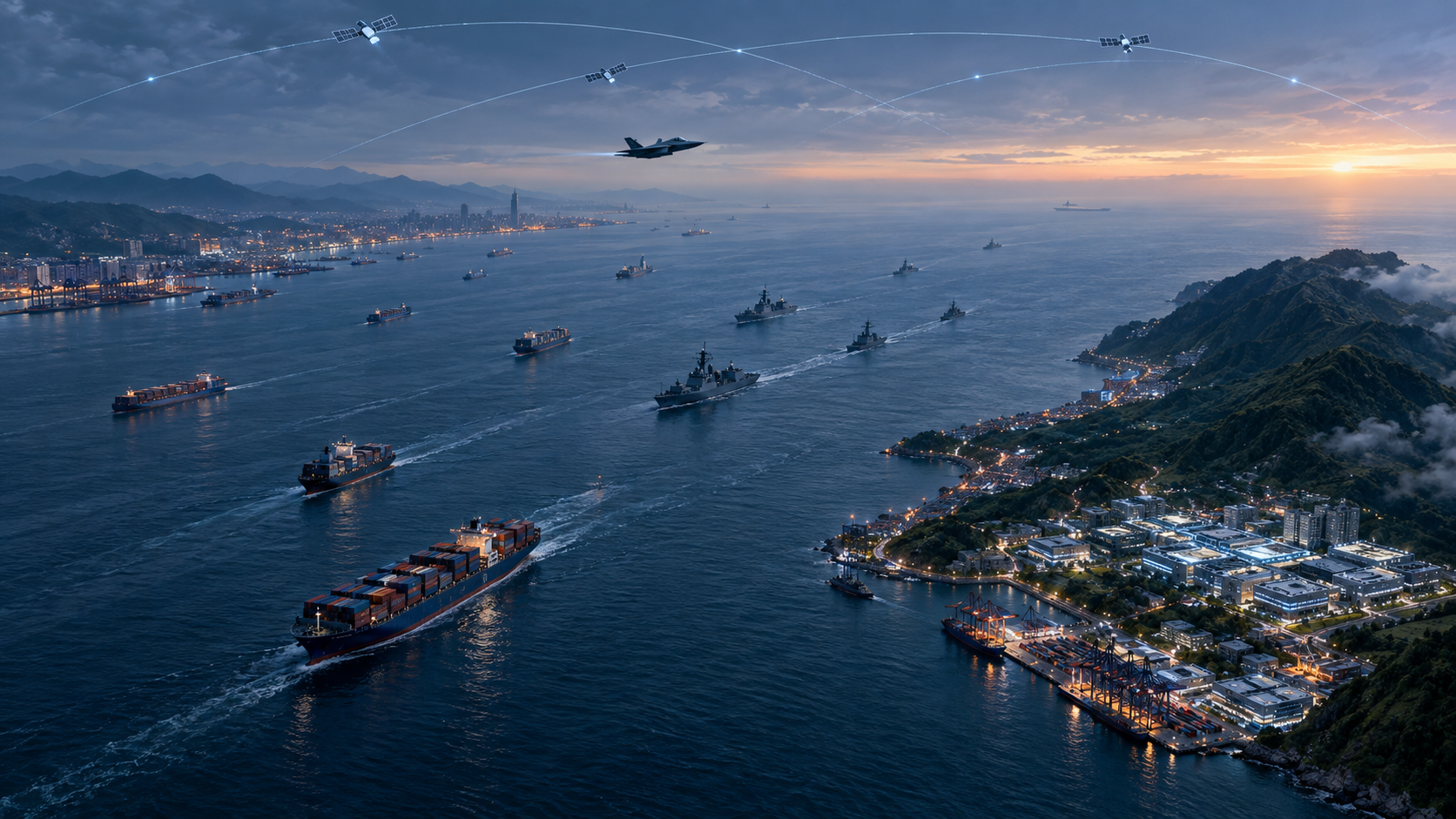
China's true strategy: Why Beijing doesn't need to conquer Taiwan militarily – Creative image on the topic, created with AI: Xpert.Digital
The dangerous misconception about the year 2027: Why an open war over Taiwan is unlikely
The world's most dangerous bottleneck: Why Taiwan is the center of a global systemic risk
Not the H-20 or J-35: China's true military superweapon lies in the civilian sector
The fear of an imminent Chinese invasion of Taiwan dominates current security policy debates. The year 2027 – coinciding with the modernization goals of the Chinese People's Liberation Army – is repeatedly cited as a supposedly fixed date for an attack. However, this fixation on a specific date for war is too simplistic and misjudges Beijing's true calculations. China has no economic interest in conquering a devastated island. A gradual escalation is far more likely, and considerably more dangerous for the global economy: maritime blockades, cyberattacks, quarantine measures, and increasing pressure in the military gray area.
For Europe, and especially for Germany's export-dependent industry, this scenario poses an extreme systemic risk. Global dependence on Taiwanese semiconductors and the Indo-Pacific trade routes makes the region the world's most dangerous economic bottleneck. The following text analyzes in depth why, although China's technological and military buildup is massive, an amphibious landing before 2030 remains the most complex and riskiest option – and why the status quo is nevertheless crumbling a little more each day.
Taiwan before 2030: China's calculated pressure and the price of war
The question of whether China will annex Taiwan by military force before 2030 cannot be reliably answered with a fixed date. A war does not automatically begin as soon as certain weapons are ready for use or a political anniversary is reached. Rather, what is crucial is how the Chinese leadership assesses the opportunities, risks, and alternatives at any given time. Military capabilities create options for action, but they do not force a decision. Even a meticulously prepared army can serve as leverage for years without actually being deployed.
A large-scale invasion of Taiwan before 2030 is not the most likely scenario. However, this by no means implies that the coming years will be peaceful. China has numerous means of exerting force without immediately launching a full-scale landing operation. These include maritime controls, temporary blockades, the closure of specific sea and airspace zones, cyberattacks, the occupation of small offshore islands, missile attacks on military installations, or a so-called quarantine, in which Chinese authorities control shipping traffic to Taiwan. These measures could be gradually intensified and presented at any time as a response to political developments.
The real risk, therefore, lies not in a fixed Chinese attack plan, but in a dynamic escalation. Beijing could increase pressure to force Taipei to make concessions. Taiwan could respond with military mobilization and closer cooperation with the United States. Washington, in turn, could deploy additional forces to the region. Each side would describe its actions as defensive, while the other would see them as offensive preparations. In such an environment, even a collision, a misinterpreted missile launch, or the interception of a merchant ship could trigger a crisis that no one originally planned for in this form.
In this context, 2027 is primarily a modernization target for the Chinese armed forces, not a reliably predictable attack date. By then, the People's Liberation Army is to be better equipped in key areas, more networked, and prepared for complex joint operations. This does not mean that China must attack in 2027. It simply means that Beijing wants to have more credible military options at its disposal from that point onward. The political impact will come when Taiwan, the United States, and other states have to consider these capabilities in their decision-making.
By 2030, therefore, the decisive factor will be less a single date for war than the ongoing shift in the regional balance of power. China is attempting to expand its military capabilities, increase the costs of an American intervention, and exert psychological and economic pressure on Taiwan. The goal is to restrict Taiwan's political freedom of action while simultaneously creating the impression that resistance is becoming increasingly futile in the long run. This strategy could succeed without Chinese troops landing on the island. However, it could just as easily fail, thereby making open conflict more likely.
Taiwan is the center of a global systemic risk
A war over Taiwan would not be a regional conflict with limited economic consequences. It would simultaneously affect two of the world's largest economies, key trade routes, the global semiconductor industry, and the security order of the entire Indo-Pacific region. China is closely intertwined with the production, distribution, and financial systems of virtually all major industrialized nations. Taiwan, at the same time, plays a pivotal role in the production of advanced semiconductors. A military crisis would therefore not only harm the directly involved states but also jeopardize the functioning of entire industries.
A significant portion of Asian and global trade passes through the Taiwan Strait and its adjacent waters. Container ships, tankers, and bulk carriers connect Chinese, Japanese, South Korean, and Taiwanese ports with Europe, North America, and Southeast Asia. The mere threat of military attack would increase insurance premiums and force shipping companies to take detours. Ports could be closed for security reasons, crews evacuated, and delivery dates postponed. Even without sunken ships, a massive logistical shock would ensue.
Semiconductor dependence exacerbates this effect. Taiwan produces a large share of the world's contract chips and plays a crucial role in particularly advanced manufacturing processes. These semiconductors are used in data centers, smartphones, vehicles, machinery, telecommunications systems, medical technology, and military electronics. If Taiwanese production were to fail, it could not be quickly relocated. Modern chip factories require highly specialized equipment, materials, software, suppliers, and experienced personnel. New plants outside Taiwan would improve long-term resilience but would not replace existing production volume or the industrial ecosystem that has developed over decades.
The economic losses of an open conflict could amount to several trillion US dollars in the first year. In a full-scale war with widespread sanctions, destroyed infrastructure, and prolonged trade disruption, a decline in global economic output of nearly ten percent is conceivable. A limited blockade would be less destructive but could still jeopardize more than two trillion US dollars in economic activity. Such figures are not exact predictions but scenarios. Their significance lies in the fact that even a short-term crisis could trigger a global recession.
Taiwan's strategic importance stems from the overlapping of military and economic dependencies. China considers the island part of its territory and views unification as a national imperative. The United States wants to prevent the regional balance of power from shifting unilaterally in China's favor. Taiwan, in turn, seeks to preserve its democratic self-determination and de facto autonomy. At the same time, the global economy relies on production facilities located in close proximity to a potential war zone. This combination makes the Taiwan Strait the most dangerous economic bottleneck of our time.
Beijing's goal is control, not destruction
China has no economic interest in taking over Taiwan as a devastated island. Taiwan's value lies in its people, its infrastructure, its technological expertise, its businesses, and its geographic location. An invasion would jeopardize precisely these assets. Factories could be destroyed, skilled workers killed or forced to flee, and ports rendered unusable. Moreover, after a military victory, China would have to control a politically hostile population and finance reconstruction. The economic and social costs would be enormous.
From Beijing's perspective, unification without widespread destruction would therefore be far more advantageous. Military buildup serves not only to prepare for war but also to exert political intimidation. The more credibly China can convey that resistance would be futile or extremely costly, the greater the pressure on Taiwan to make economic and political concessions. This strategy aims to divide the island's society, unsettle international supporters, and create the impression of eventual and inevitable integration.
This includes military exercises simulating a blockade or encirclement, as well as cyberattacks, disinformation, and economic sanctions against specific industries. China can restrict imports from Taiwan, pressure companies, and sanction political contacts between other states and Taipei. At the same time, Beijing can offer economic incentives to those actors who favor closer ties with the mainland. Coercion and incentive are thus combined.
This approach is more attractive to China than an immediate attack because it is flexible and comparatively inexpensive. Pressure can be increased or decreased without Beijing having to formally start a war. Furthermore, a gradual escalation makes a unified international response more difficult. A single military exercise or a temporary maritime control measure might not yet seem serious enough to warrant comprehensive sanctions. However, if such measures become the norm, the status quo will slowly shift in China's favor.
The central problem with this strategy lies in its own logic of success. To remain credible, China must regularly escalate its threats. If Taiwan does not react as desired, political pressure arises for Beijing to choose the next level of escalation. At the same time, this sustained intimidation can strengthen Taiwanese identity and increase its willingness to better protect itself militarily and economically. A strategy intended to force Taiwan toward rapprochement can therefore further deepen the estrangement.
Invasion remains the most difficult option
An amphibious invasion of Taiwan would be one of the most complex military operations in modern history. Chinese forces would have to transport large contingents of troops across the Taiwan Strait, while Taiwan defends its ports, beaches, and access routes. Simultaneously, China would have to establish air superiority, disable Taiwanese missile sites, clear sea mines, combat submarines, and repel potential American or Japanese intervention. Failure in even one aspect could jeopardize the entire operation.
Taiwan's geographical conditions further complicate a landing operation. Large stretches of coastline are unsuitable for extensive amphibious operations. The usable beaches and harbors are known and can be defended in advance. Behind the coast lie densely populated areas, rivers, mountains, and urban centers. Even after successful initial landings, China would have to continuously transport supplies across the strait. Fuel, ammunition, vehicles, spare parts, and medical supplies would be dependent on a few vulnerable corridors.
An invasion could therefore not be won simply by a large number of ships. China would have to quickly incapacitate the Taiwanese leadership, disrupt communication networks, and prevent organized resistance. At the same time, it would have to avoid destroying the infrastructure that would be needed after a conquest. Precision strikes could hit military targets, but in a densely populated area, civilian damage and its consequences cannot be completely controlled. Power outages, destroyed transport routes, and disrupted water supplies would affect the population as much as the defenses.
The greatest uncertainty would be the reaction of the United States. China cannot know for sure whether and to what extent Washington would intervene militarily. American reconnaissance, submarines, long-range weapons, and logistical support alone could significantly disrupt the Chinese operational plan. Japan could be drawn in through its use of American bases and its geographical proximity. The longer the war lasts, the more difficult it would become for China to contain the fighting.
For these reasons, an invasion is more of a last resort than the preferred first option. It becomes more likely if Beijing concludes that peaceful and gradual pressure is failing in the long run, if Taiwan is moving closer to formal independence, or if the military balance of power could later become less favorable. However, as long as China believes it can achieve its goals through blockades, intimidation, and economic pressure, a direct large-scale offensive remains the riskier alternative.
The blockade is more likely and more dangerous
A blockade or quarantine offers China the opportunity to exert massive pressure on Taiwan without immediately taking the risks of an invasion. Chinese ships and aircraft could close off certain maritime areas, inspect merchant vessels, and restrict flight paths. The coast guard might initially be more visible than the navy. Beijing could portray the measure as a domestic customs, security, or police operation, thereby attempting to downplay its nature as an international war.
Taiwan is heavily reliant on imports for energy, raw materials, and numerous intermediate products. Even a partial disruption of shipping would strain supplies. Liquefied natural gas, oil, coal, and industrial materials could become scarce. Power generation, and consequently semiconductor production, would be jeopardized. A blockade would not necessarily have to be complete and comprehensive. The mere risk of being detained by Chinese authorities or involved in military incidents could prompt private shipping companies and insurers to suspend their operations.
This is precisely where the economic leverage lies. China wouldn't have to physically stop every ship. It would suffice to increase the costs and risks to such an extent that commercial traffic largely grinds to a halt. International companies could suspend deliveries, banks could refuse trade financing, and insurers could exclude war risks. Taiwan would come under pressure, while Beijing could claim it wasn't imposing a traditional blockade.
Militarily, such a strategy would not be without risk. The United States could attempt to escort merchant ships or maintain open air and sea links to Taiwan. China would then have to decide whether to control, intercept, or attack American-protected vessels. Each of these steps could lead to direct combat. Conversely, Washington would have to weigh whether it risks war with China over a single controlled freighter. Beijing could exploit precisely this uncertainty.
A blockade would therefore not be a stable intermediate stage between peace and war. It would be an active coercive measure, the success of which depends on the other side either giving in or avoiding escalation. As soon as Taiwan and its supporters resist, China would have to increase the pressure or retreat. Both would be politically costly for the Chinese leadership. This makes a blockade more likely than an invasion, but by no means easier to control.
Three weapon systems do not decide a war
The strategic focus on the H-20 stealth bomber, Chinese satellite networks, and the J-35 stealth fighter captures important aspects of Chinese modernization, but overestimates the significance of individual systems. No great power war is decided by three platforms. What matters is whether reconnaissance, communications, command and control, logistics, air defense, missile forces, navy, and industry function as an integrated system. A technologically advanced aircraft loses its value if target data is missing, airfields are destroyed, or spare parts are not available in time.
China already possesses significant military capabilities against Taiwan and American bases in the western Pacific. Land-based ballistic missiles, cruise missiles, fighter jets, drones, and submarines can threaten targets in the region. While new systems increase range, flexibility, and resilience, they are not essential prerequisites for military action. Therefore, Beijing does not need to wait for their full operational capability before it could implement a blockade or launch limited attacks.
The crucial question is whether China possesses a robust intelligence and operational chain. Targets must be detected, identified, and continuously tracked. Information must be transmitted securely, even under enemy interference. Subsequently, the appropriate weapon must be deployed in a timely manner, and its effects assessed. This chain is particularly challenging when targets are moving, operating over long distances, or actively deceiving.
Equally important is the ability to compensate for losses and damage. A protracted war consumes enormous quantities of missiles, spare parts, fuel, and skilled personnel. Production facilities and depots can be attacked. Communication networks can fail. Ships and aircraft require maintenance and repairs. Military strength, therefore, is demonstrated not only in the initial attack but also in the ability to remain operational for weeks and months.
China's real advantage lies in the combination of geographical proximity, large-scale industry, growing missile capabilities, and an increasingly dense sensor network. The United States must deploy forces over vast distances to the region and protect its supply lines. China, on the other hand, can support many operations from its mainland. This advantage is more significant than any single prestige project.
The H-20 extends the range, not the certainty
The H-20 is intended to provide China with a modern, long-range bomber capability with a reduced radar signature. Such a bomber could threaten American bases, ships, and logistics hubs from multiple directions. It could carry long-range cruise missiles and force air defenses to cover larger areas. Furthermore, it would complement China's nuclear deterrent and strengthen its ability to project power more globally.
Its true significance, however, depends on factors that extend far beyond the aircraft's design. China requires trained crews, reliable engines, secure communication links, precise targeting data, and sufficient modern weaponry. Long-range missions may necessitate aerial refueling and coordinated support from other aircraft. Operational bases must be protected, damaged runways repaired, and maintenance performed even under wartime conditions.
China does not need the H-20 to attack regional bases. Many targets in Japan, Guam, and neighboring regions are already within range of other Chinese weapons systems. The new bomber would therefore not create a completely new strategic reality, but rather expand existing options. It could make attacks more flexible, less predictable, and harder to defend against. At the same time, it would itself remain a high-quality system with limited availability.
Even engaging American warships in the Pacific would not be solved by a stealth bomber alone. Moving targets must be continuously tracked. Aircraft carrier strike groups utilize deception, air defense, electronic warfare, and large operational areas. Without up-to-date target data, even a long-range precision weapon can miss its target. The H-20 would therefore be part of a comprehensive system comprising satellites, drones, submarines, surface ships, and reconnaissance aircraft.
By 2030, the H-20 could significantly strengthen China's deterrence. However, it is neither a guarantee of military success nor a necessary condition for a conflict over Taiwan. Its greatest impact could even occur before a war, because opposing planners will have to allocate additional resources to air defense, deployment, and hardening.
Our China expertise in business development, sales and marketing

Our China expertise in business development, sales and marketing - Image: Xpert.Digital
Industry focus areas: B2B, digitalization (from AI to XR), mechanical engineering, logistics, renewable energies and industry
More information here:
A thematic hub offering insights and expertise:
- Knowledge platform covering global and regional economies, innovation and industry-specific trends
- A collection of analyses, insights, and background information from our key areas of focus
- A place for expertise and information on current developments in business and technology
- A hub for companies seeking information on markets, digitalization, and industry innovations
Economic consequences of a Taiwan conflict for Europe
China's satellite networks create digital endurance
Modern warfare depends on communication, navigation, and real-time data. Large satellite networks in low Earth orbit can connect troops, ships, drones, and command centers. Because many individual satellites are involved, the entire network is more difficult to cripple due to the failure of just a few platforms. Low Earth orbits also enable short transmission times and high data throughput.
China is building two extensive satellite constellations, Guowang and Qianfan. By 2026, several hundred satellites from these programs will be in orbit. Long-term plans envision networks with many thousands of satellites. The development pursues civilian, economic, and military objectives simultaneously. Remote regions, ships, aircraft, and international customers will be able to gain broadband access. At the same time, an industrial base is being created for mass production, rocket launches, ground terminals, and digital services.
For military use, however, the number of satellites alone is not sufficient. Crucial factors include secure user terminals, encryption, interference-resistant connections, ground stations, and the ability to rapidly replace damaged or destroyed satellites. China must also prevent enemy forces from identifying and attacking terminal locations. Integration into military command structures is technically and organizationally challenging.
An expanded network would strengthen China's communications, particularly outside coastal regions. It could support naval forces and aircraft deeper in the Pacific, transmit drone data, and reduce reliance on a few large satellites. However, for operations directly against Taiwan, China already possesses terrestrial fiber optic networks, microwave links, existing satellites, and military communication systems. Therefore, a complete counterpart to Starlink is not a necessary prerequisite for a blockade or invasion.
The strategic importance lies in long-term resilience. China is not just building a communications service, but a new industrial ecosystem. The greater the mass production and launch capacity become, the easier it will be to compensate for losses and introduce new technologies. This strengthens both the civilian space industry and military capabilities.
The J-35 is intended to make China's carriers usable
With the J-35, China is developing a modern stealth fighter for use on aircraft carriers and potentially in further variants for land-based air forces. The aircraft is intended to close the gap between China's growing carrier capacity and the currently limited capabilities of its carrier-based air force. Combined with catapult launches, airborne early warning systems, and advanced data networking, the J-35 could significantly extend the operational range of Chinese naval forces.
However, effectiveness depends on more than just the aircraft. Carrier aviation requires years of training, well-coordinated deck crews, safe night and bad-weather operations, and complex maintenance logistics in a confined space. Pilots must be proficient in takeoffs and landings under challenging conditions. Weapons, fuel, and spare parts must be moved efficiently on the carrier. A technically sound aircraft does not automatically guarantee a high-performing carrier strike group.
By 2030, China could put an increasing number of J-35 aircraft into service. However, their actual combat effectiveness will depend on how quickly pilots, maintenance personnel, and carrier crews gain experience. The availability of reliable engines also remains crucial. High production numbers are only militarily valuable if the aircraft are regularly operational and sufficient weapons and spare parts are readily available.
In a Taiwan conflict, land-based aircraft would initially be at least as important as carrier-based aircraft. China has numerous airfields along its coast and can deploy fighter jets relatively quickly to the operational area. Aircraft carriers are particularly relevant if operations are to be extended further into the Pacific or if American forces are threatened from multiple directions. They expand China's operational radius but are also large and valuable targets.
The J-35 thus strengthens China's ability to deploy air power from a sea-based perspective. However, it does not determine air superiority on its own. This arises from the interplay of fighter jets, early warning systems, tanker aircraft, missiles, electronic warfare, air defense, and reconnaissance.
China's shipyards are the invisible superweapon
China's most profound advantage lies not in a single bomber or fighter jet, but in the breadth of the country's industry. China possesses the world's largest civilian shipbuilding sector and can integrate military production into an extensive network of shipyards, steel mills, machine manufacturers, electronics companies, ports, and suppliers. This structure allows for the parallel construction of different ship classes and creates a large base for maintenance, repair, and modernization.
The Chinese navy is not only growing in numbers but is also modernizing its fleet. New destroyers, frigates, amphibious assault ships, supply vessels, submarines, and carriers are replacing older systems or augmenting existing units. However, a simple comparison of the number of ships is insufficient. A small patrol boat and a large destroyer are statistically counted as one ship, but they differ considerably in combat power, range, and role. Comparisons based on tonnage can also be misleading if large individual platforms distort the overall picture.
Production speed is crucial. China can build several ship types simultaneously and benefits from strong civilian demand. Many industrial capabilities are shared, even though warships require specialized sensors, weapons, and adhere to military standards. In a crisis, civilian ferries, freighters, and other vessels could be used for transport and support tasks. They would not be full-fledged warships, but they could supplement logistical capacity.
A protracted conflict would demonstrate the value of this industrial depth. Damaged ships must be repaired, worn-out weapons replaced, and new platforms built. While the United States possesses technologically advanced systems and experienced armed forces, its shipbuilding capacity is more limited and underutilized. China could have a significant advantage in repair and replacement capabilities in a war of attrition.
This advantage, however, is not unlimited. Modern warships require specialized radars, propulsion systems, software, anti-aircraft missiles, and trained crews. Lost sailors, submarine crews, or carrier pilots cannot be replaced quickly. Even large shipyards cannot produce high-quality components at an arbitrarily rapid pace. China's industrial mass is a strategic factor, but it is not a license for costly warfare.
Warships remain valuable and vulnerable
Modern surface ships have become more easily detectable and vulnerable to attack due to satellites, drones, submarines, and long-range precision weapons. However, this does not mean they are mere expendable commodities. A destroyer combines powerful radar, air defense, command and control capabilities, and numerous weapons in a mobile platform. Its loss means not only the loss of a hull but also the loss of a complex combat unit and its highly trained crew.
Mass remains crucial. No defense system can stop every attack. A larger fleet can cover more areas, better absorb losses, and distribute enemy weapons across numerous targets. China also benefits from the fact that its ships can be supported by land-based aircraft, missiles, and sensors close to its mainland. American forces, on the other hand, must operate over greater distances and secure their own supplies.
Chinese surface vessels can extend their air defense and sensor capabilities far out to sea. Their radars detect approaching aircraft and cruise missiles earlier than coastal systems. They can serve as forward interceptor platforms, providing the mainland with additional reaction time. Simultaneously, they perform other tasks: protecting amphibious forces, anti-submarine warfare, mine countermeasures, blockade control, and securing logistical links.
Their vulnerability forces China to adopt a networked approach. Ships must cooperate with satellites, aircraft, drones, and coastal radar. Decoys, electronic warfare, and multi-layered air defenses are intended to hinder attacks. Individual platforms remain vulnerable, but the network is designed to be resilient enough to continue operating despite losses.
The comparison with tanks in modern land warfare is therefore only partially helpful. Both tanks and ships lose their value when deployed in isolation and without reconnaissance. However, in a functioning network, they remain crucial sources of firepower, protection, and mobility. The correct conclusion is not that large platforms are obsolete, but rather that their survival increasingly depends on networking and support.
America's bases are both a power base and a target
The American military presence in the Indo-Pacific relies on a network of bases, ports, airfields, and alliances. This network enables rapid air and sea operations, reconnaissance, maintenance, and resupply. At the same time, large fixed installations are easy to locate and therefore attractive targets for Chinese missiles. Runways, fuel depots, ammunition depots, and communication hubs could be attacked at the very beginning of a conflict.
China would not need to completely destroy every base. Temporarily disrupting operations, hitting aircraft on the ground, or overloading repair capacity would suffice. Repeated missile attacks could re-damage runways after they have been repaired. Cyberattacks and sabotage could also disrupt military operations.
The United States is responding by diversifying its forces. Aircraft, ammunition, and fuel are to be distributed across more locations. Mobile maintenance units and smaller airfields are gaining importance. This would require China to monitor and engage significantly more targets simultaneously. Resilience increases if the failure of a single major base does not cripple the entire operational system.
This strategy, however, depends on the political decisions of its allies. Japan, the Philippines, Australia, and other partners would have to allow the use of their infrastructure. Not every state will automatically be willing to support attacks on China from its territory. Beijing may try to deter individual governments from participating through economic pressure and military threats.
A Chinese attack on American or Japanese bases would significantly escalate the war. While it might seem necessary operationally, politically it would strengthen the resolve of the opposing side. Beijing thus faces a dilemma: if the bases remain untouched, they support Taiwan; if they are attacked, a Taiwan crisis could escalate into a major regional war.
China would wage war against itself
A conflict over Taiwan would not only affect Western economies. China itself would likely be the single biggest economic loser. The country is deeply integrated into global supply chains, relies on energy imports, and depends on access to international markets. Its industry needs raw materials, specialized machinery, software, and foreign technologies. A war would jeopardize precisely these connections.
Comprehensive sanctions could affect Chinese banks, technology companies, logistics providers, and state-owned enterprises. Foreign investors would withdraw capital, halt new projects, and evacuate staff. The renminbi would come under pressure, while Beijing would have to tighten its control over capital flows. Chinese assets abroad could be frozen, and international payment channels could be restricted.
At the same time, military spending would increase. The state would have to support banks, businesses, and local governments, while tax revenues and exports would decline. Energy and raw materials could become more expensive or harder to obtain. A maritime counter-blockade would particularly affect oil supplies. While China can build up reserves, diversify sources of supply, and expand land connections, the large import volumes cannot be completely shifted away from sea routes.
China is therefore working to reduce its vulnerability. Domestic semiconductor production is being expanded, raw material reserves are being increased, and alternative payment systems are being developed. Closer ties with Russia, Central Asia, the Middle East, and countries of the Global South are intended to create economic alternatives. These measures increase resilience but do not eliminate dependence on global markets.
The economic costs are a strong deterrent, but they do not guarantee peace. States do not make security policy decisions solely based on economic expediency. National identity, domestic legitimacy, and the fear of permanently losing Taiwan can outweigh growth targets. The more closely the Chinese leadership links the Taiwan issue to its historical claim, the greater the risk that economic rationality will lose importance in a crisis.
Europe would be an economic frontline state
Europe would be only militarily involved to a limited extent in a Taiwan conflict, but would be directly affected economically. The European Union trades goods worth well over €700 billion annually with China. European companies source intermediate products, electronics, machine components, batteries, solar technology, and consumer goods from Chinese production. At the same time, numerous industries depend on Taiwanese semiconductors. A conflict would affect both sides of this dependency simultaneously.
The immediate consequences would be supply disruptions, rising freight and insurance costs, turbulence in the financial markets, and weaker demand from Asia. The automotive, mechanical engineering, chemical, electrical engineering, telecommunications, and digital infrastructure sectors would be particularly vulnerable. Production outages could spread to European plants within a few weeks if specialized chips or intermediate products are unavailable.
Europe could not remain completely neutral politically. The United States would expect support for sanctions and export controls. China would try to prevent European states from adopting a common stance. Differing economic interests within the European Union could lead to conflicts. Countries with high levels of exports to China would be particularly concerned about the costs of harsh sanctions, while other states might rely more heavily on security solidarity.
A distinct European strategy must therefore be developed before the crisis. This includes coordinated sanctions options, exceptions for humanitarian goods, protection of critical infrastructure, and support mechanisms for particularly affected sectors. Equally important are diplomatic channels to Beijing, Washington, and Taipei. Europe should take a clear stance against any violent changes to the status quo, without giving the impression that it intends to enforce formal Taiwanese independence militarily.
The most effective European deterrent lies not in a symbolic naval presence, but in economic resilience. The better Europe diversifies its supply chains, builds up critical stockpiles, and prepares internal decision-making processes, the less China can politically exploit European dependencies. Resilience thus not only reduces economic damage but also strengthens the capacity for de-escalation.
Germany's industry is doubly vulnerable
Germany would be particularly hard hit by a conflict with Taiwan. The German economic model combines an export-oriented industry with high demand from China and complex Asian supply chains. Automotive manufacturers, mechanical engineering companies, chemical companies, and electrical engineering firms generate significant revenue in China or have production facilities there. At the same time, they require electronic components and semiconductors from Taiwan and other parts of East Asia.
A conflict would therefore affect sales and procurement simultaneously. German companies could lose Chinese customers while simultaneously lacking crucial intermediate products. Sanctions and counter-sanctions could jeopardize investments, bank balances, and production facilities in China. The valuation of Chinese assets would plummet, and profits might no longer be transferable.
Expanding European chip factories only partially reduces these risks. New plants take years to reach full production. They cannot cover all semiconductor types and manufacturing stages. Even European factories remain dependent on machinery, chemicals, wafers, software, and skilled workers from international supply chains. Technological sovereignty, therefore, does not mean complete self-sufficiency, but rather the reduction of one-sided dependencies.
German companies need transparency that extends beyond direct suppliers. Critical dependencies often lie in the second or third tier of the supply chain. A component might be assembled in Europe but contain a specialized chip from Taiwan or a material from China. Without precise knowledge of these supply chains, alternatives can only be sought once production has already ceased.
Reliable scenarios for blockades, sanctions, and war are essential. Companies must determine their inventory levels, identify replacement components, and prioritize production. Equally important are liquidity reserves, alternative payment methods, and employee evacuation plans. Such preparations are not a political statement against China, but rather fundamental risk management.
The war in Ukraine and Taiwan are indirectly linked
A conflict over Taiwan would deepen strategic cooperation between China and Russia, but would not automatically lead to a joint war. Russia could support China with energy, raw materials, military expertise, and political distraction in Europe. In return, China could provide more technology, industrial components, and economic alternatives. Both countries would have an interest in distributing the resources of the United States and Europe across multiple regions.
China would nevertheless carefully consider the extent of its support for Russia. An open military alliance could trigger additional sanctions and bind European states more closely to the United States. Beijing wants to benefit from Moscow without losing control over the escalation. Russia remains an important partner, but pursues its own interests and could create new risks through unpredictable decisions.
A gradual intensification would be more likely. China could supply more dual-use goods, secure Russian trade flows, and strengthen diplomatic protection. Russia, in turn, could increase military pressure in Europe, expand exercises, or capture Western attention. Formal joint warfare would not be necessary for this.
Europe must take this connection into account. The more its security resources are tied up by Russia, the less room it has for support in the Indo-Pacific. Conversely, a Taiwan crisis would shift the American focus even more strongly to Asia and force Europe to assume greater responsibility for its own defense. The two conflict areas are therefore not identical, but strategically linked.
The assumption that China could suddenly change its stance on Ukraine like flipping a switch is too simplistic. Beijing's policy follows a gradual cost-benefit analysis. An escalation would be likely if Europe supported comprehensive measures against China. However, this would be more apparent in economic, technological, and diplomatic aid to Russia than in Chinese combat troops on European battlefields.
Deterrence can simultaneously stabilize and escalate
China's military buildup is intended to create the possibility of a successful war and, precisely through this, to prevent one. If Taiwan and the United States believe that a military confrontation would be too costly, then, from Beijing's perspective, they should respect political boundaries. The other side follows the same logic. Taiwan is developing mobile missiles, drones, mines, and hardened infrastructure to make an invasion unattractive. The United States is diversifying forces and strengthening regional alliances to prevent China from achieving a swift victory.
This mutual deterrence can be stable as long as all parties realistically assess each other's capabilities and intentions. It becomes dangerous when one side believes the strategic window of opportunity is closing. Beijing might conclude that Taiwan is growing ever stronger militarily and increasingly distant politically. Conversely, Washington might believe that there is a limited window of time in which Chinese forces can still be contained. Such expectations can increase the incentive to act prematurely.
Technological developments also shorten decision-making times. Hypersonic weapons, cyberattacks, satellite operations, and automated target acquisition enable rapid strikes against critical systems. In a crisis, each side might fear suffering a decisive disadvantage by waiting. The pressure to act preventively is growing, even though this very action is what triggers the escalation.
Stable deterrence therefore requires political solutions. Communication between military leaders, clear red lines, and limited confidence-building measures remain essential. Neither side should get the impression that even a withdrawal or de-escalation offers no further advantages. Sanctions, threats, and military signals must be designed in such a way that a reversal remains possible.
The greatest danger arises not from weakness alone, but from a combination of strength, time pressure, and misperception. China can become ever more militarily capable while simultaneously feeling strategically threatened. The United States can strengthen its deterrence and yet inadvertently create the impression of encirclement. Taiwan can improve its defenses, thereby gaining security but also provoking Chinese countermeasures.
Before 2030, the grey area will be decisive
By 2030, China will likely attempt to control Taiwan through increasingly stringent measures that remain below the threshold of open warfare. Military exercises will become more complex and announced with shorter notice. Ships and aircraft may more frequently cross existing demarcation lines. Cyberattacks, economic sanctions, and disinformation will increase. Each individual measure may seem limited, but their cumulative effect will alter the strategic landscape.
This policy of operating in a gray area offers Beijing several advantages. It exploits China's geographical proximity, strains Taiwan's armed forces, and hinders a unified international response. Taiwan must constantly deploy aircraft, ships, and personnel, while China can determine the timing and scope of its actions. At the same time, the international community becomes accustomed to heightened military tensions.
However, the success of this strategy is not guaranteed. Sustained pressure can make Taiwanese society more resilient and deepen cooperation with the United States and Japan. Companies can shift supply chains, states can prepare sanctions, and the Taiwanese armed forces can focus more on asymmetric defense. The stronger China's threats, the greater the incentive for other actors to secure their positions early on.
A full-scale invasion before 2030 therefore remains possible, but not probable. Far more likely are limited coercive measures that could escalate into a larger crisis at any time. The H-20, satellite constellations, the J-35, and the growing navy improve China's options. However, they do not determine a specific timeframe for war. The decision remains political and depends on whether Beijing believes it can achieve its objectives with less risky means.
The crucial perspective is this: China does not need to fully conquer Taiwan to shift the regional and global balance of power. Recurring quarantines, sustained military intimidation, and economic uncertainty could permanently impact investments, trade routes, and political decisions. The status quo can be gradually eroded long before the first large-scale landing party crosses the Taiwan Strait.
That's precisely why it would be a mistake to ask solely about the date of a potential invasion. The most important economic question is how much coercion China can exert without triggering a war, and how long Taiwan and its partners can withstand this pressure. The decision before 2030 will not necessarily be whether China militarily conquers Taiwan. However, it will determine whether Beijing alters the strategic landscape to such an extent that resistance becomes increasingly costly and a subsequent escalation ever more likely.
🎯🎯🎯 Data-driven B2B industry hub as a quasi-in-house solution

The quasi-in-house solution: How Xpert.Digital closes operational gaps in B2B marketing and sales – Smart Content-Driven Business - Image: Xpert.Digital
Xpert.Digital is a data-driven B2B industry hub led by Konrad Wolfenstein . The company acts as an external, quasi-in-house solution for industrial partners, closing operational gaps in marketing, content, and sales – without requiring additional resources on the client side.
More information here:
Your global marketing and business development partner
☑️ Our business language is English or German
☑️ NEW: Correspondence in your native language!

Konrad Wolfenstein
I and my team are happy to be available to you as your personal advisor.
You can contact me by filling out the contact form here [email protected]:or simply call me at +49 7348 4088 965. My email address is
I'm looking forward to our joint project.










