
Why the true XR revolution is only just beginning – AR and VR are quietly continuing to conquer the industry
Xpert Pre-Release

Available in 27 languages 📢
Prefer Xpert.Digital on GoogleⓘPublished on: April 21, 2026 / Updated on: April 21, 2026 – Author: Konrad Wolfenstein
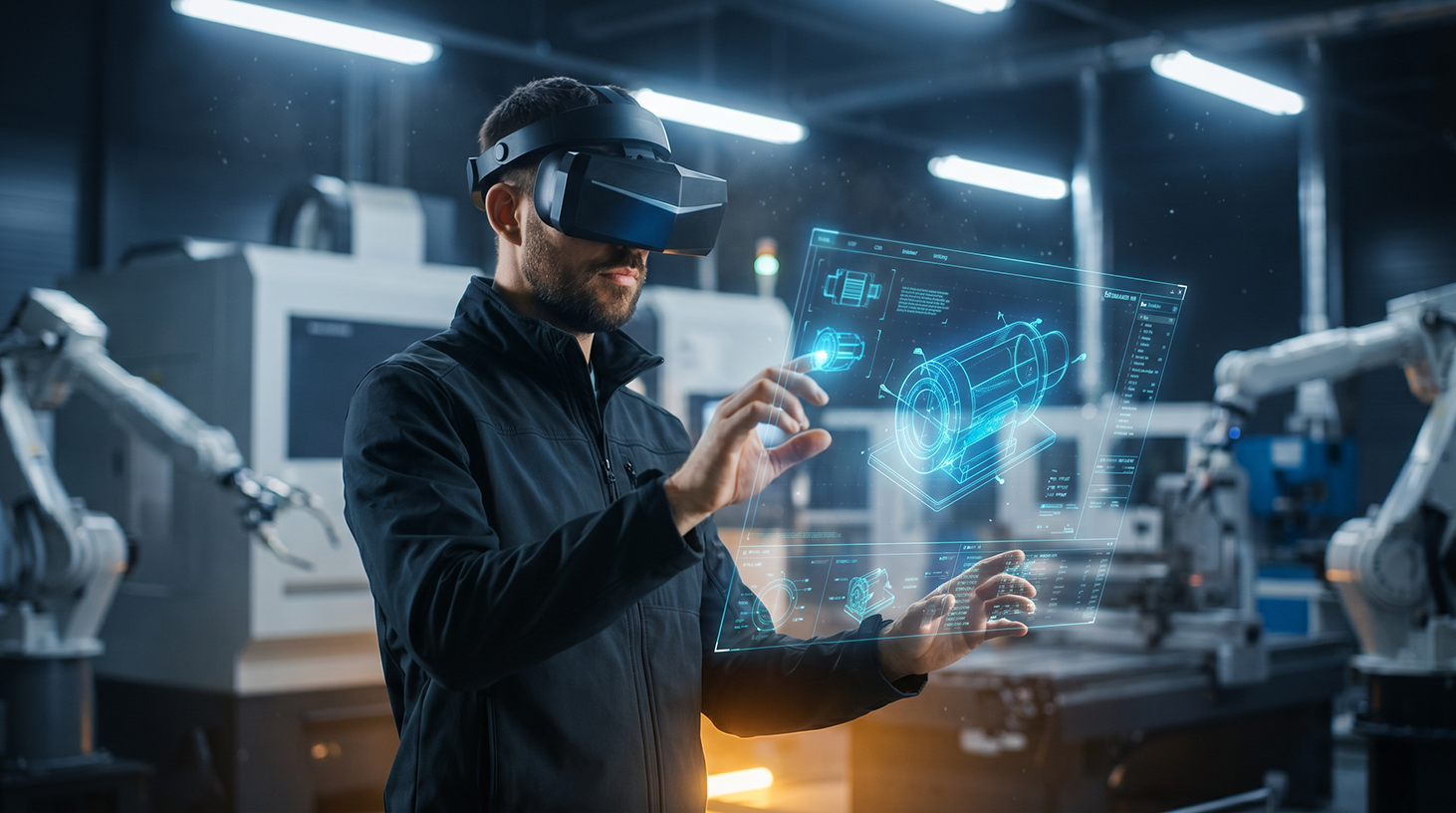
Why the true XR revolution is only just beginning – AR and VR are quietly continuing to conquer the industry – Image: Xpert.Digital
The AI revolution in the background: This is the true future of virtual reality
Forget Meta: How Android XR and new AI glasses are turning the market upside down
Beyond the hype: How XR, AI and smart wearables are truly changing industry and our everyday lives
The metaverse was once hailed as the next gigantic era of the internet—a digital dream for which tech giants like Meta burned through billions. But while empty virtual worlds are failing in the harsh realities of the market, a far more extensive, quiet revolution is taking place away from the Silicon Valley hype. Virtual, augmented, and mixed reality (collectively known as XR) have long since left their niche existence as mere gimmicks. Whether as a precise X-ray vision for surgeons in the operating room, as a 1:1 scale planning tool on global construction sites, or as a massive efficiency booster in industrial manufacturing: XR has arrived in economic reality.
At the same time, we are facing a fundamental technological paradigm shift. With the seamless integration of artificial intelligence—driven by open platforms like Google and Samsung's Android XR—headsets are transforming from rigid tools into intelligent, context-aware assistants. Novel wearables that capture input via subtle muscle impulses at the wrist, rather than cumbersome controllers, are also solving one of the industry's biggest problems: human-machine interaction. This article analyzes the spectacular failure of the metaverse concept, highlights the true growth markets of XR technology, and shows why the convergence of AI and immersive worlds will fundamentally transform the way we work and our everyday lives.
Beyond the hype – How AR, VR and XR are really changing the industry
The metaverse was once hailed as the next digital revolution – today it's an economic lesson about the difference between visionaries and markets. While Mark Zuckerberg rallied his entire company toward the virtual future in October 2021, rebranding Facebook as Meta, the term "metaverse" has since virtually disappeared from the company's official communications. More than $88 billion has been invested, more than $70 billion of which has been wasted – and the result is a hasty shift in focus toward artificial intelligence. What remains is a sobering realization: AR, VR, and mixed reality technologies do indeed have a future – just not where they were initially expected.
The global XR market (Extended Reality, the umbrella term for AR, VR, and MR) was valued at approximately $51 billion in 2024. Forecasts vary widely – depending on the methodology and definition of market size, figures for 2025 range from $60 billion to $252 billion. Some analysts predict a volume of nearly $300 billion by 2035, while others see a potential market of over $4.4 trillion for the same period. This range is less a sign of uncertainty than of fundamentally different market definitions – from pure hardware to software, platform ecosystems, and B2B services. One thing, however, remains consistent: growth is steep.
Grounding instead of escapism – Where XR really works
Construction and engineering: Precision on a 1:1 scale
The construction industry is currently one of the most dynamic growth sectors in the field of XR. Autodesk, a leading global provider of design software, has developed "Workshop XR," a virtual reality solution that allows users to experience digital building models at a 1:1 scale. Engineers, architects, and clients can work collaboratively in a shared virtual environment – regardless of their physical location – in real time. Defects, design flaws, and collisions between building components are identified before the first brick is laid. This not only saves money but also significantly reduces construction delays.
This is complemented by augmented reality solutions like GAMMA AR, which project BIM (Building Information Modeling) models directly onto the construction site, enabling real-time comparison between planning and physical reality. Collisions with HVAC systems, incorrectly positioned components, faulty installations – all of these can be immediately identified and corrected on-site using AR overlays. For an industry that has traditionally struggled with enormous cost problems associated with rework, this represents a paradigm shift. The AR/VR market in the construction industry is projected to reach US$2.2 billion by 2025.
Systematic research is keeping pace with this development. A systematic review in the journal Photogrammetric Record identified BIM and game engines as the key tools for integrating three-dimensional as-built environments into XR applications. This research demonstrates that the scientific foundation for practical application is becoming increasingly robust – a necessary condition for long-term, industry-wide scaling.
Healthcare: From simulation to precision surgery
In healthcare, XR is having an impact that goes far beyond mere gimmicks. Surgeons use AR headsets to overlay MRI scans, blood vessel networks, and tumor margins directly into their field of vision—a kind of digital X-ray view that significantly increases precision and reduces invasiveness during complex procedures. Neurosurgical interventions, which previously relied on two-dimensional screen displays, benefit from the spatial depth of immersive visualizations.
In medical education, VR is fundamentally revolutionizing training methods. Medical students practice complex procedures in risk-free virtual environments that are visually almost indistinguishable from real operating rooms. The culture surrounding mistakes is changing: where errors in the simulator have no consequences, routines can become more deeply ingrained. VR is also being used in the treatment of mental illnesses – controlled exposure therapies for phobias, PTSD, and anxiety disorders take place in virtual environments that can be precisely tailored to the patient. The healthcare sector is considered one of the fastest-growing areas in the XR market, with a projected compound annual growth rate (CAGR) of 32.2 percent.
Training and industrial manufacturing: The ROI that convinces
Companies like GE Aerospace, Ford, FedEx, Daimler Trucks, and Volvo have established their own XR programs—not out of technological enthusiasm, but because of measurable business benefits. GE Aerospace AR Program Manager Nic Sabo puts it succinctly: The decisive factor for executives is not cost savings, but capacity expansion. If XR tools help train 50 percent more employees per year, it creates a multiplier effect throughout the entire production chain—more valuable than direct savings on training costs. The AR/VR training market is projected to reach $82.92 billion by 2034.
Meta's Billion Dollar Graveyard – Analysis of a Spectacular Failure
The foundation of a bad bet
The story of Meta's metaverse is a case study in technological voluntarism: the assumption that a sufficiently grand vision, enough capital, and a company rebranding are all it takes to force a mass market. In October 2021, Zuckerberg announced that the existing internet was obsolete and renamed Facebook Meta. Five years and $88 billion later, that future is officially history. On March 18, 2026, Meta announced the end of Horizon Worlds on its Quest headsets—as of June 15, 2026, the platform exists only as a smartphone app.
The cumulative losses of the "Reality Labs" division amount to over $70 billion since 2021. In 2024 alone, the division's operating loss totaled approximately $19 billion. Quarter after quarter, Reality Labs posted losses without any discernible monetization prospects. This trend was obvious to anyone who didn't subscribe to the belief in Silicon Valley's infallibility.
The strategic retreat and its signaling effect
In January 2026, Meta began downsizing: Approximately 10 percent of the entire Reality Labs workforce—from a division that formerly employed around 15,000 people—was laid off, with a clear focus on teams working on VR headsets and the Horizon Worlds social network. The Metaverse budget for 2026 is slated to be cut by up to 30 percent. Meta has also announced that it will no longer develop new content for Horizon Worlds in VR; existing games will remain in maintenance mode.
The about-face is not only significant in terms of corporate strategy, but also linguistically: The term "metaverse" hardly appears in earnings calls and strategic outlooks anymore. Instead, a new guiding principle dominates: artificial intelligence. The company is implementing an AI-first strategy with massive investments in AI infrastructure, data centers, and AI wearables. The original metaverse concept was increasingly recognized as long-term, costly, and difficult to monetize.
Microsoft's withdrawal from VR adds another dimension to the narrative: the grand VR story as the next computing era has failed – not the technology itself, but the concept of an all-encompassing virtual world as the primary medium for human interaction. User numbers fell far short of expectations. Horizon Worlds never succeeded in bringing virtual togetherness to the masses, while demand for Quest headsets simultaneously declined. Although the mobile version of Horizon Worlds recently saw a 53 percent year-over-year increase in downloads, this only demonstrates that the market for social XR experiences lies on smartphones, not bulky headsets.
What failure teaches us
The Metaverse debacle teaches several economically significant lessons. First, platform markets cannot be forced through capital alone. The network effect that made Facebook great only works if a sufficiently critical mass of users perceives genuine added value—and avatars in empty virtual spaces do not offer that added value. Second, the difference between a technically impressive demonstration and a mass-market product is fundamental. The technology worked—people simply didn't want it. Third, companies that prioritize their strategic narrative over actual demand pay a high price in capital and reputation.
AI integration as a new beginning – When technologies converge
Samsung Galaxy XR and Android XR: A systemic paradigm shift
While Meta buried its Metaverse, a qualitatively different step took place in October 2025: Samsung, in collaboration with Google and Qualcomm, unveiled the Galaxy XR – the first product of the new Android XR platform. The device positions AI not as an add-on feature, but as a central system element. Google Gemini is deeply integrated into the Android XR platform and understands the user's environment via the headset's cameras and microphones. It responds in dialogue – not as a tool that blindly executes commands, but as an assistant that grasps context.
The Galaxy XR is powered by Qualcomm's Snapdragon XR2+ Gen 2 processor, delivers 4K resolution per eye, and enables interaction via voice, gaze control, and gestures. Users can retrieve information by pointing at objects, explore Google Maps in 3D, or automatically convert photos into 3D renderings. The platform supports OpenXR, WebXR, and Unity—open standards that appeal to a broad developer community. This is a fundamental difference from the proprietary world of MetaQuest.
The strategic significance of this collaboration extends beyond a single product. Samsung, Google, and Qualcomm—three technology giants with complementary strengths in hardware, operating system, and processor technology—are jointly creating an open XR ecosystem. Android XR is designed to scale across various form factors: from headsets and AI glasses to future mobile devices. This is the systemic infrastructure work that the metaverse has been lacking.
Vizrt AI Keyer: AI as an enabler for XR in the media world
The integration of AI into XR isn't limited to consumer headsets. In media production, Vizrt's AI Keyer is breaking a decades-old technological dependency: the green screen. This AI-powered solution enables keying—the process of removing people from the background—in real time without physical color blocks. This is no small feat. TV studios like CBS Detroit and broadcast production companies are experimenting with XR backgrounds that are completely replacing traditional sets—making them more immersive, flexible, and cost-effective. The technology is democratizing XR in production and significantly lowering the barriers to entry.
🗒️ Xpert.Digital: A pioneer in the field of Extended and Augmented Reality

Finding the right Metaverse agency, planning office, or consulting firm - Image: Xpert.Digital
🗒️ Finding the right Metaverse agency, planning office, or consulting firm – Search and search: Top Ten Tips for Consulting & Planning
More information here:
Why XR pilot projects fail – and how companies can truly scale
The neural band and the future of human-machine interaction
Meta Ray-Ban Display and Neural Band – Wearables are getting serious
In September 2025, at its Connect event, Meta presented a product that more clearly demonstrates the true direction of XR development: the Meta Ray-Ban Display, combined with the Meta Neural Band. The glasses feature a display integrated into the right lens with a resolution of 600 x 600 pixels, as well as an AI assistant that analyzes audio and video. The Neural Band, worn on the wrist, uses electromyography (EMG) to read minute electrical signals from the forearm muscles and translate them into control commands via AI models.
The principle is fascinating: Mark Zuckerberg personally demonstrated how he wrote letters on a surface, which were then converted into a text message via the wristband. The Neural Band is waterproof, recognizes the slightest hand movements, and offers an 18-hour battery life. This approach overcomes one of the biggest obstacles to using AR glasses: the lack of an intuitive input method. Bulky controllers and unwieldy touchpads are eliminated. The interface disappears with a natural gesture.
Social acceptance as a crucial variable
Despite their technical elegance, wearables encounter social resistance. Smart glasses in public spaces create unease – the awareness of being filmed or monitored is a highly sensitive issue in many societies. The failure of Google Glass was not primarily due to technological reasons, but rather social ones: glasses wearers were stigmatized as "glassholes." Meta addresses this problem through collaborations with lifestyle brands like Ray-Ban and Oakley, which integrate the devices into aesthetically acceptable designs.
The Augmented World Expo (AWE) 2026 is planning a dedicated demo session on controlling AR glasses via wearables – a sign that the industry is taking this paradigm shift in input methods seriously. Nevertheless, user acceptance remains a critical factor. According to experts, an AR headset that weighs 70 grams, emits no noticeable heat, and has an unobtrusive design could overcome social barriers. However, devices that meet all these criteria do not yet exist in the mass market.
New perspectives for people with disabilities
The Neural Band's EMG technology also opens up medically inclusive perspectives that extend far beyond the consumer market. For people with limb loss or limited motor control, the technology could create new opportunities for digital participation. The ability to control AR devices via subtle muscle impulses instead of physical finger movements is not only convenient—it is transformative for people who are unable to use conventional input methods.
Media, entertainment and culture – immersion as a storytelling tool
Television of the future: AR studios replace physical sets
TV studios are increasingly integrating XR technologies into their production workflows—no longer as an experimental field, but as an operational reality. CBS Detroit and broadcast productions like Motor City First are using virtual backgrounds and AR overlays to create more interactive and visually engaging news programs. The combination of AI keying with XR backgrounds enables productions of a quality and flexibility that were previously only conceivable with significantly larger budgets.
This fundamentally changes the economics of media production. Physical studio sets, props, and elaborate backdrops are being replaced by digital environments that can be adapted in minutes. A news broadcast can visually take place in Washington, Jerusalem, or on the moon – depending on the story's requirements. This isn't futuristic speculation, but current practice for broadcasters who are adapting early.
Retail: China as an innovation lab
China is a particularly revealing field of observation for the adoption of XR in the consumer sector. With over 10,000 VR companies by the end of 2024 and its own largely self-sufficient industrial ecosystem, the People's Republic has built a parallel infrastructure. Jiangxi province alone generated over 110 billion yuan (more than US$15 billion) in revenue from VR and related industries in 2024. The "World Conference on VR Industry 2025" in Nanchang generated US$530 million in new technology investments.
In the retail sector, Chinese shopping malls are experimenting with AR elements to appeal to young consumers – from virtual fitting rooms and AR games within the store environment to interactive brand experiences. This is no longer a niche market, but a near-mainstream marketing tool. AR in retail is measurably changing conversion rates: virtual fitting rooms and 3D product previews reduce returns and increase the likelihood of purchase.
Art and cultural heritage: Hidden layers of history
An often underestimated application area for AR is cultural mediation. Artists and museums use AR to overlay hidden stories and historical layers onto physical places – a kind of digital palimpsest. What is invisible to the naked eye becomes a cultural experience through a smartphone display or AR glasses. In New Orleans, artists are experimenting with AR-supported city tours that make the city's multifaceted history – slavery, Creole culture, jazz, Mardi Gras – spatially tangible.
These applications have an educational and democratizing character: cultural heritage is no longer preserved solely in museums, but brought to life in public spaces and made accessible to everyone. The technology itself is relatively inexpensive – a smartphone and an AR app are all that's needed. The cultural impact, however, is enormous.
The scaling question – From pilot project to operational reality
The structural dilemma
The biggest challenge for XR in companies is not the technology itself, but scaling. According to analyses, between 80 and 95 percent of all technological pilot projects fail to make the leap to productive, regular operation. This "pilot purgatory" is not a sign of technical inadequacy, but rather of organizational immaturity: missing metrics, technical debt, unclear ownership and governance, and data silo problems. What works in a controlled pilot environment fails in a real-world business context due to uncontrolled data, complex workflows, and unclear responsibilities.
The same structural pattern applies to XR. Companies invest in impressive demos that generate internal enthusiasm – and then face the questions: Who bears the costs? What IT standards must the system meet? Who maintains the devices? How will employees be trained in the long term? These questions, which are easily overlooked in the pilot phase, ultimately determine the success of scaling.
Practical solutions
Companies like GE Aerospace, Volvo, and Ford have demonstrated that scaling is possible—but it requires a structured approach. Key success factors include clear ROI metrics from the outset, based not on technical KPIs but on real business value; early involvement of the IT department to enforce production standards; and a change management process that actively engages the workforce. Those who treat XR as a purely technological project will fail. Those who understand it as a transformation project will succeed.
Computerwoche reports that some companies are deliberately focusing on "capacity arguments" rather than pure cost savings: XR training, which qualifies 50 percent more employees per year, creates a capacity multiplier that positively changes the entire production chain. This convinces decision-makers more effectively and sustainably than transactional cost-saving calculations.
Geopolitics and Market Structure – The Global Distribution of XR Power
North America and Asia-Pacific as growth poles
North America will dominate the VR market with a market share of 35.6 percent in 2025. This is due to a strong innovation ecosystem, high levels of government investment, and a mature corporate sector ready to deploy XR technologies in critical processes. The US boasts the majority of globally relevant XR platform providers, from MetaQuest and Apple Vision Pro to Microsoft HoloLens.
The Asia-Pacific region – particularly China, South Korea, and Japan – is catching up rapidly. China's VR market is projected to grow at a CAGR of 32.4 percent, driven by government support, a high-performing manufacturing base, and a consumer base that is extremely quick to adopt new technologies. The World Conference on VR Industry 2025 in Nanchang vividly demonstrated the strategic importance China attaches to this sector. South Korea, with Samsung as a key player, is positioning itself as a hub within the Android XR ecosystem.
Europe occupies an intermediate position. In Germany, over 1,000 companies are involved with XR, with the sector consisting primarily of small and medium-sized enterprises (SMEs) with fewer than ten employees. According to Bitkom, 28 percent of Germans already use AR technologies – a surprisingly high figure, primarily attributable to smartphone-based AR applications. However, the gap with the US and China in terms of hardware development and platform ownership is structurally concerning.
The economic perspective – What really drives the market?
Technological convergence as a growth driver
Five technological convergences are substantially driving the XR market: The expansion of 5G coverage and edge computing synergies are dramatically improving latency and bandwidth for wireless XR applications. The integration of XR into digital twin and Industry 4.0 frameworks is creating entirely new levels of value creation. Increasing enterprise demand for immersive remote training is fueling B2B growth. Mass-market smartphone integration of spatial sensors is making AR accessible to billions of users. And the adoption of open XR standards is reducing vendor lock-in and lowering the barriers to entry for developers.
The integration of AI into XR is not a fleeting trend, but a genuine systemic shift. The Samsung Galaxy XR demonstrates what's possible when AI doesn't just run as an app on a headset, but functions as a systemic intelligence layer that redefines the entire user experience. Gemini understands the environment, remembers contexts, and proactively suggests actions. This is a completely different paradigm from the outdated "headset with app store" model.
Market structure and competitive dynamics
The XR market is currently dominated by a handful of major players: Meta (Quest headsets, Ray-Ban smartglasses), Apple (Vision Pro in the premium segment), Samsung/Google/Qualcomm (Android XR), Microsoft (HoloLens for enterprise customers), Sony (PlayStation VR2), and a variety of Chinese vendors such as Baidu, Alibaba, and Tencent. The competitive dynamics are characterized by three areas of tension: proprietary vs. open (Meta Quest vs. Android XR), consumer vs. enterprise, and hardware-driven vs. platform-driven.
The Android XR ecosystem from Samsung, Google, and Qualcomm could play a similar role in the long term as Android does in the smartphone market – as an open platform that enables a wide range of hardware and a large developer ecosystem. This would represent a fundamental shift in market power in favor of an open, standards-based infrastructure.
The limitations of market growth
Despite justified optimism, real obstacles to growth exist. High hardware costs – especially in the professional segment – limit adoption. Motion sickness in VR applications remains an unresolved physiological problem that fundamentally restricts certain usage scenarios. Data privacy concerns surrounding always-on cameras and microphones in wearables are becoming increasingly relevant with growing public awareness of digital surveillance. Furthermore, the energy consumption of mobile XR devices remains a limiting factor for battery life and usage duration.
What remains when the metaverse hype fades?
The decline of the metaverse concept is not a defeat for AR, VR, and XR—it's a healthy market correction forcing these technologies to focus on their real-world applications. Industry is benefiting. Healthcare is transforming. New input methods like neural bands are fundamentally changing human-machine interaction. AI integration through Samsung Galaxy XR and Android XR is creating a new technological paradigm. And the global market is growing—even if the exact figures vary considerably depending on the analytical methodology.
The crucial lesson is structural: technologies developed within the closed system of a mere vision fail to grasp the complexity of real-world user behavior. Technologies applied to specific problems in specific industries, on the other hand, create measurable added value. The XR industry is at a turning point: moving away from hype-driven narratives and toward user-centric, AI-integrated, industry-specific applications.
This may no longer be a glamorous story. But it's an honest one – and the only one that works in the long run.
Your global marketing and business development partner
☑️ Our business language is English or German
☑️ NEW: Correspondence in your native language!

Konrad Wolfenstein
I and my team are happy to be available to you as your personal advisor.
You can contact me by filling out the contact form here or simply call me at +49 7348 4088 965. My email address is : [email protected]
I'm looking forward to our joint project.









