
Chinese electric cars vs. German electric cars: Who will really be ahead in 2026?
Xpert Pre-Release

Available in 27 languages 📢
Prefer Xpert.Digital on GoogleⓘPublished on: August 30, 2026 / Updated on: August 30, 2026 – Author: Konrad Wolfenstein
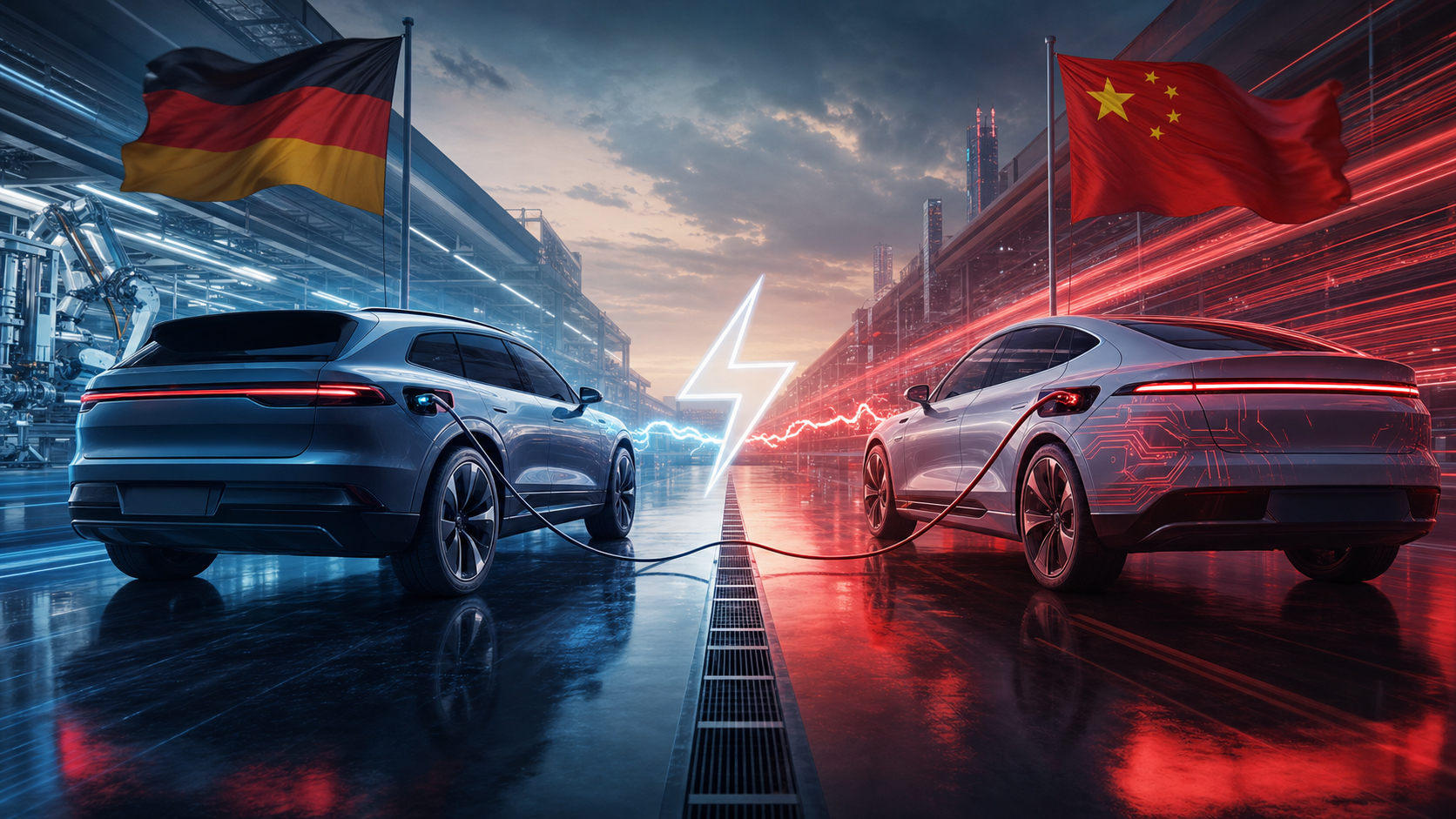
Chinese electric cars vs. German electric cars: Who will really be ahead in 2026? – Image: Xpert.Digital
Surprise in the electric car duel: Why the low Chinese price can become a cost trap
Have BYD, XPeng & Co. finally left the German car manufacturers behind?
Charging kings versus residual value winners: The tough electric car report card 2026
In the summer of 2026, the automotive world will be watching with bated breath a duel that has long since become more than just a technological race: traditional German brands versus the rising competition from China. While manufacturers like BYD and XPeng are shaking up the market with rapid charging times, generous standard equipment, and aggressive pricing, BMW, Audi, and others are countering with their decades of experience. But who is currently building the better electric car? Those who are only dazzled by glossy data sheets often overlook the pitfalls of everyday use – from drastic depreciation to patchy service networks. Our comprehensive analysis of the latest test data, registration figures, and long-term cost puzzles dispels common misconceptions and reveals, without minutiae, that the race for supremacy on Europe's roads is only just entering a completely new phase, in which low purchase prices can be deceptive and traditional strengths are making an unexpected comeback.
Related to this:

Who really has the upper hand – or is the question itself wrongly posed?
A dispute that cannot be resolved in a single sentence
Few topics heated up the German automotive public in the summer of 2026 as much as the question of whether Chinese electric cars had already overtaken German manufacturers technologically. The trigger was a concrete example: at the end of August 2026, a widely discussed comparison between the Audi Q6 e-tron and the Chinese XPeng P7 brought the industry's central question back to the forefront. However, those who only superficially followed the debate might get the impression that there is a simple, clear answer. In fact, a closer analysis of the available test data, registration statistics, and manufacturer announcements reveals a far more complex picture. The competition is discipline-specific; it doesn't follow a single axis called technology, but rather several, sometimes contradictory, dimensions of evaluation. Faster charging doesn't automatically make it the better overall vehicle, and those who promise greater range on paper don't always deliver on that promise in practice.
Figures that show how quickly power dynamics are shifting
The vehicle registration market provides the most objective basis for any evaluation. Between January and July 2026, Chinese brands accounted for approximately 70,200 passenger cars registered in Germany, representing a market share of about four percent, compared to just 2.2 percent for the entire year of 2025. BYD alone recorded around 31,500 new registrations during this period, reaching 5,245 vehicles in July 2026 – an increase of 358.5 percent compared to the same month of the previous year, corresponding to a market share of approximately 1.95 percent. In some months, XPeng even temporarily surpassed Tesla, a signal that was interpreted as a wake-up call within the industry. In Western Europe, Chinese brands achieved a 14.2 percent share of new battery-electric vehicle registrations between January and May 2026, despite the anti-subsidy tariffs in effect since October 2024, which range from 17 to 35.3 percent depending on the manufacturer, plus the regular 10 percent import duty. The trade organization Transport & Environment found that even after the tariffs were applied, Chinese battery-electric vehicles were still, on average, around 21 percent cheaper than comparable European models. These figures demonstrate that the political response to Chinese competition has not yet had a decisive braking effect, but may, at most, have dampened the growth rate.
Why a factory in Hungary changes more than just the customs bill
A key structural turning point is local manufacturing. BYD has built its first European passenger car plant in Szeged, Hungary, and began delayed test production there in early 2026, with series production scheduled for the fourth quarter of 2026. An initial capacity of approximately 150,000 vehicles is planned, which is to be doubled later, with the initial production run including the electric Dolphin Surf city car and the Atto model. A parallel plant project in Turkey has been paused, demonstrating that Chinese companies, too, must adapt their European strategies to economic and political realities. Local production in an EU member state is strategically important because it at least partially circumvents anti-subsidy tariffs, making BYD even more price-competitive than a simple import comparison would suggest. For German manufacturers, this means that Chinese competition can no longer be contained solely through imports, but is becoming a permanent, structural component of the European manufacturing landscape.
When loading curves become the actual battlefield
Recent independent tests show that Chinese models are now among the technological leaders in fast charging, or even leading the field. A Dutch comparison test conducted by Fastned and Autoblog in July 2026 declared Chinese models the winners in both vehicle classes tested, with the XPeng G9 achieving a charge from 10 to 80 percent in around 11 minutes at an average charging power of approximately 400 kilowatts. German models like the BMW iX3 and the Mercedes CLA, while reaching high charging peaks, lost power more quickly as the charging process progressed. The BMW iX3 itself boasts an 800-volt architecture, a charging power of up to 400 kilowatts, and a charge from 10 to 80 percent in around 21 minutes, measured against a battery with a usable capacity of 108.7 kilowatt-hours. In practice, however, many public charging stations do not consistently achieve these peak values, meaning that the actual charging time depends heavily on the specific infrastructure. This finding makes it clear that the charging curve as a technical criterion is increasingly becoming the actual dividing line between aspiration and reality, regardless of the vehicle's origin.
Range on paper versus range on the road
A Norwegian real-world range test conducted by the NAF automobile club in June 2026, comparing 22 to 24 electric cars, saw the BMW iX3 take first place with 781 kilometers driven, even exceeding the WLTP standard value by 1.5 percent. The Chinese XPeng X9 achieved 646 kilometers, representing an impressive 11.4 percent over the WLTP value, making it the most accurate in the test field. Other Chinese models, such as the MG IM6, fell significantly short of their standard figures, with a deviation of minus 11.7 percent. The ADAC confirms this mixed picture: In its own test cycle, the BMW iX3 achieved 669 of its promised 794 kilometers and a test consumption of 18.3 kilowatt-hours per 100 kilometers, compared to a WLTP value of 15.4 kilowatt-hours. The BYD Sealion 7 Excellence, on the other hand, stood out in the ADAC winter test due to its very high charging performance, but also its unusually high energy consumption, resulting in a comparatively weak overall score of 4.0. This variation shows that neither the German nor the Chinese websites can be generally considered to be indicative of efficiency or honesty in manufacturer specifications; rather, each model must be evaluated individually.
When crash tests shake old certainties
For a long time, safety was considered the undisputed domain of European, and especially German, vehicles. This assumption can no longer be entirely upheld. In July 2026, the ADAC (German Automobile Club) publicly confirmed that Chinese manufacturers have significantly improved in crash safety and build quality, while driver assistance systems often remain a weak point. As early as the end of 2025, Euro NCAP tests had shown that models from Leapmotor and Hongqi achieved top marks, and the BYD Seal 6 even surpassed the BMW 2 Series Gran Coupé in terms of safety rating in direct comparisons. Other sources confirm that Euro NCAP awarded the MG4, the BYD Seal, and the XPeng G6 the full five-star rating. However, it remains important to note that not every model sold in China has been independently tested in Europe, so sweeping statements about the entire Chinese model range should be treated with caution. Furthermore, a good crash test score says little about long-term durability, repair costs and the behavior of the body structure after several years of use, an area in which there is simply no reliable long-term data for many of the newer Chinese models in Europe.
The new rating system that brings German models back to the top
The ADAC (German Automobile Club) has fundamentally revised its testing procedure for 2026, weighting the categories of safety and environment equally with the other evaluation areas instead of double. This methodological change has tended to result in lower overall scores for newly tested vehicles, meaning that the 2026 results are not directly comparable with older tests conducted up to the end of 2025. Among the electric cars evaluated according to the new scheme, two BMW models share the top spot: Both the new BMW iX3 50 xDrive and the older BMW iX xDrive45 achieved an overall score of 1.9, thus leading all previously tested Chinese competitors. This finding can be interpreted in different ways. On the one hand, it shows that a well-balanced overall package of driving dynamics, build quality, driver assistance systems, and safety remains an area where German premium manufacturers can leverage their traditional strengths. On the other hand, it should be considered that so far only a relatively small test field of about twelve vehicles has been evaluated according to the new scheme, so the picture could still change with increasing test coverage of Chinese models.
Why the cheapest vehicles can become expensive in the long run
The lower purchase price of Chinese electric cars is considered by many buyers to be their most compelling argument. However, the German Automotive Trust (DAT) shows that this advantage is partially eroded over the ownership period. The average residual value of Chinese electric and plug-in hybrid vehicles fell from 61 percent at the beginning of 2024 to just 47.2 percent in April 2026, a decline of 14 percentage points in just over two years. The overall market for comparable drive systems lost only seven percentage points during the same period, which exactly doubles the depreciation of Chinese vehicles. This development is likely related to the still low level of trust among used car buyers in brands without an established service history, concerns about the long-term availability of spare parts, and fears of a potential market withdrawal by individual manufacturers. Surveys by the DAT show that around 45 percent of German new car buyers expect that some Chinese brands could leave the German market within the next five years. Anyone who weighs the lower purchase price of a Chinese model against its lower value stability may end up with a similar or even less favorable overall cost balance than when buying an established German model, even if the latter appears more expensive to purchase.
How generous warranties are supposed to buy the trust of buyers
To counteract the lack of trust, Chinese manufacturers are deliberately focusing on exceptionally long warranty periods. While German premium brands traditionally only offer a two-year vehicle warranty, Chinese manufacturers like MG or BYD often grant five to seven years of vehicle warranty and an eight-year battery warranty. The BYD Atto 3 starts at around €38,000, and the MG4 at around €32,000, each with a very generous standard equipment package compared to similarly positioned German models. This warranty strategy is economically understandable, as it aims to compensate for lower brand recognition and a lack of confidence in long-term quality by formally shifting the risk to the manufacturer. Whether these warranties can actually be honored in practice over their full duration, especially if individual brands were to leave the European market, remains an open question and a relevant one for purchasing decisions.
The software war, which is only just beginning
Besides hardware and range, the real competitive focus is increasingly shifting towards software and driver assistance systems. In July 2026, journalists in Munich were able to test XPeng's new VLA 2.0 driver assistance system for the first time outside of China; its European rollout was announced for 2027. At the same time, the ADAC (German Automobile Club) confirmed that Chinese assistance systems are even more unreliable than established European systems when it comes to traffic sign recognition, lane keeping, and adaptive cruise control. This picture is contradictory because some enthusiastic user reports on social media describe the Chinese highway assistance system as significantly superior to comparable Tesla systems, while independent, methodologically sound tests tend to reach mixed to critical conclusions. This discrepancy can be partly explained by the fact that software systems can evolve rapidly via over-the-air updates, causing isolated test results to quickly become outdated. Simultaneously, European road conditions, signage, and traffic regulations present a separate, often underestimated calibration challenge that cannot be solved solely through technical computing power.
🎯🎯🎯 Data-driven B2B industry hub as a quasi-in-house solution

The quasi-in-house solution: How Xpert.Digital closes operational gaps in B2B marketing and sales – Smart Content-Driven Business - Image: Xpert.Digital
Xpert.Digital is a data-driven B2B industry hub led by Konrad Wolfenstein . The company acts as an external, quasi-in-house solution for industrial partners, closing operational gaps in marketing, content, and sales – without requiring additional resources on the client side.
More information here:
Service network versus innovation: Why the battle for market leadership in electric cars is only just beginning
How a company's own strategy puts German manufacturers in a difficult position
A particularly revealing and simultaneously uncomfortable development concerns the German corporations themselves. In August 2026, it was revealed that models manufactured in China bearing the Audi name, specifically the E5 Sportback and E7X models, were being imported to Germany via parallel importers and offered there at lower prices than the official Audi models bearing the four rings for the European market. Audi itself clarified that these vehicles were intended exclusively for the Chinese market and did not correspond to the European product portfolio. This incident exposes a remarkable internal division within the same corporation: Models developed for the Chinese market sometimes differ significantly in terms of technology and price from those intended for Europe, raising the question of whether German corporations themselves are no longer entirely convinced that their European product line is competitive in every respect. This creates additional confusion for consumers, as legal questions regarding homologation, warranty processing, and service quality for such grey imports remain largely unresolved.
Homologation, in the automotive sector, refers to the legally mandated testing and approval process that demonstrates a vehicle type meets all technical, safety, and environmental regulations of a market. Within the European Union, this generally corresponds to EU type approval. Only after this approval can a production vehicle be legally sold and registered.
Homologation is particularly important for imports – for example, an electric car developed for China: If EU type approval is lacking, additional tests, modifications, or individual approval may be required, for instance, for lighting, brakes, software functions, charging port, radio technology, or driver assistance systems. A vehicle with valid EU type approval and a certificate of conformity, on the other hand, can generally be registered in all EU member states.
Why the German automotive industry is particularly vulnerable right now
The technological race coincides with a period in which the German automotive industry is already under considerable economic pressure. BMW reported a 35 percent decline in after-tax profit for the second quarter of 2026, while Volkswagen is internally discussing possible plant closures and the elimination of up to 100,000 jobs over several years. At the same time, sales of German brands in China plummeted between 20 and 36 percent because Chinese manufacturers have become so dominant in their own domestic market that almost all of the ten best-selling passenger cars are electric or hybrid models of Chinese origin. This concurrent technological catch-up and economic weakness makes a dispassionate assessment considerably more difficult, as media sensationalism tends to conflate technological lag and economic headwinds, even though these are analytically two distinct, albeit interconnected, phenomena. A decline in profits can be attributed to price wars, currency effects, or geopolitical trade barriers just as easily as to actual technological inferiority.
Related to this:
The political customs wall, which is more porous than expected
In October 2024, the European Union imposed definitive anti-subsidy duties on Chinese battery-electric vehicles, ranging from 17 percent for BYD, 18.8 percent for Geely, and up to 35.3 percent plus the regular 10 percent import duty for SAIC, depending on the manufacturer. The aim was to neutralize the price advantage of Chinese imports and give European industry time to catch up technologically. However, the actual effect has been limited: Despite the tariffs, the market share of Chinese battery-electric vehicles in Western Europe reached a record high in the first half of 2026, and after the tariffs, the vehicles remained on average around 21 percent cheaper than comparable European alternatives. Furthermore, Chinese manufacturers are increasingly shifting their strategy towards plug-in hybrid models, which are not yet affected to the same extent by the specific tariffs for purely battery-electric vehicles, and towards local production within the European Union, as the example of the Hungarian plant impressively demonstrates. The political trade barrier thus changes less the fundamental competitive relationship than the tactical design with which Chinese suppliers permanently secure their market position in Europe.
Why the service network ultimately determines everyday usability
Beyond mere technical specifications, a frequently underestimated factor is the density and quality of the service network. Brands like MG and Leapmotor now boast a relatively dense network of dealers and workshops in Germany, while XPeng and Nio, in particular, still struggle with a significantly thinner presence. For buyers, this represents a real, everyday risk that is rarely reflected in traditional test reports: How quickly can a spare part be obtained, how busy is the nearest workshop, and how reliable is communication in the event of a breakdown? German manufacturers continue to benefit from sales and service structures that have evolved over decades—an advantage that cannot be replicated in the short term, even if the pure vehicle technology of Chinese manufacturers is already competitive or superior in certain areas. This structural component is often neglected in public discourse in favor of spectacular individual data points such as charging performance or range, even though it plays a significant role in the actual purchasing decisions of many consumers.
What remains unanswered so far and why caution is advised
Despite the wealth of data, crucial questions remain unanswered. Reliable long-term data on the quality of Chinese vehicles after 60,000 to 150,000 kilometers driven under European conditions is lacking, as most models have only been on the market for a few years and traditional workshop reports will not be able to provide reliable data until 2027 or 2028 at the earliest. Similarly, a direct, methodologically identical comparison of winter fuel consumption and highway range between directly competing model pairs under precisely the same conditions, such as temperature, tire choice, and speed, is missing. The battery aging of lithium iron phosphate cells, as used by BYD in its Blade technology, in direct comparison to the nickel-manganese-cobalt cells installed in German new-class and premium platform vehicles over several years and in different climate zones has also not yet been sufficiently and independently investigated. Furthermore, there are unresolved questions regarding data protection, cybersecurity, and the long-term update policies of Chinese manufacturers, particularly in the event of a potential market withdrawal. Anyone who, in light of these gaps, makes a blanket statement about a general technological advantage of one side or the other, exceeds the limits of what can be empirically proven.
A nuanced assessment rather than a simple judgment
The available data allows for a nuanced, but not one-sided, conclusion. Chinese manufacturers have undergone an impressive technological catch-up process in the past two years, particularly evident in fast-charging performance, standard equipment, warranty services, and, to some extent, crash safety. At the same time, German premium manufacturers continue to maintain demonstrable advantages in areas such as chassis tuning, overall harmony, real-world range under everyday conditions, residual value stability, and service network density, as the recent ADAC results, with the BMW iX3 and iX models taking the top spots, impressively demonstrate. The true economic core of the debate, therefore, lies less in the question of who is technically superior, but rather in the fact that global competition in electromobility has definitively shifted from a purely hardware-based race to a multidimensional competition encompassing software, brand trust, industrial location policy, and total cost of ownership over the vehicle's lifetime. Anyone who ignores this complexity and instead seeks a simple ranking will fail to do justice to the economic reality of this market in 2026.
So, is this a draw or is the result still undecided?
Neither a true draw nor a definitively open result: The most reliable finding at present is that Chinese manufacturers are ahead in several particularly visible electric vehicle disciplines, while German manufacturers still maintain clear, economically relevant advantages when it comes to the complete vehicle and usage package. It is therefore a shared lead with the long-term outcome still uncertain.
The most precise classification
The wrong question would be: "Who is technically better overall?" There is no single, objective metric for that. A car is not a single product feature, but a bundle of components including battery, drive system, charging behavior, software, safety, chassis, perceived quality, service, financing, and resale value.
The current situation can be summarized as follows:
| Area | Trend 2026 | Why |
|---|---|---|
| Price and standard equipment | China in the lead | Chinese manufacturers often combine lower prices with extensive standard features and long warranties |
| Battery integration and scaling | China in the lead | BYD and others are gaining greater vertical control over parts of the cell, battery, and vehicle value chain |
| DC fast charging and charging curve | China usually in the lead | In particular, new XPeng and other 800-volt models exhibit very short 10-to-80 percent charging times |
| Range and consumption | Open, with a German counterattack | The BMW iX3, with a range of 669 km in the ADAC test and a consumption of 18.3 kWh/100 km, demonstrates that German manufacturers are once again among the leaders in efficiency |
| Chassis, steering and overall harmony | Germany in the lead | German premium manufacturers still possess experience in tuning, long-distance comfort and driving feel |
| Passive occupant protection | Largely open | Several Chinese vehicles have achieved five Euro NCAP stars; the former automatic German lead has disappeared |
| Driver assistance systems in Europe | Germany is probably in the lead | Not only because of the sensors, but also because of the adaptation to European traffic rules, signs, construction sites and liability requirements |
| Software potential and development pace | China in the lead, EU rollout open | Chinese manufacturers are developing quickly and rapidly adding features to models, but they still need to be validated in Europe |
| Service, spare parts and repair processing | Germany clearly in the lead | The dense network of dealers, workshops and spare parts is a difficult-to-copy advantage |
| Residual values and total costs | Germany is currently in the lead | Chinese electric cars and plug-in hybrids had an average residual value of 47.2 percent in April 2026, compared to about 54 percent in the broader comparison market |
| Long-term quality | Still open | For many new Chinese brands, European data is lacking after 6 to 10 years or 100,000 to 150,000 km |
No draws in any category
It can be described as an asymmetrical draw: Both sides have roughly the same number of decisive strengths, but these strengths lie at different points in the value chain and appeal to different buyer groups.
For a technology-savvy private buyer who is purchasing a new vehicle, expects a lot of features, primarily charges at public charging stations, and plans to use the vehicle for three or four years, an XPeng, BYD, Zeekr, or MG electric vehicle can be the more attractive option both economically and technically. The combination of price, battery warranty, displays, convenience features, charging performance, and standard equipment is often very compelling.
For fleet managers, lessees, or buyers with long-term holding periods, German brands often remain the less risky choice. This isn't because every German electric car is inherently better, but because residual value, workshop access, spare parts availability, insurance processing, financing, and used car liquidity are easier to predict. Especially with a purchase price of €45,000 to €75,000, a difference of 5 to 10 percentage points in residual value can later completely or partially negate the initial price advantage of a cheaper vehicle.
The outcome is uncertain in the long term
The open question does not concern current technical capabilities. Chinese manufacturers are undoubtedly no longer mere imitators, but rather independent innovation leaders in areas such as batteries, production speed, software integration, and pricing. Localization is also progressing: BYD began test production at its Szeged plant in Hungary at the end of January 2026; series production is scheduled to start in the fourth quarter of 2026 after some delays. This will reduce disadvantages related to customs, transport, and supply chains in the long term and will permanently intensify competition in Europe.
The real question is whether Chinese brands can translate their current strengths into lasting trust, stable residual values, a robust service network, and demonstrable long-term quality. This is precisely where it will be decided whether high new registration figures will translate into sustainable market leadership.
Conversely, German manufacturers must prove that their latest technology platforms not only produce excellent individual vehicles, but are also scalable at competitive costs. The BMW iX3 is a serious example of this: In the ADAC car test, it achieved a score of 1.9, a test range of 669 kilometers, and a very good safety rating of 1.5. At the same time, the stated running costs, with a score of 3.6, are significantly lower than the overall technical rating, demonstrating how strongly price and costs will determine future success.
My reasoned judgment
Therefore, today the verdict is not "Draw", but:
China has a strategic lead in electric drive and supply models. Germany still has a significant lead in terms of a mature overall product, market access, and the economically viable infrastructure for its use.
China is more likely to win the short-term competition regarding purchase price, equipment value, battery expertise, and charging innovation. Germany is more likely to win the current competition regarding predictable long-term use, premium driving experience, service, and resale value.
The final result remains open because the decisive tests will only become visible in the years 2027 to 2030:
- How reliable are Chinese vehicles after 100,000 kilometers under European climate, highway and workshop conditions?
- Will warranty promises remain valid even with high repair volumes and potential market consolidation?
- How quickly can Chinese manufacturers close the European service and spare parts gap?
- Can Germany transfer the New Class, PPE successor platforms and new software architectures quickly enough into cheaper volume models?
- Will residual values change once BYD, XPeng, and others have built up a larger installed vehicle base, more workshops, and a more liquid used car market?
The competition is therefore not yet decided. But it has already progressed far enough that German manufacturers can no longer rely on brand image, tariffs, or hoping for quality problems from Chinese manufacturers. They must at least match the competition in terms of cost profile, software speed, and charging capabilities, without sacrificing their existing strengths in ride quality, service, and trustworthiness.
📈🚀 From visibility to trust 👀🤝 Your scalable path with Xpert.Digital

From visibility to trust: Your scalable path with Xpert.Digital - Image: Xpert.Digital
In industrial B2B, sustainable business relationships rarely emerge overnight. They develop step by step – through visibility, professional relevance, recurring touchpoints, and growing trust. Xpert.Digital's 4-stage model addresses precisely this: It offers a structured path that begins with a manageable entry point and can evolve into deeper collaboration in business development if needed.
Instead of relying on loud marketing promises, this model puts the relationship at the forefront. Companies start with clearly defined, easily calculable measures and then decide, based on their own experience, how far they want to expand the collaboration. A key factor for this undisturbed trust-building process: The platform completely avoids annoying advertising ads, so the editorial focus remains solely on the companies' expertise.
More information here:
Your global marketing and business development partner
☑️ Our business language is English or German
☑️ NEW: Correspondence in your native language!

Konrad Wolfenstein
I and my team are happy to be available to you as your personal advisor.
You can contact me by filling out the contact form here [email protected]:or simply call me at +49 7348 4088 965. My email address is
I'm looking forward to our joint project.










