
Tesla shock and leadership in China: Why a single US car exposes the excuses of German manufacturers
Xpert Pre-Release

Available in 27 languages 📢
Prefer Xpert.Digital on GoogleⓘPublished on: August 18, 2026 / Updated on: August 18, 2026 – Author: Konrad Wolfenstein
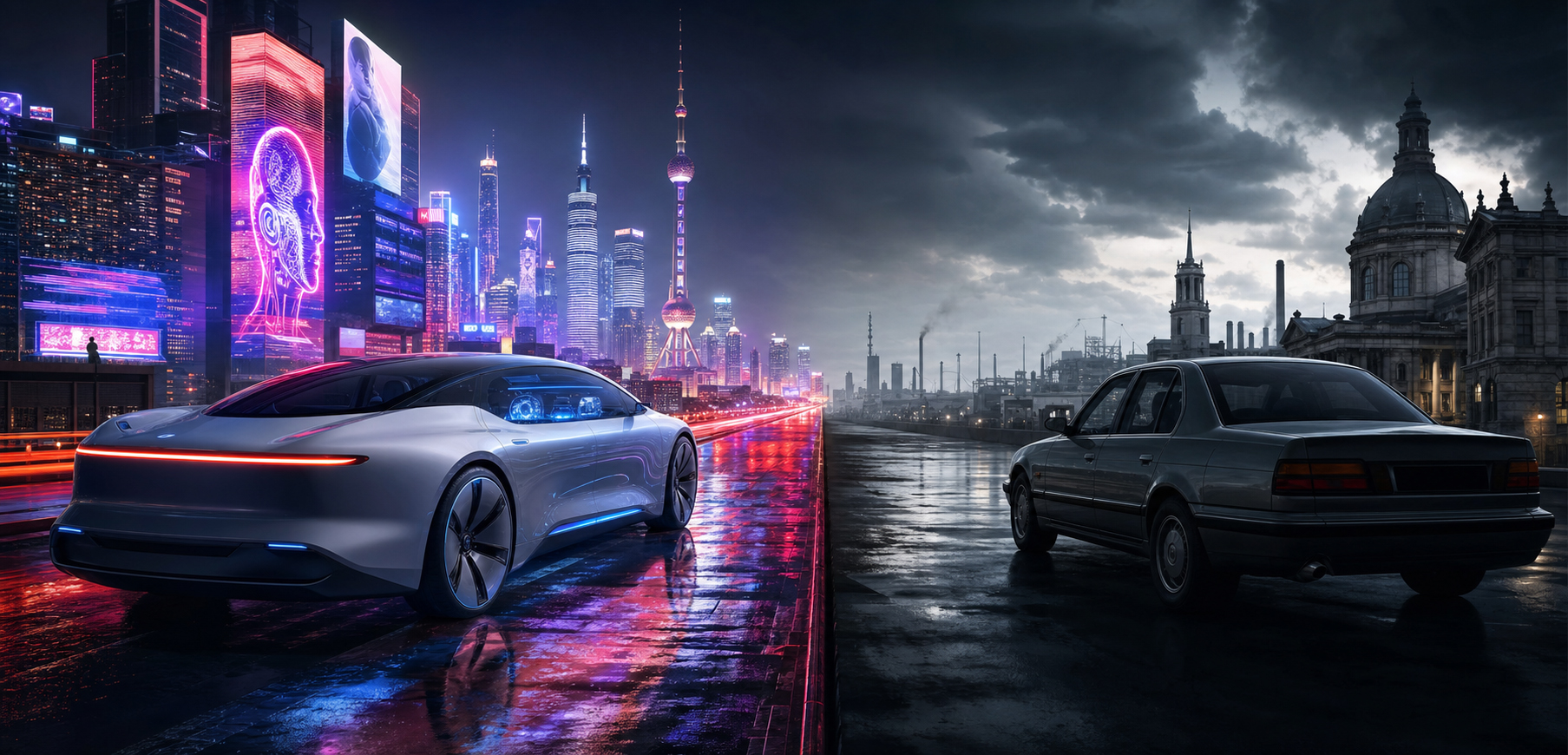
Tesla shock and leadership in China: Why a single US car exposes the excuses of German manufacturers – Image: Xpert.Digital
Market share down to just 1.6 percent: The bitter reality for VW, BMW and Mercedes in China
It's no longer about range: The real reason why the German automotive elite is failing in China
It's not Beijing's fault: The real problem for German car manufacturers lies in their management boards
The German automotive industry is facing an unprecedented upheaval in China – formerly its most important and lucrative market. While executives readily attribute the dramatic slump in sales figures to Chinese protectionism, unfavorable conditions, or strong patriotic consumer sentiment, a US automaker is proving these excuses wrong. The overwhelming success of the Californian Tesla Model Y impressively demonstrates that the Chinese market is indeed open to foreign brands, provided the product resonates with current trends. The harsh reality, however, reveals an alarming collapse in German electric vehicle market share to a historic low of just 1.6 percent. The real problem, therefore, lies not in Beijing, but in the persistent hardware fixation of German boardrooms. Modern Chinese consumers have long demanded smart vehicles with seamless software integration, voice recognition, and artificial intelligence. The following analysis ruthlessly exposes how established manufacturers have missed the boat on the transformation into software companies, why classic purchasing criteria are losing importance, and why the biggest threat to Volkswagen, BMW, and Mercedes is deeply rooted in their own corporate structures.
Tesla right under our noses: How China's car market is shattering the German illusion
When a Californian car disproves German excuses
In June 2026, the best-selling vehicle in the world's largest car market was not a Chinese product, but the Tesla Model Y, designed in California and produced at Tesla's Shanghai factory. With 38,654 retail registrations, the Model Y topped the list of all vehicles in China, regardless of powertrain, leaving significantly cheaper competitors in its wake. Remarkably, it was also the most expensive model in the top 10, with prices ranging from approximately US$38,800 to US$46,100. For Tesla, June was also its best month of 2026, with a 24.4 percent increase compared to the same month of the previous year, continuing an eight-month growth streak.
This single data point undermines two explanatory models that parts of the German automotive industry are currently using to reassure themselves. The first narrative claims that Chinese customers no longer buy foreign brands because nationalism and state control dominate the market. The second narrative asserts that vehicles for the Chinese market can only be successfully developed locally. The success of a vehicle that was neither designed in China nor produced by a Chinese brand refutes both assumptions.
The great shift in power relations
Six years ago, foreign brands held roughly two-thirds of the Chinese automotive market, while Chinese manufacturers claimed about one-third. This situation has completely reversed: Chinese brands now hold a market share of approximately 71 percent, as recent analyses based on delivery figures from January to May show. More recent figures from the China Association of Automobile Manufacturers for the first half of 2026 confirm this trend, with Chinese brands accounting for 71.8 percent of the market share, while joint ventures and foreign brands only reach 28.2 percent. In June alone, the combined market share of foreign and joint venture brands even fell to 24.5 percent, with German brands alone still representing 12.8 percent, Japanese brands 11.0 percent, and American brands 5.8 percent of retail sales.
This development is not the result of a sudden upheaval, but rather of a multi-year, accelerating trend. Between 2024 and 2025, the market share of Chinese brands rose from 65.2 to 69.5 percent, while the share of foreign manufacturers fell from 34.8 to 30.5 percent during the same period. The New Energy Vehicle segment, i.e., electric and plug-in hybrid vehicles, which represents China's actual growth market, is particularly revealing. Among the ten largest manufacturers in this segment, only three companies—Geely, SAIC, and Changan—also rank among the top ten for conventional combustion engine vehicles. All three are Chinese companies, and no foreign brand achieves this dual ranking.
The painful reality of Germany's electricity balance
Perhaps the clearest evidence of the structural weakness of German manufacturers in the Chinese future segment lies in the figures for pure electric vehicles. In the first quarter of 2026, the combined market share of Volkswagen, Audi, BMW, Mercedes-Benz, and Porsche for battery-electric vehicles in China reached a mere 1.6 percent, the lowest figure ever recorded. This metric is all the more alarming considering that China is the world's largest electric car market and that battery-electric vehicle registrations there had already increased by 27 percent to 6.3 million vehicles in 2024, while the German manufacturers together only managed to register 325,637 electric cars. By comparison, BYD already achieved a market share of 16 percent in the electric vehicle segment in 2022, while VW, as the best-performing German supplier, reached 2.4 percent, and BMW, Mercedes, and Audi together barely achieved half that figure.
The following overview illustrates the development of the German electrical market share in China over several years and shows a downward spiral without any discernible bottom formation.
| Period | Combined market share of German manufacturers of electric vehicles in China |
|---|---|
| 2022 | approximately 6.5 percent |
| 2023 | approximately 6.5 percent |
| 2024 | approximately 5 percent |
| Q1 2026 | approximately 1.6 percent |
This development coincides with a general sales crisis. Volkswagen experienced a 36.6 percent decline in sales in China in the second quarter of 2026, with the company itself admitting that, despite newly introduced, locally developed electric models, it could not escape the general market downturn of around 20 percent. Sales of VW's purely electric models in China even plummeted by 47.9 percent in the first half of 2026, to just under 30,900 vehicles. Mercedes-Benz reported a decline of around 30 percent for the second quarter and a total drop of 28 percent for the first half of the year, with only 210,000 vehicles sold. BMW was also not spared from the downturn, recording a 20.4 percent decline in China in the first half of the year.
Why range and charging time are no longer the decisive criteria
The basic technical specifications of German electric vehicles, such as range and charging speed, are quite competitive internationally. The real differentiating factor that allows Chinese buyers to distinguish between an attractive and an uninteresting vehicle now lies elsewhere: in the software, connectivity, and artificial intelligence integrated into the vehicle. More than twenty Chinese automakers have already integrated large-scale language models, such as that of the company DeepSeek, into their vehicles, giving the integration of artificial intelligence into the cockpit a significant boost.
The so-called smart cockpit, which can be controlled via natural language, gestures, and facial recognition and understands context across multiple interactions, is no longer a niche product for the luxury segment in China. For new cars priced above the equivalent of €77,000, the smart cockpit has already achieved a market penetration of 85 percent, and even for vehicles under €39,000, the share is already at 60 percent. Across the entire new car market, smart cockpit penetration is currently just under 60 percent, while central cockpit domain controllers already control 14 percent of vehicles. Manufacturers such as Changan, Geely, Great Wall Motor, Leapmotor, and other Chinese brands have integrated voice models like Baidu's Ernie Bot into their vehicles, allowing drivers to not only give simple voice commands but also to engage in genuine, context-aware conversations with the car.
This shift in purchasing criteria hits German manufacturers where they have traditionally been weakest. While the mechanical engineering of German vehicles continues to be valued, in an increasingly digitalized market, software architecture is the deciding factor between purchase and rejection. Chinese customers now expect a fully connected, adaptive, and voice-controlled experience, more comparable to a smartphone than a traditional automobile.
Our China expertise in business development, sales and marketing

Our China expertise in business development, sales and marketing - Image: Xpert.Digital
Industry focus areas: B2B, digitalization (from AI to XR), mechanical engineering, logistics, renewable energies and industry
More information here:
A thematic hub offering insights and expertise:
- Knowledge platform covering global and regional economies, innovation and industry-specific trends
- A collection of analyses, insights, and background information from our key areas of focus
- A place for expertise and information on current developments in business and technology
- A hub for companies seeking information on markets, digitalization, and industry innovations
Why German car manufacturers are really failing in China: The problem is in the boardroom
The real problem is not in Beijing, but in the boardrooms
Anyone who explains the crisis facing German manufacturers in China solely through protectionist industrial policies, cut subsidies, or unfavorable conditions overlooks the fact that a single Californian product proves precisely the opposite. Tesla doesn't develop its vehicles in China, but it does produce some of them there and sells them in large numbers despite a significant price premium over local competitors. Market access is therefore clearly available, and development outside of China doesn't pose a fundamental obstacle either. What's missing is the consistent implementation of a software strategy that meets the demands of Chinese customers.
For more than 15 years, the German automotive industry has been attempting to transform itself from a traditional mechanical engineering company into one that embraces software as its core competency. While this transformation is regularly announced, it is repeatedly delayed in practice. A key reason for this lies in the composition of decision-making levels, which are often dominated by individuals whose careers began in the old, hardware-dominated system. For this generation of executives, a consistently software-centric organization is not primarily seen as an opportunity, but rather as a potential threat to their professional authority and their position of power within the company. This very situation fosters a gradual stalling of transformation processes that are officially considered to have been initiated long ago at the board level.
The financial consequences of this delayed adjustment are now clearly visible in the group balance sheets. At Volkswagen, net profit fell by around a third to €1.54 billion in the second quarter of 2026, and by a good 30 percent to €3.1 billion in the first half of the year. For the full year, the group no longer expects growth, but rather a possible decline in revenue of up to three percent. At BMW, profit plummeted by 35 percent in the same period, while the Chinese market became the biggest drag on the half-year results for all three major German manufacturers.
A legitimate counter-position to a pure fixation on software
Not everyone in the debate shares the diagnosis that a lack of software expertise is solely responsible for the crisis. A valid point is that a one-sided focus on digital functions and artificial intelligence may not be the only strategic answer, even if the Chinese market currently relies heavily on highly digitized vehicles. A significant portion of car users primarily want to travel comfortably, reliably, and affordably from one place to another, possibly with additional passengers or luggage on board. From this perspective, the vehicle should primarily function, rather than transforming into a digital toy that is neither essential nor willingly paid for.
This opposing view points to a real risk of current market developments in China: the potential overload of vehicles with digital features whose practical use in everyday life remains limited. At the same time, however, it can be observed that the most commercially successful models in China, including the Tesla Model Y, combine both requirements: solid basic functionality as a practical means of transportation on the one hand, and a contemporary digital experience on the other. The success of the Model Y is therefore not solely based on spectacular software, but on a combination of practical utility, a competitive price-performance ratio, and a minimum level of digital modernity that is now considered a basic requirement rather than an optional extra.
The price gap as an additional burden factor
Besides the software issue, a structural price difference further intensifies the competitive situation. Current analyses show that an average electric car in China costs the equivalent of around €29,765 according to the price list, while comparable vehicles in Germany are offered at an average price of €43,749, almost 50 percent more expensive. This difference is partly explained by lower production costs in China, particularly for battery cells, but also by a more aggressive scaling strategy employed by Chinese manufacturers, who focus on high production volumes with lower margins. For German manufacturers, this means a double disadvantage: In the Chinese market, they encounter both technologically more advanced software solutions and a more aggressive price level against which their traditionally margin-oriented model policy struggles to compete.
At the same time, German manufacturers are also coming under pressure in their own domestic market, as Chinese brands are increasingly expanding into Europe and especially Germany. This dual challenge – losing market share in China while simultaneously facing growing Chinese competition in Europe – significantly exacerbates the strategic dilemma facing German corporations.
An organizational problem, not a market access problem
A comprehensive review of the available data suggests a clear conclusion. The decline in German market share in China is not primarily attributable to government restrictions, nor to a fundamental rejection of foreign brands by Chinese consumers. The success of the Tesla Model Y as China's best-selling vehicle in June 2026, developed outside of China and priced significantly above the market average, empirically refutes both common excuses. Instead, it is a self-inflicted, structural organizational problem rooted in the slow and often stalled transformation of hardware companies into software companies.
The crucial question for the coming years is therefore not how to improve market access in China, but how quickly and consistently German automotive companies are prepared to restructure their internal power structures in favor of genuine software expertise. As long as decision-making positions remain occupied by a generation whose professional identity is rooted in the old, mechanically driven system, the risk remains high that necessary changes will be announced but repeatedly delayed in practice. The Chinese market now provides a painfully clear indicator of this.
📈🚀 From visibility to trust 👀🤝 Your scalable path with Xpert.Digital

From visibility to trust: Your scalable path with Xpert.Digital - Image: Xpert.Digital
In industrial B2B, sustainable business relationships rarely emerge overnight. They develop step by step – through visibility, professional relevance, recurring touchpoints, and growing trust. Xpert.Digital's 4-stage model addresses precisely this: It offers a structured path that begins with a manageable entry point and can evolve into deeper collaboration in business development if needed.
Instead of relying on loud marketing promises, this model puts the relationship at the forefront. Companies start with clearly defined, easily calculable measures and then decide, based on their own experience, how far they want to expand the collaboration. A key factor for this undisturbed trust-building process: The platform completely avoids annoying advertising ads, so the editorial focus remains solely on the companies' expertise.
More information here:
Your global marketing and business development partner
☑️ Our business language is English or German
☑️ NEW: Correspondence in your native language!

Konrad Wolfenstein
I and my team are happy to be available to you as your personal advisor.
You can contact me by filling out the contact form here [email protected]:or simply call me at +49 7348 4088 965. My email address is
I'm looking forward to our joint project.





