
Germany in economic decline: Who bears the responsibility? The convenient lie of distraction
Xpert Pre-Release

Available in 27 languages 📢
Prefer Xpert.Digital on GoogleⓘPublished on: May 5, 2026 / Updated on: May 5, 2026 – Author: Konrad Wolfenstein
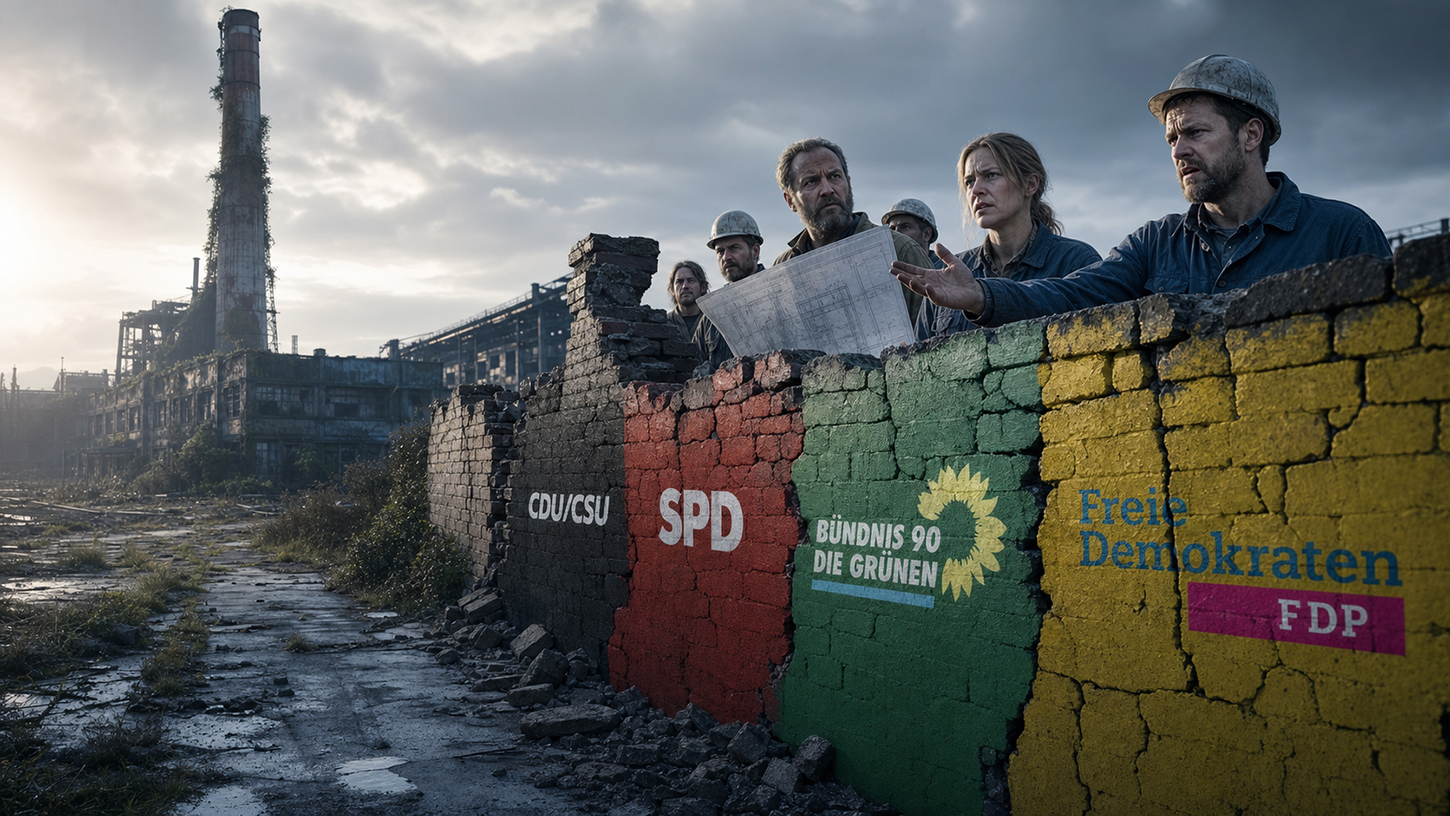
Germany in economic decline: Who bears the responsibility? The convenient lie of distraction! – Image: Xpert.Digital
Germany's gradual decline: The real culprits behind the economic crisis
The Great Bluff: How legitimate criticism of the government is systematically silenced
The German economy is mired in a deep, structural crisis – but instead of ruthlessly addressing its self-inflicted causes, politicians are resorting to a convenient excuse. While rampant bureaucracy, a haphazard energy policy, and exploding social spending are paralyzing the country's competitiveness, criticism of decades of failure by the CDU, SPD, Greens, and FDP is systematically stifled. The most popular tactic: anyone who addresses the economic woes is reflexively labeled as right-wing populist and blocked with "firewall" rhetoric. This intellectually dishonest tactic not only prevents urgently needed reforms but, above all, protects those politicians responsible for the economic decline. This is a critical analysis of why we must strictly separate economic realities from partisan taboos – and why concealing mistakes ultimately poses the greatest threat to our democracy.
Two realities that must not be mixed
Germany is in a deep economic crisis. This is not the claim of some fringe group, nor is it populist rhetoric or fear-mongering. It is a sobering observation shared by the country's most reputable economic research institutes. Gross domestic product (GDP) fell by 0.3 percent in 2023 and again by 0.2 percent in 2024 – according to revised data from the Federal Statistical Office, by as much as 0.5 percent. The last time Germany experienced two consecutive years of recession was in the early 2000s. At the same time, government spending has now reached almost 50 percent of GDP, and social welfare expenditures amount to over €1.3 trillion annually.
Anyone who cites these figures and critically examines the economic policies of the past decade and a half risks being pigeonholed in Germany. They face accusations of strengthening the AfD, promoting right-wing populism, or even supporting anti-democratic forces. The so-called red or brown card is brandished – not as a factual argument, but as a political tool to stifle discourse. This is intellectually dishonest. And it is dangerous because it obscures real problems.
Two issues must be strictly separated: On the one hand, there are the political concerns regarding a party like the AfD and its positions on Europe. On the other hand, there is the entirely separate question of the Federal Republic's economic policy failures – caused by those parties that formed the federal government for decades: the CDU/CSU, SPD, Greens, and FDP. Mixing these two debates is not only intellectually wrong; it is a strategic distraction.
The long decline: How Germany squandered its lead
Germany's economic weakness is not an accident of the recent traffic light coalition, even though it has contributed to it. The roots run deeper and further back. The German Institute for Economic Research (DIW), the Kiel Institute for the World Economy, the RWI, and the Ifo Institute agree in their diagnosis: Germany has made four fundamental economic policy errors in the past two decades, the full extent of which is now becoming apparent.
The first and most consequential mistake was the failed ecological and technological transformation. While other economies actively shaped the transition to sustainable technologies and digital production models, Germany clung to its tried-and-tested industrial model for far too long. It didn't deny the need for change, but it delayed it, buffered its impact, and protected existing structures instead of replacing them with new ones. The result is an economy that has become dangerously dependent on fossil fuel imports—primarily Russian natural gas—and has largely missed the technological leap to innovative key technologies.
The second mistake concerns education and infrastructure. While Germany was celebrated as an export world champion for decades, its education system has noticeably deteriorated in international comparison. Public infrastructure has quietly decayed: bridges, railways, schools, fiber optic networks. The IMD World Competitiveness Ranking places Germany only 24th out of 67 economies in 2024 – in terms of government efficiency, the Federal Republic even ranks 32nd, and in terms of economic efficiency, 35th. In 2021 and 2022, Germany still held 15th place. The decline is steep, it is documented – and it began long before the traffic light system.
The third problem is paralyzing bureaucracy, which systematically stifles private investment and erodes competitiveness. A recent Ifo study puts the annual cost of bureaucracy to the German economy at up to €146 billion. The National Regulatory Control Council estimates the direct costs of compliance at around €65 billion per year. In an international comparison of bureaucratic efficiency, Germany ranks only 19th out of 21 industrialized nations. Approval processes take years where months suffice elsewhere. Planning law and administrative procedures have become so complex that even urgently needed infrastructure projects get bogged down in endless bureaucratic processes.
The fourth mistake is demographic change, which has been ignored for far too long. The shortage of skilled workers is no longer an abstract concern for the future, but a daily reality in businesses. In digitalization-related professions alone, an estimated 128,000 skilled workers will be needed by 2027 – following a record high of 123,000 in 2022. In the IT sector, filling a vacancy takes an average of 159 days, more than one and a half times the general average. The digitalization of the German economy and administration remains chronically underdeveloped, and the pool of qualified workers is shrinking faster due to the retirement of the baby boomer generation than it can be replenished through new recruits or immigration.
Energy as the Achilles' heel: The strategic errors of several governments
No issue illustrates the cross-party failure of German economic policy as starkly as energy policy. The catastrophic dependence on Russian natural gas was not the work of a single cabinet. It was the result of a strategic miscalculation that was defended and expanded over many years of government – under CDU chancellors as well as under SPD leadership. Nord Stream 1 and Nord Stream 2 were continued and completed despite massive geopolitical warning signs. Former economic advisor Volker Wieland of Goethe University Frankfurt states this clearly: Dependence on Russian gas was a strategic error, and the previous governments bear partial responsibility for it.
When Russia's invasion of Ukraine in 2022 abruptly transformed this dependence into a supply crisis, energy prices exploded to historically unprecedented levels. The annual electricity price for industry temporarily rose to over €570 per megawatt-hour – many times the previous norm of around €40. For energy-intensive industries such as chemicals, steel, aluminum, and glass, this was a shock from which many have still not recovered. The nationwide 2024 Chamber of Industry and Commerce (IHK) Energy Transition Barometer illustrates the extent of this loss of confidence: On a scale of minus 100 to plus 100, the German economy as a whole rates the impact of energy policy at minus 20. In energy-intensive industries, the figure is even lower, at minus 34.
The concrete implications of these figures become clear in companies' investment decisions. According to the 2024 IHK Energy Transition Barometer, four out of ten industrial companies are considering reducing their production in Germany or relocating it abroad. For large companies with more than 500 employees, this figure rises to a majority. BDI President Siegfried Russwurm speaks of a German business model under "enormous stress" and a very real threat of industrial relocation. This warning doesn't come from populists or demagogues – it comes from the heart of German business.
Deindustrialization is no longer a scare tactic. In the manufacturing sector, gross value added fell by 3.0 percent in 2024, with even steeper declines in mechanical engineering and the automotive industry. The construction sector saw a drop of 3.8 percent, and gross fixed capital formation fell by 2.8 percent overall, with machinery and vehicles experiencing a decline of 5.5 percent. While Germany's economy is shrinking, its companies are increasingly investing elsewhere. This reversal of investment flow is a structural warning sign that extends far beyond economic cycles.
The welfare state as a growing burden and an untouched taboo zone
In addition to weaknesses on the production side, the German government's expenditure side deserves an honest assessment. The government spending ratio reached 49.5 percent of GDP in 2024 – the share of government spending in economic output is thus 2.2 percentage points above the long-term average since 1991. This increase is primarily attributable to rising social spending: pensions, long-term care benefits, basic income support, and social benefits in kind such as hospital treatments have expanded considerably.
Total social spending amounts to over €1.3 trillion annually – more than 30 percent of GDP. According to a study by the German Economic Institute (IW), around 41 percent of total government spending goes toward social security, a top figure in European comparison. By comparison, the same study found that only 9.5 percent of government spending goes toward education, and Germany ranks among the lowest in Europe in terms of public investment. The priorities are thus clearly defined – and have been enshrined by politicians and governments of all political persuasions.
This spending structure is the result of decades of political decisions. The pension formula has been repeatedly adjusted to the detriment of future generations. The basic income system has been significantly weakened compared to the previous Hartz IV system. At the same time, social security contributions have risen to record highs, along with employers' non-wage labor costs. However, any criticism of this development in public debate is reflexively met with accusations of social dismantling or contempt for the vulnerable – a strategy that stifles substantive discussion rather than fostering it.
The paradox of this situation is that a welfare state that becomes too expensive to remain financially viable ultimately harms precisely those people it is meant to protect. If investments in education, infrastructure, and technological change are neglected because the money is flowing into current transfer payments, growth potential decreases—and with it, the foundation upon which future social benefits can be financed. This is not a far-right argument, but fundamental public finance.
Cross-party failure: A government record without holding back
It is important to clearly assign responsibilities – not to engage in polemics, but to learn from mistakes. For the past fifteen years, Germany has been governed by governments supported by the CDU/CSU, SPD, Greens, and FDP. Each of these parties has played a role in key economic policy decisions.
The era of grand coalitions under Angela Merkel from 2005 to 2021 was characterized by an economic policy stagnation aptly described by the term "Merkelism": The focus was on administration rather than policymaking. The period of low interest rates was not used to make urgently needed investments in infrastructure and digitalization. Instead, budget surpluses—the "black zero"—were celebrated, while roads, schools, and bridges deteriorated. The grand coalition's pension reforms—retirement at 63, mothers' pensions—distributed benefits at the expense of the future. During this time, strategic dependence on Russian gas was consistently defended and expanded, even though the warning signs were unmistakable.
The SPD, which for a long time helped shape the Ministry of Economics and Finance in the grand coalition, also contributed significantly to the current imbalance. The failure to implement a consistent reform agenda following Schröder's policies meant that the state's ability to act was bought at the price of increased spending, without strengthening growth potential. The FDP, in turn, failed during its time as a coalition partner to truly implement its proclaimed economic liberal agenda. It left the traffic light coalition following a budget dispute that was symptomatic of the lack of a coherent plan on the part of all involved – not with a structural reform program in hand, but with the debt brake as its sole argument.
The traffic light coalition of the SPD, Greens, and FDP failed to solve the underlying structural problems; in fact, it exacerbated them in many areas. Bureaucracy continued to grow, levies and taxes reached record levels, energy policy remained haphazard, and the economic outlook deteriorated. Habeck ultimately had to admit that the German economy is in a structural crisis. Jens Spahn of the CDU put it succinctly: Germany is the only industrialized nation in the world that is shrinking, and the problems are homegrown. This assessment is accurate—he simply forgot to add that the CDU itself bears significant responsibility for these self-inflicted problems.
Economist and former HQ Trust director Michael Heise also comes to this conclusion: Germany's weak growth began even before the coalition government and has since led to a significant increase in bankruptcies and unemployment. The performance of the German economy since 2018 is the worst among major economies, and private households have seen hardly any increase in real income during this period.
Our EU and German expertise in business development, sales and marketing

Our EU and German expertise in business development, sales and marketing - Image: Xpert.Digital
Industry focus areas: B2B, digitalization (from AI to XR), mechanical engineering, logistics, renewable energies and industry
More information here:
A thematic hub offering insights and expertise:
- Knowledge platform covering global and regional economies, innovation and industry-specific trends
- A collection of analyses, insights, and background information from our key areas of focus
- A place for expertise and information on current developments in business and technology
- A hub for companies seeking information on markets, digitalization, and industry innovations
Banning dialogue instead of finding solutions: How politics stifles debate
The firewall as a conversation killer: A political trick at the expense of truth
In this context, the concept of the so-called firewall unfolds its true, problematic effect. As a political instrument against the AfD and as a rhetorical device to associate any inconvenient economic policy criticism with right-wing extremism, it is intellectually dishonest and detrimental to democracy.
The mechanism is simple and effective: Anyone who names the economic crisis, questions the social and redistribution policies of recent years, addresses the catastrophic consequences of energy policy, or criticizes the bureaucratic burden – they are cornered, accused of using AfD rhetoric, of playing into the hands of the right wing, of being at least naive, if not politically suspect themselves. The red card. The brown card. The suspicion of being an enemy of democracy.
This strategy has concrete consequences. It prevents those truly responsible from being held accountable. It makes it impossible to have honest debates about reforms that are genuinely needed. And it drives people with legitimate economic concerns into the arms of the very forces one claims to be fighting. The firewall doesn't protect democracy—it protects the political careers of those responsible for the economic crisis.
That this realization has now also reached business circles was demonstrated in a debate initiated by the association "Die Familienunternehmer" (The Family Businesses) in the fall of 2025. Association President Marie-Christine Ostermann had lifted the previous ban on contact with AfD members of parliament, explaining that the total isolation order had not yielded the desired results. She argued that the party needed to be confronted on its issues, and that this could only be achieved through direct dialogue. The German Association for Small and Medium-Sized Businesses (BVMW) subsequently reviewed its own approach, and Managing Director Christoph Ahlhaus concluded that the previous strategy had clearly failed in light of the polling and election results.
What followed was a textbook example of the limits of free speech in Germany. The association faced an immediate and massive wave of public criticism after the announcement. Member companies resigned in rapid succession: Rossmann, Vorwerk, and fritz-kola publicly declared their withdrawal, citing the association's stance as the reason. Deutsche Bank announced it would no longer provide the association with venues for future events. Politicians from the CDU and SPD publicly called on other companies to also abandon the association. The pressure was enormous – and it worked.
A few days after her initial statement, Ostermann backtracked. Following internal committee meetings, she admitted that inviting AfD members of parliament to a parliamentary evening had been a mistake. The association wanted to continue being perceived as representing what it stood for: democracy, the market economy, and reforms. It distanced itself from extremists. Ostermann also stated for the record that this was the opposite of what had originally been intended. The BVMW subsequently drew its own clear lines and abandoned its intention to develop an independent association position.
This example is revealing in several respects. First, it shows that any attempt at purely factual dialogue—with the stated goal of explaining one's own neoliberal economic position to the other side—is immediately and categorically interpreted as a rapprochement or normalization. Second, it demonstrates that economic actors who deviate from this position must expect significant economic consequences: loss of members, denial of meeting space, and political pressure from above. Third, and perhaps most importantly, it shows how effective this pressure is. Associations that wish to resist this mechanism are brought to their knees by coordinated protest before any substantive debate has even taken place. The actual issue—the economic policy failures of recent years—is never even addressed.
Related to this:

Structural change missed: The legacy of a complacent industrial nation
The real tragedy of the German economy lies deeper than economic cycles or partisan missteps. It lies in the failure of an entire society to adapt to change in a timely manner. For decades, Germany benefited from three major competitive advantages, all of which have simultaneously disintegrated: cheap Russian natural gas, expanding Chinese demand for German capital goods, and a relatively stable global trading system under American leadership. All three pillars have crumbled or been shaken – and policymakers failed to develop sufficient alternatives during the prosperous years.
Professor Guido Bünstorf from the University of Kassel puts it succinctly: Germany relied far too long on an outdated model of prosperity, becoming an export world champion and profiting from cheap Russian energy and strong Chinese demand – those days are over. At the same time, excessive bureaucracy and high taxes for businesses have hampered the country's economic competitiveness. This isn't far-right criticism. It's academic consensus.
Digitalization is chronically underdeveloped in Germany. In e-government, the Federal Republic lags far behind in European comparisons. Administrative processes that can be completed online and in minutes elsewhere require personal appearances, written applications, and weeks of waiting time in Germany. For the economy, this translates into billions of euros in lost productivity every day. The Ifo Institute considers excessive bureaucracy by far the most significant obstacle to Germany's competitiveness. And yet, this problem has been systematically ignored for three or four legislative periods.
The skills gap is particularly acute in this context. The 128,000 missing digital specialists are not just a number – they represent the bottleneck through which the entire economic transformation must flow. Investments in artificial intelligence, green energy technologies, semiconductor manufacturing, and digital infrastructure are hampered by this shortage. The political responses of previous governments – hesitant deregulation of immigration law, isolated incentive programs, and symbolic digital packages – were far too inadequate to meet the challenge.
The IMD ranking for 2025 shows a slight improvement to 19th place, but this still lags far behind its 15th place ranking in 2021 and 2022. Particularly concerning is Germany's 61st place ranking out of 69 countries surveyed in terms of tax policy. This is not a neutral signal to international investors – it is a structural invitation to invest elsewhere.
The figures on foreign direct investment confirm this picture with alarming clarity. According to an EY study, the number of investment projects announced by foreign companies in Germany fell by 17 percent to 608 in 2024 – the lowest figure since 2011 and the seventh consecutive decline. Compared to the record year of 2017, the number of investment projects has plummeted by 46 percent; no other major European location has experienced such a sharp drop. Foreign direct investment fell from over €150 billion in 2021 to just under €43 billion in 2024. And according to the Association of German Chambers of Industry and Commerce (DIHK), the balance between domestic and foreign investment shows an exceptionally large gap of 26 percentage points – a clear indication that companies prefer to invest elsewhere rather than in Germany. Companies consistently cite the same main reasons: high energy prices, excessive bureaucracy, high taxes, and lengthy approval processes.
This is precisely where an opportunistic line of argument comes into play, one that is increasingly used in German public discourse. In light of these sobering figures, it is occasionally claimed that a further strengthening of a particular opposition party will definitively drive away investors, or has already done so. A case that received considerable media attention seemingly provided evidence for this: Entrepreneur Kaspar Pfister halted a planned investment of ten million euros for a nursing school in Albstadt because, with a certain party holding 37 percent of the vote in the town, he considered the risk of employing foreign nursing staff there too high. The case was widely discussed and cited as proof that political sentiment can have direct economic consequences.
That's true in individual cases. However, it doesn't serve as a general explanation for the structural decline in investment. The downward trend demonstrably began in 2017 – a time when the party in question entered the Bundestag for the first time, but had no real political power. The seven consecutive years of decline thus run completely parallel to periods in government in which the CDU/CSU, SPD, Greens, and FDP dominated the political landscape. Business associations and research institutes are unequivocal in their analysis of the causes: EY CEO Henrik Ahlers explicitly cites the constant back-and-forth regarding regulations and political guidelines, a lack of reliable infrastructure, and excessive bureaucracy and taxes as core problems – but not the party-political composition of the Bundestag. The Ifo Institute, the DIHK (Association of German Chambers of Industry and Commerce), and the IW (German Economic Institute) reach the same conclusions.
The selective use of the decline in investment as an argument against a particular political party thus follows the same pattern as the debate strategy described earlier: A real problem is not measured against its actual causes, but rather attributed to a politically undesirable actor. This exonerates those who have set the framework for investment for years – and distracts the public from the fact that the real levers for more investment lie precisely where the federal governments of the past fifteen years have systematically failed to act.
Honest diagnosis instead of political smokescreens: What is needed now
The real danger of the current political debate lies not in the fact that economic problems are being identified. The danger lies in the fact that these problems are either not addressed or are addressed incorrectly, because any honest discussion is obscured by a political veil of suspicion. A society that cannot openly discuss its economic weaknesses will not be able to solve them.
The necessary measures are widely known and undisputed in the expert community. First, Germany needs a fundamental reduction in bureaucracy that goes beyond symbolic measures – with binding targets, measurable results, and political consequences if these are not met. Second, a reliable and affordable energy supply is the essential prerequisite for industry and commerce. Four out of ten industrial companies are considering relocation or downsizing – this trend must be reversed through concrete energy policy decisions. Third, the public investment rate must be massively increased. Germany ranks among the lowest in Europe in terms of public investment, while 41 percent of government spending flows into ongoing social transfers. This imbalance is unsustainable in the medium and long term.
Social spending of over €1.3 trillion annually is not a taboo subject that cannot be addressed. Anyone who fails to connect this sum to declining investments, rising social security contributions, and an aging society is engaging in political smoke and mirrors. Chancellor Friedrich Merz himself has now addressed this connection and announced cuts – demonstrating that the question of the welfare state's sustainability has long since entered the political mainstream. Criticism of it has therefore never been merely a fringe phenomenon on the far right.
We need a political culture that sharply distinguishes criticism from radical positions. The demand for deregulation is not merely a sentiment or an idea. Criticism of a lack of fiscal discipline is not a sign of anti-democratic thinking. Identifying perverse incentives in the social welfare system is not evidence of contempt for humanity. All these issues are the subject of legitimate economic policy debate in every functioning democracy in the world.
Political responsibility without a scapegoat: The real task of democracy
The central message of this analysis can be summarized in one sentence: Germany's economic decline is the result of political decisions made by the CDU/CSU, SPD, Greens, and FDP while in government. The AfD is not responsible for this situation – it has never governed, and it did not make the flawed decisions described.
This does not mean that the AfD has no problems of its own, or that its positions should be accepted without criticism. It means that two completely separate debates must be conducted: one about the economic state of the country and the political responsibility for it; the other about democratic values, the rule of law, and how to deal with a party whose integrity and credibility are in question. Mixing these debates, as the firewall rhetoricians systematically do, helps no one—except those who want to distract from honest economic accountability.
A democracy that tells its citizens certain questions can't be asked because the answer might please the wrong people has a profound problem. A political system that responds to criticism with accusations of political bias instead of arguments and sound strategies has ceased to fulfill its true purpose. And a society that accepts this suppression of dialogue slowly loses what constitutes a functioning democracy: the capacity for honest self-reflection.
Germany has all the prerequisites to regain its economic strength – a well-educated population, strong technological traditions, excellent research institutions, and a robust rule of law. But the path to this lies in acknowledging the facts, as economist Michael Heise demands – not in the political management of debates through stigmatization and exclusion of discourse. Those who are not allowed to name problems cannot solve them. That is not just a profound insight. That is common sense.





