
When warehousing becomes a brake on growth: The economic signals of an overloaded logistics system
Xpert Pre-Release

Available in 27 languages 📢
Prefer Xpert.Digital on GoogleⓘPublished on: July 12, 2026 / Updated on: July 12, 2026 – Author: Konrad Wolfenstein
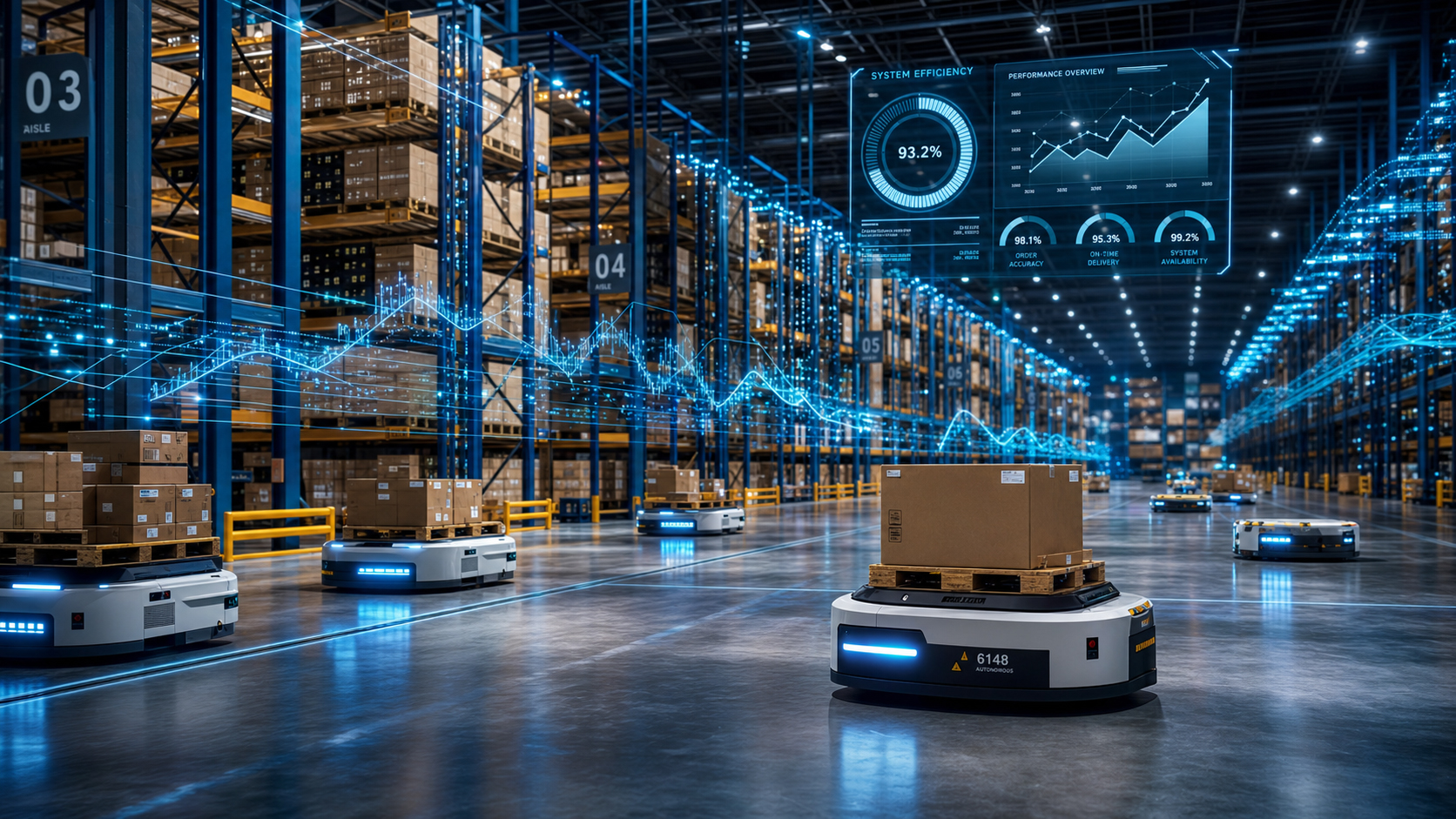
When warehousing becomes a growth inhibitor: The economic signals of an overloaded logistics system – Image: Xpert.Digital
When inventory eats up profits: 4 warning signs every company needs to know
The cost trap of order picking: How hidden warehouse bottlenecks destroy your margin
From cost driver to success factor: When does warehouse automation really pay off?
In many companies, warehousing only becomes a management issue when problems arise – but this reactive approach is economically disastrous. In times of e-commerce booms, chronic skills shortages, and ever-increasing customer expectations, overloaded logistics centers are gradually transforming from inconspicuous cost centers into massive strategic growth inhibitors. Those who respond to space constraints, delivery delays, and rising error rates simply with more – and increasingly expensive – personnel are usually only treating the symptoms and exacerbating the underlying problem. This article examines the four key warning signs of an overloaded warehouse system and demonstrates why persistent bottlenecks are not a matter of chance, but rather the result of exceeding system limits. Learn why modernizing intralogistics is no longer merely a technical matter, but a strategic question of survival – and which indicators will help you recognize when the time has come to switch to intelligent automation solutions.
From silent cost driver to strategic bottleneck – why companies systematically underestimate warning signals in the warehouse
A systemic finding: Growth as a stress factor
In many medium-sized and larger companies, the warehouse is seen as an operational back-office function – visible only when something goes wrong. This perception is fundamentally flawed, and the economic consequences of this misjudgment can be quantified. A distribution center that reaches the limits of its system architecture is not merely a logistics problem: it is a strategic obstacle to growth that costs revenue, squeezes margins, and jeopardizes the competitiveness of the entire company.
The simultaneous occurrence of several structural pressures has significantly exacerbated this problem in recent years. The e-commerce boom has fundamentally changed end-customer expectations. Faster delivery times, a wider product range, and higher return rates are impacting warehouse systems designed for a different order profile and volume. At the same time, the ongoing shortage of skilled workers in warehouse logistics has considerably increased the cost of compensating for system weaknesses – according to IAB statistics, over 60,000 positions in the German warehousing sector were vacant in 2025. This structural tension makes the economic analysis of overloaded warehouse systems a topic of considerable business relevance.
The European market for intralogistics automation is estimated to reach approximately US$7.72 billion by 2026, with a projected growth rate of 10.79 percent by 2031. This growth trajectory is not accidental, but rather the result of a forced response from businesses to manifest systemic limitations. The question is no longer whether companies need to modernize their warehouse infrastructure – but when, to what extent, and based on which signals they should act.
Permanent bottlenecks as a systemic failure
The first and perhaps clearest economic indicator of an overloaded warehouse system is the persistence of bottlenecks. Occasional bottlenecks during peak periods—such as around Christmas, the start of the school year, or during sales campaigns—are a normal part of warehouse operations and can be managed with temporary capacity expansions. Bottlenecks that occur permanently, meaning they have shifted from seasonal exceptions to normal operations, must be assessed fundamentally differently.
This transition marks a qualitative system change: The warehouse was designed for a specific throughput level and order profile. If the company has expanded beyond these original capacity parameters – through organic growth, mergers and acquisitions, or market entry into new segments – the system becomes structurally overwhelmed. The result is a chain reaction: Delays in order picking lead to later shipping times, which in turn lead to missed delivery dates, ultimately damaging customer satisfaction.
The changing order profiles are a key driver that is often underestimated. With the growth of the B2C segment and the fragmentation of the retail sector, typical order units have changed drastically: more item numbers, smaller individual orders, and shorter response windows now characterize the daily operations of many distribution centers. A warehouse system designed for pallet and full-carton picking is neither spatially nor process-wise suitable for handling single and partial-quantity picking at high throughput. According to the Zebra Technologies Warehouse Vision Study, more than half of the decision-makers surveyed cited the utilization of existing warehouse capacity as one of their most pressing problems, and 82 percent were already in the process of expanding their warehouse capacity. These figures clearly demonstrate that this is not an isolated case, but rather an industry-wide structural problem.
The economic costs of persistent bottlenecks manifest themselves on several levels: direct costs through overtime, emergency deliveries, and short-term staff increases; indirect costs through lost revenue due to missed delivery deadlines; and strategic costs through customer loss and reputational damage. The latter are difficult to quantify, but their long-term impact is often more severe than the immediate additional operational costs.
Labor as a systemic buffer: A costly illusion
The classic response to system bottlenecks in the warehouse is to increase staffing. More shifts, more temporary workers, more overtime – the human factor as a universal buffer. This strategy works in the short term, but is not economically sustainable in the medium term for several reasons.
First, the framework conditions in the labor market have fundamentally changed. In the fourth quarter of 2024, around 45 percent of the surveyed companies in the warehousing sector stated that their business operations were hampered by a shortage of skilled workers. As recently as 2009, this figure was below ten percent – a sixfold increase within a decade and a half. According to the KOFA study, the warehousing sector alone was short over 3,800 skilled positions, with more job openings than suitably qualified unemployed individuals. This structural shortage is not due to economic conditions but is rooted in demographics: Around one-third of logistics employees are over 50 years old, and the impending retirement of this cohort will further exacerbate the situation.
Secondly, the use of temporary workers incurs significant, often underestimated additional costs. Besides the direct wage costs – which, due to temporary work bonuses, are typically 20 to 30 percent higher than regular wages – substantial transaction costs arise from recruitment, onboarding, quality assurance, and the ongoing coordination with staffing agencies. Furthermore, employees with limited training exhibit significantly higher error rates than experienced permanent staff – meaning that the personnel buffer doesn't solve the original problem, but rather creates a second one.
Thirdly, a purely personnel-based solution falls short: If system architecture and space utilization are the actual bottlenecks, no amount of staff increase can compensate for these structural deficiencies. More employees in a spatially and processually overloaded system will, at worst, increase the density of conflicts and further slow down throughput. The symptom is treated while the cause persists.
Seventy percent of the logistics companies surveyed complained of a shortage of skilled workers in 2024, and more than 60 percent expected the situation to worsen. Anyone relying on continued staff expansion as their primary compensation strategy in light of this situation is heading down a dead end – because the supply of qualified workers will not increase at the same pace as the demand from growing companies.
The Arithmetic of Error: When Picking Deficiencies Become a Cost Machine
Increasing error rates in order picking are another warning sign that is too often accepted in practice as an unavoidable side effect of daily business. In fact, order picking errors are precisely measurable economic events, the accumulation of which indicates structural overload.
An average picking error in US logistics costs between $20 and $75, depending on the company – an amount that includes the direct costs of the return (shipping, receiving, inspection, restocking) as well as the costs of customer service and reshipment. With 300 orders daily and an error rate of two percent, and an average error cost of $50, this results in a daily loss of approximately $300 – extrapolated to over $100,000 per year. This figure increases proportionally with order volume: A company with 3,000 daily orders and the same error rate already accumulates over $1 million annually in error costs alone.
The crucial factor is causal analysis: What are the causes of rising error rates? In well-functioning systems with a clear spatial structure, optimized routes, and moderate cycle times, the natural error rate is typically well below one percent. As soon as employees have to cover larger areas, routes become confusing, time pressure increases, and spatial orientation is hampered by poor warehouse organization—sometimes forced by capacity constraints—the probability of errors rises significantly.
Modern warehouse management systems can reduce error rates to below 0.1 percent through scan validation, guided picking, and real-time plausibility checks. Goods-to-person systems automatically deliver picking items to the employee, completely eliminating search processes and minimizing the potential for mix-ups. Inventory accuracy rates of 99.9 percent, as achieved in modernized distribution centers, are the result of systematic process architecture—not exceptional individual diligence.
The economic diagnosis is clear: picking errors that increase in frequency or dynamics are not isolated incidents. They are symptoms of a system that is beginning to suffer under its processing load – and they are precisely measurable proof by accounting that structural action is needed.
Space capacity as a strategic resource: The underestimated bottleneck
The fourth classic indicator of an outdated warehouse system is the progressive exhaustion of storage capacity – visible in its most extreme form in the floor storage of pallets that should actually be on shelves. In warehouse logistics, this practice is unequivocally a stopgap measure and carries a number of operational and economic risks.
First, let's consider the spatial dimension: The available floor space of a warehouse is a fixed resource. Its efficient use depends on the ceiling height, the racking density, and the ratio of storage area to traffic area (aisles, maneuvering areas, picking routes). Floor storage completely ignores the vertical dimension, thus radically reducing area productivity. Stacking on the floor not only sacrifices capacity but also creates new problems: Forklift maneuverability is restricted, products in the back become difficult to access, and the risk of damage from tipping or incorrect handling increases significantly.
The costs of this inefficiency are multifaceted: longer picking times due to limited accessibility, increased probability of accidents and thus liability risks, potential product damage, and finally the hidden opportunity costs of unused vertical space. In a high-bay warehouse with the same footprint, multi-level storage can be implemented – which, depending on the building height, increases the theoretically available storage capacity to three to five times that of floor-level storage.
Optimizing available space – both vertically and horizontally – becomes a core economic challenge as volume increases. Automated high-bay warehouses with stacker cranes not only enable significantly higher capacity density but also more precise inventory management, because each storage location is uniquely addressed and managed by the system. The increase in capacity on the same footprint is often impressive: companies that have switched to automated high-bay warehouses regularly report doubling or even tripling their effective storage density. This expansion of usable volume on the same footprint is a key economic argument for automation investments – especially in regions with high commercial rents and limited available space.

Expert partner in warehouse planning and construction
From bottleneck to competitive advantage: How modernizing your warehouse pays off
Systemic thinking instead of symptom treatment: The interconnected diagnosis
A more nuanced economic analysis reveals that the four warning signs described – persistent bottlenecks, increasing dependence on personnel, rising error rates, and lack of space – rarely occur in isolation in practice. They are interconnected, reinforce each other, and reflect the same fundamental problem: the warehouse system is not designed for the company's current operating and growth model.
This systemic perspective has direct consequences for how these problems are addressed. Attempting to solve bottlenecks by increasing staff may exacerbate the space problem and increase the likelihood of errors, because more people are working in the same space under greater time pressure. Relying on ad-hoc floor storage slows down order picking and creates new bottlenecks. The problems are not additive, but multiplicatively linked – each amplifies the effect of the others.
Therefore, a holistic system assessment is the methodologically correct response to the appearance of these warning signals. This assessment must answer the following questions: How far is the current system from its optimal workload? What expansion capacities – both spatial and technological – are available? How do the costs of further manual capacity expansion compare to the investment in automation? And what requirements will the company place on its warehouse system within a three- to five-year horizon?
According to Mordor Intelligence, the global warehouse automation market will grow from an estimated $25-30 billion in 2024 to as much as $54-63 billion by the end of the decade – representing an annual growth rate of over 16 percent. These figures reflect not a technological fad, but an economic necessity: companies that are reaching structural limits with their warehouse systems are responding rationally by transitioning to automation.
Investment calculation and timing of the decision
The question of when a modernization investment is economically justified cannot be answered with a universal formula. It depends on several parameters: the current cost pressure due to inefficient operation, the projected volume growth, the financing costs of the investment, and the available timeframe for the transformation.
According to current industry estimates, the typical payback period for a Warehouse Management System (WMS) is 12 to 24 months, with an annual ROI of 15 to 25 percent. These figures are guidelines, not guarantees – but they illustrate that well-planned automation investments can become profitable in relatively short periods. Companies that switch from manual processes with high error rates to validated, system-supported order picking, while simultaneously improving warehouse space efficiency, achieve particularly high returns.
Specific efficiency gains from WMS implementations typically include improvements in inventory accuracy from 85 to over 99 percent, an increase in picking productivity of 20 to 40 percent, and better space utilization efficiency of 15 to 25 percent. These improvements accumulate over the system's lifetime and amplify their economic impact with increasing operational volume.
The decision regarding the type of modernization – whether partial automation of individual process steps, complete system transformation, or phased modernization – depends on the initial situation, the investment budget, and the growth horizon. In any case, the optimal time to invest is not when the system has already completely collapsed, but rather when the warning signals are clear and sufficient operational stability still exists to carry out an orderly transformation.
Technological solution architectures: A differentiated overview
The automation landscape for warehouses and distribution centers is diverse, ranging from simple digital management tools to fully automated units. The right solution depends crucially on the operational profile, the product range, and the order volume.
Warehouse Management Systems (WMS) form the digital foundation of every modern warehouse organization. They manage inventory data in real time, optimize storage allocation and picking routes, control incoming and outgoing goods, and provide the data basis for performance analyses and capacity planning. Without a functioning WMS, further automation steps are hardly feasible because the coordinating control system is missing.
Automated small parts warehouses (AS/RS) and goods-to-person (WtP) systems address the challenge of small-quantity order picking. In these systems, goods are transported to the picking workstation via automated conveyor technology, instead of requiring employees to move around the warehouse. This drastically reduces walking distances, increases cycle times, and improves ergonomics. At the same time, picking accuracy increases because the system actively positions the employee at the correct location and confirms the picking process.
High-bay warehouses with automated storage and retrieval systems are the classic solution to space constraints and high pallet volumes. They make optimal use of available building height, can operate fully automatically around the clock, and offer precise inventory management. The investment costs are substantial, and the amortization period is correspondingly longer – profitability increases with the regularity and volume of throughput.
Autonomous mobile robots (AMRs) and automated guided vehicles (AGVs) complement the portfolio of automation solutions. They take over internal transport tasks, support picking teams with mobile order containers, or dynamically connect different areas of the warehouse. Their advantage lies in their flexibility: Unlike rigid conveyor technology, AMRs can be reprogrammed and repositioned to meet changing requirements. In the European intralogistics automation market, AMRs are experiencing the fastest growth, with a projected compound annual growth rate (CAGR) of 11.21 percent.
The strategic dimension: From operational problem to competitive issue
The decision to transform a warehouse is not purely an operational question. It is a strategic positioning decision that determines whether a company can realize its growth ambitions or whether its warehouse infrastructure becomes a structural obstacle to growth.
The quality of logistics operations is visible to many end customers – in the form of delivery times, delivery reliability, packaging quality, and the smooth handling of complaints. In a market environment where 81 percent of online shoppers abandon a purchase if the delivery option does not meet expectations, logistics quality directly impacts sales. The operational weaknesses of an overloaded warehouse are not absorbed internally – they negatively affect the customer experience and thus revenue.
At the same time, the skills shortage is intensifying the strategic need for automation. Companies that rely on continuous staff expansion are exposing themselves to a resource that is becoming structurally scarcer. Automation partners, on the other hand, enable a decoupling of growth trajectories and workforce growth – a crucial competitive advantage for scalable companies.
As recently as 2024, according to Mordor Intelligence, 80 percent of the world's warehouses were operating without any supporting automation, and only 5 percent were considered fully automated. These figures illustrate the extent of the structural need for improvement—but also the extent of the competitive advantage for companies that act before their competitors. In industries with thin margins and intense supply chain competition, the difference between a modern, automated warehouse and an outdated system can mean the difference between market leadership and margin erosion.
Transformation planning: Based on signals, not crises
The practical consequence of analyzing the four warning signals is a proactive transformation logic: companies should not wait until their warehouse system collapses under the weight of the demands, but should use the early signals – bottlenecks, personnel dependency, error rates, lack of space – as a planning horizon.
A systematic inventory of current key performance indicators (KPIs) provides the data basis for decision-making. Relevant metrics include: average picking time per order and its development over time; current picking error rate and return rate; personnel costs per 1,000 processed orders; warehouse utilization rate and development of floor storage capacity; and the frequency of on-time delivery and missed delivery dates. These KPIs enable a precise diagnosis and form the basis for comparison in the subsequent ROI measurement of modernization measures.
The selection of the right technology approach should not be determined by supply orientation – that is, not by what the market offers – but by operational requirements analysis: Which processes cause the greatest friction? Where do most errors occur? Which areas of the warehouse are most overloaded? The answers to these questions determine whether a WMS, a goods-to-person solution, an automated high-bay warehouse, or a combination of several approaches is the optimal solution.
In successful practice, phased transformation models have proven effective: First, the digital infrastructure is stabilized by a WMS; then, the most overloaded processes are relieved through partial automation; and in a third step, full system integration is pursued. This approach minimizes transformation risk and enables continuous measurement and evaluation of the return on investment at each stage.
Germany remains the central hub for innovation and demand in European intralogistics automation. Both technology providers and investing companies are disproportionately represented here. For medium-sized and large companies, this translates into a favorable market situation: a dense network of competent solution partners, a mature technology base, and proven implementation models for virtually every company size and industry. The question is therefore less about whether suitable solutions are available – they are. The real strategic question is: How long can a company afford to ignore warning signs?
Your intralogistics experts

Consulting, planning and implementation of complete solutions for high-bay warehouses and automated storage systems - Image: Xpert.Digital
More information here:
Your global marketing and business development partner
☑️ Our business language is English or German
☑️ NEW: Correspondence in your native language!

Konrad Wolfenstein
I and my team are happy to be available to you as your personal advisor.
You can contact me by filling out the contact form here [email protected]:or simply call me at +49 7348 4088 965. My email address is
I'm looking forward to our joint project.
☑️ SME support in strategy, consulting, planning and implementation
☑️ Creation or realignment of the digital strategy and digitization
☑️ Expansion and optimization of international sales processes
☑️ Global & Digital B2B trading platforms
☑️ Pioneer Business Development / Marketing / PR / Trade Fairs
Our global industry and economic expertise in business development, sales and marketing

Our global industry and economic expertise in business development, sales and marketing - Image: Xpert.Digital
Industry focus areas: B2B, digitalization (from AI to XR), mechanical engineering, logistics, renewable energies and industry
More information here:
A thematic hub offering insights and expertise:
- Knowledge platform covering global and regional economies, innovation and industry-specific trends
- A collection of analyses, insights, and background information from our key areas of focus
- A place for expertise and information on current developments in business and technology
- A hub for companies seeking information on markets, digitalization, and industry innovations










