
When metals become weapons: How China's raw materials monopoly threatens the West
Xpert Pre-Release

Available in 27 languages 📢
Prefer Xpert.Digital on GoogleⓘPublished on: August 16, 2026 / Updated on: August 16, 2026 – Author: Konrad Wolfenstein
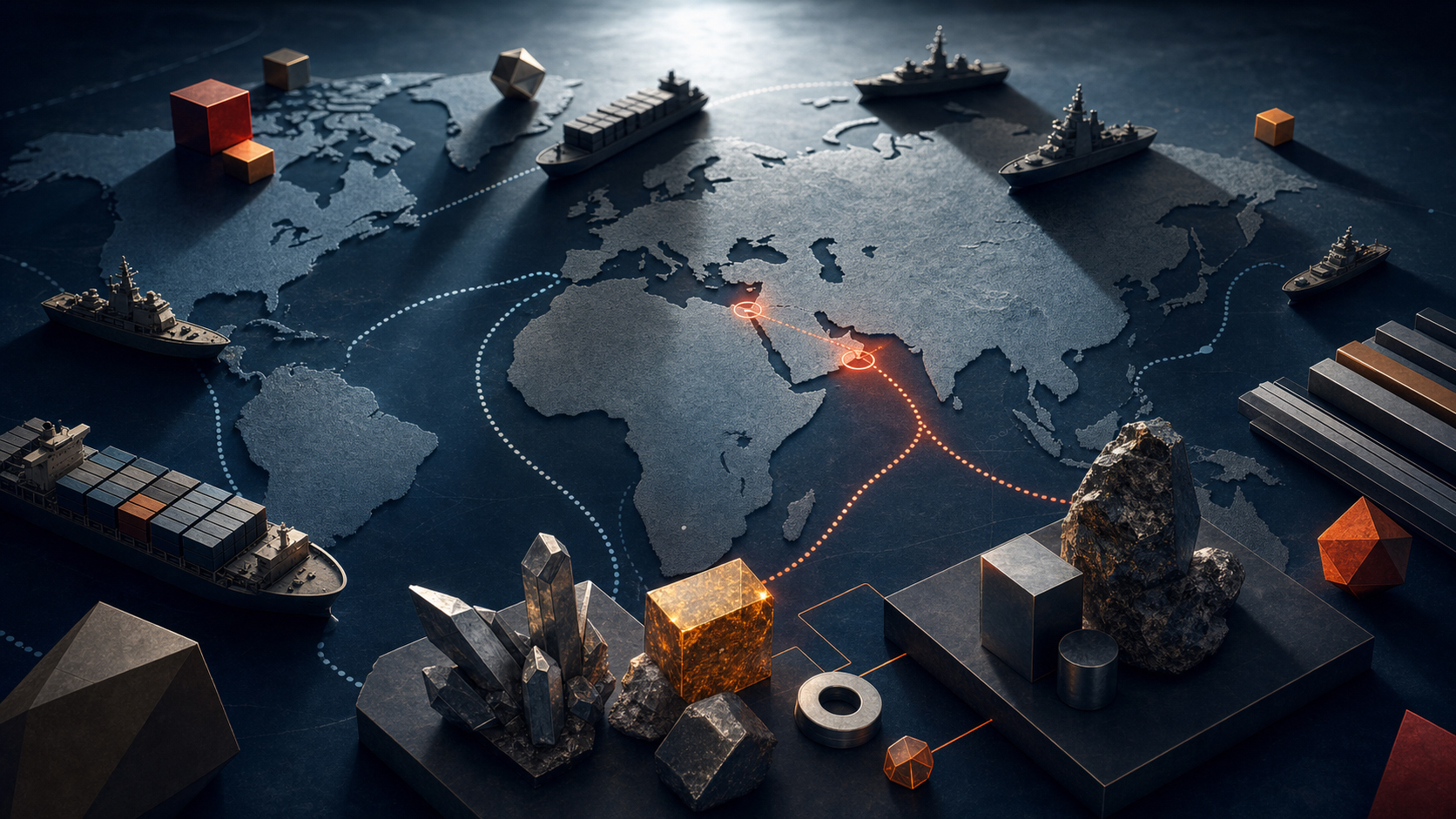
When metals become weapons: How China's raw materials monopoly threatens the West – Image: Xpert.Digital
The end of the free market: Why critical commodities are the new global currency
Secret deals and new alliances: How the West is trying to free itself from China's stranglehold
Rare earths and critical minerals are the oil of the 21st century – and this is precisely where the West faces a formidable problem. While the US and Europe relied on free market mechanisms for decades, China has built an unprecedented monopoly through strategic industrial policy. Now, Beijing is increasingly using this power as a geopolitical weapon to exert pressure in the global balance of power. From drastic export controls and the desperate construction of new supply chains to the military protection of global trade routes by Western warships: the battle for the essential building blocks of our modern technology has long since begun. It no longer merely determines the future of the energy transition and electromobility, but has become a central question of national security and the technological sovereignty of entire nations.
The global struggle for critical raw materials: When metals become weapons
The People's Republic of China's dominance in rare earths, permanent magnets, and a whole range of critical minerals has become the greatest systemic risk for Western industry. According to recent surveys, Beijing controls around 90 percent of the world's rare earth processing capacity, about 80 percent of tungsten refining, and roughly 60 percent of global antimony production. This concentration is not a geological accident, but the result of decades of state-directed industrial policy through which China has systematically brought the entire value chain, from the mine to the finished magnet, under its control.
Since 2023, the Chinese Ministry of Commerce has implemented export controls in several waves, initially targeting gallium, germanium, and graphite. These controls were extended to antimony in September 2024 and, in February 2025, to include tungsten, tellurium, bismuth, molybdenum, and indium. In April 2025, a particularly drastic measure was introduced, subjecting seven heavy rare earth elements—samarium, gadolinium, terbium, dysprosium, lutetium, scandium, and yttrium—as well as industrial magnets made from them, to licensing requirements. In October 2025, Beijing drastically broadened the scope of these controls: not only physical goods, but also technical know-how, production facilities, and even products manufactured abroad using Chinese components would henceforth be subject to export licensing if they contained more than 0.1 percent Chinese origin.
This extraterritorial expansion of controls triggered considerable unease in Europe, the US, and Japan because it would have effectively subjected every company worldwide that uses Chinese raw materials or technologies in its supply chain to Chinese export controls. Following an agreement between Donald Trump and President Xi Jinping, Beijing initially suspended these stricter regulations for one year until November 10, 2026. However, previous restrictions, such as those for gallium, germanium, and the seven elements controlled in April 2025, explicitly remained unaffected. The result is massive price distortions: according to market observations, the price of dysprosium climbed from around US$150 to US$900 per kilogram within a short period, while tungsten tripled and antimony quadrupled. The approval rate for European importers temporarily fell below 25 percent, leading to production bottlenecks in numerous industries.
What is distinctive about this approach is that it is not a classic scarcity in the sense of physical resource depletion, but rather a deliberately employed political steering technique. The temporary, reversible restrictions allow Beijing to exert targeted pressure without permanently damaging its own export economy. This flexibility makes Chinese commodity policy a particularly effective, but also difficult to predict, geopolitical instrument that can be tightened or loosened at short notice depending on the state of negotiations in trade disputes with the US or the EU.
The race among Western nations for alternative supply chains
In light of this structural vulnerability, Western states have begun to fundamentally restructure their procurement strategies. The European Union, with the Critical Raw Materials Act, has for the first time created a binding regulatory framework stipulating that by 2030 the Union may source no more than 65 percent of its annual demand for any single critical raw material from a single third country. To achieve this goal, Brussels concluded a Sustainable Critical Minerals Partnership with Australia in May 2024, encompassing the entire value chain from exploration and mining to processing and recycling of mineral waste. In March 2026, negotiations were concluded on a comprehensive free trade agreement between the EU and Australia, which eliminates almost all tariffs on European exports while significantly improving access to Australian lithium, aluminum, and manganese.
In November 2025, the European Investment Bank announced its intention to directly finance raw material projects in Australia, while EU Trade Commissioner Maroš Šefčovič presented an initial list of projects of official European interest in Melbourne. The plans include not only traditional loans but also direct equity investments in mining companies and long-term offtake agreements, designed to channel European capital specifically into Australian commodity supply chains. Simultaneously, Brussels is also negotiating a similar raw materials agreement with South Africa, which, in addition to securing raw materials, aims to facilitate greater value creation and processing directly within the producing country.
The United States and Japan are also pursuing an explicit diversification strategy focused on closer ties with resource-rich countries in Africa and Latin America. These efforts reflect a new bloc formation, in which economic cooperation is increasingly organized along geopolitical lines of trust rather than solely based on cost advantages. Indicative of this realignment is India's growing positioning as an independent power center between the blocs. In May 2026, it was revealed that New Delhi was in advanced talks with Russia on an agreement concerning critical minerals, encompassing exploration, processing, and technological cooperation in lithium and rare earth elements. Russia even offered India access to the Tomtor deposit in Siberia, one of the world's largest untapped rare earth deposits. This development exemplifies how, in the shadow of the Western-Chinese rivalry, new, third axes of resource cooperation are emerging, axes that cannot be clearly assigned to either the Western or the Chinese camp.
🎯🎯🎯 Global Sourcing & Commodity Trading with integrated logistics

Raw materials, global procurement & trade - Image: Xpert.Digital
State-of-the-art cargo planes, optimized transport routes, and multimodal logistics chains are interchangeable—they can be bought, leased, or outsourced. What money can't buy are direct contacts with producers in Peruvian mines, reliable supply relationships in the CIS countries, and years of built-up trust in markets that are unfamiliar to outsiders. The decisive competitive advantage in global commodity trading lies not in transporting the good from A to B, but in knowing where the good comes from, who produces it, and how to gain access before others even know the market exists. Whoever owns the network sets the price. Everyone else pays it.
More information here:
Raw materials as a security risk: Why the era of the free market is ending – How states are regaining control over raw materials
Raw materials as a matter of national security and military preparedness
The increasing link between raw material supply and national security is most clearly demonstrated by direct government intervention in mining and processing companies. In the summer of 2025, the US Department of Defense signed a multi-billion dollar agreement that made it the largest shareholder in the American rare earth producer MP Materials, and also pledged several financial support measures for the company. According to the Pentagon, it has already invested nearly $540 million in projects for critical minerals and announced its intention to continue these efforts within the limits of funds approved by Congress. These direct equity investments mark a break with the traditionally free-market approach of the US and signal that resource security is now treated as a matter of national survival, one that no longer permits a purely private-sector solution.
The militarization of raw materials policy becomes even clearer in the securing of maritime transport routes, which are of central importance for the movement of goods. The Strait of Hormuz, at only about 33 kilometers wide at its narrowest point, is one of the most sensitive bottlenecks of the global economy and was effectively blocked for a time during the war between Israel, the USA, and Iran in the spring of 2026. Almost 20 percent of the world's oil shipments, as well as a significant portion of global liquefied natural gas (LNG), are normally transported through this strait. After the fighting began, Iran even temporarily demanded tolls from passing ships and established a permit system for passage – a procedure considered questionable by international law experts.
In response, several G7 nations deployed warships to the region. France sent three larger vessels, while Italy, the United Kingdom, and the Netherlands also dispatched naval ships to the Mediterranean and the Persian Gulf. Germany also participated by deploying the minehunter Fulda and the supply ship Mosel, although any actual combat deployment remained subject to a separate mandate from the German Bundestag. As part of the US-initiated Operation Freedom, American warships began escorting stranded merchant ships out of the strait in May 2026, with German shipping associations reporting that more than 47 ships with German ties were affected. Following a ceasefire in June 2026, the G7 nations also planned a permanent, strictly defensive military mission for mine clearance and the escort of merchant vessels.
Parallel to the situation in the Persian Gulf, the situation in the Red Sea also deteriorated, where the Iranian-backed Houthi militia in Yemen again threatened merchant ships, prompting several major shipping companies, such as Hapag-Lloyd and Maersk, to reroute their shipments around the Cape of Good Hope. This resulted in significantly longer transit times and a war risk surcharge of up to US$3,500 per container. These developments exemplify how the physical security of trade routes has long since become an integral part of the raw material supply strategy of Western industrialized nations. Those who want to secure raw materials must now also secure the sea lanes along which they are transported. This task can no longer be left solely to private shipping companies but requires direct state and military involvement.
Structural vulnerability of Western industry and long-term prospects
A deeper economic analysis of these developments reveals a fundamental structural problem in Western industrial policy over the past three decades. While China has systematically secured control over the mining, processing, and refining of rare earth elements through long-term strategic planning, Western economies have largely abandoned these sectors for cost reasons and concentrated on individual, highly profitable links in the value chain. This division of labor appeared economically rational for years, but is now proving to be a geopolitical security risk of the highest order because processing capacity is lacking even when raw material deposits are available elsewhere.
The Western response to this dependency currently operates on three parallel levels: building alternative geopolitical partnerships with Australia, South Africa, and African states; direct state investment in domestic processing capacity, modeled on the Pentagon's involvement with MP Materials; and military protection of critical transport routes. None of these approaches, however, offers a short-term solution. Developing new mining and processing capacity outside of China typically takes many years, often a decade or more, due to permitting processes, necessary environmental regulations, and the technological complexity of separating and refining rare earth elements.
It is also noteworthy that Chinese export controls have so far been used primarily as a tactical negotiating tool in bilateral trade disputes with the US, as demonstrated by the repeated suspensions during the rapprochement between Washington and Beijing. This volatility creates considerable planning uncertainty for companies, as procurement costs can change dramatically within a few months, without reliable forecasts regarding the duration of such measures. For energy-intensive and technology-dependent sectors such as electromobility, wind energy, and the defense industry, this translates into structural cost uncertainty, which complicates investment decisions and generates supply chain risks of an unprecedented magnitude.
In the long term, the global raw materials landscape is likely to evolve toward a more fragmented, bloc-oriented order, in which geopolitical affiliation increasingly determines access to critical materials. India's positioning as an independent actor cooperating with both the West and Russia also suggests that, in addition to the Chinese and Western blocs, further, more flexible alliance structures could emerge. For European and German companies, this means one thing above all: raw material security is no longer a purely economic calculation, but a strategic task requiring close coordination between industry, foreign policy, and defense policy if the West's technological sovereignty is to be preserved in the long run.
Your contact for raw materials ⛏️ Global sourcing 🚢🌐 & trading 📦

Dmitry Kovalenko
I would be happy to serve as your personal advisor.
Dmitry Kovalenko
Tel: +49 7348 4088 961
Your contact for raw materials ⛏️ Global sourcing 🚢🌐 & trading 📦

Konrad Wolfenstein
I would be happy to serve as your personal advisor.
Konrad Wolfenstein
Email: [email protected]
Our global industry and economic expertise in business development, sales and marketing

Our global industry and economic expertise in business development, sales and marketing - Image: Xpert.Digital
Industry focus areas: B2B, digitalization (from AI to XR), mechanical engineering, logistics, renewable energies and industry
More information here:
A thematic hub offering insights and expertise:
- Knowledge platform covering global and regional economies, innovation and industry-specific trends
- A collection of analyses, insights, and background information from our key areas of focus
- A place for expertise and information on current developments in business and technology
- A hub for companies seeking information on markets, digitalization, and industry innovations





