
China's CO₂ emissions exceed those of the entire West: The suppressed power question in the climate debate
Xpert Pre-Release

Available in 27 languages 📢
Prefer Xpert.Digital on GoogleⓘPublished on: February 2, 2026 / Updated on: February 2, 2026 – Author: Konrad Wolfenstein
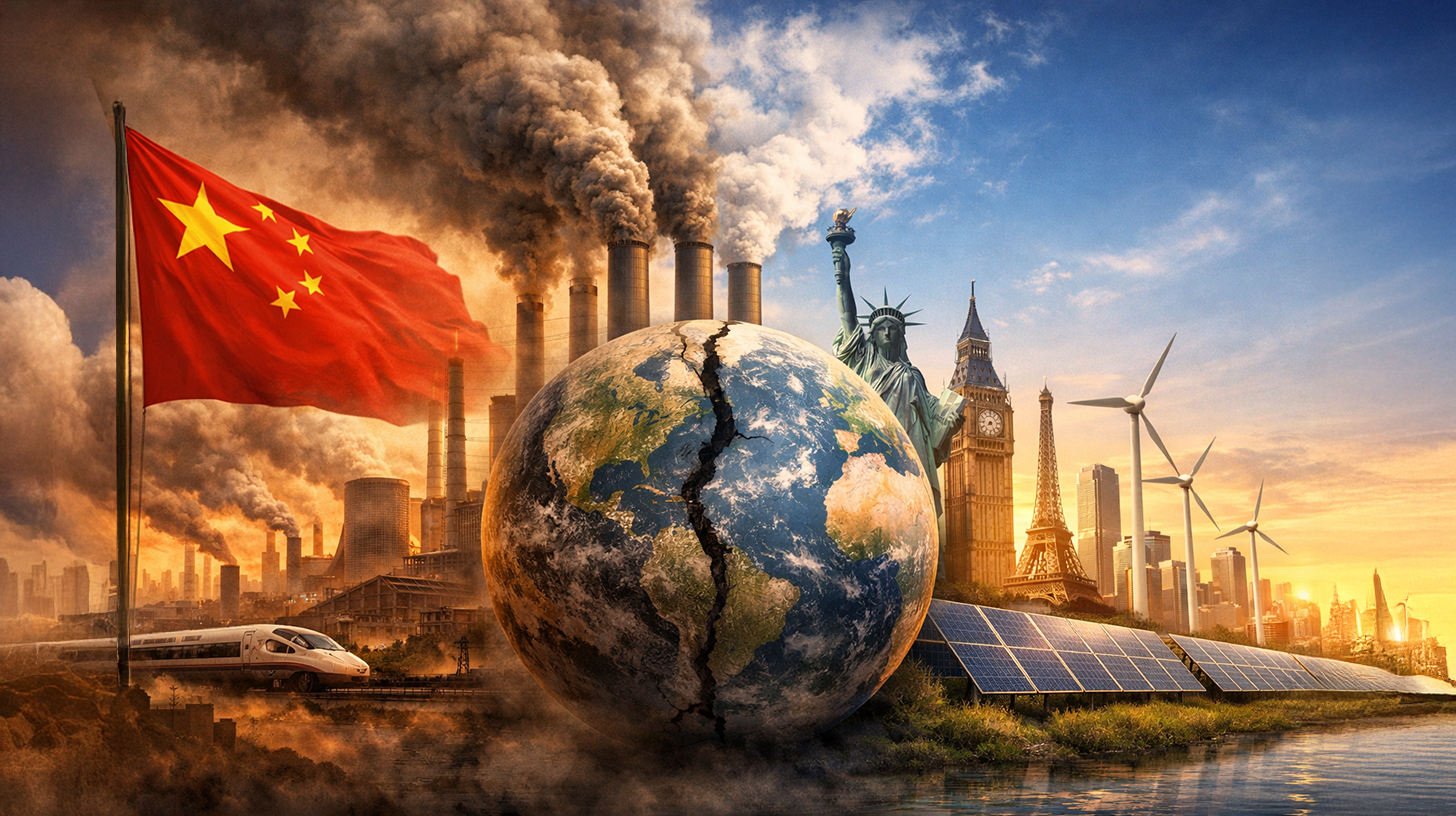
China's CO₂ emissions exceed those of the entire West: The suppressed power question in the climate debate – Image: Xpert.Digital
The inconvenient truth: Why China alone decides on the global climate
Green giant or climate sinner? The dangerous double game of the Chinese economy
Data analysis 2024: China's emissions expose the failure of Western strategies
While the West becomes bogged down in moral debates, the 2024 emissions data is creating a new geopolitical reality. The figures are clear: China's CO₂ emissions now exceed the combined emissions of the US, the EU, Russia, and Japan. This dominance—China alone accounts for 35 percent of global emissions—marks a fundamental shift in power. The country has gone from participant to pacesetter, now determining the speed and direction of global decarbonization.
But these figures represent far more than just environmental statistics. They are evidence of a massive geopolitical power shift. While Europe groans under record-high energy prices and erodes its industrial base through stringent regulations, China uses its emissions as leverage for an aggressive industrial policy. Beijing now controls not only the fossil fuel present but also the technological future – from solar panels to critical raw materials.
This article sheds light on the hard facts behind climate rhetoric. We analyze why reliable figures for 2025 are still a long way off, why Europe's "green" strategy is becoming a competitive trap, and how China is cleverly exploiting its dual role as the world's largest polluter and largest producer of green technologies to rewrite the rules of the global economy. The realization is uncomfortable, but necessary: Whoever controls emissions controls the market.
The dimensions behind the numbers
The global climate debate often focuses on technical solutions and moral appeals. But behind the CO₂ emissions data lies a fundamental geopolitical power shift that is conveniently ignored in Europe. China reached a historic turning point in 2024: The country emits more carbon dioxide than the USA, the European Union, India, Russia, and Japan combined. This fact is not a footnote in climate statistics, but rather an indicator of who will determine the rules of the global economy in the future.
While Europe burdens its industry with rising energy costs and increasingly stringent regulations, China is expanding its industrial base and simultaneously securing control over the entire value chain of the energy transition. The figures speak for themselves: China is responsible for around 35 percent of global CO₂ emissions and has thus effectively assumed the power to define the pace, costs, and direction of global decarbonization.
The data situation: Why 2024 figures are reliable and 2025 estimates are not
Methodological foundations of emissions reporting
A key point is often overlooked in the public debate: The data cited here refers to the year 2024, and there are important reasons why reliable figures for 2025 will not be available until the end of 2026 at the earliest. The parties to the UN Framework Convention on Climate Change report their greenhouse gas inventories with a structural time lag of two years. This means that in 2026, official data for 2024 will be published, not for 2025.
This delay is not a bureaucratic oversight, but a methodological necessity. Accurate emissions data requires the consolidation of energy production data, trade statistics, and industrial production figures from various sources. The Global Carbon Budget, the world's leading scientific data source for CO₂ emissions, is updated annually and provides complete data only for the previous year, while projections for the current year are based on incomplete information.
The unreliability of real-time estimates
Research shows that near-term emission estimates are subject to considerable uncertainty. A comprehensive study on the accuracy of emission estimates in China found that monthly statistics systematically lead to overestimations, with relative errors averaging 3.6 percent, which can accumulate to as much as six percent after three years. When estimating emission changes, not just absolute values, the problems become even more serious: the margins of error can be dramatic, especially during economic disruptions such as the COVID-19 pandemic.
Energy bulletins that directly record consumption data are indeed more accurate than monthly production statistics, but they too have a median relative error of about 0.3 percent and fail to capture sudden changes due to unexpected societal events. Therefore, what circulates in the media and political debates as "current emissions data" is often politically biased projections, not reliable statistics.
China's emissions in a global context
Absolute dominance in numbers
Reliable data is now available for 2024 documenting the extent of China's emissions. With 12.3 gigatons of CO₂ from fossil fuels, China accounted for approximately 35 percent of all global emissions. By comparison, the USA emitted 4.9 gigatons, and the EU27 only 3.2 gigatons. Even when the emissions of the USA and the entire European Union are combined, the total comes to 8.1 gigatons – significantly less than China's emissions alone.
The eight largest emitters – China, the USA, India, the EU, Russia, Indonesia, Brazil, and Japan – together contributed 66.2 percent to global greenhouse gas emissions in 2024. However, within this group, China occupies a special position: no other country even comes close to this scale.
The historical context
The historical perspective only slightly puts China's position into perspective. In terms of cumulative emissions since 1850, the USA, with 537 gigatons of CO₂, still bears the greatest responsibility for climate change. China, with 312 gigatons, only overtook the EU (303 gigatons) in 2023, thus securing second place. However, given current emission rates, China is steadily closing the gap with the USA.
However, the crucial point is this: per capita emissions only tell part of the story. China's cumulative per capita emissions of 227 tons of CO₂ are significantly lower than those of the EU (682 tons) and the USA (1,570 tons). But for the global climate, the absolute amount of emissions is what counts, not the per capita figure. And here, China is unchallenged at the top.
European climate policy as a competitive trap
Energy prices as a structural disadvantage
European climate policy has a serious side effect that is often underestimated in political debate: it is increasingly turning into a massive competitive disadvantage for European industry. The figures are clear. In 2024, European industrial companies paid an average of 19.9 cents per kilowatt-hour of electricity – compared to 7.5 cents in the US and 8.2 cents in China. Germany, the industrial heart of Europe, was even 25 percent above the EU average at 23.3 cents.
This price difference is not marginal, but rather an existential threat to energy-intensive industries. By 2050, European energy costs are projected to be at least 50 percent higher than those of its global competitors. The consequences are already visible: since the pandemic, the EU has lost over 800,000 manufacturing jobs, and steel production reached its lowest level since 1960 in 2024.
The emissions trading system as a double-edged sword
The EU Emissions Trading System (ETS) is considered the flagship of European climate policy. Studies show that the ETS reduced total EU emissions by 14 to 16 percent between 2005 and 2020, albeit with limited economic disruption. However, the success is unevenly distributed: while the energy sector reduced its emissions by almost 30 percent between 2013 and 2022, energy-intensive industries reduced their emissions by only nine percent during the same period.
The reason lies in the generous allocation of free emission allowances to industrial companies, which was actually intended to prevent carbon leakage – the relocation of production to countries with less stringent climate regulations. However, this free allocation has not triggered the hoped-for transformation momentum. In 2023 alone, Germany spent €2.4 billion on energy subsidies for carbon-intensive industries, with up to 30 percent of the expenditures from the Climate and Transformation Fund being classified as harmful to the climate.
Carbon Border Adjustment: Solution or Additional Problem
The carbon border adjustment mechanism (CBAM), which comes into effect in 2026, is intended to solve the problem by imposing equivalent CO₂ costs on imports, thus creating a level playing field. However, its implementation reveals fundamental weaknesses. CBAM initially only covers basic materials such as cement, fertilizers, iron, steel, aluminum, electricity, and hydrogen. Processing industries that use these materials as intermediate products will therefore face additional burdens without being protected themselves.
An example illustrates the problem: Kronospan, the world's largest particleboard manufacturer with 13,000 employees in the EU, has to pay higher prices for raw materials, while its competitors outside the EU do not bear these costs. Extending the CBAM to downstream products fails due to administrative complexity and the sheer number of goods affected.
China's strategic dual role: Largest emitter and decarbonization champion
Industrial dominance in climate technologies
China occupies a paradoxical position in global climate policy: it is simultaneously the largest emitter and the dominant producer of decarbonization technologies. This strategic duality grants China considerable geopolitical power. The country controls 92 percent of global solar panel production and 82 percent of wind turbine manufacturing. China's share of the entire solar panel supply chain exceeds 90 percent in every segment.
This control extends to critical raw materials: China processes over 60 percent of the cobalt needed for batteries and controls 90 percent of rare earth processing. This vertical integration of the entire value chain for green technologies is no accident, but the result of targeted industrial policy for over a decade.
The solar panels, batteries, electric vehicles, and wind turbines exported by China in 2024 alone will save approximately four billion tons of CO₂ over their lifetime – with production emissions of only 110 million tons. The positive climate effects of Chinese technology exports are already reducing global emissions outside of China by one percent per year.
Coal expansion despite climate pledges
The ambivalence of China's climate strategy is particularly evident in its coal expansion. Although President Xi Jinping personally pledged in 2021 to "strictly control" new coal-fired power plants, China approved the construction of 94 gigawatts of new coal capacity in 2024 – the highest figure since 2015. The government argues that these power plants will only be used for flexible grid stabilization during periods of low demand.
At the same time, China installed 240 gigawatts of solar capacity and 61 gigawatts of wind power in the first nine months of 2025. This unprecedented speed in the expansion of renewable energies led to a one percent decrease in China's CO₂ emissions in the first half of 2025, and even a 1.6 percent decrease in the third quarter. The energy sector has recorded declining emissions since the beginning of 2024.
The 2035 climate target: Modest ambition or strategic flexibility?
In September 2025, China presented its new climate target for 2035: a reduction in overall net greenhouse gas emissions by seven to ten percent below peak levels, with the addition of "striving for better results." This is China's first absolute emissions reduction target, after previous pledges only included intensity targets (emissions per unit of GDP).
Analysts consider the target conservative. The Climate Action Tracker estimates that China will achieve a reduction of 10 to 16 percent between 2025 and 2035 under existing policies – meaning the target would not require any additional efforts. Reductions of at least 30 percent would be necessary to stay within the 1.5-degree range.
Crucially, this allows China maximum strategic flexibility. The exact timing and magnitude of the emissions peak remain undefined, thus increasing Beijing's room for maneuver. This ambiguity is not accidental, but rather a calculated geopolitical strategy.
Look, this little detail saves up to 40% installation time and reduces costs by up to 30%. It comes from the USA and is patented.

NEW: Ready-to-install solar systems! This patented innovation significantly accelerates your solar construction project
The core of ModuRack 's innovation lies in the departure from conventional clamp fastening. Instead of clamps, the modules are inserted and held in place by a continuous support rail.
More information here:
Caught between the USA and China: Europe's path to green irrelevance
The question of power: Who determines the rules of transformation?
Emissions as an indicator of industrial power
The central thesis is this: Whoever is the largest emitter in 2024 will not only determine climate targets but also the rules of the game for global industry. This logic contradicts the moral framework of the climate debate but reflects geopolitical reality. High emissions are a direct indicator of industrial production, energy consumption, and economic activity. A country that emits more than the entire West effectively holds the upper hand in decisions about the pace, costs, and direction of the transformation.
China is using this position strategically. Beijing's climate strategy is less a response to scientific necessities than an economic policy instrument to secure industrial dominance. While Western democracies increasingly frame climate policy as a cultural conflict, China views it as a strategic economic opportunity.
Control over decarbonization infrastructure
The real question of power is not who sets the most ambitious goals, but who builds the necessary infrastructure, secures critical resources, and wins investor confidence. China is clearly leading in all three dimensions. The International Energy Agency estimates that global emissions could be 15 percent lower by 2030 if existing solar and battery production capacity were fully utilized – and almost all of that capacity is located in China.
While the EU blocks Chinese cleantech products with tariffs to protect domestic industries, China is using precisely these products to accelerate its own decarbonization. This different approach gives China a crucial head start: scale trumps rhetoric.
Asymmetric power in global climate governance
Global climate diplomacy is characterized by fundamental power asymmetries that are rarely addressed in public debate. Theoretically, the Paris Agreement grants all countries equal opportunities for participation. In practice, however, weaker states often adapt their positions to external demands instead of pursuing their own priorities. The major emitters – the US and China – exert considerable influence on how international climate policy is formulated, where financial flows go, and which technologies become the standard.
Instruments like the European carbon border adjustment mechanism can unintentionally disadvantage countries that do not yet have the capacity for rapid emissions reductions. The accusation is that climate rules are used more to protect advanced economies than to promote global justice.
China is skillfully positioning itself within this tension. As a “developing country,” it demands financial and technological support from the global North, yet as an economic power, it has long since operated on an equal footing with the US and surpasses the EU. This hybrid positioning maximizes China’s geopolitical room for maneuver.
The industrial race: Europe between the USA and China
The Inflation Reduction Act as a turning point
The US Inflation Reduction Act of 2022 marked a fundamental paradigm shift in Western climate policy. With massive subsidies and protectionist elements, the Biden administration transformed the US virtually overnight into one of the most attractive locations for cleantech investments. German companies invested a record $15.7 billion in US projects in 2023, compared to $8.2 billion the previous year.
The IRA is explicitly designed as a counterweight to China's dominance and pursues industrial policy goals with a clear geopolitical orientation. Its domestic production requirements for electric vehicles and batteries largely exclude Chinese suppliers and favor components from countries with free trade agreements.
Europe's dilemma: Caught in a headwind
The EU is facing headwinds from Chinese and American industrial policies. Europe's existing support mechanisms are fragmented and largely used to cushion high energy prices rather than for long-term industrial transformation. The Green Deal Industrial Plan and the Net-Zero Industry Act of 2023 attempt to counteract this, but do not achieve the same impact as the Industrial Revolution.
The European Commission has shifted its priorities: climate policy is no longer framed primarily as a response to the climate crisis, but as a strategy for industrial leadership. The Clean Industrial Deal aims to “create the right conditions for industry to invest and produce in the EU, in particular by lowering energy prices and increasing demand for clean products.”.
This realignment reveals the core problem: Europe is trying to simultaneously pursue the most ambitious climate goals and maintain industrial competitiveness – a balancing act that is becoming increasingly difficult. Regulatory instability undermines investor confidence precisely at the moment when planning certainty could be a crucial competitive advantage.
The subsidy race and its risks
The escalating subsidy race between the US, China, and the EU carries significant risks. An uncontrolled subsidy race could lead to overt trade protectionism and export restrictions, which would have negative consequences for global transformation. At the same time, there is a lack of coordination to ensure that the massive investments do not lead to overcapacity and market distortions.
China is expected to have invested six trillion dollars in climate and digital infrastructure between 2021 and 2025. The sheer scale of these investments far surpasses Western efforts and gives China economies of scale that its European and American competitors can hardly match.
Climate policy as a geopolitical zero-sum game
The transformation of the climate debate
The data for 2024 force an uncomfortable realization: climate policy has long since evolved from a technical and scientific challenge into a geopolitical power struggle. The moral framework – who has historically contributed most to global warming, who emits the most per capita – is losing relevance compared to the hard question: who will control the industrial base of the future?
When a single country emits more CO₂ than the entire Western world combined, this is not a temporary imbalance, but rather an expression of a fundamental shift in economic and, consequently, political power. China uses its emissions not despite, but because of, its climate policy as leverage to secure industrial dominance.
Europe's structural dilemma
Europe is caught in a structural trap. The region has committed to the most ambitious climate targets, but at the same time bears the highest costs of implementing them. The combination of high energy prices, strict regulatory requirements, and fragmented support mechanisms is systematically eroding the competitiveness of European industry.
The hope that early investment in green technologies would give Europe a competitive edge has not materialized. Instead, China dominates the value chains of virtually all relevant decarbonization technologies. Europe risks finding itself in a position where it controls neither the fossil fuel industry nor the post-fossil fuel industry – with devastating consequences for employment, prosperity, and political agency.
The suppressed question of power
The real question of power is systematically ignored in the European climate debate: Who will decide on the conditions for global decarbonization in the future? The answer lies in the 2024 emissions data. A country that causes a third of all global CO₂ emissions and simultaneously produces 90 percent of the technologies for emissions reduction writes the rules – regardless of what is decided at climate conferences.
The historical analogy is instructive: In the 19th and 20th centuries, control over fossil fuels determined geopolitical power structures. In the 21st century, control over decarbonization technologies and the industrial capacity to produce them will assume this role. China understood this logic and acted accordingly. The West is still debating CO₂ prices and per capita emissions.
Beyond morality lies reality
The emissions data for 2024 tells an uncomfortable story about the future of the global order. China's emissions not only surpass those of the US and Europe combined—they are both the expression and the instrument of a comprehensive industrial strategy that inextricably links climate and economic policy. While Europe burdens its industry with the highest energy costs and the strictest regulations in the world, China is securing control over the entire decarbonization value chain.
The methodological reservations are important: Reliable emissions data for 2025 will not be available until the end of 2026 because precise measurements take two years due to systemic limitations. What circulates before then are estimates with considerable uncertainties. But the fundamental dynamic is clear: China emits more, produces more, and invests more than the entire West – and translates this dominance into geopolitical power.
The uncomfortable truth is this: the climate debate is no longer just about saving the planet, but about who determines the economic order of the 21st century. Europe has taken a moral stance, but has become strategically scattered. China has acted pragmatically and created the facts that will shape future negotiations. The emissions data is not the problem – it is merely the most visible indicator of a tectonic power shift that Europe still refuses to acknowledge.
Your global marketing and business development partner
☑️ Our business language is English or German
☑️ NEW: Correspondence in your native language!

Konrad Wolfenstein
I and my team are happy to be available to you as your personal advisor.
You can contact me by filling out the contact form here or simply call me at +49 7348 4088 965. My email address is: [email protected]
I'm looking forward to our joint project.
☑️ SME support in strategy, consulting, planning and implementation
☑️ Creation or realignment of the digital strategy and digitization
☑️ Expansion and optimization of international sales processes
☑️ Global & Digital B2B trading platforms
☑️ Pioneer Business Development / Marketing / PR / Trade Fairs
🎯🎯🎯 Benefit from Xpert.Digital's extensive, five-fold expertise in one comprehensive service package | BD, R&D, XR, PR & Digital Visibility Optimization

Benefit from Xpert.Digital's extensive, five-fold expertise in a comprehensive service package | R&D, XR, PR & Digital Visibility Optimization - Image: Xpert.Digital
Xpert.Digital possesses in-depth knowledge across various industries. This allows us to develop tailored strategies precisely aligned with the requirements and challenges of your specific market segment. By continuously analyzing market trends and monitoring industry developments, we can act proactively and offer innovative solutions. The combination of experience and expertise generates added value and provides our clients with a decisive competitive advantage.
More information here:










