More speed, less space? What automated warehouses can actually achieve
Xpert Pre-Release

Available in 27 languages 📢
Prefer Xpert.Digital on GoogleⓘPublished on: November 21, 2026 / Updated on: November 21, 2026 – Author: Konrad Wolfenstein
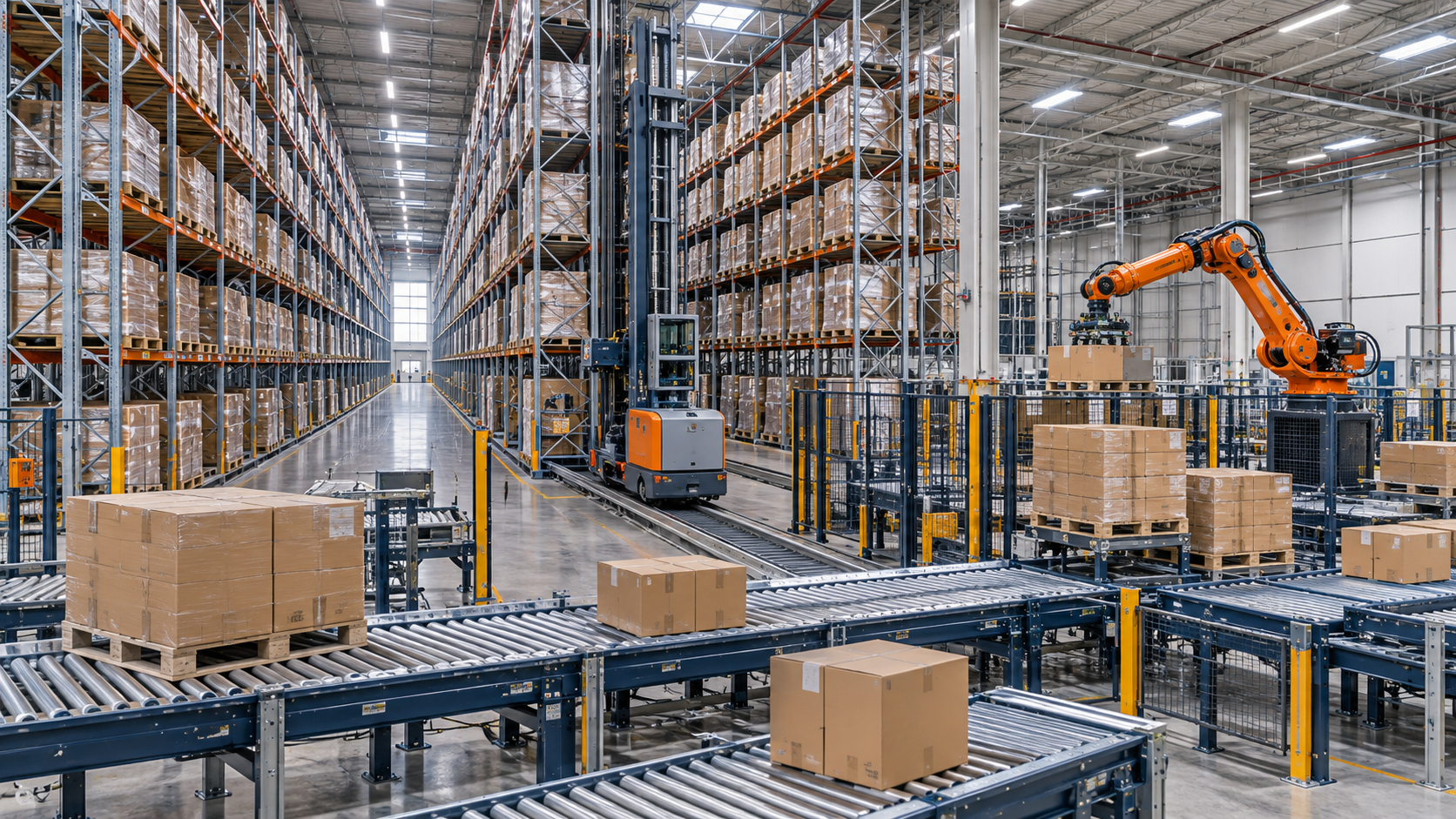
More speed, less space? What automated warehouses can actually achieve – a creative image on the topic, featuring AI: Xpert.Digital
Why high-bay warehouses change more than just the work in the warehouse
REWE and EDEKA are focusing on automation – but the calculation is complex
Saving on personnel costs is not enough: What matters in automated warehouses
Automated high-bay warehouses promise greater performance in a smaller footprint and are intended to help companies manage a growing product range and increasing delivery demands. However, these investments often cost millions – and don't automatically pay off simply because machines take over tasks. Crucial factors include capacity utilization, integration into existing processes, and the benefits for the entire supply chain. Examples from the food retail sector demonstrate the scale that modern systems can reach. At the same time, they make it clear: anyone wanting to assess economic viability must consider not only personnel and space costs, but also software, maintenance, energy consumption, downtime risks, and ongoing operations. The central question, therefore, is not how much a warehouse is automated, but whether the chosen technology reliably and economically solves a specific problem in the long term.
Automated high-bay warehouses: How intralogistics is changing competition in trade and industry
Automated high-bay warehouses are evolving into a strategic component of modern value creation. Supermarkets, industrial companies, and logistics providers are investing in systems that store goods more densely, process orders more reliably, and integrate material flows more closely with purchasing, production, and sales. Behind these investments lies a fundamental economic question: How can a growing diversity of products, orders, and delivery requirements be managed without costs and organizational complexity increasing proportionally?
The answer is not simply to replace people with machines. Automation changes the relationship between labor, capital, space, time, and risk. A highly automated warehouse initially ties up considerable financial resources. However, it can create the conditions for handling additional volumes without a proportionally increasing need for personnel, consolidating locations, or extending the lifespan of existing buildings. At the same time, new dependencies arise on software, technical availability, and specialized service providers. Therefore, the economic evaluation must go beyond saved labor hours and consider the entire lifespan of the system.
The crucial factor is not whether a company automates as much as possible. What matters is whether it automates the right processes and thereby makes its entire supply chain more efficient. A technically impressive high-bay warehouse can be a business disappointment if it is underutilized or loses performance at unsuitable interfaces. Conversely, limited, well-integrated automation can deliver greater benefits than a fully automated facility with an unsuitable size.
Structural investment pressure coincides with a weak economy
The notion of an unchecked automation boom is too simplistic. While digitalization, robotics, and automated material flows remain long-term drivers of development, companies are simultaneously reacting cautiously to uncertain sales prospects, financing costs, and a weak industrial economy. Long-term modernization needs and short-term investment readiness can therefore diverge significantly.
The production volume of German manufacturers of conveyor technology and intralogistics systems fell by five percent in 2025 to €26.3 billion. Production was expected to remain largely unchanged in 2026. Global export volume for conveyor technology and intralogistics also declined in 2025, decreasing by approximately four percent compared to the previous year to €119.3 billion. These figures refer to the broader industry sector and should not be equated with the market volume of automated high-bay warehouses. However, they demonstrate that technological pressure for change does not automatically translate into continuous sales growth for equipment suppliers.
There is no contradiction in this. Especially during economically challenging times, individual companies can push ahead with large automation projects, while others postpone investments. Financially strong retail groups modernize their distribution networks for the long term. Industrial companies with uncertain capacity utilization, on the other hand, may wait and see. Logistics service providers must also assess whether customer contracts run long enough to make specialized systems economically viable.
The industry is thus characterized by both structural demand and cyclical caution. This distinction is crucial for the analysis: A technology field that is convincing in the long term is not automatically a market that grows in the short term.
The real problem is the increasing complexity
The economic challenges of modern logistics cannot be measured solely by the number of pallets moved. Two warehouses can handle the same quantity of goods and yet have fundamentally different requirements. Crucial factors include the number of items, the composition of orders, the frequency of replenishment, and the required shipping times.
A company that delivers a few standardized products in large quantities requires different structures than a retailer with a broad product range and many small branch orders. Additional items not only create additional storage requirements, but also increase the demands on inventory management, replenishment, search processes, and order picking. Logistics must reliably manage an ever-increasing variety of situations.
The modernization of the REWE logistics center in Neu-Isenburg illustrates this development. The site is designed to supply approximately 2,200 stores with 16,700 dry goods items. On peak days, total throughput is expected to exceed 640,000 retail units. The planned automation is also expected to increase the site's overall throughput by about 20 percent. These are announced target figures, not yet proven results of the modernized operation.
The economic value, therefore, does not arise solely from speed. It also lies in being able to offer a wider product range with manageable process costs. Automation thus becomes a tool for organizing product diversity economically.
High-bay warehouses and order picking fulfill different tasks
An automated high-bay warehouse is initially a storage and retrieval system. It receives standardized loading units, manages their positions, and retrieves them as needed. However, whether it becomes a high-performance distribution center only depends on its interaction with replenishment, order picking, packaging, and shipping.
Especially in the retail sector, various product forms need to be processed. Entire pallets, individual cartons, small containers, and bulky products all present different requirements. A single, standardized technical process is therefore not necessarily economical. Instead, high-performance systems combine several systems whose tasks are coordinated with one another.
The planned EDEKA central warehouse in Melsungen exemplifies such an approach. Spanning 35,300 square meters, it will offer a total of 306,000 pallet, tray, and container storage locations, along with 58 stacker cranes. The targeted daily throughput is up to 285,500 picking units. It's important to distinguish between the categories: the 306,000 storage locations are not exclusively for pallets, but rather represent a combined capacity figure for various storage technologies.
Within the same system concept, automated systems will place a large portion of the goods onto pallets and roll containers, ready for store delivery, while other methods will handle small or bulky items. The economic logic lies precisely in this differentiation: not every item is moved using the same technology, but rather with the most appropriate method for each situation.
In the food retail sector, the benefits extend all the way to the sales shelf
For supermarkets, logistics doesn't end at the distribution center's loading dock. What's crucial is how the goods arrive at the store and the effort required to get them onto the shelves. Focusing solely on warehouse costs can therefore lead to poor decisions.
When pallets and roll containers are assembled according to their intended storage layout, some of the work can be shifted from the stores to the distribution center and automated there. The advantage doesn't necessarily stem from each individual picking step becoming cheaper. Rather, the total amount of warehouse work, transport, and store effort can be reduced. At both the REWE store in Neu-Isenburg and the planned EDEKA location in Melsungen, store-specific assembly is one of the intended functions.
This is economically significant because local efficiency and overall efficiency can diverge. Particularly fast order picking in the warehouse would be of little use if the goods then had to be laboriously re-sorted in each store. Conversely, additional control effort in the central warehouse can be justified if it eliminates many downstream steps.
The appropriate unit of analysis is therefore not just the picking station. It is the entire process from supplier receipt to the goods ready for sale. Only there does it become apparent whether automation actually reduces costs or merely shifts them between departments.
In industry, material availability determines the value
In industrial companies, warehouse automation follows a somewhat different logic. Here, the focus is often not on supplying branches, but rather on the reliable provision of materials for manufacturing and assembly. The value of a warehouse movement is then measured not only by its immediate costs, but also by its importance for downstream processes.
If a needed part is missing, the economic damage can be considerably greater than the value of that single component. Conversely, a large inventory alone does not guarantee supply security if material locations are unclear or delivery is delayed. The crucial factor is the combination of accurate inventory management, readily available parts, and timely retrieval.
This leads to an important economic perspective: An automated warehouse can be beneficial even if direct personnel savings are limited. Decisive factors can include a more stable production supply, reduced search time, or the avoidance of additional floor space. However, such benefit categories must be evaluated using operational data; simply stating them does not replace a sound investment analysis. A comprehensive cost-benefit analysis therefore considers not only labor and space but also operational reliability and avoided additional costs.
The appropriate automation depends heavily on the production model. A stable series production process has different requirements than a highly variable manufacturing process with frequent changes.
For logistics service providers, the contract duration is a key factor
Logistics service providers face a particular challenge: they often invest in facilities whose utilization depends on the business models and contractual decisions of other companies. A solution optimally designed for a specific customer may only be of limited use after that customer ceases to exist.
This creates a tension between specialization and reusability. The more precisely the system is tailored to a customer's product structure, order profile, and packaging, the higher its productivity can be. At the same time, the risk increases that this technical specialization will prove to be an economic limitation when switching customers.
Investment calculations must therefore consider not only the expected quantity but also its contractual security. A multi-year contract with reliable minimum quantities provides a different basis than a deal that can be terminated at short notice. Equally important is the question of which parts of the system can continue to be used if requirements change.
General cost logic suggests examining different comparison scenarios: continuing operations as before, adding conventional capacity, establishing a second location, or implementing automated consolidation. The economic value of the same plant can vary considerably depending on the realistic alternative.
For service providers, flexibility thus becomes an asset in its own right. It is not free, but it can prevent technical efficiency from turning into a long-term economic commitment to a single order profile.
Space efficiency is more than just a real estate argument
Automated warehouses can utilize existing space more efficiently, thereby avoiding the need for additional buildings or enabling the consolidation of multiple locations. The economic advantage then lies not only in a theoretically smaller footprint per loading unit. It also potentially includes eliminated rent, less duplicated infrastructure, and reduced organizational effort. However, the extent of this effect depends heavily on the initial warehouse and the chosen system.
This is precisely why blanket statements about space savings are not very meaningful. A high degree of densification compared to a generously sized existing warehouse cannot simply be transferred to an already well-utilized site. Furthermore, not every vacated area is immediately economically viable. A saving only has a full cash impact when, for example, a lease is terminated or a planned expansion is actually avoided.
Furthermore, storage capacity and throughput should not be confused. A large number of storage spaces does not automatically guarantee a fast flow of goods. A densely packed warehouse can become a bottleneck if inbound and outbound throughput, transfer stations, or shipping areas are insufficient.
The central planning question is therefore not how many goods fit into a building. It is how much economically usable output a location can generate with its entire spatial and technical concept.
Staff shortages change the equation, but they don't eliminate the problem
Reducing manual labor remains a key driver of automation. However, it requires a more nuanced approach than simply comparing the number of employees with the price of machinery. Overtime, recruitment, training, seasonal peaks, and the ability to reliably organize operations across multiple shifts are also relevant factors.
Automation can reduce the need for direct manual tasks while simultaneously creating new ones in maintenance, system monitoring, and troubleshooting. These additional functions must be factored into the cost calculation. A calculation that fully considers saved picking hours as a benefit but ignores the technical personnel requirements overestimates the economic impact.
Furthermore, a distinction must be made between avoiding staff increases and actual staff reductions. If the business grows, a plant can be economically successful even if the number of employees at the site does not decrease. The benefit then lies in achieving higher output with a largely stable workforce.
For management, productivity is therefore more meaningful than an isolated number of employees. The decisive factor is the total cost per processed order or per comparable unit of service. However, even these key figures must be adjusted for differences in product range, order structure, and service quality to avoid misleading comparisons.
LTW Intralogistics Solutions

LTW Intralogistics – Engineers of Flow - Image: LTW Intralogistics GmbH
LTW offers its customers not individual components, but integrated complete solutions. Consulting, planning, mechanical and electrotechnical components, control and automation technology, as well as software and service – everything is networked and precisely coordinated.
In-house production of key components is particularly advantageous. This allows for optimal control of quality, supply chains, and interfaces.
LTW stands for reliability, transparency, and collaborative partnership. Loyalty and honesty are firmly anchored in the company's philosophy – a handshake still means something here.
Related to this:
The conversion of existing warehouses as a management task
The purchase price is only the beginning of the capital commitment
An automation project, from an economic perspective, consists of more than just racking systems, conveyors, and robots. It also includes planning, structural modifications, power supply, safety equipment, software integration, training, and preparation for the transition to operation. After commissioning, further costs arise for licenses, maintenance, spare parts, technical support, and future upgrades.
This structure explains why a low initial investment price does not automatically mean a good deal. Two systems may have similar acquisition costs but differ significantly in ongoing fees, expandability, or maintenance requirements. Conversely, a more expensive initial solution may be more economical if it incurs lower operating costs or eliminates the need for an additional location.
The calculation must therefore cover the entire economic lifespan. Major upgrades must also be taken into account. Mechanical components, controls, and software do not evolve at the same pace. A building designed for long-term use does not prevent the need for earlier replacement or upgrade of individual technical components.
The timing of payments is equally important. Investment expenditures are often incurred before full operational capacity is reached. Therefore, the available funding must cover not only the final state but also the setup, transition, and start-up phases. This is precisely where a convincing presentation and a sound financial plan differ significantly.
A short amortization period can mask a long miscalculation
The simple payback period is understandable, but incomplete. It shows after how many years the initial investment would be recouped through assumed annual returns. However, it says little about how stable these returns are, what upgrades will be needed later, or what alternative value the tied-up capital could generate.
A deliberately simplified example illustrates the sensitivity. If a system costs €30 million and generates an additional €5 million in net cash flow annually, the resulting payback period is statically six years. If the annual cash flow drops to €3 million, the payback period extends to ten years. These figures are not industry benchmarks but merely serve to illustrate the relationship.
A sound valuation requires placing cash flows in a temporal context and considering them with a discount rate appropriate to the risk. Additionally, several scenarios are advisable: lower volume growth, a changed product mix, higher operating costs, or a slower start-up phase.
The most important starting point remains identifying the right alternative. Compared to an unchanged existing operation, a new facility may seem expensive. However, if a second building with additional staff would be required without it, the same investment can become significantly more attractive. Profitability arises from comparing realistic courses of action, not from an isolated return on investment figure.
Capacity utilization determines the cost per order
Automation typically increases the importance of fixed costs. The plant, its software, and essential services must be financed regardless of whether the planned output is actually achieved. This results in a strong correlation between capacity utilization and unit costs.
High capacity utilization spreads capital and operating costs across more orders. Low capacity utilization has the opposite effect. This becomes particularly problematic when a plant was designed based on optimistic growth expectations, but business falls short of those projections. In such cases, high fixed costs meet insufficient volume.
However, an overly conservative design is also risky. If capacity reserves are lacking from the outset, growth, seasonal peaks, or new customer demands can quickly necessitate further investment. The challenge lies in providing reserves where they would be particularly difficult to add later, without unnecessarily oversizing the entire system.
Different capacities must be considered separately. Storage spaces, receiving capacity, order picking, and shipping do not necessarily have the same reserves. A warehouse can have free spaces and still be operating at its delivery limit. Therefore, sound planning considers not only annual volumes but also peak periods and the distribution of the workload across individual process steps.
Existing sites make the conversion a management task
A new building allows for the integrated planning of both the building structure and the technology. Modernizing an existing warehouse, on the other hand, often offers the opportunity to reuse existing infrastructure. For this to work, the new technology must be integrated into the existing spatial, organizational, and IT requirements.
This becomes particularly challenging when operations continue. The REWE project in Neu-Isenburg is planned as an integration during ongoing operations. Starting in the third quarter of 2027, 22 automatic palletizing machines are expected to assemble 247,500 retail units daily. Upstream, a tray warehouse with 167,900 storage locations and 48 stacker cranes is planned. This capacity is a sub-area of the site and should not be interpreted as a separate total throughput in addition to the overall capacity.
Economically, the transition is crucial for the project's success. Temporary redundancies, training requirements, and a temporarily lower throughput can reduce the benefits during the initial operational phases. These effects must be factored into the investment calculation and should not be treated as a surprise after the fact.
A good restructuring plan is therefore not just a schedule for installation work. It is a supply concept that defines how the company will remain able to deliver during each transition phase.
Software turns machines into an economic system
Mechanical technology moves goods. However, software establishes the economic connection: it links inventory, orders, and technical resources. Warehouse management, plant control, and higher-level enterprise systems must interact in such a way that individual movements result in a reliable flow of materials.
This makes integration a significant cost and risk factor. Connecting to existing enterprise, order, and transport systems is not automatically a simple, standard task. Interfaces, data models, and ongoing software maintenance create effort that extends beyond the initial setup.
This dependency has an organizational consequence. Data quality is not solely an IT matter. Incorrect product dimensions, unsuitable packaging information, or unclear process rules can directly impact plant performance. Purchasing, master data management, logistics, and suppliers must therefore work together to ensure that technical planning is based on reliable information.
Even when using artificial intelligence, the economic benchmark should remain clear. A method is not valuable simply because it is labeled AI, but because it, for example, improves decision-making or detects malfunctions earlier. The benefit must be demonstrated through measurable performance. Technological labels are no substitute for stable interfaces or clean operational data.
Energy efficiency requires a complete comparison
Automated warehouses require electricity for drives, controls, and other technical components. However, this does not automatically imply a worse or better environmental impact. The decisive factor is a comparison with the actual operation being replaced, including buildings, material handling equipment, and any additional locations.
Denser storage can reduce the need for building space. Better load configuration can also contribute to the utilization of transport vehicles. At the same time, this incurs costs for the manufacture, operation, and subsequent modernization of the technology. At the EDEKA logistics center in Marktredwitz, denser loading is explicitly described as an approach to better truck utilization; however, a generally applicable savings rate cannot be derived from this.
Therefore, two perspectives are needed for operational evaluation. On the one hand, the total energy consumption of the site is relevant. On the other hand, consumption per unit of actual output is also important. A growing warehouse may require more electricity in absolute terms, yet still become more efficient per unit processed.
Here too, the reference point should not be too narrow. If consumption in the warehouse decreases while additional transport is required between separate locations, an isolated warehouse metric would be misleading. Therefore, economic efficiency and environmental impact should be examined along the same complete process boundaries whenever possible.
High levels of automation change the risk of failure
The more closely processes are technically interconnected, the more crucial their availability becomes. A failure can affect not just a single workstation, but larger parts of the material flow. Therefore, maintenance, spare parts inventory, technical support, and restart procedures must be included in the economic evaluation from the outset.
The crucial question is not solely how rarely a disruption occurs. Equally important is what can continue operating during the disruption and how quickly the system regains usable performance. A system with high average availability can still be economically problematic if a few disruptions last particularly long and coincide with critical shipping windows.
It follows that technical redundancy and reserve capacity should not be categorically considered unnecessary costs. They can represent insurance against substantial consequential damages. Conversely, complete coverage is usually neither achievable nor economically viable. An assessment of the specific consequences of a failure is necessary.
This analysis must also consider digital dependencies. If operations depend on networked control systems and software platforms, access rights, data backup, and recoverability are essential for economic viability. The technical system and its information systems do not constitute separate risk environments.
Centralization creates economies of scale and concentrates responsibility
Large, automated distribution centers can consolidate volumes, thereby making high-performance specialized technology economically viable. At the same time, they can potentially avoid duplicate infrastructure. This creates economies of scale that smaller, separate locations cannot achieve to the same extent.
However, these advantages must be weighed against the consequences of centralization. A concentrated network is more dependent on the performance of individual nodes. Furthermore, it is necessary to examine how the location structure affects transport routes and delivery times. Low storage costs cannot automatically compensate for an unfavorable network layout.
The ideal number of locations is therefore not determined solely by warehouse technology. It depends on customer distribution, delivery frequency, product structure, and the economic consequences of potential disruptions. A large central warehouse may be advantageous for certain product ranges, while other goods should be stocked regionally.
The benchmark is the overall cost and performance structure of the network. Automation should support a well-founded network decision, not serve as a retrospective justification for an already oversized site. Especially with capital tied up long-term, it is dangerous to prioritize technical planning over the strategic question of the right supply model.
Supplier dependency becomes part of the investment decision
Automated warehouses are long-term systems. Their economic viability therefore also depends on the availability of spare parts, software maintenance, and qualified service over many years. The supplier is not only the provider at the time of installation but often a key partner during ongoing operations.
Recurring license fees, support contracts, and technical upgrades can represent a significant portion of the total costs. Equally important is how quickly support is actually available in the event of a malfunction. A formally comprehensive service contract is no substitute for readily available technical expertise.
This means that operators need to evaluate more than just the initial performance. Documentation, interfaces, data access, and expansion options all influence future flexibility. A solution that initially seems inexpensive can become costly if every adjustment is only possible under strict technical or contractual conditions.
The economic considerations remain nuanced. A tightly integrated, single-source solution can simplify responsibilities and reduce interface risks. Conversely, a more open architecture can increase independence but also entail additional integration effort. There is no free path to flexibility. The crucial factor is which dependencies a company consciously enters into and whether it can bear the long-term consequences.
The most meaningful key figure combines costs and delivery performance
Individual key performance indicators (KPIs) can obscure the true picture of profitability. A high number of picks per hour is of little use if orders remain incomplete or the shipping process can't keep up. Similarly, high technical availability doesn't guarantee on-time delivery.
Therefore, a key performance indicator (KPI) system that integrates costs, quality, and reliability is essential. This includes total costs per comparable order, complete and on-time delivery, error costs, and the effort required for manual exception handling. Additionally, technical metrics such as capacity utilization and restart times must remain transparent. The resulting economic benefits range from personnel savings and avoided additional floor space to reliably met shipping windows.
A clear definition is crucial. A "pick" can refer to a single item being removed, a carton, or another handling unit. Similarly, pallet, tray, and container storage locations are not directly equivalent capacities. Without these distinctions, performance data appears precise, even though it describes different things.
The best key performance indicator (KPI) is therefore not necessarily the most technically impressive. It is the one that shows whether the company provides its customers with the promised service at a sustainable overall cost.
The competitive advantage lies in the mastered overall logic
Automated high-bay warehouses and modern intralogistics are neither an end in themselves nor a universal solution to rising costs. Their economic value arises when product structure, site network, technology, software, and organization are aligned. The large-scale projects visible in the food retail sector demonstrate the scale that automated supply is intended to achieve. At the same time, the weak economic climate in the industry shows that investments are being carefully prioritized and that the path to modernization is not straightforward.
A clearly reasoned perspective is therefore: The strongest investments are those that solve a specific structural problem. This could be a lack of capacity, insufficient space utilization, costly branch supply, or unreliable material provision. Technology must adapt to this problem, not the other way around.
Equally important is the ability to actually realize the benefits. This includes realistic volume expectations, reliable data, a financed operational transition, and an organization capable of managing the plant. If these prerequisites are neglected, a productivity promise can easily turn into a long-term fixed cost burden.
The real competitive advantage, therefore, does not lie in the highest shelf or the greatest degree of automation. It lies in a supply chain that combines capital, personnel, space, and time in such a way that it remains economical, reliable, and adaptable under real-world conditions.
Consulting - Planning - Implementation

Konrad Wolfenstein
I would be happy to serve as your personal advisor.
You can contact me at wolfenstein∂xpert.digital or
Just call me on +49 7348 4088 965 .
Your intralogistics experts

Consulting, planning and implementation of complete solutions for high-bay warehouses and automated storage systems - Image: Xpert.Digital
More information here: