
65% less electricity costs in the warehouse: The storage and retrieval machine that pays for itself in three years
Xpert Pre-Release

Available in 27 languages 📢
Prefer Xpert.Digital on GoogleⓘPublished on: April 26, 2026 / Updated on: April 26, 2026 – Author: Konrad Wolfenstein
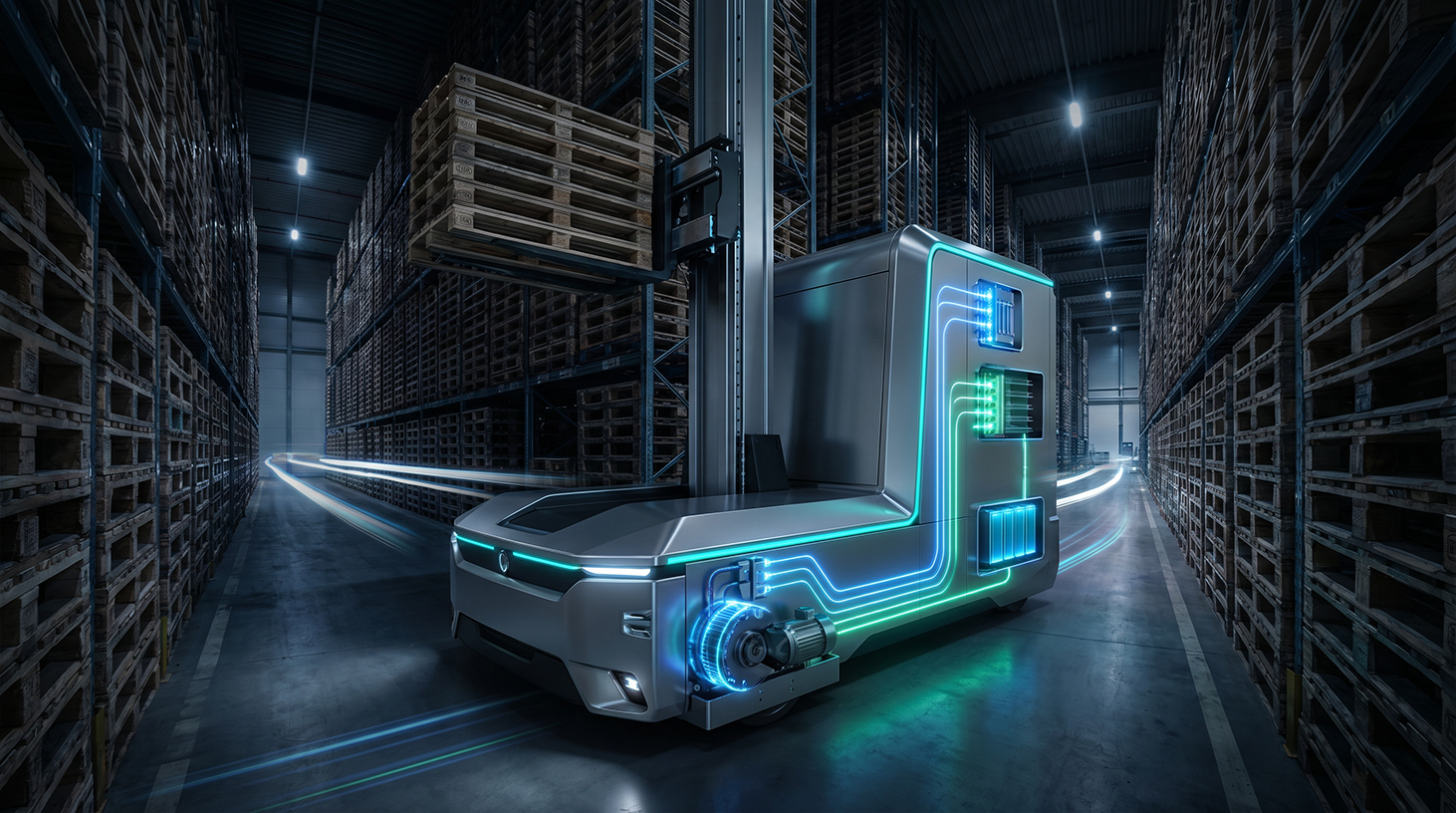
65% lower electricity costs in the warehouse: The storage and retrieval machine that pays for itself in three years – stock image: Xpert.Digital
Secret weapon against high electricity prices: Why smart energy storage systems are now becoming mandatory
Smart Power – Capdrive: The storage and retrieval machine with energy storage
Intralogistics faces a physical and economic dilemma: Conventional storage and retrieval machines (SRMs) consume immense amounts of electricity when accelerating loads weighing several tons – and then completely dissipate the released kinetic energy as waste heat during subsequent braking. Given skyrocketing electricity prices, expensive peak loads on the grid, and increasingly stringent ESG regulations for CO₂ reduction, this energy inefficiency is no longer acceptable for companies. The solution lies in a conceptual paradigm shift called *Smart Power Technology*: By using innovative supercapacitors (supercaps) – such as those in the Capdrive system from LTW Intralogistics – braking energy is stored in fractions of a second and used directly for the next lifting or travel operation. The result of this engineering feat is astonishing: up to 65 percent lower energy costs, an 80 percent reduction in peak current, and significantly slimmer power cables. Read this comprehensive analysis to find out why intelligent energy storage systems are no longer a nice extra in modern warehouse logistics, but a compelling economic necessity – and how they are fundamentally changing the planning of logistics centers.
Those who don't brake are wasting money – Why intelligent energy storage in intralogistics is not a luxury, but an economic necessity
The global market for storage and retrieval machines (SRMs) is not a niche market. With an estimated volume of around US$1.15 billion in 2024 and a projected annual growth rate of over 7 percent, it is one of the most dynamic segments within global intralogistics. According to some analysts, market volumes could reach up to US$2.14 billion by 2034. This growth is driven not only by the increasing demand for storage capacity due to the booming e-commerce sector and the growing requirements for fast supply chains, but above all by the imperative for efficiency – both economic and environmental.
And this is precisely where the wheat is separated from the chaff. While many market participants are still content to bring energy-inefficient systems to market, pioneers like LTW Intralogistics from Wolfurt (Vorarlberg, Austria) have achieved a conceptual paradigm shift with their so-called Smart Power Technology. The flagship product of this development is the CAPDRIVE storage and retrieval machine – a system that no longer pointlessly converts the kinetic energy released during braking into heat, but instead stores it using supercapacitor technology and feeds it directly back into operation. What sounds technically simple has profound economic consequences – for operators, planners, and the entire industry.
The physical dilemma: When masses brake
To understand why Smart Power Technology is a relevant economic category and not merely a marketing slogan, it's worth looking at the physical principles of stacker crane operation. At its core, a stacker crane is a highly dynamic lifting system with a horizontal travel component. It accelerates heavy loads to high speeds and must then decelerate these masses precisely – and this must be done in rapid succession, in 24/7 operation.
The kinetic energy released during deceleration corresponds exactly to the energy previously expended for acceleration. In conventional systems, this energy was—and still is in many systems—converted into waste heat via braking resistors. This means that energy is paid for twice: once for acceleration and once in the form of cooling costs in cold storage areas, where the generated heat must be actively dissipated. This effect is particularly dramatic in deep-freeze warehouses, as every unit of heat generated requires additional cooling capacity and drives up operating costs accordingly.
Added to this is the issue of peak loads. When a storage and refueling system (SRG) accelerates, a very high power demand arises briefly. In normal operation without energy storage, this peak power must be entirely supplied by the grid. This forces planners and operators to design the entire energy infrastructure – transformer stations, feed-in cables, fuses, switchgear – for maximum capacity. These investments in passive infrastructure are substantial, yet they are never even close to being fully utilized during normal operation.
The supercap approach – physics as a competitive advantage
The answer to this dilemma is the supercapacitor, also called a supercap or ultracap. Unlike a conventional battery, a supercap stores energy through electrostatic charge separation at an electrode-electrolyte interface – without chemical reactions. This has a number of technically and economically significant consequences.
Supercapacitors can be charged and discharged within seconds, achieve well over a million charge/discharge cycles, and have a lifespan of more than ten years – without any noticeable loss of capacity. By comparison, lithium-ion batteries typically achieve 200 to 1,200 cycles at an operating temperature of 20 to 25 degrees Celsius before their performance deteriorates significantly. For an RBG (Rail-Driven Carriage Company) that performs thousands of braking and acceleration cycles daily, the cycle life of the supercapacitor is therefore not a technical footnote, but a crucial economic factor.
The power density of supercapacitors is exceptionally high, reaching up to 10,000 W/kg, meaning they can deliver a very large amount of power very quickly. This is precisely what's needed when an RBG (Rail-Based Processing Unit) draws very high currents briefly during acceleration. The fact that supercapacitors operate flawlessly in temperatures ranging from -40 to +70 degrees Celsius makes them the superior solution for cold storage and deep-freeze applications. Battery-based systems would reach their limits in these environments or require significantly more complex temperature control systems.
CAPDRIVE and Smart Power Technology – Concept and Architecture
LTW Intralogistics uses the term Smart Power Technology to encompass all measures for intelligent energy use in storage and retrieval machines. This encompasses two main levels: Firstly, the standard storage and retrieval machines with DC link coupling and intelligent control, which already consume up to 15 percent less energy in basic operation than conventional systems. Secondly – as the most powerful variant – the CAPDRIVE storage and retrieval machine with integrated supercapacitor energy storage.
The basic principle of CAPDRIVE is elegant: When the chassis brakes and the load is lowered, the drive motors generate electricity. This electricity is fed directly into the supercapacitors mounted on the device, instead of being dissipated as heat via braking resistors. During the next acceleration phase or lifting operation, the stored energy is retrieved from the supercapacitors and supplied to the drive – entirely locally, without grid feedback and without complex grid synchronization.
This avoids several problems at once: Braking energy is not lost. Grid feedback, which can occur with regenerative braking systems, is eliminated. The grid infrastructure does not need to be designed for maximum peak loads. And overall energy consumption is noticeably reduced. Specifically, according to the manufacturer, CAPDRIVE enables energy savings of up to 35 percent compared to a conventional system without energy storage.
The practical test in Wolfurt – convincing figures
Theory and laboratory values are one thing. Crucial for economic evaluation are practical results from real-world warehouse operations. LTW Intralogistics documents such a reference project from its own high-bay warehouse at its headquarters in Wolfurt, Vorarlberg. There, a CAPDRIVE-RBG with integrated supercapacitor energy storage was operated in parallel with a conventional unit, and the results were directly compared.
The results are remarkable: Grid feed-in was reduced by approximately 80 percent. A visible sign of this reduction is the significantly slimmer main supply cable: 4 x 2.5 mm² instead of 4 x 16 mm² – a cross-sectional reduction of more than a factor of six. This is not merely a cosmetic difference. It means less material, lower installation costs, smaller control cabinets, and potentially even a smaller transformer substation. These infrastructure savings represent direct investment costs when planning a new high-bay warehouse – and can be significantly reduced with CAPDRIVE.
Even more significant for ongoing operations: Energy costs were reduced by 65 percent. The additional costs for implementing the supercapacitor technology were recouped after three years. A payback period of three years for a technology whose supercapacitor unit has an operating life of more than ten years is exceptionally attractive from an economic perspective – especially in an environment where industrial investments typically aim for payback periods of five to eight years.
Energy costs as an underestimated lever in intralogistics
To properly assess the economic significance of these savings, it is necessary to examine the importance of energy costs within intralogistics. According to surveys, intralogistics accounts for approximately 14 percent of a company's total energy consumption – comparable to the share of overall building management (15 percent). In highly automated logistics centers, energy costs can represent up to 48 percent of total operating costs.
This magnitude makes it clear: anyone who considers energy efficiency in intralogistics a secondary optimization goal is missing out on significant savings potential. Given the development of industrial electricity prices in Germany and Europe – which have remained volatile and structurally elevated in recent years due to the energy crisis, the expansion of renewable energies, and the associated grid expansion costs – the importance of these savings continues to grow. At the same time, grid-related cost drivers are becoming increasingly relevant: in Germany, the measurement and billing of peak loads (the so-called capacity charge) accounts for a considerable portion of the electricity bill. Those who reduce their peak electricity consumption pay less – not only proportionally to the electricity consumed, but also for the entire capacity charge component of the bill.
Herein lies a key, often underestimated economic advantage of CAPDRIVE. DAMBACH Lagersysteme, another provider in this field, reports that its DSE (DAMBACH Smart Energy Management) reduces peak loads from the grid to one-fifth of their original value, coupled with a one-third reduction in overall energy consumption. Klinkhammer Intralogistics documents energy savings of up to 40 percent in real-world operation with its supercapacitor solution, along with the possibility of using smaller power lines, transformer stations, and other infrastructure components.
Hörmann Intralogistics even claims that its Powercap technology can achieve energy savings of up to 40 percent and a reduction in connected load of up to 65 percent. This reduction in connected load is particularly relevant in situations where the grid capacity at the site is limited or where increasing the connected load would involve considerable costs – situations that regularly occur when expanding storage capacities in existing industrial parks or with limited grid infrastructure in rural areas.
LTW Intralogistics Solutions

LTW Intralogistics – Engineers of Flow - Image: LTW Intralogistics GmbH
LTW offers its customers not individual components, but integrated complete solutions. Consulting, planning, mechanical and electrotechnical components, control and automation technology, as well as software and service – everything is networked and precisely coordinated.
In-house production of key components is particularly advantageous. This allows for optimal control of quality, supply chains, and interfaces.
LTW stands for reliability, transparency, and collaborative partnership. Loyalty and honesty are firmly anchored in the company's philosophy – a handshake still means something here.
Related to this:
Why supercapacitor energy storage is revolutionizing the economics of high-bay warehouses
Market barriers and know-how as a crucial differentiating factor
Why then don't all manufacturers of storage and retrieval machines offer Smart Power Technology with energy storage? The answer lies in the complexity of the technical integration and the specific know-how required for an economically viable implementation.
A supercapacitor energy storage system is not a component that can simply be added to an existing automated guided vehicle (AGV). Integration requires a deep understanding of the drive technology, the control architecture, the energy flows in the DC link, and the dynamic operating procedures of the specific AGV type. The energy management system must calculate the optimal charging and discharging strategy for the supercapacitors in real time, coordinate the power flows between the grid, the supercapacitor, and the drive, and simultaneously ensure the system's performance during warehouse operation. This is no trivial task – it is an interdisciplinary engineering problem at the interface of electrical engineering, control engineering, drive technology, and logistics software.
LTW Intralogistics has built up this expertise over many years. The company has been part of the Doppelmayr Group since its founding in 1981 and has since implemented more than 2,000 storage and retrieval machines. Its deep roots in drive and control technology – typical of a manufacturer that develops systems entirely in-house and doesn't simply assemble them from components – create the foundation for the intelligent integration of driving dynamics and energy management. Only those who understand the vehicle as a whole can optimally integrate energy storage into the operational process.
This competence hurdle explains why the market for smart power technology with energy storage has not yet fully taken hold, despite its obvious economic advantages. Since 2022, LTW has been delivering 15 percent of all its storage and retrieval machines with a supercapacitor energy storage system – a share that is steadily growing, but also shows that the technology, despite its benefits, is still in the process of becoming established. The hurdles on the supplier side are technical in nature; on the customer side, conservative investment behavior and a lack of understanding of the actual total cost of ownership (TCO) are often additional obstacles.
TCO analysis: What a storage and retrieval machine really costs
A well-founded investment decision for or against smart power technology is only possible if the total operating costs are considered over the entire life cycle. Focusing solely on the acquisition costs is systematically insufficient.
Let's take a fully automated high-bay pallet warehouse with six storage and retrieval machines as an example. The investment costs for such a system range from 5 to 20 million euros, depending on the configuration. A significant, often underestimated cost factor is energy and the associated infrastructure. The energy costs of a fully automated warehouse frequently exceed those of conventional manual warehouses by 15 to 25 percent – because conveyor belts, storage and retrieval machines, and control systems operate around the clock.
When a CAPDRIVE system is used, this balance changes considerably. With documented energy cost savings of 65 percent compared to conventional operation and a payback period of three years, and assuming a system lifespan of 15 to 20 years, the cumulative advantage far outweighs the additional costs for the supercapacitor equipment.
In addition, there are savings in infrastructure: Smaller-diameter feed cables, reduced transformer requirements, and lower demands on control cabinets and fuse concepts reduce investment costs right from the initial construction. While this advantage is partially lost in retrofit cases – i.e., when upgrading existing systems – the ongoing operating cost savings remain. With DAMBACH systems, the technology can even be partially retrofitted to existing control systems, further lowering the market entry barrier.
Finally, supercapacitor technology offers another economically significant benefit that isn't reflected in energy costs alone: bridging short-term grid fluctuations. When a supercapacitor system internally absorbs voltage fluctuations that occur during acceleration or braking, the system's susceptibility to malfunctions is reduced. This improves system availability – and in highly automated intralogistics, availability is a directly quantifiable monetary factor. A single hour of downtime in a fully automated high-bay warehouse can result in consequential costs in the five- to six-figure range.
Competitive dynamics: Between pioneers and laggards
A clear differentiation strategy is emerging within the RBG market. On the one hand, there are providers offering smart power technology with energy storage as part of an integrated system concept – with their own control framework, vehicle design, and drive architecture. On the other hand, there are providers who rely on standardized drive technology and have not developed their own supercapacitor integration. The price difference is immediately apparent; however, the economic difference over the life cycle clearly favors the energy storage solutions.
Besides LTW Intralogistics with CAPDRIVE, DAMBACH Lagersysteme with the DSE system, Klinkhammer Intralogistics, and Hörmann Intralogistics are pursuing similar approaches. GEBHARDT Intralogistik, with its Cheetah series, relies on an alternative efficiency approach through consistent lightweight construction combined with energy recovery. SEW-Eurodrive offers effiDRIVE, energy-efficient drive packages for stacker cranes that can reduce consumption by 10 to 25 percent.
What's remarkable is that the combination of lightweight construction, intelligent control, and supercapacitor energy storage shouldn't be seen as an either-or proposition, but rather as complementary measures. The lighter the device, the less energy is required for acceleration – and the smaller the supercapacitors can be, which in turn saves costs. A holistic systems approach, like the one LTW pursues with its Smart Power Technology, aims precisely at these synergies.
Competitive differentiation thus follows a knowledge boundary: Whoever possesses the proprietary know-how for system integration can establish a lasting quality and cost advantage. This know-how is not a secret, but it is difficult to copy – because it is embedded in practical engineering experience, hundreds of completed projects, and a sophisticated control architecture. Market entrants or companies attempting to quickly acquire this know-how risk falling short of theoretical promises in practice.
Sustainability goals as market drivers – ESG meets intralogistics
The economic analysis would be incomplete without considering the regulatory and strategic framework within which investment decisions are made today. ESG (Environmental, Social, Governance) reporting obligations, supply chain due diligence requirements, and the EU Taxonomy Regulation are increasingly creating binding requirements for companies to document and reduce their carbon footprint.
An automated high-bay warehouse that consumes 14 percent of a company's total daily energy needs is a significant source of emissions. Every kilowatt-hour saved through intelligent energy recuperation directly and measurably reduces the CO₂ footprint – and can be communicated as a concrete contribution to the sustainability strategy. For companies that have to account for their carbon footprint to investors, customers, or authorities, this has tangible strategic value beyond direct cost savings.
At the same time, awareness is growing among small and medium-sized enterprises (SMEs): According to a survey by Reichelt Elektronik, 89 percent of all companies in Germany have already replaced light bulbs with LEDs – but in intralogistics, which consumes a comparable amount of energy, the exploitation of technical savings potential is far from complete. Smart Power Technology addresses precisely this gap.
The fact that the share of CAPDRIVE devices in LTW production has been growing steadily since 2022 is also a signal that customer companies are increasingly understanding the combination of energy cost savings, infrastructure optimization and sustainability strategy as a coherent investment logic.
The strategic investment dimension – future-proofing as a selling point
One final, often overlooked aspect deserves special attention: the future viability of the investment. A high-bay warehouse is not a short-term investment. It is operated for 15 to 25 years. Energy prices, grid fees, and regulatory requirements during this period are currently difficult to predict. However, it is certain that the pressure on energy efficiency and CO₂ emissions will structurally increase – not decrease.
Anyone investing in a storage and retrieval machine without energy storage today is locking in energy consumption for 15 to 20 years, which will become increasingly expensive under likely future changes in conditions. In contrast, investing in smart power technology creates a system that already gets the most out of available electricity and is therefore structurally more robust against rising energy costs.
This resilience perspective is not a sentimental argument – it is a rational economic calculation. CAPDRIVE's break-even point is reached after three years, while continued operation beyond the more than ten-year supercapacitor lifespan generates net profits solely from energy savings. Anyone who soberly translates this into a net present value calculation – with realistic assumptions regarding discount rates and expected energy price developments – will find that smart power technology is the economically dominant choice in most application scenarios.
Where is the market headed?
The direction is clear, even if the pace still varies. Energy storage systems based on supercapacitors will continue to gain ground in the market for storage and retrieval machines – driven by rising energy costs, increasing ESG requirements, and the growing experience base from implemented projects, which increasingly demonstrates the economic advantages.
At the same time, technological competition will intensify. Hybrid solutions combining supercapacitors and lithium-ion batteries—already tested in research under terms like PowerCaps or FastStorage—could deliver further performance improvements in a few years. Fraunhofer IPA and its partners have developed such hybrid storage systems that combine the fast-charging capacity of supercapacitors with the energy density of batteries. Once these technologies reach mass production and fall within a price range relevant for intralogistics systems, even higher recuperation rates and longer energy buffering times could be achieved.
Until then, the supercapacitor will be the economically and technically mature standard for highly dynamic applications in intralogistics – and CAPDRIVE one of the most convincing examples of how technological know-how and economic added value are not opposites, but rather mutually dependent. Anyone planning a high-bay warehouse today who doesn't include smart power technology in their economic analysis is planning out of touch with reality.
Know-how as both a barrier to market entry and a competitive advantage
The premise of the introduction is no exaggeration: Not many manufacturers can offer smart power technology with integrated energy storage – because the necessary know-how is too complex, too specific, and too deeply woven into the system architecture to be quickly imitated. This protects pioneers like LTW Intralogistics from price pressure from interchangeable competitors – and creates a technical and economic partnership with demonstrable added value for customers who choose CAPDRIVE.
The CAPDRIVE is more than just a product. It's proof that intralogistics is no longer a purely mechanical field. It represents the convergence of drive technology, energy systems engineering, and intelligent control into an integrated, learning system. Anyone who understands the physical, economic, and regulatory interrelationships also knows why Smart Power Technology isn't an optional add-on – but rather the new benchmark for future-proof automated storage systems.
Consulting - Planning - Implementation

Konrad Wolfenstein
I would be happy to serve as your personal advisor.
contact me at wolfenstein ∂ xpert.digital
Just call me on +49 7348 4088 965 .
Your intralogistics experts

Consulting, planning and implementation of complete solutions for high-bay warehouses and automated storage systems - Image: Xpert.Digital
More information here:










