
Bridge collapse in Germany: Why our dilapidated infrastructure threatens fresh food logistics
Xpert Pre-Release

Available in 27 languages 📢
Prefer Xpert.Digital on GoogleⓘPublished on: September 6, 2026 / Updated on: September 6, 2026 – Author: Konrad Wolfenstein
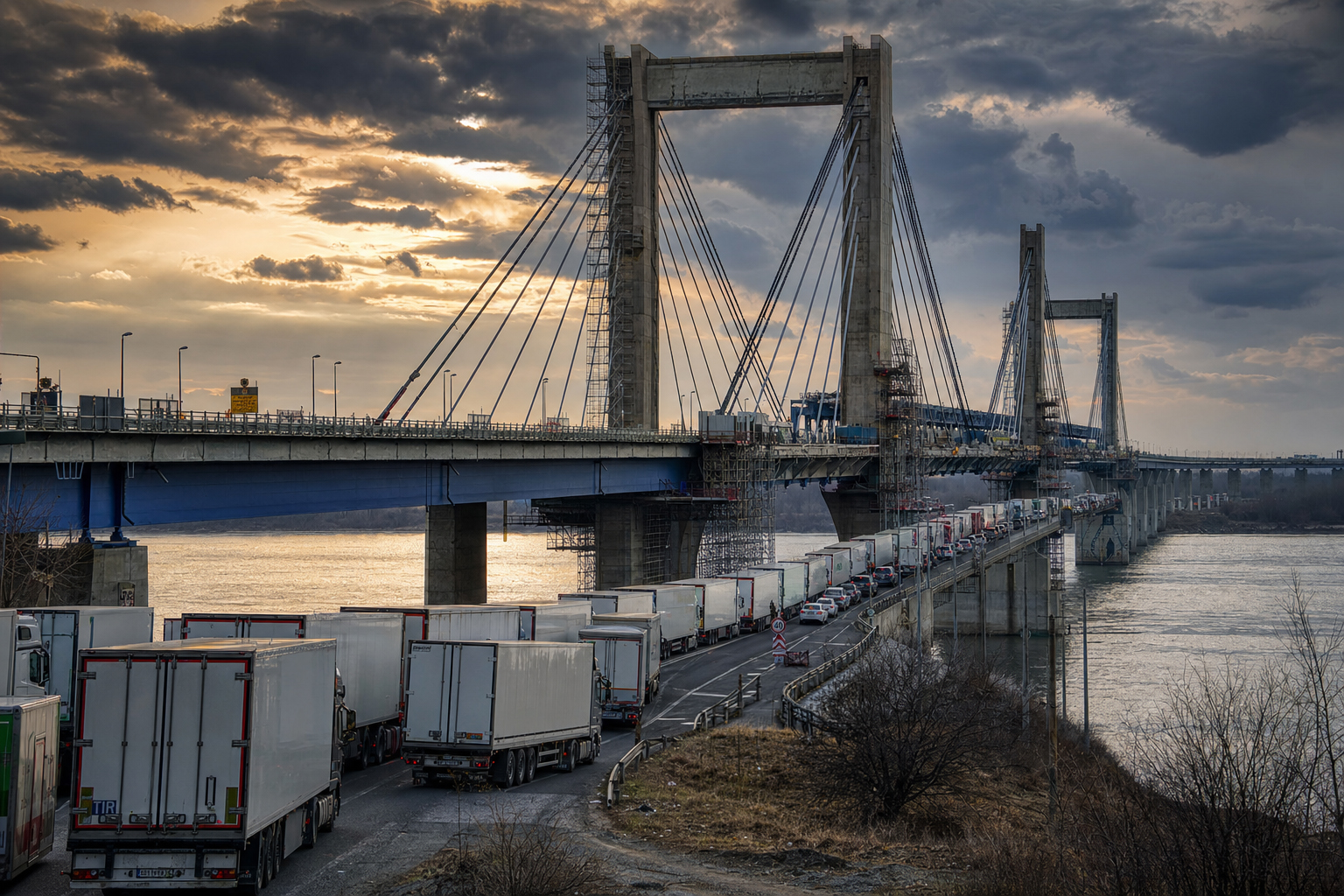
Bridge collapse in Germany: Why our dilapidated infrastructure threatens fresh food logistics – Creative image on the topic, with AI: Xpert.Digital
The cold chain breaks: How sudden bridge closures bring logistics to its knees
TÜV failure on the road: Why Germany's strictest bridge testing fails in reality
Billion-dollar risk of the "last mile": When every third bridge becomes a danger to the supply chain
Germany is facing an unprecedented infrastructure stress test. Although the country boasts one of the strictest and most detailed inspection regimes for engineering structures worldwide on paper, the reality on the roads paints an alarming picture: Bridges that are theoretically subject to close monitoring are increasingly being closed completely, almost overnight, due to the acute risk of collapse. When key traffic arteries like the Bonn North Bridge or important overpasses in Braunschweig and Göttingen are unexpectedly out of service for years, it's not just commuters who are severely impacted. For temperature-controlled logistics, this development is becoming an existential threat. Unplanned detours and trucks stuck in traffic jams mean not only a loss of time, but also the disruption of critical cold chains and the potential total loss of valuable goods. In light of this progressive deterioration, the traditional site selection based on land price and building permits is no longer sufficient. Rather, it is becoming clear that only those who create genuine resilience through forward-looking master planning and intelligent, redundant networks can avoid the billions of euros in risks posed by dilapidated infrastructure.
Collapse on the home stretch: When dilapidated bridges bring fresh produce logistics to its knees
The last mile as the biggest risk in the cold chain: Germany's bridge inspection system passes on paper – but fails on the road
A functioning logistics chain is only as strong as its weakest bridge. In Germany, a country with one of the densest and most formally monitored transport infrastructures in Europe, this truism is increasingly becoming a bitter reality. According to DIN 1076, engineering structures must undergo a main inspection every six years and a simpler inspection three years later, supplemented by annual inspections and semi-annual monitoring. This stringent inspection regime is among the most demanding worldwide, yet it does not prevent numerous bridges from having to be closed overnight due to acute structural deterioration.
The case of the Bonn North Bridge in the summer of 2026 exemplifies how quickly a theoretically monitored structure can become an acute safety risk. On June 3, 2026, the Friedrich Ebert Bridge on the A565 motorway was completely closed to traffic from one moment to the next due to massive damage to the supporting structure, cracks in the concrete, and corrosion of the reinforcing steel. Reconstruction is not expected until the late 2030s at the earliest, while daily traffic has effectively ground to a halt since the closure. For commuters, this is a nuisance; for temperature-controlled logistics, it is potentially an existential threat. What good is the most modern cold storage facility if the truck cannot cover the last few kilometers due to a sudden, unannounced road closure, and the cold chain breaks down in the middle of nowhere?
Such incidents are no longer isolated cases. The canal bridge in Braunschweig also had to be completely closed for renovation work in the summer of 2026, while in Göttingen, an arched bridge on the B3 highway has been restricted to one-way traffic since June 2026. The president of the Federal Chamber of Engineers confirms that a lack of responsibility contributes significantly to the problem of dilapidated bridges throughout Germany. For refrigerated transport, which already operates at the limits of its thermal and temporal capacity, every sudden detour over long distances considerably increases the risk of temperature loss in the cargo hold.
A testing regime on paper, a loss of substance in reality
Germany finds itself in a paradoxical situation. On the one hand, it has one of the world's oldest and most detailed testing systems for engineering structures, DIN 1076, whose roots date back to 1930. On the other hand, there is a physical reality that has failed to meet this formal standard for decades. In North Rhine-Westphalia alone, according to recent surveys, 2,439 bridges – every third bridge in the state – are classified as dilapidated, more than in any other German state. In Brandenburg, according to state data, 46.6 percent of rural roads are considered to be in very poor condition, and a further 18 percent are classified as deficient.
This imbalance has structural causes. Decades of underfunding for maintenance management have coincided with an enormous backlog of work, which has increasingly manifested itself in sudden, complete closures since the 2020s. Structural engineering itself often takes years, even decades, in Germany. According to the authorities, construction of a new Bonn North Bridge cannot begin until the 2030s at the earliest, while traffic is already being diverted. In the summer of 2026, the Federal Minister of Transport admitted that unexpected bridge closures are possible again at any time and that the situation cannot yet be reassured.
At the same time, the pressure on the existing network is increasing due to growing heavy goods traffic and the progressive aging of the infrastructure from decades of motorway expansion. When structural capacity bottlenecks, decades-old structures, and unannounced closures due to newly discovered damage overlap, a risk profile emerges that can no longer be managed with traditional site planning alone. Mobility researchers are already warning that those affected, such as commuters and businesses, must prepare for further closures in the coming years, some of which will be imposed at short notice.
LTW Intralogistics Solutions

LTW Intralogistics – Engineers of Flow - Image: LTW Intralogistics GmbH
LTW offers its customers not individual components, but integrated complete solutions. Consulting, planning, mechanical and electrotechnical components, control and automation technology, as well as software and service – everything is networked and precisely coordinated.
In-house production of key components is particularly advantageous. This allows for optimal control of quality, supply chains, and interfaces.
LTW stands for reliability, transparency, and collaborative partnership. Loyalty and honesty are firmly anchored in the company's philosophy – a handshake still means something here.
Related to this:
From growth to profitability: What companies need to prioritize when restructuring their value chains
The need for resilient site development as a response to sudden axis failures
Against this backdrop, it becomes clear why site planning needs to be rethought. It is no longer sufficient to evaluate a property based solely on land acquisition costs, building regulations, and infrastructure quality. The crucial question increasingly revolves around the resilience of a site's transport connections when a single critical link suddenly fails without warning. For temperature-controlled logistics, this question is doubly critical, as physical time windows determine economic success. A cold chain interrupted for twelve hours not only causes delays but often results in the complete loss of goods.
A key element of resilient site development is the autonomous energy supply of refrigeration systems. Photovoltaic systems, battery storage, and emergency generators must be designed not only to enable short-term bridging but also to maintain operation over extended periods should the external power supply fail unexpectedly for a prolonged time. This requires a precise demand analysis of the cooling capacities and energy consumption of all critical systems – not only the refrigeration units themselves, but also the warehouse management software and temperature monitoring, which become useless without a stable data connection.
Equally important is an intelligent site selection that considers alternative transport routes from the outset. Before a location is determined, it must be examined whether there are indeed reliable alternative routes in case main arteries such as bridges or highways are out of service, or whether the location is effectively dependent on a single bottleneck. This bottleneck risk is exemplified by the case of the Bonn North Bridge: If such a central Rhine crossing is out of service for years, there are hardly any equivalent alternative routes for heavy goods traffic in the region, meaning that entire flows of goods have to be diverted via detours of sometimes considerable length or come to a standstill during peak hours.
A third element is technical redundancy within the building itself. Not only the energy supply, but also cooling technology, warehouse management, and control systems must be redundantly designed, supplemented by the option of manual emergency operation in case automated systems fail. Furthermore, proactive risk management in the form of concrete emergency plans is essential. These plans address specific scenarios such as power outages, sudden bridge closures, or the short-notice rerouting of trucks and must be regularly rehearsed with employees to ensure they are effective in an emergency. Networking with local authorities, road maintenance agencies, and neighboring logistics companies in the region completes this concept, as the speed of communication often determines the extent of the damage in a crisis.
For operators, this represents a paradigm shift: emergency support centers and energy supply points along the route are no longer optional extras, but an integral part of the location strategy. The numerous short-notice road closures in Bonn, Braunschweig, Göttingen, and Esslingen in 2026 demonstrate just how urgent this need is, forcing affected businesses to resort to improvised detours virtually overnight.
Structural inspection alone does not create resilience
These infrastructural weaknesses would be less of a problem if Germany were a logistically insignificant location. However, the exact opposite is true. As a central hub for European trade, Germany is existentially dependent on a functioning transport network, particularly regarding the cold chain, where timeframes determine product quality and economic success. This makes it all the more serious that even a formalized testing system like DIN 1076 has failed to halt the actual deterioration of buildings for decades.
The reason lies less in the inspection regime itself than in the lack of consistent implementation of the inspection results. Special inspections after floods, severe weather events, or vehicle impacts are mandatory, but the resulting repair and new construction measures often fail due to planning periods of several years or even decades, capacity bottlenecks in the construction industry, and insufficient public funding. This leads to a peculiar situation: a structure is formally considered monitored, but in reality, it is only repaired or closed when the damage has already reached a safety-critical level.
A recent analysis of the resilience of global logistics networks highlights this contradiction: by 2026, resilience will determine which locations, networks, and business models survive, because logistics is increasingly becoming strategic infrastructure where energy, data, and capital commitment interact. Formal auditing systems alone, therefore, do not create resilience; rather, it is the interplay of consistent restructuring planning, redundant connectivity, and operational preparedness that truly makes a location crisis-proof.
General planning as a response to fragmented responsibilities
Given this complexity, it becomes clear why simply searching for a location based on classic criteria such as land price, building regulations, and proximity to the market is no longer sufficient. What's needed is holistic project management that extends far beyond the individual property and treats site development, specialist planning, and project management as an integrated system. This is precisely where experienced general planners come in, whose scope of activity ranges from area and site development through all specialist planning to general planning and comprehensive project management.
The decisive added value of such an integrated approach lies in the early linking of site analysis and infrastructure risk assessment. While traditional project development often only begins to consider access roads, connections, and emergency scenarios after securing the land, experienced general planners integrate these issues into the site selection phase. They assess not only whether a property is suitable under building regulations, but also how robust its transport connections actually are under realistic disruption scenarios, which alternative routes exist, and which structural provisions—such as redundant energy supply or dedicated shunting and buffer areas—must be planned from the outset.
For commercial and logistics projects, particularly in the sensitive area of temperature-controlled storage and distribution, this means specifically: The specialist planning for refrigeration technology, energy supply, and IT infrastructure is not considered in isolation, but rather integrated into a comprehensive concept that also takes into account outdoor facilities, connections to the public transport network, and potential emergency depots along critical routes. This comprehensive project management ensures that project developers, businesses, and investors in the construction industry, as well as public clients, maintain a reliable overview of deadlines, costs, and risks throughout the entire implementation phase, instead of having to rely on a multitude of independently operating specialist planners and tradespeople whose interfaces could lead to delays and cost overruns in a critical situation.
This integrated planning approach is particularly relevant in Germany because a formally demanding inspection system and a real, ever-accelerating deterioration of structures are occurring simultaneously. An investor who relies solely on the formal existence of an inspection regime without assessing the actual resilience of the last mile is taking a risk that will only become apparent during operation, when a sudden bridge closure interrupts the cold chain. Conversely, those who focus on holistic site and project development from the outset can systematically identify and assess these risks and mitigate them through structural and organizational measures before they result in economic damage.
Without embellishment
The combination of one of the strictest bridge inspection regimes in Europe and a simultaneously dramatic rate of structural deterioration makes Germany a prime example of how inspection standards and actual resilience are two very different things. A DIN standard alone is no substitute for a functioning bridge. As long as key transport arteries like the Bonn North Bridge remain out of service for years and every third bridge in North Rhine-Westphalia is considered dilapidated, the last mile remains the real bottleneck for fresh food logistics. Anyone who wants to invest successfully in this environment must understand site planning as integrated risk management that takes physical connectivity as seriously as formal inspection systems and legal frameworks. Only in this way can it be prevented that the most modern cold storage facility becomes an expensive investment ruin at the end of a suddenly closed bridge.
Consulting - Planning - Implementation

Konrad Wolfenstein
I would be happy to serve as your personal advisor.
You can contact me at wolfenstein∂xpert.digital or
Just call me on +49 7348 4088 965 .
Your intralogistics experts

Consulting, planning and implementation of complete solutions for high-bay warehouses and automated storage systems - Image: Xpert.Digital
More information here:










