
The inconvenient truth about humanoid robots in logistics: Between billion-dollar hype and operational disillusionment
Xpert Pre-Release

Available in 27 languages 📢
Prefer Xpert.Digital on GoogleⓘPublished on: February 27, 2026 / Updated on: February 27, 2026 – Author: Konrad Wolfenstein
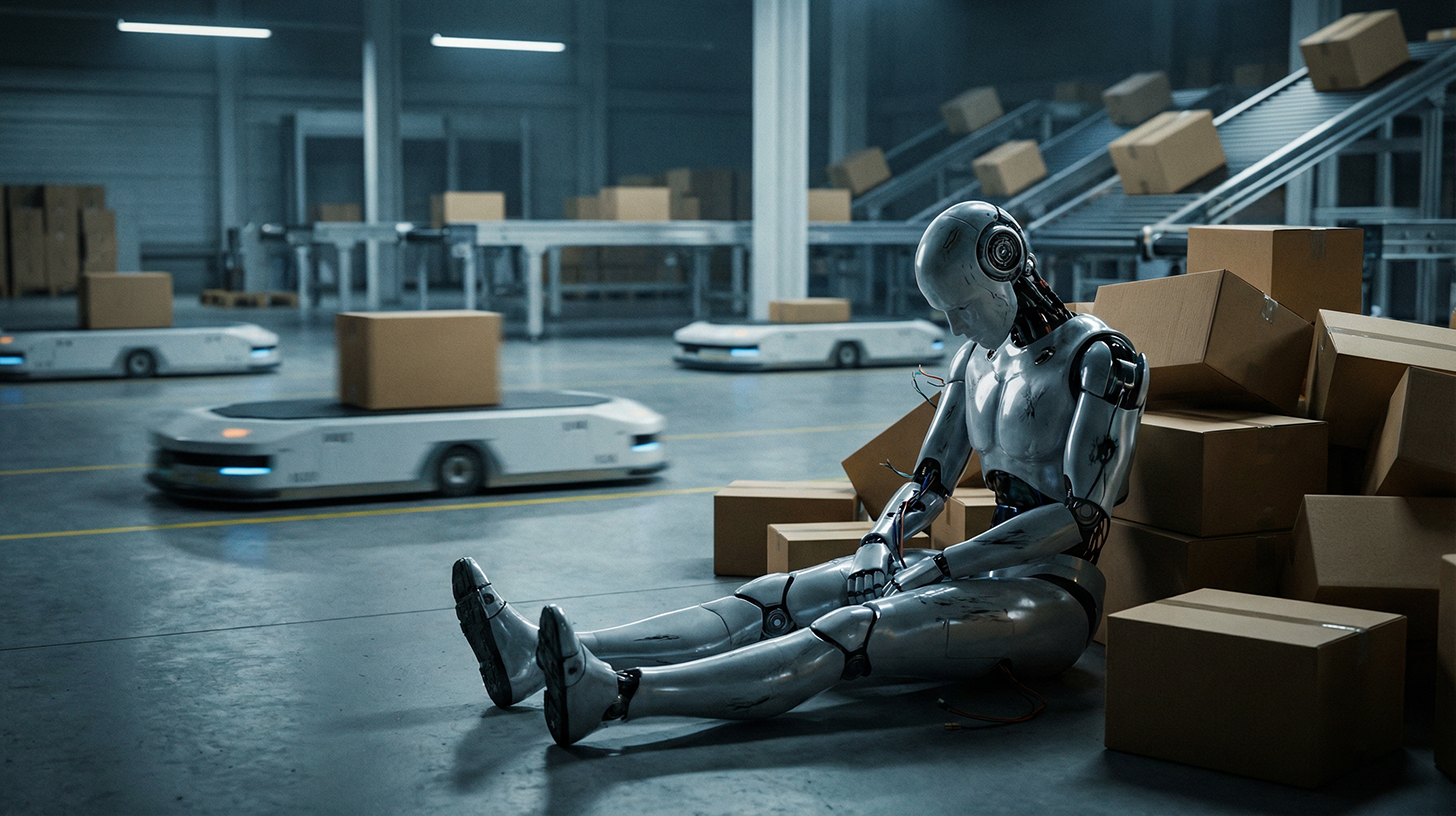
The inconvenient truth about humanoid robots in logistics: Between billion-dollar hype and operational disillusionment – Image: Xpert.Digital
Hidden costs and short battery life: Why humanoid robots often fail in real-world situations
Big promises, little staying power: Why you shouldn't (yet) equip your camp with humanoid robots
Humanoid robots are capturing the imagination of investors and logistics professionals alike. Given the massive and ever-worsening shortage of skilled workers in warehouse logistics, manufacturers' promises sound enticing: machines built to human dimensions are supposed to integrate seamlessly into existing work environments – without any expensive modifications or rigid infrastructure. Expectations are high: technology giants are investing billions, while analysts are predicting a truly gigantic future market.
But those who look beyond the glossy presentations and onto the hard floor of operational reality quickly encounter an uncomfortable truth. Despite immense progress, these humanoid machines often suffer massive efficiency losses in continuous operation. Short battery life, relatively slow working speeds, and potentially high maintenance costs stand in stark contrast to the relentless demands of a modern high-throughput warehouse. While humanoid robots are still struggling to master complex movements flawlessly, highly specialized, established automation solutions are already moving millions of containers a day completely silently and with utmost reliability.
Is the humanoid robot the long-awaited answer to the labor shortage – or rather an overpriced high-tech toy that simply can't compete with conventional systems? The following economic analysis separates the hype from reality. It ruthlessly demonstrates why the most expensive machine in the room isn't necessarily the smartest investment and how decision-makers must set the course for future-proof logistics today.
Why the most expensive machine in the room isn't automatically the smartest investment
While specialized storage systems have been silently moving millions of containers per day for years, achieving availability rates of over 99 percent, humanoid robots are now pushing into the spotlight with spectacular promises. Goldman Sachs forecasts a market of $38 billion by 2035, with 1.4 million units delivered. Morgan Stanley even anticipates a total market, including services, of $5 trillion by 2050. However, a gap exists between investor euphoria and the harsh realities of warehouse operations, requiring a sober economic analysis. The central question is not whether humanoid robots are technically fascinating, but whether they can be economically viable and operationally superior to existing automated warehouse solutions.
The labor shortage as the driver of a questionable equation
The structural shortage of skilled workers in warehouse logistics is real and worsening. According to a Gartner survey, 40 percent of warehouse operators rank the labor shortage as their single largest business risk. In the US alone, the transportation and warehousing sector created more than 250,000 jobs in 2025, with this trend accelerating in 2026. Approximately 76 percent of employers in transportation and logistics report difficulties filling vacancies. Warehouse labor costs in the US are rising at nearly four times the national average wage.
This environment creates enormous pressure for automation. The number of robot-assisted warehouses has increased from 4,000 in 2019 to 50,000 in 2025, a growth factor of 12.5. Amazon alone operates over 750,000 robots in its fulfillment network. But the logical conclusion that humanoid robots are the answer to this shortage deserves critical scrutiny.
The promise of the human form: Where humanoid robots score points
The strongest argument for humanoid robots is their inherent compatibility with existing warehouse infrastructure. Shelves, aisles, ladders, pallets, control elements, and scanners are designed for human body dimensions, reach, and dexterity. A humanoid robot can theoretically operate in an existing environment without requiring expensive modifications or dedicated automation zones. This so-called drop-in principle potentially reduces initial investment and accelerates commissioning.
Another advantage lies in their versatility. While specialized systems are optimized for narrowly defined tasks, humanoid robots can theoretically cover a wide range of tasks – from picking and placing items from standard shelves to operating pallet trucks and trolleys, as well as scanning and inventory work. This flexibility is particularly valuable for facilities with high SKU diversity, irregular orders, or frequent process changes.
Furthermore, there is the potential for human-robot collaboration. Humanoid robots, due to their shape and movement patterns, are easier to integrate into human teams than industrial robot arms or autonomous vehicles. They could cover seasonal peaks, take over night shifts, or perform dangerous tasks that pose health risks to humans.
The uncomfortable reality: energy, speed, and endurance
The theoretical advantages clash with a sobering operational reality. Most commercial humanoid robots achieve only 1.5 to 4 hours of runtime per charge cycle. Under heavy load, such as continuous walking, lifting, or dynamic balancing, operating time often drops to just 1 to 2 hours. TrendForce confirms that most products currently offer only two to four hours of runtime, with battery capacities of less than 2 kWh.
This figure stands in stark contrast to autonomous mobile robots (AMRs) and shuttle systems, which can operate for 10 to 20 hours with predictable work cycles and optimized routes. Agility Robotics' Digit model, with up to 8 hours of operation under optimal conditions, is an exception, but currently operates at a 2:1 ratio – two units in use while a third charges. The company plans to improve this ratio to 10:1, highlighting the fundamental problem of limited battery life.
There are two approaches to overcoming the five- to eight-hour limitation: Firstly, the battery swapping strategy with so-called hot-swap designs, as pursued by Agility Robotics (Digit) and Apptronic (Apollo), which allow battery changes without a restart. Secondly, increasing capacity through solid-state batteries, as used, for example, in Xpeng IRON or GAC GoMate, which achieve runtimes of over four hours.
Even more critical than the runtime is the limited speed. Humanoid robots are significantly slower than their industrial counterparts for safety and balance reasons, and currently considerably slower than human workers. UBTech has admitted that its latest humanoid robots currently achieve only 30 to 50 percent of human productivity. With an average manual picking rate of 100 to 200 picks per hour and automated systems capable of 400 to 800 or more picks per hour, a humanoid robot, with its limited speed, falls far short of both benchmarks. The payload capacity of most current models is limited to 20 to 30 pounds, severely restricting heavy picking, bulk handling, or use in high-speed fulfillment centers.
The true cost: acquisition, operation and hidden expenses
The economic analysis of humanoid robots requires a total cost of ownership that goes beyond the purchase price alone. Enterprise humanoids currently cost between $100,000 and $250,000 per unit. The Agility Digit is estimated at $100,000 to $250,000, while Tesla aims for a long-term price of around $20,000 to $30,000 for Optimus. Goldman Sachs reports that manufacturing costs fell by 40 percent between 2023 and 2024, with current costs ranging from $30,000 to $150,000 depending on the configuration. Bank of America forecasts a further decline in material costs from $35,000 in 2025 to between $13,000 and $17,000 over the next decade.
In addition to the initial purchase price, there are significant additional costs. The total cost of ownership (TCO) is 20 to 40 percent higher than the purchase price when maintenance, training, and integration are taken into account. For a five-year analysis of an entry-level model costing US$13,500, the TCO ranges from US$32,250 to US$39,600, including hardware, implementation, and annual maintenance costs of 10 to 12 percent of the purchase price.
LTW Intralogistics Solutions

LTW Intralogistics – Engineers of Flow - Image: LTW Intralogistics GmbH
LTW offers its customers not individual components, but integrated complete solutions. Consulting, planning, mechanical and electrotechnical components, control and automation technology, as well as software and service – everything is networked and precisely coordinated.
In-house production of key components is particularly advantageous. This allows for optimal control of quality, supply chains, and interfaces.
LTW stands for reliability, transparency, and collaborative partnership. Loyalty and honesty are firmly anchored in the company's philosophy – a handshake still means something here.
Related to this:
Why a dishwasher is currently beating every humanoid robot in the warehouse
Failures, wear and tear, and the Achilles' heel of complexity
Humanoid robots contain numerous joints and moving parts, significantly increasing their potential for wear and tear and failure. Unlike simpler robotic systems, the complex actuators, sensors, and mechanical structures of a humanoid robot are subject to a constant cycle of stress from balance corrections, grasping movements, and locomotion. By industry standards, mechanical defects account for up to 40 percent of all robot failures. Hardware failures are responsible for 35 percent of total downtime, with grippers, belts, gears, actuators, and drives being the most vulnerable components.
For industrial robots, the mean time between failures (MTBF) is between 30,000 and 60,000 hours. In 24/7 operation, 60,000 hours equates to almost 7 years, although demanding environments can significantly reduce this value. The mean time to repair (MTTR) averages between 3 and 6 hours, which translates into substantial productivity losses in high-throughput operations. These figures are likely to be even worse for humanoid robots due to their greater mechanical complexity.
Calibration and realignment work is required every 2,000 to 5,000 operating hours. For a robot operating 40 hours per week, this equates to roughly one visit per year. For humanoid systems with their numerous degrees of freedom—up to 22 in the case of Tesla's Optimus Gen 3—this requirement will be even more frequent and complex.
The typical lifespan of humanoid robots is currently estimated at 3 to 5 years before major repairs are needed. Technological obsolescence further shortens this period, as the rapid pace of innovation renders today's models outdated within just a few years. Annual maintenance costs for industrial humanoids can range from $20,000 to $100,000, requiring specialized technicians for repairs. Commercial robots also require annual support contracts in the range of $10,000 to $30,000 for software updates, technical support, and remote diagnostics.
Established systems: The quiet efficiency of specialized automation
In direct comparison, specialized automation solutions demonstrate a significantly more sophisticated performance record. Exotec, a leading provider of goods-to-person systems, has achieved an operational availability of over 99 percent with its Skypod fleet, accumulating 425,000 operating hours. The robots perform more than one million bin presentations worldwide daily, offering a fivefold increase in picking productivity. The AutoStore system even achieves an availability of 99.7 percent, with ten robots consuming no more energy than a standard vacuum cleaner. At Ludwig Meister, for example, the AutoStore implementation resulted in a system availability of 99.96 percent with 6,000 picks per day, scalable to 13,500.
Modern AS/RS configurations reduce space requirements by up to 85 percent while simultaneously increasing storage density by 40 to 60 percent. Throughput rates reach 400 to 600 picking operations per hour in standard configurations. Automated systems report 40 to 60 percent lower direct labor costs while maintaining consistent throughput across multiple shifts. Footwear company Ariat achieved a tenfold increase in picking speed with Exotec's Skypod system, with 80 percent of its previous pickers transitioning to higher-value tasks such as quality control.
AMRs, in turn, offer a compelling track record: a 15 to 30 percent increase in throughput, a 40 to 60 percent reduction in labor costs for transport-intensive operations, and amortization periods of 12 to 18 months. BMW recorded a 40 percent reduction in material transport time after switching from AGVs to AMRs, with a return on investment after just 11 months.
Pilot results: What the real factory teaches
The most extensive real-world deployments of humanoid robots to date present a mixed picture. At Amazon, Agility Robotics' Digit robots achieved a task success rate of 98 percent after 18 months of testing, at a cost of $10 to $12 per hour – compared to $30 per hour for human workers. Amazon has invested approximately $150 million in Agility Robotics and is primarily testing Digit for the task of container recycling, i.e., picking up and moving empty containers.
Figure AI deployed its Figure 02 robot at BMW's Spartanburg plant for over 11 months. The robots ran ten-hour shifts from Monday to Friday, loading over 90,000 parts and contributing to the production of more than 30,000 BMW X3 vehicles. This equated to over 1,250 operating hours and an estimated 1.2 million robot steps. However, the task was a clearly defined pick-and-place operation involving three sheet metal parts that had to be positioned within a 5-millimeter tolerance in 2 seconds. Upon completion of the pilot program, the Figure 02 fleet was retired, with the robots showing significant signs of scratches, scuffs, and soiling.
By early 2026, Tesla had deployed over 1,000 third-generation Optimus robots in its own manufacturing facilities. These robots feature a 22-degree-of-freedom hand assembly with integrated tactile sensors and are powered by the FSD-v15 neural architecture. Tesla aims to produce 1 million units annually by the end of 2026, with a long-term manufacturing cost target of approximately $20,000 per unit. However, their use has so far been limited to well-defined, repetitive tasks such as autonomous part machining and kitting.
The ghost plane analogy: Why specialization prevails
Romain Moulin, CEO of Exotec and thus one of the most prominent figures in established warehouse automation, has compared the development of humanoid robots for warehouses to trying to build airplanes that flap their wings. Warehouse processes consist of a series of fundamental tasks, each of which can be solved more efficiently by a specialized, optimized machine than any single machine type ever could. In an optimally automated warehouse environment, humanoid robots are simply useless given the range of effective, non-humanoid solutions.
This position is supported by the analogy of the dishwasher: A dishwasher is faster, more efficient, and significantly cheaper than a humanoid robot washing dishes because it is specifically designed for a single task. In structured environments like warehouses, where tasks are predictable and repetitive, specialized systems will always outperform humanoid robots.
However, this argument falls short. It describes the status quo, not the future. The crucial weakness of specialized systems lies in their rigidity. An AS/RS system requires months for installation and extensive infrastructure adjustments. Layout changes for AGVs mean expensive reprogramming and production stoppages. In a world where product ranges, order profiles, and fulfillment requirements are changing ever more rapidly, the flexibility of humanoid systems could represent a strategic advantage, despite their lower efficiency in individual tasks.
The software problem: When the AI's hardware runs away from it
Even if the mechanical and energy challenges are overcome, software remains the most critical hurdle. Effective warehouse operation requires robust perception and localization—the ability to accurately model complex, dynamic environments, track moving objects, and determine one's own position to the centimeter or even millimeter. Current SLAM approaches and sensor fusion still struggle in visually repetitive environments such as racking systems or under varying lighting conditions.
Manipulation and dexterity remain a major challenge. Human hands adapt seamlessly to thousands of object geometries, surface textures, and weights. Humanoid grippers, on the other hand, do not yet possess sufficient compliance, tactile sensors, and fine motor control to reliably grasp diverse SKU profiles. Tasks such as handling deformable packaging, irregular objects, or stacked goods are particularly problematic.
Furthermore, software autonomy is not yet mature enough to consistently handle unstructured workflows. Higher-level task planning, troubleshooting, and human-robot collaboration require advanced AI models that can reason logically from incomplete information and adapt their strategies in real time. These capabilities are the subject of active research and are still far from being ready for production.
Future scenarios: Evolution instead of revolution
The economic analysis does not result in a clear either-or decision, but rather in a differentiated timeline. In the short term, between 2026 and 2028, humanoid robots will be used in narrowly defined niche functions: container handling, simple pick-and-place tasks, and supplementing human teams in repetitive, ergonomically demanding activities. The cost per unit is expected to fall to between US$15,000 and US$20,000, and global shipments could reach between 50,000 and 100,000 units.
In the medium term, between 2028 and 2032, increasing integration into hybrid warehouse concepts is conceivable. Advances in solid-state batteries, more efficient actuators, and AI-driven task planning could extend operating times to 8 to 12 hours and significantly expand the range of tasks. In this scenario, humanoid robots would not replace existing automation but rather complement it in areas that were previously not economically viable to automate.
In the long term, from 2032 onward, the vision of a universal humanoid work platform could become a reality—but only if three conditions are met simultaneously: battery life exceeding 16 hours, human-level manipulation capabilities, and acquisition costs of less than $10,000. Even in this optimistic scenario, specialized systems for high-throughput applications will remain superior. Physics cannot be cheated: a rail-mounted shuttle will always be faster and more energy-efficient in a racking system than a robot balancing on two legs.
Strategic recommendations for warehouse decision-makers
The economic assessment of humanoid robots in warehouse logistics paints a clear picture: For high-throughput environments with predictable processes, specialized systems such as AS/RS, AMR, and goods-to-person solutions remain the superior choice. Their availability of over 99 percent, their proven ROI periods of 12 to 18 months, and their ability to achieve 400 to 800 picks per hour are performance metrics that humanoid robots will not be able to match in the foreseeable future.
Humanoid robots offer real value where other automation fails: in unstructured environments, with frequently changing tasks, in existing buildings without the possibility of infrastructure modifications, and as flexible buffers for seasonal peaks. The decision between a humanoid robot and a specialized system is ultimately not a technological one, but a business decision. Anyone planning a warehouse for the next ten years should invest in specialized automation. Those who need maximum flexibility with minimal infrastructure adjustments should closely follow the development of humanoid robots, but start with pilot projects, not fleet purchases. The technology is promising, but not yet transformative. The revolution in the warehouse has already taken place – quietly, efficiently, and entirely without a human form.
Consulting - Planning - Implementation

Konrad Wolfenstein
I would be happy to serve as your personal advisor.
contact me at wolfenstein ∂ xpert.digital
Just call me on +49 7348 4088 965 (Munich) .
Your intralogistics experts

Consulting, planning and implementation of complete solutions for high-bay warehouses and automated storage systems - Image: Xpert.Digital
More information here:









