
8K resolution and modular design: Pimax's VR strategy
Xpert Pre-Release

Available in 27 languages 📢
Prefer Xpert.Digital on GoogleⓘPublished on: February 21, 2026 / Updated on: February 21, 2026 – Author: Konrad Wolfenstein
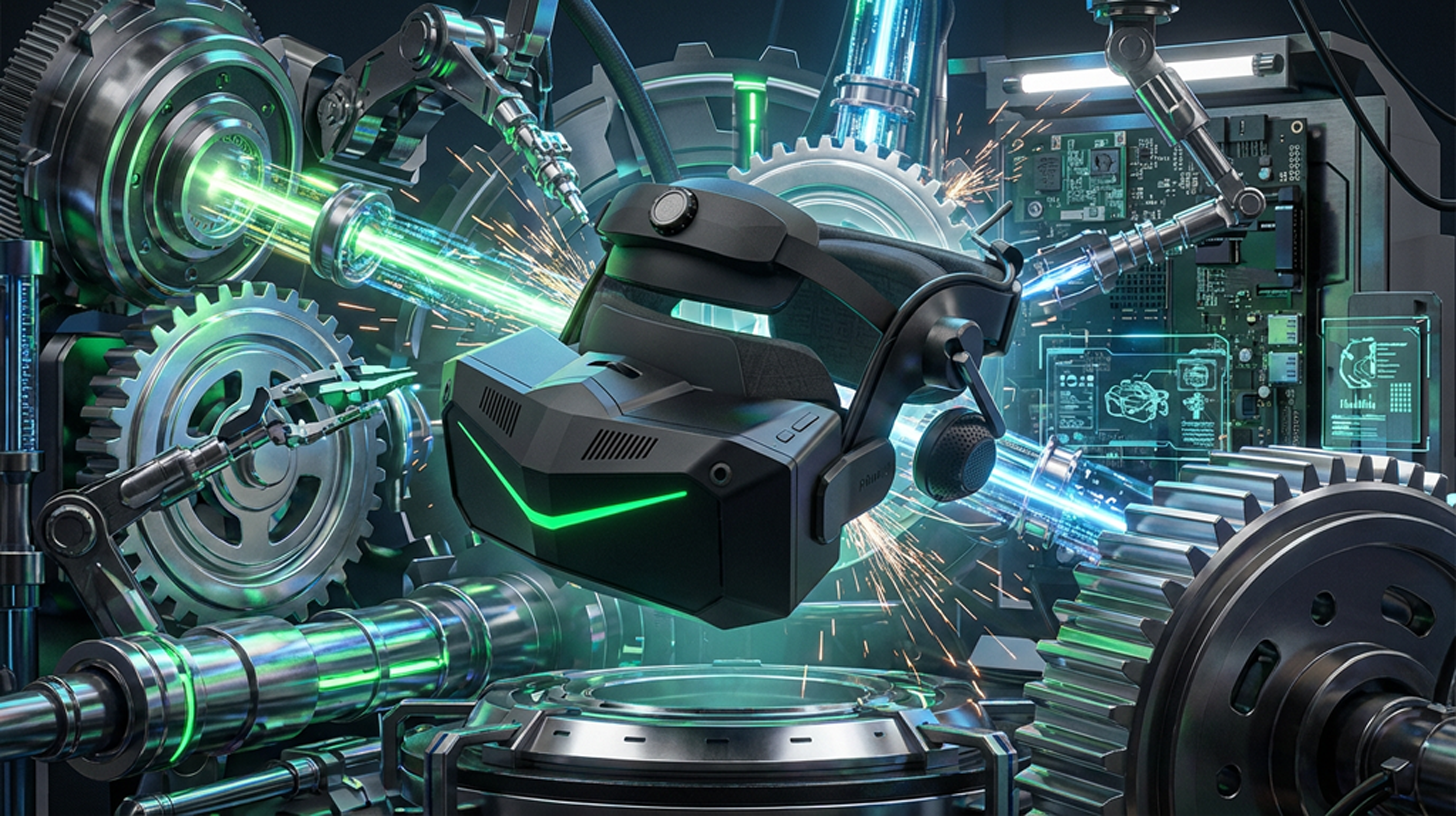
8K resolution and modular design: Pimax's VR strategy – Image: Xpert.Digital
Pimax is pushing the boundaries of VR: Why Meta and Apple need to take a close look
How a niche pioneer is pushing the boundaries of virtual reality
In an era where tech giants like Meta are focusing on mass-market all-in-one solutions and Apple aims to usher in the luxurious age of spatial computing with its Vision Pro, a Chinese company is confidently swimming against the tide: Pimax. This VR pioneer from Shanghai is uncompromisingly dedicated to high-end virtual reality, delivering headsets that regularly set new technological standards with extreme fields of view, interchangeable lenses, and retinal resolution. Instead of targeting the mainstream, Pimax focuses on the most demanding enthusiasts – from hardcore gamers and sim racers to flight simulator pilots. However, the path to the technological forefront of PC VR is anything but easy: Ambitious development goals often clash with the logistical realities of production at this rapidly growing company. This comprehensive analysis takes a detailed look at Pimax's fascinating hardware portfolio. From the experimental handheld hybrid “Portal” to the price-performance hit “Crystal Light” to the new modular flagship “Crystal Super” and the feather-light “Dream Air”, we clarify the strengths and weaknesses of the individual models, clear up the confusion about standalone capabilities and show whether the company can live up to its ambitious delivery promises in the future.
Between engineering ambition and delivery logistics: What makes Pimax arguably the most exciting VR company in the industry?
The Chinese company Pimax has carved out a remarkable position for itself in the virtual reality industry. The headsets from Shanghai are considered technological leaders in high-resolution PC VR, regularly setting new standards in resolution, field of view, and image quality. That a relatively small manufacturer achieves such innovative feats in this fiercely competitive market deserves recognition. Nevertheless, the company faces the typical challenge of rapidly growing technology firms: ambitious development goals sometimes clash with production and logistics capacities. This analysis examines the technical capabilities of individual Pimax models, their standalone features, and the potential of the company's future plans.
To understand Pimax's product portfolio, it's helpful to grasp the company's fundamental philosophy. While Meta focuses on maximum mass appeal with its Quest series of self-contained, standalone devices, and Apple aims to pave the way for the future of spatial computing with its Vision Pro, Pimax pursues a unique and bold approach. The company consciously positions itself as a provider for the most demanding VR users, particularly simulation enthusiasts, racing drivers, and flight simulator pilots who prioritize maximum visual quality above all else. This clear niche focus is strategically astute and explains both the impressive technical specifications and the intense pressure for innovation under which the team constantly operates.
The Pimax Portal: A bold hybrid concept between handheld and VR
The Pimax Portal represents a particularly creative experiment within the product portfolio. Conceived as a hybrid Android handheld device for gaming, it was also designed from the outset for use in virtual reality. The base device can be inserted into a special VR housing called Portal View, transforming it into a mobile VR headset. It is powered by a Snapdragon XR2 processor, which, in combination with four cameras, enables spatial tracking without external sensors.
The product was launched via a successful Kickstarter campaign, with deliveries to backers beginning in April 2023. Pimax produced 569 Portal devices in various versions and configurations for internal testing, external trials, and content developers. The hardware offered impressive raw data with a 4K display at 144 Hz. As with many innovative first products, there was still room for improvement on the software side, and the VR store was still under development at launch. Heat generation, energy consumption, and the wireless controller connection were known areas that the development team continuously worked on.
Pimax has now completely shifted its focus to the Crystal series and the announced Dream Air. The Portal remains an interesting chapter in the company's history, demonstrating Pimax's willingness to experiment with new form factors. The experience gained from this process is incorporated into the further development of current product lines.
From PC to headset and back: The Crystal's clever AIO mode
The original Pimax Crystal, internally referred to as the Crystal-OG, was designed as a dual-mode headset, making it unique in the premium VR segment. In addition to classic PC VR operation via a DisplayPort cable, the device features an integrated all-in-one mode, activated by a physical slider on the front right of the headset. Switching modes launches the Crystal's own Android-based home environment, conceptually similar to the interfaces of MetaQuest or Pico.
The technical basis for this standalone operation is a built-in Snapdragon XR2 processor, the same chip used in the MetaQuest 2 and the Pico 4. As expected, performance in standalone mode is therefore significantly lower than in PC mode. Even an older PC VR system considerably surpasses the processing power of the mobile chip. Standalone mode is thus primarily suitable for lighter applications, streaming movies, or simple VR games like Beat Saber or Pistol Whip. Naturally, the Crystal's full resolution and image quality cannot be utilized in AIO mode, as the mobile processor is unable to adequately drive the high-resolution displays.
Setup is done via a smartphone app, which allows the headset to be paired without the need for controllers. The Crystal AIO mode was initially released as a beta feature and improved over time through firmware updates. An additional option was to stream to a PC from standalone mode via Steam Link, allowing the device to be used as a kind of wireless monitor replacement. However, important apps like Virtual Desktop, which play a central role in wireless PC VR streaming with competing products, were missing.
The Crystal Light: Smart focus on the essentials
The Pimax Crystal Light, introduced in May 2024, represents a shrewd product decision. Designed as a purely wired PC VR headset, it deliberately omits all components necessary for standalone operation. Specifically, the Snapdragon XR2 processor, integrated battery, onboard storage, and compatibility with a 60 GHz wireless module were removed. This decision resulted in a weight reduction of approximately 30 percent compared to the original Crystal and a drastic price cut from $1,599 to $899.
The Crystal Light maintains the optical quality of the original with a resolution of 2,880 x 2,880 pixels per eye and 35 pixels per degree. The aspherical glass lenses produce a wide field of view with a large sweet spot. A maximum refresh rate of 120 Hz is supported, which is an advantage over the newer Crystal Super models, which are limited to 90 Hz. Instead of dynamic eye tracking, a fixed foveated rendering 2.0 is used, and the IPD adjustment is manual rather than automatic.
Pimax explicitly positions the Crystal Light as a high-performance entry-level model in the world of premium PC VR. It is particularly suitable for users with mid-range graphics cards starting at an RTX 2060 who are looking for excellent image quality without having to invest in the latest GPU generation. With local warehouses in the USA, Europe, the UK, and Canada, the device is typically available for delivery within a week, which is a remarkable exception in the Pimax universe.
The Crystal Super: Pimax sets new standards in image quality
Released in April 2025, the Pimax Crystal Super is the company's current flagship model and represents a significant technological leap over its predecessors. With a resolution of 3,840 by 3,840 pixels per eye and up to 57 pixels per degree, the device achieves a level of image sharpness that Pimax markets as the first consumer VR headset with retinal resolution. This surpasses professional headsets like the Varjo Aero or the Somnium VR1 in pure pixel density.
A key feature of the Crystal Super is its modular optical system with interchangeable lens units. At launch, a QLED unit with 50 pixels per degree and a 127-degree horizontal field of view was available, complemented by a sharper variant with 57 pixels per degree and a 106-degree field of view. Additionally, a Micro-OLED module with Sony panels is currently being shipped, with production beginning at the end of October 2025. This modular design allows owners to switch between different display technologies without having to purchase a completely new headset.
Unlike the original Crystal, the Crystal Super does not have a standalone mode. Designed purely as a PC VR headset, it requires no battery. Pimax has prioritized visual quality and PC-based performance with this model. Integrated eye tracking enables Dynamic Foveated Rendering 2.0, which maximizes image quality precisely where the user is looking, thereby reducing performance demands. Automatic IPD adjustment, 1,000 local dimming zones per eye, and improved SLAM tracking complete the package.
The performance requirements are considerable, however. While the Crystal Light can already be operated with an RTX 2060, the Crystal Super only reaches its full potential with graphics cards in the RTX 4090 or RTX 5090 class. At a price of $1,799, the device is positioned in the upper premium segment, but is significantly cheaper than comparably specified competitor products.
Pimax's modular design
Pimax is particularly known in the virtual reality industry for its modular design. This flexibility is especially central to newer high-end models like the Pimax Crystal Super, allowing users to replace hardware without having to buy a new headset.
Interchangeable display modules
The Pimax Crystal Super's highly innovative modular feature is its interchangeable optical engine. Users can completely replace the display module and choose, for example, between QLED panels for high brightness or Micro-OLED panels for perfect black levels. This extends the device's lifespan, as future display generations can easily be retrofitted.
Interchangeable lenses
Another important element of the modular concept is the lens system of the Crystal series. Users have the option of physically replacing the lenses (for example, aspherical glass lenses). This allows the headset to be specifically adjusted for a particularly large field of view (FOV) or for maximum pixel density (PPD) for the highest image sharpness.
Tracking and connectivity
Pimax also prioritizes maximum modular expandability in data acquisition. While the headsets use camera-based inside-out tracking as standard, the front panel can be replaced with a module for precise Lighthouse tracking with base stations. Furthermore, the regular cable connection can be replaced with attachable adapters, such as a WiGig module, for wireless PCVR gaming.
The WiGig module
A WiGig module is a hardware extension that enables extremely high-speed, low-latency wireless data transmission. Unlike standard Wi-Fi (such as the 2.4 GHz or 5 GHz bands), WiGig technology (based on the IEEE 802.11ad or 802.11ay standard) utilizes the unlicensed 60 GHz frequency band.
By using the 60 GHz band, significantly wider channels are available, enabling data transfer rates of up to 7 gigabits per second (Gbit/s). This allows for the wireless transmission of enormous amounts of data in real time. However, the disadvantage of this high frequency is the very short range (usually only 1 to 10 meters). Furthermore, the high-frequency signals cannot penetrate physical obstacles such as walls, ceilings, or even people; therefore, a direct line of sight between transmitter and receiver is required.
In the VR sector – as with Pimax or HTC Vive – a WiGig module solves the biggest problem of high-end PCVR headsets: the thick video cable to the PC.
The module is mounted as an attachment to the VR glasses and receives the extremely high-resolution image data and tracking information in real time from a special transmitter on the PC.
Because WiGig provides enough bandwidth to transmit the huge amounts of data from high-resolution displays (such as 4K per eye) almost without delay (without noticeable latency), users can enjoy true PCVR quality completely wirelessly, without the need for heavy image compression.
🗒️ Xpert.Digital: A pioneer in the field of Extended and Augmented Reality

Finding the right Metaverse agency, planning office, or consulting firm - Image: Xpert.Digital
🗒️ Finding the right Metaverse agency, planning office, or consulting firm – Search and search: Top Ten Tips for Consulting & Planning
More information here:
Between supply bottlenecks and VR dreams: Pimax's ambitious future roadmap
Crystal Light and Crystal Super in direct comparison
Choosing between Crystal Light and Crystal Super is an exciting balancing act between excellent value for money and technological advancement. The following comparison highlights the respective strengths of both models.
Released in May 2024 for $899, Crystal Light differs in several key aspects from Crystal Super, which was launched in April 2025 for $1,799.
Technically, the Crystal Super offers a higher resolution of 3,840 x 3,840 pixels per eye and a pixel density (PPD) of 50 or 57 thanks to interchangeable lenses. In comparison, the Crystal Light has a resolution of 2,880 x 2,880 pixels and 35 PPD, but offers a higher maximum refresh rate of 120 Hz compared to the Super model's 90 Hz. A key advantage of the Crystal Super is its dynamic eye-tracking, which enables dynamic foveated rendering 2.0, while the Crystal Light forgoes eye-tracking and uses fixed foveated rendering (Fixed 2.0).
Both headsets utilize QLED + MiniLED display technology, with the Crystal Super offering an optional OLED version and significantly more local dimming zones per eye (1,000 zones) compared to the Crystal Light's 576. Unlike the Crystal Light, the Super model features interchangeable lenses. IPD adjustment is manual on both models, ranging from 58 to 72 mm. Neither headset offers a standalone mode.
The hardware requirements reflect the performance differences: The Crystal Light requires at least an RTX 2060 (RTX 3080 / RTX 4070 recommended), while the Crystal Super requires an RTX 2080 as a minimum (RTX 4090 / RTX 5090 recommended).
In terms of design, the Crystal Light is described as "lighter," whereas the Crystal Super is considered "lightweight and optimized for comfort." Finally, the Crystal Light is available from stock within about a week, while the Crystal Super, being a special order item, has a delivery time of one to two months.
| feature | Crystal Light | Crystal Super |
|---|---|---|
| Price | 899 USD | 1,799 USD |
| publication | May 2024 | April 2025 |
| Resolution per eye | 2880 x 2880 | 3840 x 3840 |
| Pixels per degree (PPD) | 35 | 50 / 57 (interchangeable) |
| Maximum refresh rate | 120 Hz | 90 Hz |
| Eye-tracking | No | Yes, dynamic |
| Foveated Rendering | Fixed (Fixed 2.0) | Dynamic 2.0 |
| IPD setting | Manual (58-72 mm) | Automatic (58-72 mm) |
| Local dimming zones | 576 per eye | 1,000 per eye |
| Display technology | QLED + MiniLED | QLED + MiniLED / OLED optional |
| Interchangeable optics | No | Yes |
| Standalone mode | No | No |
| Minimum GPU | RTX 2060 | RTX 2080 |
| Recommended GPU | RTX 3080 / RTX 4070 | RTX 4090 / RTX 5090 |
| Weight | Lighter | Lightweight, comfort-optimized |
| Availability | In-stock items, approximately 1 week | Made to order, 1-2 months |
A key point that is often misunderstood in public discussion: Neither the Crystal Light nor the Crystal Super offers a standalone mode. This capability was exclusive to the original Crystal OG and was removed from both successor models. The Crystal Light sacrificed portability in favor of weight reduction and a lower price, while the Crystal Super invested the freed-up resources in higher image quality and its modular lens system.
From an economic perspective, the Crystal Light offers remarkable value for money. For under $900, buyers get image quality that until recently was only available for three times the price. The Crystal Super justifies its twice-as-high price with its significantly higher resolution, eye-tracking with dynamic foveated rendering, and future-proofing thanks to interchangeable optical modules. However, for those primarily engaged in sim racing or flight simulators and who don't own a top-of-the-line GPU, the Crystal Light is the more economical choice.
The Dream Air: Pimax takes the leap into the Micro-OLED future
With the Pimax Dream Air, announced in December 2024, the company aims to push the boundaries of what's technically possible in a compact form factor. The device utilizes Sony Micro-OLED panels with a resolution of 3,840 by 3,552 pixels per eye and weighs less than 170 grams. It shares the optical engine with the Micro-OLED module of the Crystal Super, but packages this technology in a completely new, significantly lighter housing design.
For mobile use of the Dream Air, an optional computing module called Cobb was announced, which is said to include its own Snapdragon XR2 chip and a battery. This would transform the wired PC VR headset into a self-contained mobile VR headset. However, the current status of the Cobb module is unclear. In community discussions from January 2026, it was only referred to as a concept still on the roadmap, without any concrete timelines being communicated.
The development of the Dream Air has been delayed compared to the original plans, which is not unusual given the technological complexity of such a product. Initially announced for May 2025, the delivery date was adjusted several times: first to the third quarter of 2025, then to December 2025, and finally to January or February 2026. On the positive side, Pimax communicated transparently: according to an official update from January 2026, production of the Lighthouse version began at the end of December 2025, with the first deliveries starting at the end of January 2026. The SLAM version was to follow in February, and the Dream Air SE variants in March. External beta testers had already received initial units by this time, thus confirming the progress in development.
In addition to the Dream Air, Pimax also offers a more affordable SE version, which features a reduced resolution of 2,560 x 2,560 pixels per eye, a 105-degree field of view, and weighs less than 140 grams. Prices range from $899 for the Dream Air SE Lighthouse to $2,299 for the Dream Air SLAM version.
Mobile diversity at a glance: Standalone capabilities of all models
To clearly present the standalone capabilities in the Pimax product range, the following table summarizes the current status.
| Model | Device concept | Standalone use | Status (February 2026) |
|---|---|---|---|
| Pimax Portal | Hybrid console with VR attachment | Yes, by inserting it into the Portal View housing | Delivered to Kickstarter backers, no active distribution |
| Pimax Crystal (OG) | High-end headset with dual mode | Yes, through the integrated AIO switch | No longer available for sale, replaced by Crystal Light/Super |
| Pimax Crystal Light | Affordable PC VR headset | No, only wired operation | Available from stock, approximately 1 week |
| Pimax Crystal Super | Flagship PC VR Headset | No, only wired operation | Available, 1-2 month waiting time |
| Pimax Dream Air | Compact Micro-OLED Headset | Planned via optional Cobb module, status unclear | Production started, delivery from January/February 2026 |
| Pimax Dream Air SE | More affordable Micro-OLED variant | Planned via optional Cobb module, status unclear | Production starts in February, delivery begins in March 2026 |
A look at the standalone capabilities of the Pimax product line reveals a diversified offering (as of February 2026). The Pimax Portal, a hybrid console with a VR attachment, allows for independent use by inserting it into the Portal View case; it was shipped to Kickstarter backers but is no longer actively sold. Also usable independently was the original Pimax Crystal (OG), a high-end headset with an integrated all-in-one switch, which has since been replaced by the Crystal Light and Super models and is no longer available for purchase.
The newer models, the affordable Pimax Crystal Light and the flagship PC VR headset Pimax Crystal Super, do not offer standalone capabilities and are designed exclusively for wired PC VR operation. The Crystal Light is available from stock with a delivery time of approximately one week, while the Crystal Super has a waiting time of one to two months.
Looking ahead, Pimax plans to release two models: the compact micro-OLED headset, the Pimax Dream Air, and its more affordable variant, the Pimax Dream Air SE. Both will offer standalone operation via an optional Cobb module, the status of which is still unclear. Production of the Dream Air has already begun, with deliveries starting in January/February 2026, while production of the Dream Air SE will begin in February, with deliveries expected from March 2026.
Patience required: How Pimax is working on its delivery reliability
One aspect that shouldn't be overlooked in any evaluation of the Pimax portfolio is the challenge of meeting delivery deadlines. The company has set ambitious timelines in the past, which haven't always been met. The Crystal Super was originally announced for the fourth quarter of 2024 and didn't appear until April 2025. The Dream Air was promised for May 2025 and is now reaching its first customers, starting in January 2026. On review platforms like Trustpilot, these experiences are reflected in mixed customer reviews, although the product quality upon receipt is frequently highlighted positively.
Within the dedicated Pimax community, the issue of delays is a well-known topic of discussion, and experienced users recommend including a certain time buffer in the announced delivery dates. Pimax employees have openly admitted that ambitious deadlines also serve as an internal motivator. The company has demonstrated a willingness to learn and has noticeably improved its customer communication recently, for example, through regular production and shipping updates.
The delays have some understandable causes. The shortage of Micro-OLED panels, sourced from Sony, represents an industry-wide bottleneck that Pimax, as a smaller customer, can only influence to a limited extent. The fact that the company nevertheless has access to this cutting-edge technology and integrates it into consumer products is a remarkable achievement.
Future prospects: Pimax on the way to a modular VR platform
Pimax's strategic direction for the coming months and years follows two promising development paths. First, the consolidation of the existing portfolio through the complete shipment of the Micro-OLED module for the Crystal Super and the Dream Air in all variants. Second, the further development of the modular platform approach, in which different headsets are based on common optical and electronic components.
The Crystal Super, with its interchangeable optical system, represents the most interesting business model in the current VR market. Instead of forcing customers to buy a completely new headset every one to two years, Pimax offers an upgrade path via new optical modules. Those who buy the QLED version with 50 PPD today can later purchase the Micro-OLED module without having to replace the entire headset. This modularity has the potential to significantly improve cost-effectiveness for the end customer while simultaneously strengthening customer loyalty.
Mobile and standalone use is an area where Pimax still has potential. With the discontinuation of the Crystal OG, there is currently no actively marketed Pimax headset with an integrated standalone mode. The Cobb module for the Dream Air is still in the early planning stages. In a market where the MetaQuest 3 has made standalone operation the standard, this presents an interesting growth opportunity. Pimax is pursuing the understandable strategy of first perfecting its core competency in PC VR image quality and gradually adding mobile use as a complementary feature.
Pimax's future looks promising. The company's technological expertise is widely recognized in the industry, and its hardware regularly impresses even the most critical reviewers. The modular design of the Crystal Super points the way to a more sustainable and customer-centric product philosophy. If Pimax succeeds in consistently continuing its advancements in customer communication and delivery logistics, the company has everything it needs to expand and solidify its position as a leading provider in the premium VR segment for the long term.
Your global marketing and business development partner
☑️ Our business language is English or German
☑️ NEW: Correspondence in your native language!

Konrad Wolfenstein
I and my team are happy to be available to you as your personal advisor.
You can contact me by filling out the contact form here or simply call me at +49 7348 4088 965. My email address is: [email protected]
I'm looking forward to our joint project.









