
Published on: January 22, 2026 / Updated on: January 22, 2026 – Author: Konrad Wolfenstein
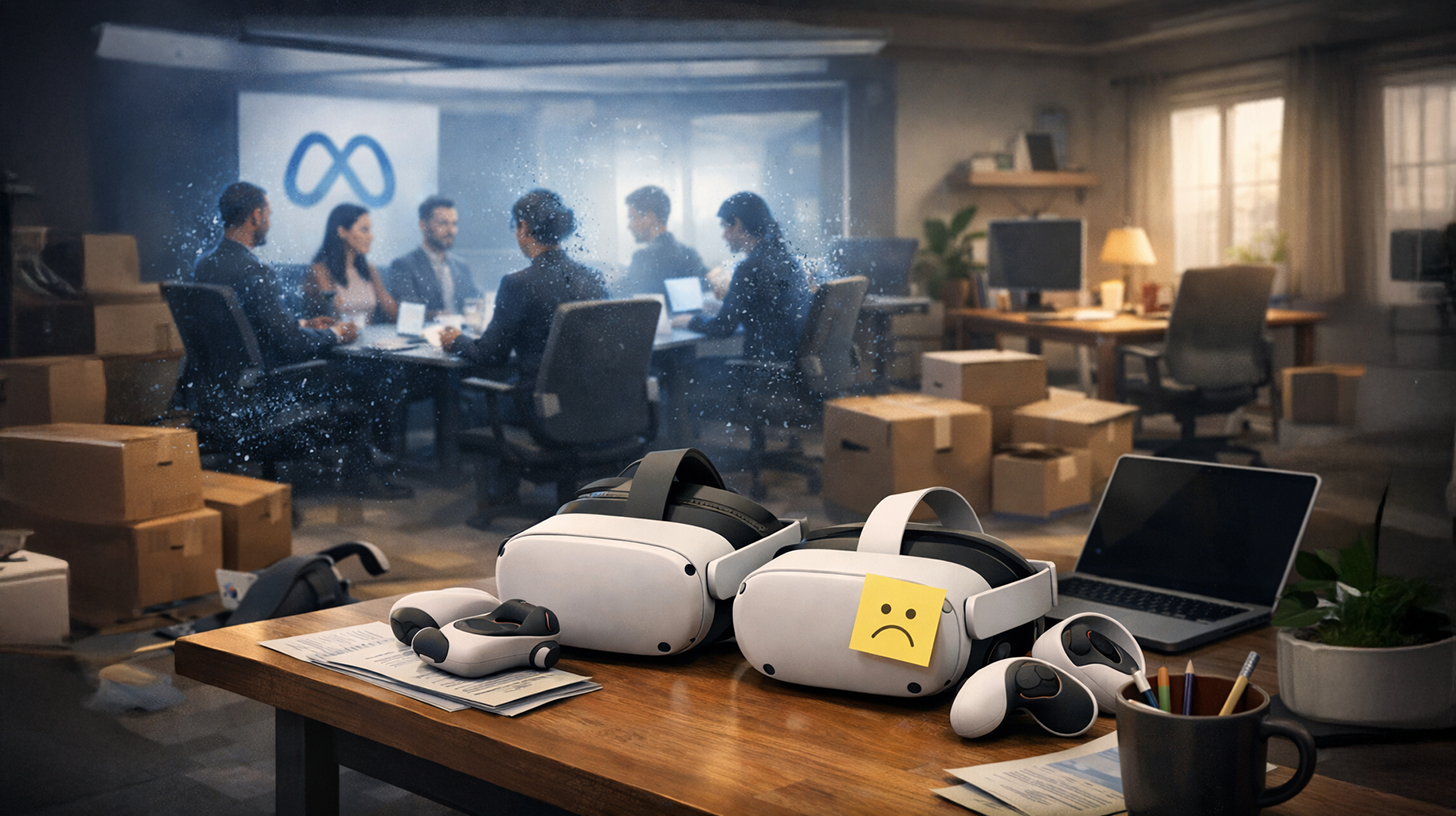
Meta's masterpiece of misinvestment: Metaverse and the $70 billion investment in Reality Labs – The strategic U-turn – Creative image: Xpert.Digital
Zuckerberg's U-turn: AI displaces VR – The end of the Reality Labs strategy
When the metaverse dream meets reality
Metaverse: A Billion-Dollar Money Pit? Meta capitulates to the reality of working from home: No more workrooms, no more headsets – Meta withdraws from the enterprise business
Meta will discontinue its Horizon Workrooms platform on February 16, 2026 – a decision that extends far beyond a single software product. This announcement marks a clear turning point in one of the biggest misinvestments in technology history and reveals the economic logic behind a fundamental strategic shift that redefines the company's entire self-image.
Since 2021, when Mark Zuckerberg launched Meta's Metaverse zeal, the company has invested over $70 billion in Reality Labs—without any significant commercial success. Horizon Workrooms perfectly embodies this absurdity: An ambitious project, announced during the pandemic as a revolutionary solution for remote work, never managed to establish itself as a standard in enterprise collaboration. The series of feature cuts following a 2024 update—whiteboarding capabilities disappeared, along with file sharing and room customization options—already signaled its imminent demise.
Economic realities forced a reassessment. With over 1,000 layoffs in its Reality Labs division (approximately 10 percent of the total workforce) and the closure of three VR studios, Meta is demonstrating a corporate dynamic caught between two competing technological visions: The VR Metaverse dream is losing out to a more central battle – the global arms race for artificial intelligence. Meta is investing between 70 and 72 billion euros in AI infrastructure by 2025, with an upward trend. This reallocation of resources is not a tactical shift, but an existential reorientation.
Horizon Workrooms: Meta's virtual office and meeting platform
Horizon Workrooms is a virtual office and meeting platform from Meta, specifically designed for collaboration in virtual reality and seamlessly integrated with traditional screen-based workspaces. It aims to give distributed teams the feeling of working in a shared space by combining avatars, spatial audio, virtual screens, and collaboration tools into a single environment.
At the heart of the concept is a virtual meeting room where participants, as individually designed avatars, can meet, talk to each other, work on presentations, and use shared whiteboards. Thanks to spatial audio, users perceive voices coming from the direction in which the respective avatars are seated, adding a stronger sense of presence to traditional video conferences. The platform is designed as a hybrid: employees can join either with a MetaQuest headset in VR or conventionally via a 2D video client, so participation remains possible even without a headset.
A key feature is the close connection between the physical workspace and the virtual environment. The remote desktop function allows users to bring their own computer into VR and display it as up to three large virtual screens, enabling workrooms to function both as group meeting spaces and as personal offices for focused work. Users see their desk and keyboard in a mixed-reality view, allowing them to type, take notes, or conduct research without removing their headset. Furthermore, the integration of calendar systems and video conferencing platforms like Zoom makes it possible to combine traditional online meetings with the immersive VR environments.
In its positioning, Horizon Workrooms sees itself as a productivity-oriented component within Meta's larger Metaverse strategy: It's less about gaming or entertainment and more about virtual offices, meeting rooms, and collaborative work environments for companies and project teams. This very focus on business use cases made the platform one of the key experiments in determining whether VR-supported collaboration can achieve widespread acceptance in everyday work beyond the prototype stage.
The collective user dilemma: No viable alternatives on the horizon
For companies and employees who used workrooms productively, a practical vacuum is emerging. While Meta recommends alternatives like Microsoft Teams Immersive, Zoom Workplace, and Arthur, these solutions are not true drop-in replacements – rather, they represent a fragmented market without a clear winner.
Microsoft Teams Immersive, which only became generally available in December 2025, offers expanded functionality: Teams can meet as avatars in 3D spaces, with up to 300 participants in immersive events (compared to 16 in Microsoft's earlier Mesh iterations). The system integrates directly into Teams workflows and works on Windows, Mac, and MetaQuest devices. However, adoption is fragmented; Zoom Workplace is developing similar VR collaboration features in parallel, while Arthur is targeting niche positions in the Horizon Store. For businesses, this means no standardized VR collaboration. Instead, they have to choose between competing platforms, reinforcing a classic market fragmentation dynamic.
The deeper strategic implication is revealed in Meta's decision to also discontinue the sale of commercial Quest headsets – as of February 20, 2026, new licenses for business subscriptions may no longer be available. While existing customers will receive free licenses until January 2030, this is effectively an exit strategy. Meta is clearly signaling that the enterprise VR market is not the future of this company.
Mass market dynamics: Why enterprise VR failed
Paradoxically, the overall market for VR and augmented reality continues to grow. The global AR/VR segment reached approximately $59.75 billion in 2024 and is projected to grow to $200.87 billion by 2030 – an average annual growth rate of 22 percent. The European market is estimated at around €2.3 billion in 2025, with forecasts exceeding €30 billion by 2035. Germany alone, driven by the automotive and mechanical engineering sectors, currently generates around €320 million and is expected to expand to €1.76 billion by 2030.
Why did Workrooms fail in the enterprise segment while the overall industry is growing? The answer lies in the asymmetry between industrial VR adoption and general office collaboration. Companies are increasingly using VR for training, prototyping, and remote maintenance—applications with quantifiable ROI. Manufacturing companies report a 40 to 52 percent reduction in training costs and a 60 percent reduction in onboarding time. These applications will account for roughly 60 percent of total VR revenue by 2030.
General office meetings in VR, however, fail to impress decision-makers. The adoption barriers are both cultural and practical: video conferencing is sufficiently efficient, hardware requirements and training create friction, and concerns about data privacy remain unresolved. Meta's attempt to create a comprehensive Metaverse solution for all activities clashed with the reality that companies are more likely to accept incremental, problem-specific solutions than radical platform shifts.
The data-driven reality behind the turnaround
Meta's pivot highlights an economic recalculation: AI is the next platform competition. Meta is vying for market share in Foundation Models and Large Language Models with Google, OpenAI, and Chinese players. Smart glasses with integrated AI assistants—especially the Ray-Ban-Meta partnership—are creating a real market shift. These wearables are selling better than consensus forecasts predicted, with plans for 20 million units annually by the end of 2026.
The strategic message is unambiguous: Ambient computing, where AI assistants are accessible via voice without the need for screens, will define the next era – not immersive VR for all activities. Meta's Llama speech models are intended to run directly in these glasses. This makes economic sense: The path to mass adoption leads through everyday, unobtrusive technology, not through bulky headsets worn solely for meetings.
Consequences for stakeholders: Decentralization with question marks
For companies that have invested in Workrooms, the immediate task is data migration and platform switching by February 2026. Meta promises to provide export options by then, but the reality is more chaotic than claimed. For managed company accounts, data export is the responsibility of the IT administrators – an additional burden. For remote desktop functionality, Meta refers users to its own remote desktop app; for meetings, to fragmented alternatives.
This fragmentation opens up space for a broader ecosystem: Microsoft Teams Immersive will likely become the most dominant alternative for large enterprises; Zoom Workplace will grow in Zoom-centric organizations; Arthur and specialized players like Immersed and Virtual Desktop will serve niche segments. No platform will achieve the quasi-standardization that Workrooms could theoretically have offered—if Meta hadn't sabotaged the project.
At the same time, this exit reveals a deeper truth: The Metaverse vision itself was a conceptual flaw. Transferring all aspects of life into a proprietary virtual reality platform was economically unrealistic and regulatoryly untenable. Decentralized, open solutions and integrated enterprise tools are more practical. Meta's withdrawal accelerates this realization—though the company itself paid a $70 billion learning fee.
Your global marketing and business development partner
☑️ Our business language is English or German
☑️ NEW: Correspondence in your national language!

Konrad Wolfenstein
I would be happy to serve you and my team as a personal advisor.
You can contact me by filling out the contact form or simply call me on +49 7348 4088 965 (Munich) . My email address is: wolfenstein ∂ xpert.digital
I'm looking forward to our joint project.


