
Germany's energy transition: between expansion records and system failure
Xpert Pre-Release

Language selection 📢
Published on: February 21, 2026 / Updated on: February 21, 2026 – Author: Konrad Wolfenstein
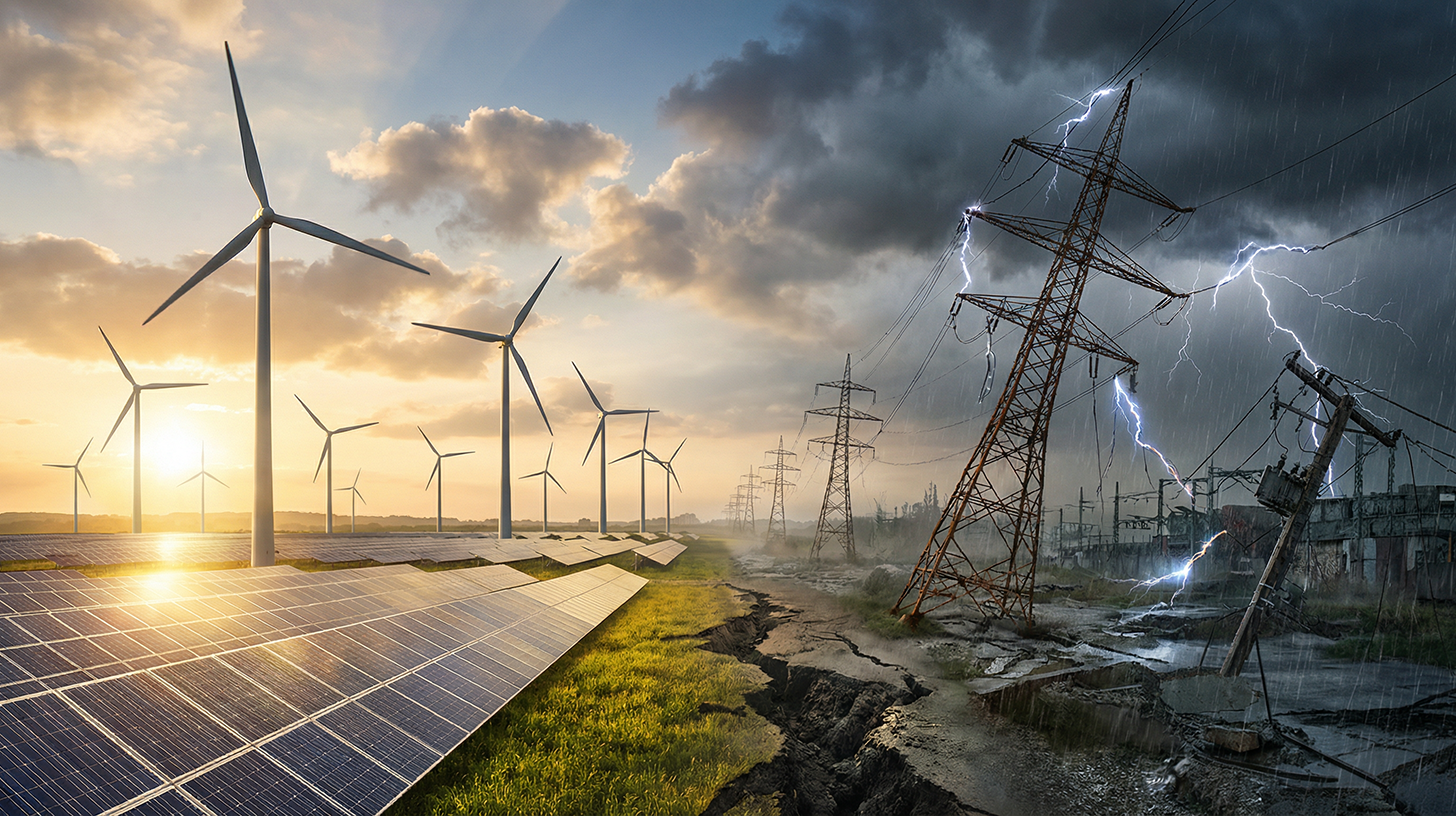
Germany's energy transition: between record expansion and system failure – Image: Xpert.Digital
Billions in costs for phantom power and negative prices on the electricity exchange: The fatal system failure of green electricity
End of feed-in tariffs? Grids at their limit: Why the expansion of solar and wind power is suddenly becoming a problem
Germany is expanding wind and solar power plants at a record pace – but the electricity grid can no longer handle the enormous amounts of energy. The result is an absurd paradox: While green plants in the north have to be curtailed en masse because of a lack of transmission lines, billions are flowing into expensive backup power in the south. This system failure is not only driving up grid fees but is also increasingly leading to negative electricity prices, where electricity is worth less than nothing. According to the latest studies, the total costs of the energy transition could amount to as much as five trillion euros. Faced with this looming financial and structural collapse, policymakers are now considering a radical change of course: A new 10-point plan is intended to pull the emergency brake and replace the indiscriminate expansion of capacity with intelligent system integration. But will this change of course come in time?
Related to this:

Billions for power cuts – and nobody is taking the right action
Germany is experiencing an energy policy paradox of historic proportions. The installed capacity of renewable energies is growing at a pace that hardly anyone would have thought possible just a few years ago. At the same time, an ever-widening gap is emerging between what could technically be generated and what the electricity grid can actually absorb, transport, and utilize. This crack in the foundation of the energy transition is causing billions of euros in costs every year, which are ultimately borne by electricity customers. In 2024 alone, the costs for grid congestion management amounted to around €2.78 billion. And while renewable energy plants in the north are being curtailed, conventional power plants in the south have to be ramped up or expensive imported electricity procured to guarantee supply. It is an absurd double burden that undermines the entire promise of affordable green energy.
Against this backdrop, it is only logical that Federal Minister for Economic Affairs Katherina Reiche presented a 10-point plan for realigning the energy transition in September 2025. The plan marks a paradigm shift: away from simply expanding capacity at any cost, towards a systemic approach in which costs, security of supply, and the actual usability of green electricity are given equal priority alongside climate protection. Whether this change of course comes in time and whether it goes far enough is the crucial question for the coming years.
When abundance becomes a cost driver: The paradox of curtailment
The core problem of Germany's energy transition can be summarized in a single sentence: More green electricity is being produced than the system can process. In 2024, renewable energy plants had to be curtailed to the extent of 3.5 percent of total renewable electricity generation. The development was particularly drastic in the photovoltaic sector, where curtailment increased by 97 percent to 1,389 gigawatt-hours. Bavaria was by far the hardest hit region, with 986 gigawatt-hours.
The causes lie not only in the nature of renewable energies, but also in an electricity system that has not kept pace with the rate of expansion. The Federal Network Agency cites the rapid expansion of photovoltaics and the exceptionally high solar irradiance in the summer of 2024 as the main reasons. What sounds like good news at first glance – more sun, more solar power – turns out in reality to be a structural problem if the grid simply cannot transport the electricity to where it is needed.
The financial consequences are significant. In 2024, €554 million in compensation payments were paid to operators of curtailed renewable energy plants. The total costs of grid congestion management, which includes both curtailment and conventional redispatch, amounted to €2.78 billion. This represents a decrease compared to the previous year, but it is still a figure that should give cause for concern. Especially since the costs had already risen again to €667 million in the third quarter of 2025, compared to €608 million in the same quarter of the previous year.
Related to this:
Negative electricity prices: The thermometer of a sick market
Even more clearly than the curtailment figures, the negative electricity prices demonstrate the dysfunctionality of the current system. A new record was reached in 2025: 573 hours with negative wholesale electricity prices, an increase of around 25 percent compared to the already record-breaking previous year. In June 2025 alone, there were 141 such hours, meaning that on three out of four days at midday, electricity on the wholesale market was worth less than nothing.
The extreme value was reached on May 11, 2025, at minus 25 cents per kilowatt-hour, while in January of the same year, electricity temporarily cost up to 58 cents per kilowatt-hour. This enormous volatility is not an expression of a functioning market sending out scarcity signals, but rather a symptom of a structural imbalance between generation and demand. As the electricity provider Enpal aptly put it, this development demonstrates a growing discrepancy between generation and demand, as well as an insufficiently flexible and digitized energy system with inadequate intelligent storage capabilities.
For consumers, negative wholesale prices do not mean lower electricity bills. Negative prices occur exclusively on the wholesale market and do not reach most households, as long-term contracts with fixed prices are prevalent. At the same time, additional costs arise for the general public because feed-in tariffs for many existing solar power systems are paid even when the electricity has no value on the exchange. Taxpayers are therefore subsidizing electricity that no one needs and simultaneously paying for the replacement electricity that has to be generated elsewhere.
Reich's ten-point plan: A course correction with explosive potential
On September 15, 2025, Federal Minister for Economic Affairs Katherina Reiche initiated the anticipated shift in energy policy. Her 10-point plan is based on a comprehensive monitoring report that systematically assessed the progress of the energy transition. Reiche spoke of a turning point in the energy transition and made it clear that the previous focus on rapid expansion had to give way to a new prioritization centered on reliability, security of supply, affordability, and cost-efficiency.
The plan's key elements include an honest assessment of demand, based on a significantly lower electricity demand than previously assumed: 600 to 700 terawatt-hours for 2030 instead of the previously projected 750 terawatt-hours. The fixed feed-in tariff for new solar and wind power plants is to be abolished. Instead, renewables are to be promoted more effectively based on market and system support – meaning compensation will not be based solely on the amount of electricity generated, but rather on whether the electricity is actually needed and can be integrated into the grid.
Furthermore, the plan envisions the introduction of a technology-neutral capacity market, which is intended to guarantee security of supply through tenders. The flexibilization of the electricity system through smart meters, whose installation rate across Germany is currently less than three percent, is identified as a key instrument. The reduction of subsidies, the pragmatic promotion of hydrogen production, and the use of CCS/CCU as climate protection technologies are also included in the catalog of measures.
Energy-intensive industries have welcomed the change of course, while environmental groups and the opposition are sounding the alarm, fearing that climate targets will be lost sight of. The Greens, in particular, criticize Reiche's so-called grid package, arguing that it effectively abolishes the previously guaranteed priority grid access for wind and solar power plants and slows down the expansion of renewables instead of intelligently managing it.
New: Patent from the USA – install solar parks up to 30% cheaper and 40% faster and easier – with explanatory videos!

New: Patent from the USA – Install solar parks up to 30% cheaper and 40% faster and easier – with explanatory videos! - Image: Xpert.Digital
The core of this technological advancement is the deliberate departure from conventional clamp mounting, which has been the standard for decades. The new, more time- and cost-effective mounting system addresses this with a fundamentally different, more intelligent concept. Instead of clamping the modules at specific points, they are inserted into a continuous, specially shaped support rail and held securely in place. This design ensures that all forces – whether static loads from snow or dynamic loads from wind – are distributed evenly across the entire length of the module frame.
More information here:
Germany's energy transition is stalled: The real reason for high electricity prices
Network expansion: The real bottleneck of the transformation
The most honest diagnosis of the German energy system is this: the grid is the bottleneck, not generation. In the north, wind power is curtailed because there aren't enough lines to transport it to the south. There, gas-fired power plants then have to be ramped up or expensive imported electricity purchased. Around 74 percent of the grid bottlenecks that led to the curtailment of renewable energies in 2024 were in the transmission grid. At the same time, a worrying shift towards the distribution grids is evident: their share of bottlenecks rose from 20 percent in 2023 to 26 percent in 2024, and in the second quarter of 2025, 49 percent of redispatch measures in the renewables sector were already due to distribution grid bottlenecks.
Positive signals are coming from the major direct current (DC) projects. SuedLink, the largest DC project currently under construction, received full approval in October 2025. It connects Schleswig-Holstein with Baden-Württemberg and Bavaria via two underground cables, each with a transmission capacity of two gigawatts. SuedOstLink, which will transport high-voltage direct current from Saxony-Anhalt to Bavaria over approximately 543 kilometers, also received full approval in July 2025 and is scheduled to go into operation in 2027. Transmission system operators are forecasting a significant decrease in redispatch volumes between 2028 and 2030, once these lines are operational.
But until then, the gap will remain, and costs will continue to mount. The DIHK study by Frontier Economics estimates network costs alone—that is, investments and ongoing operations in transmission and distribution networks—at a total of around €1.2 trillion by 2049. This enormous capital requirement raises the question of whether existing financing models based on network charges will remain viable. Reiche has announced plans to reduce network charges in 2026 through a federal subsidy of €6.5 billion from the Climate and Transformation Fund, in order to provide relief to industry, small and medium-sized enterprises, and consumers.
Related to this:

Storage and flexibility: The missing third pillar
Besides grid expansion, the development of storage capacity is the second major challenge without which the energy transition cannot succeed. Official forecasts predict that around 18 gigawatts of large-scale battery storage will be connected to the grid by 2030 and approximately 45 gigawatts by 2045. The pace of grid connection requests is breathtaking: In 2024, almost 10,000 connection requests were submitted at the medium-voltage level and above, with a total output of 400 gigawatts and a capacity of 661 gigawatt-hours. The cumulative requests now total around 500 gigawatts, 28 times what is expected by 2030.
This surge in demand is structurally overwhelming network operators. Grid connection has become the central bottleneck for storage expansion. In some distribution network regions, the annual increase in connection requests has exceeded 400 percent. The result is paradoxical: On the one hand, storage is urgently needed, while on the other hand, many viable projects lack a reliable basis for planning because of a lack of transparency regarding connection availability and a lack of uniform legal requirements for procedures and processing times.
At the end of 2025, legal simplifications came into effect to facilitate the construction and operation of large-scale battery storage systems. Energy storage facilities are no longer subject to the power plant grid connection regulations and are therefore not treated like conventional power plants. However, a key problem remains: battery storage systems that do not operate in a grid-friendly manner can actually exacerbate grid congestion if they all react to price signals simultaneously. A grid fee system that specifically rewards grid-friendly behavior, rather than penalizing flexibility, is therefore just as urgently needed as the physical expansion itself.
Related to this:

Dark periods of low energy and the question of guaranteed performance
The debate surrounding backup capacity for periods without wind and solar power has gained new urgency due to the growing share of renewable energies. Germany currently maintains approximately 65 gigawatts of dispatchable capacity from gas and coal-fired power plants to bridge supply gaps. Studies on the electricity system in 2035 project a total backup capacity requirement of around 76 gigawatts, of which approximately 15 gigawatts could be covered by hydropower and bioenergy, while the remaining 61 gigawatts would need to be provided by gas or hydrogen. To achieve this figure, at least 23 gigawatts of additional gas-fired power plant capacity would be required, on top of the existing 38 gigawatts.
In January 2026, the EU Commission gave the green light for new gas-fired power plants in Germany, intended to serve as backups during periods when renewable energies cannot meet electricity demand. However, the financing remains unclear. Reich's 10-point plan places gas-fired power plants at the heart of the flexibility strategy and anticipates clarity regarding the tendering process by the end of 2025.
The German Association of New Energy Industries (BNE) cautions, however, that a capacity market overly reliant on gas-fired power plants could be counterproductive, as it would hinder business models for battery storage and entrench high, long-term operating costs in the electricity system. The association instead outlines a three-pronged approach: short-term flexibility through batteries, medium-term security via flexible bioenergy and load balancing, and long-term renewable gases and seasonal storage. As is so often the case, the truth likely lies in a smart combination of all these options.
Five trillion euros: The true cost of the energy transition
To understand the scale of the task facing Germany, one must look at the total costs. A study commissioned by the German Chamber of Industry and Commerce (DIHK) and conducted by Frontier Economics arrives at a sobering conclusion: If current energy policy continues, the total costs of the energy transition will amount to between 4.8 and 5.4 trillion euros between 2025 and 2049. This sum comprises 2.0 to 2.3 trillion euros for energy imports, approximately 1.2 trillion euros for grid expansion, 1.1 to 1.5 trillion euros for new generation capacity, and around 500 billion euros in operating costs.
From 2030 onwards, annual system costs will rise to between €212 and €229 billion, and even to as much as €257 billion per year under less favorable technological learning curves. The annual investments required for the energy transition would have to at least double by 2035, from the current level of around €82 billion to between €113 and €316 billion, which would correspond to up to 40 percent of total gross private investment in Germany.
At the same time, the study points to a way out: A technology-neutral, market-oriented approach, which the DIHK refers to as Plan B, could reduce total costs by €530 to €910 billion by 2050 – a cost reduction of 11 to 17 percent. Key levers include increased use of CO2 emissions trading, technological neutrality in energy sources, internationally coordinated climate policy, and increased use of existing gas infrastructure for climate-friendly energy carriers such as hydrogen.
Related to this:

Integration instead of mere installation: What needs to happen now
The key lesson of recent years is that the energy transition will not fail due to insufficient generation capacity, but rather due to a lack of system integration. The costs of feed-in tariffs alone already burdened the federal budget with approximately €17.8 billion in 2024, with a projected increase to €22.9 billion in five years. Added to this are the billions spent on grid congestion management and the indirect costs of negative electricity prices. These are not unavoidable costs of climate protection, but rather the costs of a system design that has not kept pace with the expansion of renewable energy.
The measures currently on the table are fundamentally sound. Synchronizing the expansion of renewable energy and grid development is not a hindrance to climate protection, but rather a prerequisite for ensuring that every kilowatt-hour of green electricity generated is actually used. Developing a smart storage infrastructure that supports the grid and doesn't just react to price signals is just as essential as creating sufficient backup capacity for periods of low wind and solar power generation. Accelerating permitting processes, digitizing the grid through smart meters, and reforming the market design are not optional additions, but fundamental requirements.
The real political challenge lies in implementing this realignment without calling the fundamental transformation path into question. Germany can afford neither the costs of the status quo, where billions are wasted on curtailed electricity and negative wholesale electricity prices, nor a relapse into a fossil fuel-based energy supply, which is not a viable option in light of the climate crisis. The path forward inevitably leads through greater market integration, more systems thinking, and less blinkered thinking on all sides. The question is no longer whether the energy transition will be expensive, because it already is. The question is whether Germany is finally prepared to think it through intelligently and systemically to its conclusion, instead of continuing to finance the symptoms of a flawed system with billions of euros.
Your global marketing and business development partner
☑️ Our business language is English or German
☑️ NEW: Correspondence in your native language!

Konrad Wolfenstein
I and my team are happy to be available to you as your personal advisor.
You can contact me by filling out the contact form here or simply call me at +49 7348 4088 965. My email address is: [email protected]
I'm looking forward to our joint project.
☑️ SME support in strategy, consulting, planning and implementation
☑️ Creation or realignment of the digital strategy and digitization
☑️ Expansion and optimization of international sales processes
☑️ Global & Digital B2B trading platforms
☑️ Pioneer Business Development / Marketing / PR / Trade Fairs
Our EU and German expertise in business development, sales and marketing

Our EU and German expertise in business development, sales and marketing - Image: Xpert.Digital
Industry focus areas: B2B, digitalization (from AI to XR), mechanical engineering, logistics, renewable energies and industry
More information here:
A thematic hub offering insights and expertise:
- Knowledge platform covering global and regional economies, innovation and industry-specific trends
- A collection of analyses, insights, and background information from our key areas of focus
- A place for expertise and information on current developments in business and technology
- A hub for companies seeking information on markets, digitalization, and industry innovations







