

Hidden away in the mega-depot in Erding: What happens to the 110,000 invisible treasures of the Deutsches Museum?
Xpert Pre-Release

Available in 27 languages 📢
Prefer Xpert.Digital on GoogleⓘPublished on: September 22, 2026 / Updated on: September 22, 2026 – Author: Konrad Wolfenstein
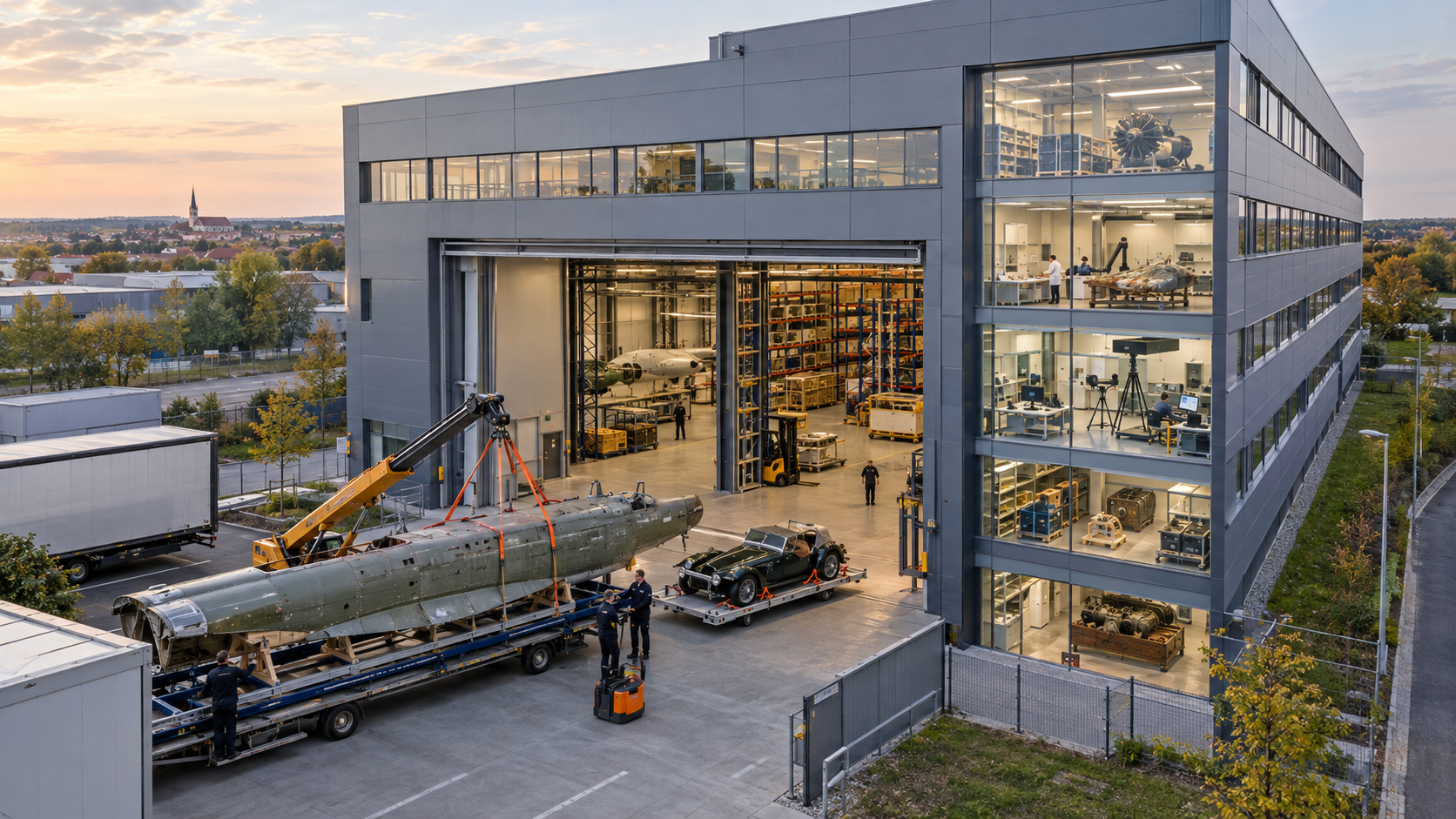
Hidden away in the mega-depot in Erding: What happens to the 110,000 invisible treasures of the Deutsches Museum – a creative image on the topic, created with AI: Xpert.Digital
115 million euros against perpetual rent: The ingenious move of the German Museum
A logistical masterpiece for historical treasures: What's behind the new mega-building in Erding?
The end of temporary solutions: Why this construction project in Bavaria will change the museum world forever
A new era is dawning for the Deutsches Museum. With the groundbreaking ceremony for the €115 million collection center in Erding-Aufhausen, the decades-long, costly temporary arrangement of "perpetual rent" at eight fragmented locations comes to an end. But this ambitious construction project is about far more than just providing sufficient space for the approximately 110,000 exhibits that have so far mostly slumbered unseen in hidden storage. It is a forward-looking investment at the intersection of logistics, research, and digitization, transforming a fragmented collection into a state-of-the-art knowledge factory. The following article analyzes the complex economic, infrastructural, and strategic dimensions of this monumental project – and demonstrates why building this specialized mega-depot as a public-private partnership is the only sensible solution for preserving and rediscovering Germany's industrial heritage for future generations.
Germany's technological memory is moving into the logistics center – transforming hidden treasures into an economic infrastructure
The new collection center of the Deutsches Museum in Erding-Aufhausen is far more than just a construction project for a cultural institution steeped in tradition. It represents a long-term investment decision at the intersection of logistics, real estate, research, digitization, and public funding. With a total volume of approximately €115 million for planning, construction, financing, and operation over 25 years, the project aims to address an infrastructural deficit that has plagued the museum since its relocation to Munich's Museum Island. The crucial economic factor lies not solely in the size of the new building, but in transforming recurring rental, transport, and coordination costs into a manageable, long-term, and self-sustaining infrastructure.
The official groundbreaking ceremony in September 2026 therefore marks a strategic turning point. Currently, the vast majority of the collection, comprising around 125,000 objects, is stored at eight decentralized locations in Bavaria. Only about ten percent of the holdings are on display in the Deutsches Museum's exhibitions. Approximately 110,000 objects, on the other hand, are in storage facilities, some of which are only partially suitable for conservation, research, and logistics. With the planned handover in December 2028 and the arrival of the first exhibits in early 2029, this historically grown temporary arrangement will be transformed into an integrated collection, research, and logistics system.
This investment is therefore not a luxury project, but rather the material prerequisite for the museum to efficiently fulfill its core legal and cultural mission. Collecting means more than simply possessing objects. It means clearly documenting them, preserving them permanently, researching them scientifically, transporting them safely, and keeping them accessible for future generations. Without suitable storage facilities, even an internationally significant collection gradually loses its scientific and economic value. The central question, therefore, is not whether a museum should be able to afford such a building. It is what costs will be incurred if it continues to forgo it.
Eight temporary solutions become one system
The current depot structure incurs a multitude of visible and hidden costs. Visible burdens include millions in rent, energy expenditures for partially unsuitable storage facilities, and transportation and security costs. Hidden expenses also arise: employees must organize travel, search for objects in different locations, maintain multiple sets of equipment, and ensure suitable transport conditions for each access. Every spatial separation between storage, documentation, restoration, and research creates interfaces. These interfaces cost time, increase the likelihood of errors, and hinder consistent quality control.
The collection center replaces this fragmented model with a central hub. In logistics, a hub is a point where goods are consolidated, sorted, and forwarded. Applied to the museum, this means that delivery, quarantine, cleaning, testing for hazardous materials, inventorying, storage, retrieval, restoration, photography, digitization, and scholarly research can all take place in a coordinated process chain. Objects no longer necessarily have to be moved between spatially separated facilities. This reduces not only direct transport costs but also the risk of damage, mix-ups, or unnecessary changes in climate.
The very heterogeneity of the collection makes centralization challenging. The spectrum ranges from microchips to historical vehicles and machinery, and includes parts from the shipping and aviation industries. Such objects differ considerably in terms of weight, dimensions, material composition, fragility, and potential contamination. A repository for technical cultural assets is therefore not the same as a conventional warehouse. It requires different load-bearing capacities, access and lifting concepts, fire protection zones, suitable climate zones, and traceable object movements. The new building consolidates these requirements in a purpose-built facility.
Centralization, however, does not automatically eliminate all inefficiencies. The crucial factor is how consistently the museum standardizes its processes. If old data sets, inventory numbers, condition reports, and location information are not harmonized, the organizational chaos simply moves to a more modern building. Economic benefits only arise when physical consolidation is combined with a unified data model, clear responsibilities, and digitally supported workflows. The building is therefore a necessary, but not sufficient, condition for success.
More space for relatively little additional cost
The development of the project between its initial presentation in February 2026 and the groundbreaking ceremony in September 2026 demonstrates how strongly the economic viability of a commercial building depends on economies of scale. Initially, a total volume of approximately €100 million was planned. Subsequently, the investment was increased by about €15 million. As a result, the initial total floor space grew by approximately 9,000 square meters, or roughly 40 percent, to almost 30,000 square meters. In contrast, the additional costs increased by only 15 percent.
This ratio is economically remarkable. Purely mathematically, the additional 9,000 square meters included in the expansion plan cost approximately €1,667 per square meter. This figure should not be confused with a typical construction cost benchmark, as the overall model encompasses not only construction but also financing and long-term operation, and the precise details of the expansion package are not publicly available. Nevertheless, the scale clearly demonstrates that the marginal cost of the additional space is considerably lower than the average cost of the entire project. Many basic costs, such as land acquisition, development, planning, project management, security concept, and essential parts of the technical infrastructure, would be incurred regardless. Therefore, additional floor space or usable area can usually be realized more cost-effectively during the initial construction phase than in a later, separate construction phase.
From a business perspective, it would have been problematic to undersize the first construction phase. A storage building has a very long lifespan, while the collection grows continuously and additional temporary storage needs can arise during exhibition modernization. If the space is already full shortly after opening, further external rental costs will be incurred. Furthermore, internal relocations will be necessary, tying up staff and putting stress on sensitive objects. Therefore, the early expansion not only buys square meters, but also strategic flexibility.
At the same time, the modular expansion reserve remains important. The five-story center begins with a total area of just under 30,000 square meters and can be expanded to approximately 45,000 square meters in the long term. The first construction phase includes roughly 21,000 square meters of pure storage space and approximately 5,000 square meters for workshops, digitization, logistics, and other functions. The difference to the total area is accounted for, among other things, traffic areas, technical facilities, and ancillary spaces. This distinction is important because earlier project information sometimes only mentioned the storage or usable area, creating apparent contradictions. At the beginning of 2026, a smaller initial expansion phase with approximately 14,000 square meters of storage space was still being discussed. The nearly 30,000 square meters mentioned at the groundbreaking ceremony refers to the subsequently increased total area of the first construction phase.
The bill behind the 115 million euros
At first glance, €115 million seems like a high sum for a museum storage facility. However, a serious assessment cannot consider this amount in isolation. According to the project details, it includes planning, construction, financing, and the building's operation over 25 years. A simple division yields a calculated average of €4.6 million per year. This figure is not an actual annual rate, as the payment profile, interest components, price adjustment clauses, and operating fees are not publicly disclosed. Nevertheless, it provides a useful benchmark.
This contrasts sharply with current rental costs of several million euros per year. Previous estimates put storage rentals alone at nearly three million euros annually. Depending on the locations included, energy, security, and ancillary costs, the actual total burden could be even higher. Even if the new solution costs more than the old leases in individual years, a crucial difference emerges at the end of the contract period: The museum will have its own dedicated property instead of continuing to pay rent for scattered spaces. The comparison is similar to the difference between a long-term lease and the financed purchase of a property, but is more complex due to the specialized use and the associated operating costs.
The economic advantage depends significantly on four factors: the development of previous rents, the actual payment schedule of the PPP contract, the avoided logistics and maintenance costs, and the condition of the building after 25 years. If commercial rents, energy prices, and technical requirements rise more sharply than expected, the in-house solution becomes more attractive. Conversely, if substantial additional costs arise or essential services are not covered by the operating agreement, the financial outlook may worsen. Therefore, without access to a complete cost-benefit analysis, it is impossible to provide an exact return on investment for the project.
Nevertheless, the basic structure supports a plausible economic logic. Current rental payments represent perpetual costs without any asset accumulation. The new model combines usage fees with the development of ownership and infrastructure. Furthermore, consolidating multiple locations should significantly reduce process costs. Reduced travel time for employees, consolidated transport, and the storage of equipment directly adjacent to workshops will result in productivity gains that are not apparent in a simple comparison of rental costs.
It would be dishonest, however, to describe the investment as budget-neutral. The fact that no additional tax revenue is being requested and that payments are to be made from the museum's regular budget does not mean the project is free. Every euro tied up in long-term financing and operation is a euro unavailable for other purposes. The crucial question, therefore, is whether the avoided rental and operating costs sufficiently offset the burden. The claim that the project relieves the public budget is only valid if all payment obligations, risks, and residual values are compared transparently over the entire life cycle.
PPPs as a tool, not as a miracle weapon
The collection center is being realized as a public-private partnership. Georg Reisch GmbH & Co. KG, together with the architectural firm LRO, is responsible for planning and construction; the Bayerische Landesbank is the financing partner. The private partner will also operate and maintain the building for 25 years. The Deutsches Museum will pay for the agreed construction, financing, and operating costs over the contract period. According to the museum, ownership of the building will already be held by the institution during the construction phase.
The most important advantage of this model is the pooling of responsibility. Those who not only construct a building but also have to maintain it for decades have a stronger incentive to use durable materials, maintenance-friendly technology, and energy-efficient solutions. Cheap components that cause high repair costs after just a few years become a problem for the operator. This life-cycle approach can overcome the common disconnect in public construction between low construction costs and high subsequent operating costs.
A second advantage is the reliable schedule. Handover is planned for December 2028, the first exhibits are expected to arrive in early 2029, and an additional extension is slated for completion by the end of March 2029. Ideally, the private partner assumes clearly defined risks related to scheduling, construction, and availability. This is valuable for the museum because every additional month of delay extends existing rental and operating costs and complicates the organizational transition.
However, public-private partnerships (PPPs) are not an automatic proof of cost-effectiveness. Private financing is generally more expensive than direct public borrowing because companies factor in higher financing costs and risk premiums. This higher price can be justified if genuine risks are effectively transferred and the operator creates greater value through more efficient planning, faster implementation, and lower operating and maintenance costs. If, despite contractual arrangements, risks effectively remain with the museum, the public sector may end up paying a private premium without any corresponding relief.
The specifications therefore deserve particular attention. For a typical office building, availability can be defined relatively easily. For a collection center, however, the focus is on long-term climate stability, security, pest prevention, load-bearing capacity, fire protection, emergency preparedness, and the protection of unique objects. The contract must measurably define the temperatures, humidity levels, response times, and maintenance standards that must be met. It must also be clear who is liable for damages if technical systems fail or conservation limits are exceeded.
Flexibility also comes at a price. A 25-year contract provides planning security, but can bind the museum to technical and organizational assumptions from 2026. Digitization, sensor technology, robotics, and building technology will change significantly by 2053. Therefore, well-structured contracts must allow for modernization without every adjustment becoming an expensive addendum. The decisive quality of the PPP model will become apparent less on opening day than during the second half of its operational life.
Your intralogistics experts
Consulting, planning and implementation of complete solutions for high-bay warehouses and automated storage systems - Image: Xpert.Digital
More information here:
From warehouse to innovative knowledge factory
From warehouse to knowledge factory
The term "collection center" is more accurate than "central depot." A depot stores objects; a collection center generates usable knowledge from them. The plans include restoration workshops, scientific analysis laboratories, digitization workstations, and areas for object logistics. Around 15 permanent staff members will work on-site. Their number may seem small at first glance, given the tens of thousands of objects, but the benefits arise primarily from specialization, standardized processes, and the close proximity of the collection and processing areas.
Direct access to objects is crucial for research. Photographs and database entries are insufficient when investigating material aging, manufacturing processes, signs of wear, or technical details. In the new center, objects can be removed, analyzed, conserved, and then restored without long transport distances. This reduces transaction costs in the literal sense: fewer coordination efforts, shorter distances, and lower risks make each individual scientific investigation more efficient.
Restoration research on modern materials is particularly relevant. Plastics, rubber, composites, lubricants, and coatings age differently than classic materials such as stone, wood, or metal. Some plastics become brittle, discolor, or release substances that can affect neighboring objects. Technical collections therefore face problems that increase with the progressive aging of 20th-century products. A specialized center can develop methodological expertise in this area that extends far beyond the needs of the Deutsches Museum itself.
This creates a scientific infrastructure with potential external effects. Insights into material aging, conservation, and digital documentation can benefit other museums, archives, universities, and businesses. The societal benefit cannot be fully reflected in the museum's revenue. This is precisely the economic justification for public investments in culture and research: they generate knowledge, education, and cultural continuity, the benefits of which are more widely distributed than the immediate costs.
Digitalization requires physical order
Digitizing the collection is not a replacement for the physical storage facility, but rather depends on its quality. A digital dataset can make an object searchable worldwide, but first the physical original must be clearly identified, measured, photographed, described, and linked to its location. The more disorganized and geographically fragmented the collection, the more expensive this process becomes. Therefore, a central infrastructure is essential for scalable digitization.
Around 52,000 objects are already searchable via the Deutsches Museum's digital portal. At the collection center, data records will be supplemented with photographs, scans, plans, operating instructions, and other technical information. Digitization will be particularly valuable when it creates not just individual images, but structured relationships between the object, manufacturer, year of manufacture, material, operating principle, usage history, and related documents. In this way, an online catalog can gradually evolve into a research platform.
From an economic perspective, digitization increases the reach of a largely invisible collection. While a physical exhibition space can only be visited by a limited number of people at a time, a digitally cataloged object can be accessed simultaneously worldwide. Researchers can check in advance whether a trip to Erding is necessary. Teachers can integrate materials into their lessons. Curators at other institutions can prepare loan requests more effectively. This reduces information costs and increases the use of the collection without requiring every object to be on permanent display.
Building high-quality digital collections is labor-intensive. Automated image recognition and artificial intelligence can assist with tagging, text recognition, and data matching, but they cannot replace expert review. Historical terminology, inconsistent inventories, and complex provenances require human expertise. Therefore, the collection center should not treat digitization as a one-off project, but rather as an ongoing production process with quality control, open interfaces, and clear priorities.
Digital long-term archiving is an often underestimated topic. High-resolution images, three-dimensional scans, and technical documents require storage, metadata, format migrations, and cybersecurity. A physical repository preserves objects for decades; the associated digital infrastructure must be able to handle the same time horizon. Otherwise, large amounts of data are generated, but no reliably usable digital memory is created.
Preservation becomes a cost prevention measure
Preventive conservation is more economical than later restoration. An object stored under stable conditions, regularly inspected, and protected early against pests or material degradation requires less extensive intervention. The new center will therefore systematically combine climate monitoring, insect control, cleaning, consolidation, and condition assessment. These measures not only safeguard cultural value but also prevent future damage costs.
The technical challenge lies in the diversity of materials. A rigid, uniform climate for all areas would not always be optimal from a conservation standpoint and would be energy-intensive. Modern museum concepts therefore utilize climate corridors, material-specific zones, and targeted microclimates for particularly sensitive objects. For less sensitive storage collections, wider temperature and humidity ranges are often used today than in the past, as long as changes occur slowly and in a controlled manner. A well-insulated, largely closed building envelope can achieve stable conditions with less technical effort than an unsuitable hall that requires constant heating, cooling, or dehumidification.
This is a key lever for life-cycle costs. The investment costs of a robust building envelope are visible and incurred early on. In contrast, the savings from smaller systems, lower energy consumption, and reduced maintenance requirements are spread over decades. Especially in a public-private partnership (PPP) model, the operator should have an incentive to undertake this long-term optimization. This requires that energy costs, technical availability, and conservation quality are meaningfully incorporated into the contract.
The energy issue is also strategically relevant. A collection center is expected to be used well beyond the 25-year contract term. Energy prices, climate requirements, and legal regulations can change significantly. Photovoltaics, heat pumps, heat recovery, zoned ventilation, passive temperature control, and intelligent building management can reduce dependence on ongoing energy costs. Whether and to what extent these solutions are implemented must be measured against the actual planning. For economic evaluation, energy consumption should be transparently documented and defined with clear target values.
Erding location: between proximity and space
Erding-Aufhausen combines several locational advantages. The site covers approximately 20,000 square meters, is conveniently located between Munich and the district capital, and offers ample space for a multi-story, modularly expandable building. For a technology museum, accessibility for heavy transport is particularly important. Large vehicles, machines, or aircraft parts cannot be moved like ordinary archive boxes. Access roads, maneuvering areas, and proximity to major transport routes therefore significantly impact operating costs.
Compared to an inner-city location, Erding offers more favorable land conditions and greater expansion possibilities. At the same time, the distance to Museum Island remains manageable. This combination makes more economic sense than a distant, low-cost location whose lower land costs would be offset by permanently higher transport and personnel expenses. The location does not need to offer maximum proximity; it must optimize the overall costs in terms of land area, accessibility, security, and long-term development.
For the region, the project is not a typical major job creator. Around 15 permanent museum jobs alone will hardly change the regional labor market, and the Deutsches Museum will not become a significant contributor to local business tax revenue. The benefits lie instead in qualitative effects. International researchers, specialist events, educational programs, and the association with the museum's global reputation can strengthen Erding's profile as a center of science and culture. Such reputational effects are real, but difficult to quantify and should not be confused with exaggerated promises of growth.
Additional regional benefits can arise if the center develops collaborations with schools, universities, restoration companies, logistics firms, and technology providers. Occasional guided tours for school classes are a start, but they do not replace a systematic knowledge transfer concept. Joint research projects, training programs, internships, conferences, and testbeds for digital data collection or climate-friendly storage technology would be conceivable. Only through such networks can a significant building become a regional innovation hub.
Education without a traditional public depot
The originally considered publicly accessible storage facility was not realized for financial and staffing reasons. This decision is understandable, as regular public operation places additional demands on security, escape routes, accessibility, supervision, educational programs, and personnel. A storage facility that also functions like a museum loses some of its functional efficiency. Therefore, focusing on collection, research, and preservation protects the core purpose of the investment.
Nevertheless, public access should not be completely abandoned. Guided tours for closed groups and school classes can be highly educational if they are closely linked to the center's work processes. A glimpse behind the scenes demonstrates that museum activity does not end at the display case. It shows how technical objects are examined, restored, and digitized, and which professions are involved.
From an economic perspective, a phased approach is recommended. Physical openings remain limited and predictable, while digital tours, video workshops, three-dimensional models, and live formats allow for greater reach. This expands the educational mission without permanently disrupting sensitive depot operations. It is crucial that digital outreach is not merely understood as marketing, but as an independent educational product with editorial quality.
The provocative counter-question is: who owns a publicly funded collection if 90 percent of it remains invisible? The objective answer is: invisibility does not mean uselessness. A repository preserves options for future research and exhibitions. It prevents the perspective of a single generation from determining what remains relevant in the long term. Nevertheless, public funding creates an obligation to ensure the broadest possible digital and scholarly accessibility. The new center therefore does not have to become a leisure museum, but it should more consistently open its hidden holdings to the public.
The move as a major project in itself
With the building's completion, the most challenging operational phase begins. Tens of thousands of objects must be cataloged, inspected, packed, transported, and stored at the new location. Large technical exhibits require custom transport racks, dismantling, crane operations, and permits. For objects containing hazardous materials or fragile items, occupational safety and quarantine measures must also be implemented. A depot relocation of this scale is therefore not a typical shipping operation, but rather a multi-year transformation program.
The order of the move determines costs and risks. Prioritizing based on expiring leases, location costs, conservation urgency, and logistical complexity is advisable. Particularly expensive or unsuitable storage facilities should be emptied early, provided new spaces are available. At the same time, objects must be stored in such a way that future expansions do not lead to constant relocations. Space reserves alone do not prevent inefficiency; a long-term occupancy strategy is crucial.
Every object relocation offers an opportunity to clean up inventory data and re-document the condition. This initially increases personnel and time requirements, but creates lasting benefits. If the items were merely moved from old to new storage locations, a large part of the digitization potential would remain untapped. The move should therefore be seen as a unique opportunity to organize the physical and digital collections simultaneously.
One risk lies in staffing capacity. Around 15 permanent employees can handle regular operations later on, but significantly more support will likely be needed temporarily for the move and initial inventory. External expertise in restoration, logistics, and digitization can help manage peak workloads. The museum must ensure that critical knowledge remains solely with service providers. Processes, decisions, and condition data must be institutionally documented.
Success requires measurable key performance indicators (KPIs)
Whether a collection center is economically successful cannot be determined solely by whether it opens on time. Key performance indicators (KPIs) are needed that integrate construction, operation, logistics, conservation, research, and digitization. These include the actual total annual costs, energy consumption per square meter, technical availability, the number of critical climate deviations, the cost per object movement, the processing time for inquiries, and the proportion of digitally cataloged holdings.
In addition, there are qualitative factors to consider. How many research projects utilize the collection? How frequently are objects made available for exhibitions or external loans? How many conservation problems are identified early on? How is the use of the digital portal developing? Such indicators reveal whether the center actually provides more than just secure storage.
Key performance indicators (KPIs) are particularly important for managing public-private partnerships (PPPs) because the operator can only be held accountable for contractually defined services. If requirements are formulated too generally, room for interpretation arises. If they are defined too rigidly, they hinder meaningful technical adjustments. Good management therefore combines clear minimum standards with regular reviews and transparent change processes.
The promised savings should also be transparent. The museum could report annually on which old storage areas have been relinquished, how rental, energy, and transport costs have changed, and what additional expenses the new building has incurred. Such transparency would not only strengthen public acceptance but would also provide other cultural institutions with valuable experience for their own storage projects.
The true value lies beyond the construction costs
The strongest economic justification for the project lies in the combination of cost reduction and added value. On the one hand, it aims to reduce rental payments, redundant infrastructure, transportation, and conservation risks. On the other hand, it will create better conditions for research, digitization, education, and international collaboration. This second aspect is more difficult to measure, but at least as important for a research museum.
The project also corrects a systematic imbalance in public perception. New exhibitions are visible, politically appealing, and easy to communicate. Storage facilities, databases, and restoration workshops, on the other hand, remain in the background, even though they ensure the long-term value of a collection. Decades of neglected infrastructure investment may seem cost-effective in the short term, but they generate rising rents, inefficient processes, and risks to the collection's integrity. For the first time, the collection center makes this invisible infrastructure a strategic priority.
The decision to invest 115 million euros is therefore justifiable, but not without risk. It is convincing if the center is completed on schedule, the old rental spaces are indeed vacated promptly, the operator maintains consistently high quality standards, and the expanded space is used not only as a reserve but also as productive infrastructure. It becomes problematic if additional costs, unclear responsibilities, or a sluggish relocation delay the anticipated savings.
The early expansion of the site is particularly positive. An increase of approximately 40 percent with 15 percent higher overall costs indicates favorable economies of scale and reduces the risk of having to rent external space again soon. The spatial integration of the depot, workshops, laboratories, and digitization facilities is equally beneficial. This transforms the real estate project into a viable business model.
The true success, however, can only be assessed after 2030. By then, it must be clear whether the eight decentralized locations have truly been largely replaced, whether the ongoing costs remain manageable, and whether more objects are accessible for scholarly research and digital means. Furthermore, the building must be maintained until 2053 in such a way that the museum does not inherit any outdated technical infrastructure. The long-term perspective is crucial because cultural assets do not age according to legislative periods, and infrastructure is not depreciated according to press cycles.
A depot as an industrial policy memory
The Deutsches Museum preserves not only individual historical artifacts, but also tangible evidence of economic development. Machines, vehicles, instruments, electronic components, and technical documents demonstrate how innovation actually arose: through materials, production processes, trial and error, standardization, and application. For an economy whose prosperity is strongly linked to industry, engineering, and technical education, this knowledge is of strategic importance.
Especially in times of rapid digitalization, the value of physical originals is growing. Digital models can convey form and function, but they cannot depict every material property, manufacturing mark, or subsequent modification. Furthermore, historical technology is a source of information on repairability, robust construction, and long-term product use. Research into older solutions can open up new perspectives for the circular economy, resource efficiency, and sustainable design.
The collection center thus also serves as an infrastructure for Germany's industrial memory. Its value is not limited to visitor numbers, as the majority of its work takes place behind the scenes. It safeguards options: the possibility of asking different questions about historical objects in the future, applying new methods, and recognizing previously overlooked connections. This value is difficult to quantify economically, but it is real.
The €115 million investment seems substantial when viewed simply as the price of a warehouse. However, considering 25 years of operation, some 110,000 undisplayed items, and the replacement of millions in long-term lease payments, the perspective shifts. The project then appears as a long-overdue consolidation of critical infrastructure. The new building won't automatically be a success. But continuing with the current temporary arrangement would very likely be the more expensive and technically inferior option in the long run.
Your global marketing and business development partner
☑️ Our business language is English or German
☑️ NEW: Correspondence in your native language!

Konrad Wolfenstein
I and my team are happy to be available to you as your personal advisor.
You can contact me by filling out the contact form here [email protected]:or simply call me at +49 7348 4088 965. My email address is
I'm looking forward to our joint project.










