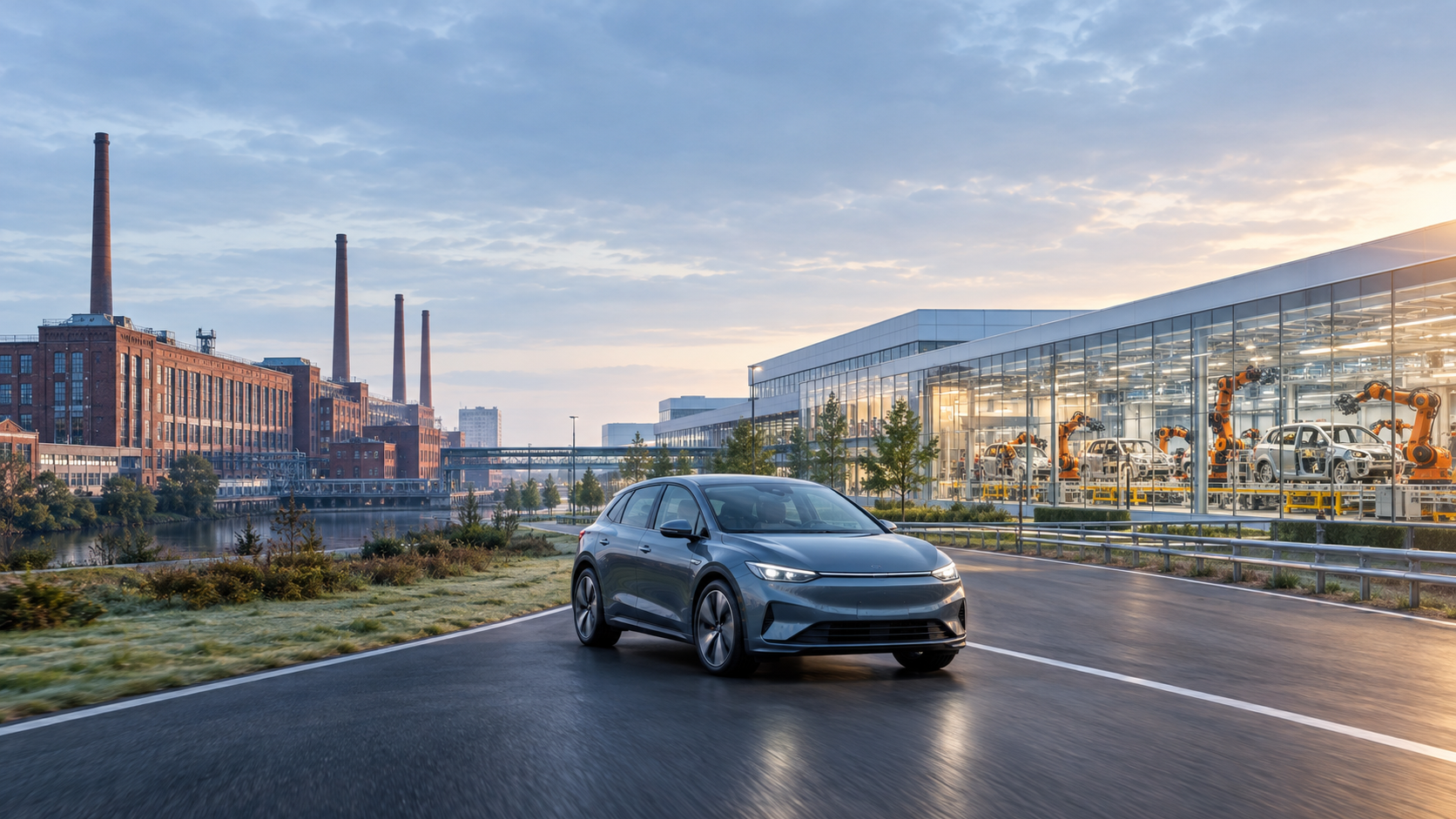
Volkswagen's China strategy: Volkswagen wants to export from China to the world – and is thus changing the company – Creative image on the topic, with AI: Xpert.Digital
3,000 developers in China: Why Hefei is becoming increasingly important for Volkswagen
Hefei versus Wolfsburg? How Volkswagen's industrial power is shifting
Volkswagen is shifting its future to China: What Hefei means for Wolfsburg
Volkswagen is restructuring its industrial future: While the company is cutting costs and reducing jobs in Germany, Hefei in China is growing into one of its most important development centers. Volkswagen has invested around €3.5 billion there; approximately 3,000 engineers and developers are now working on vehicles and technologies. Hefei is no longer intended solely to serve the Chinese market. The site is also meant to co-develop products and technological foundations for other regions – thus becoming an international platform for the company.
There's more to this than just a regional sales strategy. Volkswagen is increasingly outsourcing development tasks and technological responsibility. Particularly with regard to electric cars, electronics, and software, the work in China is intended to help bring competitive vehicles to market faster and more cost-effectively. By 2030, the company aims to export at least 300,000 vehicles annually from China. This is a goal, not yet a achieved result.
This raises a key question: Does Hefei complement Wolfsburg's capabilities – or will the technological significance within the group shift in the long term? The answer doesn't depend solely on where vehicles are built. Crucially, it depends on who develops and is responsible for the platforms, software, and technical foundations for future models. Hefei is neither automatically Volkswagen's salvation nor necessarily the downfall of Wolfsburg. However, the location illustrates how industrial importance changes: In global competition, it must be continually proven through economically successful products and indispensable expertise.
Wolfsburg saves, Hefei develops: How Volkswagen is redistributing its industrial future
Germany's largest car manufacturer is seeking to improve its competitiveness in China – and is thus calling into question the existing division of labor within its own group
Volkswagen's realignment in China is far more than simply adapting a regional sales strategy. The company is changing the international distribution of its technological expertise. While in Germany, the focus is on personnel costs, overcapacity, and the economic future of individual plants, Hefei in the eastern Chinese province of Anhui is gaining a role that extends beyond the Chinese market. The site is no longer solely producing vehicles and technologies for Chinese customers. It is increasingly intended to co-develop and supply other regions of the world.
Volkswagen has invested around €3.5 billion in Hefei. Approximately 3,000 engineers and developers work there. After Wolfsburg, the site is considered the Group's second-largest development center worldwide. This represents an organizational and technological scale that can no longer be considered a mere supplement to the German development apparatus. Hefei is becoming an independent industrial center of excellence within a global company.
The crucial question, therefore, is not whether Hefei will replace Wolfsburg in the short term. This has neither been announced nor is it a realistic description of the current situation. Rather, the decisive factor is which tasks, technologies, and future investments will emerge at which location. Industrial power rarely shifts through a single spectacular decision. It shifts through development budgets, platform decisions, supplier relationships, and the question of who defines the next product technically.
A regional catch-up strategy is evolving into a global business model
Volkswagen's initial response to technological change in China followed a logical approach: A company seeking renewed success in a dynamic market must work more closely with its customers, competitors, and development cycles. Therefore, vehicles should be developed more locally, rather than adapting products designed elsewhere to Chinese requirements.
This approach was intended to particularly address weaknesses in electric vehicles, digital features, and development speed. Volkswagen is now expanding this strategy. Chinese development expertise is no longer intended solely to improve its competitive position in China, but also to be deployed internationally. Markets in South America, South Africa, and other parts of the Global South are among those targeted. The company aims to export at least 300,000 vehicles annually from China by 2030. This is a target figure, not a representation of actual exports.
Regional localization thus creates a potential global division of labor: development and production in China, marketing and, if necessary, further local value creation in other regions.
This makes economic sense, provided the vehicles and technologies developed in China actually offer cost or performance advantages. However, it also means that the original justification for the location is no longer sufficient. Companies developing for international markets inevitably face competition from other development centers within their own group when it comes to new projects.
Why the expansion in Hefei does not yet prove a successful China restart
A large development center is initially an investment of capital and personnel. It is not yet proof of successful competition. Several stages lie between building technical capabilities and their economic return: products must be launched on time, convince buyers, achieve acceptable prices, and generate sufficient profit margins over their life cycle.
Therefore, it would be premature to consider the Hefei expansion as proof of a successful catch-up. However, it would be equally inaccurate to claim that investments are pointless as long as market share doesn't recover immediately. Vehicle development requires lead time. New electronic architectures or software foundations often only become fully effective over several model generations.
Economic evaluation must therefore distinguish between leading indicators and results. Shorter development times, fewer technical interfaces, or lower development costs can indicate progress. Market shares, sales prices, warranty costs, and operating results, on the other hand, show whether this progress actually translates into tangible benefits for the customer and reflected in the balance sheet.
The international use of Chinese technology also allows for two interpretations. It can be an expression of growing technological strength. However, it can also help to better utilize existing investments and capacities when business in the Chinese domestic market falls short of expectations. Both motives can be at play simultaneously. A sound analysis should not prematurely pit them against each other.
The real power gain lies beneath the bodywork
Hefei's strategic importance is not solely derived from the number of vehicles produced there. More significant is the technological foundation being developed there. Volkswagen has presented a technology package called VEGA, which integrates vehicle platforms, electronics, and software. This is intended to make Chinese development work more readily available as a cohesive system.
A platform defines the essential characteristics of a vehicle: installation space, drive concept, technical interfaces, and the possibilities for economically building different models on it. The electronic architecture organizes the interaction of computers, control units, sensors, and communication links. Software, in turn, controls functions, operation, updates, and numerous customer-relevant features.
Mastering these levels together allows for more influence than just the design of a single model. It shapes how quickly future vehicles are developed, which components are used, and how expensive subsequent modifications will be.
This is precisely where the significance of the Chinese development center lies. Hefei is not only meant to deliver a finished product, but a reusable technical toolkit. When this toolkit is deployed in different regions of the world, its importance within the corporation increases. Then it's not just production that grows at one location; its influence on the company's technological direction also grows.
The pace of development is becoming a key economic factor
Public discussions about the automotive industry often focus on wages, energy prices, and factory costs. These factors are important. However, for software-intensive vehicles, the speed with which a company translates technical changes into marketable products is also crucial.
Long development times cause several economic disadvantages. Capital is tied up for longer before revenues are generated. Assumptions about customer needs can become outdated during development. Technical changes become more expensive the later they are implemented in an already advanced project. Furthermore, the risk increases of launching a vehicle whose digital features already fall short of expectations.
Faster development, however, does not automatically mean better development. If tests are shortened, requirements are unclearly defined, or technical problems are postponed to later updates, short-term time savings can be eaten up by increased quality costs.
The relevant benchmark is therefore not the shortest development time at any cost. What matters is the shortest economically viable time to a sufficiently mature product. A high-performing location must combine speed, safety, quality, and cost.
Hefei will become particularly valuable for Volkswagen if it not only enables faster work, but also the development of workflows that reduce rework, provide clearer responsibilities, and facilitate better technical integration. Such organizational advantages cannot be explained solely by lower wages.
The question of costs begins long before the assembly line
A vehicle doesn't become expensive or cheap only at the factory. A large part of its eventual costs is determined during the development phase. The selection of components, the number of variants, the technical complexity, and the design of interfaces all determine how costly production, maintenance, and further development will be.
A simplified electronics architecture can, for example, reduce the number of different components. Uniform software foundations can lower the effort required to provide functions across multiple models. A consistent platform strategy can prevent similar tasks from having to be solved anew for different vehicles.
However, such savings don't happen automatically. Centralized solutions can create new dependencies. A flaw in a widely used software base can affect many models simultaneously. A platform that is optimized too tightly can make later adjustments difficult. Standardization therefore only offers a lasting advantage if it is combined with sufficient flexibility.
For comparing locations, this has an important consequence: A developer's hourly wage is not a sufficient cost indicator. What matters are the total costs up to the point of a marketable feature and subsequently over the entire product lifecycle. A more expensive team can be more economical if it produces fewer errors. A less expensive team can be superior if it works faster and more reliably.
Two technology spheres are intended to hold the group together
Volkswagen's China management describes a division of labor between a Western technology sphere for Europe and the USA, and a Chinese sphere that is also intended to serve markets in the Global South. This description is meant to clarify that Hefei and Wolfsburg are undertaking different tasks and are not simply implementing the same development program in two locations.
There are understandable reasons for such a separation. Vehicles must meet different regulatory requirements. Digital services require regional partners. Data protection, cybersecurity, and the handling of vehicle data can necessitate different technical and organizational solutions. Customer preferences and willingness to pay also differ.
Nevertheless, such a division is not a natural equilibrium. It must be economically justified and sustainably financed.
The greater the technical differences between the spheres, the greater the effort required for parallel development, testing, and maintenance. The more shared components are used, the more difficult a clear organizational separation becomes.
The company must therefore navigate between two risks: excessive standardization may fail to meet regional requirements, while excessive separation can create unnecessary duplication of effort. The optimal solution is likely to consist less of two completely independent systems and more of shared technical foundations with regionally controllable adjustments.
When better technology challenges the internal order
The most delicate question arises as soon as an in-house solution of comparable quality is significantly cheaper than another. Then, regional specialization becomes an economic selection process.
Assuming an architecture developed in Hefei enables lower vehicle costs, faster updates, and shorter development times, the company would then have to justify why this solution should not be used outside its intended markets. Foregoing its use might be sensible if regulatory hurdles, security requirements, or high adaptation costs negate the advantages. Mere organizational responsibility, however, would be a weak argument in the long run.
Conversely, it would be equally wrong to roll out a Chinese solution globally simply because of a low initial price. The decisive factor is the cost after adaptation, approval, safeguarding, and long-term support.
The central economic tension remains, however: An international corporation can only partially shield internal boundaries from demonstrable competitive advantages. The greater the performance gap between two technical systems becomes, the stronger the pressure to converge.
This means that the competition between Wolfsburg and Hefei is not necessarily an officially declared location rivalry. It can develop quietly over the question of which modular system will be used for the next vehicle project.
The Global South is not a single market
The term Global South is strategically catchy, but economically broad. Southeast Asia, Africa, South America, and the Middle East differ considerably in terms of income, financing options, infrastructure, energy supply, and government industrial policy.
An electric vehicle might be attractive in a wealthy metropolitan area with reliable charging infrastructure, but fail in another market due to high financing costs or a lack of charging options. Similarly, fleet customers may have different requirements than private buyers. A delivery service assesses utilization and operating costs differently than a household that wants to use a vehicle as flexibly as possible over many years.
Volkswagen therefore cannot assume that an electric car that is competitive in China will automatically be successful in all intended export regions.
Market-oriented answers to specific questions are needed: What range is necessary under local conditions? What charging capacity is actually usable? How readily available are spare parts? What repairs can local workshops perform? What are the monthly financing costs?
The international success of Chinese development therefore depends not only on technology and production costs. It depends on whether a cost-effective vehicle becomes a locally viable mobility option.
For many buyers, the monthly payment is the deciding factor, not the software
Discussions about modern vehicles often focus on displays, computing power, and driver assistance features. However, in many target markets, financial accessibility is likely to be a more decisive factor.
A lower manufacturing cost can help, but it's not enough. Transportation, import duties, distribution costs, financing, and local risks all affect the final price. High interest rates can significantly diminish the advantage of a cheaper vehicle through lower monthly payments. Uncertainty about residual values can make leasing more expensive or prevent such offers altogether.
Furthermore, the ongoing costs are also important. Low energy consumption is only a convincing selling point if the required energy is available reliably and at predictable prices. Inexpensive maintenance is of little use if spare parts have long delivery times.
Volkswagen therefore needs to integrate development, sales, and financial services more closely. The economic success of an export model cannot be determined solely by its ex-factory costs.
This leads to a clear priority for product planning: not every technically possible function creates sufficient additional customer value. In price-sensitive markets, a deliberately minimalist, robust, and easily repairable vehicle can be more attractive than a fully equipped model whose higher price significantly reduces the potential customer base.
Our China expertise in business development, sales and marketing

Our China expertise in business development, sales and marketing - Image: Xpert.Digital
Industry focus areas: B2B, digitalization (from AI to XR), mechanical engineering, logistics, renewable energies and industry
More information here:
A thematic hub offering insights and expertise:
- Knowledge platform covering global and regional economies, innovation and industry-specific trends
- A collection of analyses, insights, and background information from our key areas of focus
- A place for expertise and information on current developments in business and technology
- A hub for companies seeking information on markets, digitalization, and industry innovations
Volkswagen's export strategy and its global impact
Capacity utilization makes exports attractive – but it doesn't guarantee profits
The goal of at least 300,000 annual vehicle exports from China by 2030 also has a production-economic dimension. Additional production volumes can help spread development costs and fixed factory expenses across more vehicles. This distribution is a particularly important factor when significant upfront investments are involved.
However, a distinction must be made between average costs and additional profit. A plant may theoretically be operating at a higher capacity through increased production, without every additional export necessarily delivering an attractive profit contribution.
The crucial factor is the profit remaining after transport, customs duties, distribution, warranty risks, and any price reductions. If vehicles are only sold with substantial discounts, increasing the production volume may not improve the result as much as hoped. In the worst-case scenario, revenue and operating costs increase simultaneously.
The scale of production also needs to be clearly defined. The export target refers to vehicles from China and should not simply be interpreted as a production target solely for Hefei.
Strategically, however, this expansion is significant. It demonstrates Volkswagen's intention to leverage its Chinese presence more effectively as an international production and technology platform. This transforms China from a primarily regional sales and manufacturing location into a more broadly integrated component of the company's global architecture.
Technology exports could become more important than finished vehicles
Exporting a vehicle is visible: a finished product leaves a factory and is sold in another country. Exporting technology is less obvious, but can have a greater impact in the long run.
If a platform developed in Hefei is used in other regions, assembly jobs, local supply chains, and sales services may still be created there. However, the underlying technology originates in China. Key decisions regarding further development, components, and software maintenance may also remain there.
This does not necessarily mean that all jobs will move to the same location. Instead, the distribution of different value creation stages will change.
This is crucial for the location debate. A factory can remain in operation and yet lose strategic importance if it increasingly assembles externally defined technical systems. Conversely, a development site can gain considerable influence without taking over all of the production based on it.
For Volkswagen, this division of labor opens up economic opportunities. Technologies could be used in multiple regions without having to transport all vehicles over long distances. For Germany, however, this raises a more complex question than simply the issue of direct vehicle imports: Which core competencies will remain necessary to ensure that domestic production sites continue to play a key role in shaping technological direction?
Wolfsburg won't automatically lose – but its role is changing
The notion of a direct zero-sum game is too simplistic. An international corporation can become more competitive overall through a high-performing Chinese development center. If this leads to attracting additional customers and enabling profitable products, other parts of the corporation can also benefit.
However, it is equally not guaranteed that every benefit of the group will be equally available at all locations.
For Wolfsburg, the number of vehicles sold worldwide under the Volkswagen name is not the only decisive factor. What matters is which development tasks, investment decisions, and technological responsibilities remain associated with the location.
A corporate headquarters can continue to control strategy, financing, and brand management while simultaneously losing operational development expertise. Conversely, it can retain a central role through system integration, safety responsibility, and sophisticated overall vehicle development.
Wolfsburg's future therefore does not depend on minimizing Chinese expertise. It depends on the essential skills the city develops itself.
Particularly valuable are tasks that combine technical depth, high reliability, and mastery of complex systems. However, simply pointing to past successes is not enough. Such capabilities must be demonstrated both economically and technically with each new product generation.
German staff reductions and Hefei are not the same thing
The simultaneous expansion of Chinese development and the restructuring of German sites suggest a direct connection. Nevertheless, the two should be analytically separated.
Volkswagen already agreed at the end of 2024 to cut more than 35,000 jobs in Germany by 2030. The economic issues addressed in that agreement included excess capacity as well as labor and development costs. These problems cannot be fully explained by the expansion of a single Chinese plant.
Hefei is therefore not the sole cause of German adaptation problems. Rather, the location illustrates how the alternatives within the group are changing.
As long as certain technical tasks could only be solved at a few European locations, their negotiating position was particularly strong. This position changes when other units offer comparable or better services.
This creates a double burden for employees: existing structures must become more efficient, while at the same time new skills need to be developed. Simply reducing staff does not automatically solve this problem. It can lower costs, but it can also damage skills that are needed for future products.
A viable restructuring must therefore be more precise than a blanket downsizing. It must differentiate between avoidable complexity, dispensable redundancies, and strategically necessary competencies.
Suppliers come under pressure earlier than the large factories
The consequences of this new division of labor extend beyond Volkswagen. Suppliers, development service providers, and software companies depend on where technical decisions are made and what requirements arise from them.
If an architecture is defined in China, established suppliers there can be more easily integrated into early development phases. Those who already collaborate on prototypes, interfaces, and validation have an advantage when making later decisions regarding series production.
For German and European suppliers, this does not necessarily mean exclusion. However, it does change the conditions for their competitiveness. Technical quality alone may not be enough if proximity to development, speed of response, and cost position cannot keep pace.
The situation is particularly challenging for companies with a high dependence on a few customers and established product families. When vehicle architectures change, previously important components can lose significance or be integrated into more comprehensive systems.
The strategic response must therefore go beyond mere price concessions. Suppliers need clarity on which skills will remain in demand in new architectures and where they can take on new tasks.
This is crucial for Germany as an industrial location. The loss of a development contract can spread across numerous specialized companies and therefore initially be less visible than the closure of a large production line.
Low costs are only as good as the risks that are controlled
The use of Chinese technologies can bring significant economic benefits. At the same time, it can create new dependencies. These should neither be dramatized nor downplayed.
Crucial factors include who has access to which technical components, what rights exist to the software and its further developments, and whether systems can be maintained independently. The availability of components, development tools, and specialized personnel is also part of the risk assessment.
A cost-effective technical kit is less valuable if later modifications are only possible under strict conditions. Likewise, a seemingly more expensive solution can be economically advantageous if it offers greater flexibility.
Therefore, the relevant factor is not just the current price, but the risk-adjusted benefit over several years.
Volkswagen must distinguish between different forms of dependency. Utilizing its own Chinese development resources is different from being completely dependent on an external supplier. However, even in-house capabilities are subject to regional constraints and cannot be arbitrarily transferred between countries.
A robust strategy should therefore consider technical interchangeability, documented interfaces, and clear responsibilities. Resilience does not arise from complete isolation, but from the ability to react to changing conditions.
The dual strategy could even become more expensive temporarily
A common misconception is to equate new technologies directly with lower overall costs. During a transition phase, the opposite is often true.
When existing vehicle architectures require ongoing support while new systems are being developed, expenses run in parallel. Software teams maintain multiple generations. Plants require different processes. Employees need training. New components and procedures necessitate additional testing.
For Volkswagen, building a high-performance Chinese technology sector may therefore initially involve additional burdens, even if the vehicles based on it later become cheaper.
The economically crucial factors are how long this transition phase lasts and whether older structures are actually simplified. If new systems are constantly added without consistently phasing out existing versions, complexity will increase permanently.
This makes the architectural decision a management task. The company must determine which solutions are sustainable in the long term and where consolidation makes sense.
This is precisely where a potential limitation of the formula of two separate technology spheres lies. If both areas become increasingly complex independently, regional optimization can come at the expense of overall efficiency. The advantages of local speed must therefore be weighed against the costs of company-wide diversity.
The brand must credibly combine different technologies
Volkswagen doesn't just sell platforms and software. The brand is associated with expectations of reliability, usability, safety, and everyday practicality.
If vehicles with different technical foundations are offered under the same brand name in the future, the company must meet these expectations across regional differences. Customers are generally less interested in where a control unit was developed than in whether the vehicle functions reliably and whether support is available.
This can become a strength. A shared brand makes it possible to pool technical expertise from different regions. However, it can also become a risk if quality, user interface logic, or service diverge significantly.
Therefore, the global division of labor requires common minimum standards. These include verifiable quality requirements, a reliable supply of spare parts, and clear responsibilities in case of errors.
Volkswagen should not standardize every regional peculiarity. Different markets require different solutions. The challenge lies in allowing diversity where it creates customer value and enforcing uniformity where it ensures trust, safety, and profitability.
The brand is therefore not a substitute for technical integration. Rather, it raises the bar for combining different systems in such a way that the differences do not become a problem for customers.
What success should actually be measured by
The evaluation of Hefei's strategy should not be limited to investment sums or individual model launches. A multi-layered analysis is necessary.
First and foremost, development productivity is key: How much time and money does a new vehicle need to reach market readiness? How frequently do delays occur? How much effort is required for subsequent corrections?
Next comes the product's competitiveness: What price are customers willing to accept? How are orders, residual values, and repurchase rates developing? Do sales need to be supported by high discounts?
At the corporate level, the crucial question is whether increased production volumes and technical simplifications lead to a better result. This also includes the question of whether the number of parallel architectures decreases or continues to grow.
For each location, the distribution of development budgets and responsibility for future platforms should also be considered. These factors reveal strategic shifts earlier than employment figures alone.
A successful export launch would be an important step, but not conclusive proof. Sustainable success will only come when vehicles can be sold economically over a longer period, reliably serviced, and technically further developed.
Three possible developments instead of a premature certainty
Three fundamentally plausible development paths can be distinguished for the coming years.
In the first scenario, regional integration is successful. Hefei improves its business in China and develops competitive solutions for other markets. European locations retain clearly defined core competencies. Common standards limit complexity. In this case, the international division of labor strengthens the group without reducing any single location to a mere administrator of leftover resources.
In the second phase, the influence of Chinese technology gradually expands beyond the initially targeted regions. Cost and speed advantages lead to an increasing number of projects utilizing technologies developed there. Wolfsburg remains important, but loses some of its previous technological uniqueness.
In the third scenario, the expected benefits fall short of the plans. Export markets develop more slowly, adjustments become more expensive, or products fail to achieve sufficient margins. This can lead to a situation where Volkswagen has built additional structures without adequately resolving its existing economic problems.
These scenarios are not predictions with equal probability. They illustrate which variables are crucial: actual competitiveness, managed complexity, market access, and the ability to translate technological advances into profitable business.
Germany needs an answer beyond protecting its economic base
From a German perspective, it would be too simplistic to view Hefei solely as a threat. An internationally operating manufacturer must be able to develop its products where important markets and relevant technical expertise are emerging. Forgoing this could weaken the entire corporation.
It is equally insufficient to assume that successful foreign business deals automatically benefit Germany as an industrial location.
The quality of domestic value creation is crucial. Germany must remain a place where complex systems can not only be managed, but also developed, tested, and produced with reasonable effort. This requires high-performance digital infrastructure, a readily available skilled workforce, favorable economic conditions, and companies that implement decisions swiftly.
At the operational level, this means clarifying responsibilities and taking technical simplification seriously. High levels of engineering expertise lose some of their economic value when they are tied up in slow coordination processes or unnecessary product variety.
The most sensible response to Hefei is therefore not to demand that they be less capable there. It consists of demonstrating more convincingly at German locations why certain tasks are particularly well accomplished there.
This is more demanding than a simple cost debate. It combines productivity with technological innovation and requires concrete decisions about which capabilities should be maintained and expanded in the long term.
The decisive boundary does not lie between countries, but between capabilities
Hefei represents a change that goes beyond Volkswagen: The origin of a brand no longer permanently determines where its most important technology is developed.
This could present an opportunity for the company. Chinese development expertise, European systems experience, international sales networks, and regional production could combine to form a powerful force. The prerequisite, however, is that this actually results in better products and sustainable outcomes.
For Wolfsburg, this means a new reality. Historical significance does not automatically protect against the loss of future responsibilities. At the same time, technological leadership is not the immutable property of another location. It must be continually earned.
The economically decisive question is therefore not whether Volkswagen will become more German or more Chinese. It is whether the company organizes its globally distributed capabilities in such a way that it remains competitive in terms of cost, quality, and speed in the long term.
The crucial question from a location policy perspective is a different one: What indispensable contribution do German development centers and plants make to this overall system?
As long as these two questions are kept clearly separate, the development can be assessed objectively. Hefei is neither automatically Volkswagen's salvation nor necessarily the downfall of Wolfsburg. However, the location sends a clear signal: In global competition, industrial importance is no longer solely determined by tradition, but by the ability to create the next generation of economically compelling products.
🎯🎯🎯 Data-driven B2B industry hub as a quasi-in-house solution


The quasi-in-house solution: How Xpert.Digital closes operational gaps in B2B marketing and sales – Smart Content-Driven Business - Image: Xpert.Digital
Xpert.Digital is a data-driven B2B industry hub led by Konrad Wolfenstein . The company acts as an external, quasi-in-house solution for industrial partners, closing operational gaps in marketing, content, and sales – without requiring additional resources on the client side.
More information here:
Your global marketing and business development partner
☑️ Our business language is English or German
☑️ NEW: Correspondence in your native language!

Konrad Wolfenstein
I and my team are happy to be available to you as your personal advisor.
You can contact me by filling out the contact form here wolfenstein@xpert.digital:or simply call me at +49 7348 4088 965. My email address is
I'm looking forward to our joint project.