
Leadership in AI Transformation: A Workshop Report for Specialists and Managers
Xpert Pre-Release

Available in 27 languages 📢
Prefer Xpert.Digital on GoogleⓘPublished on: May 10, 2025 / Updated on: May 10, 2025 – Author: Konrad Wolfenstein

Leadership in AI Transformation: A Workshop Report for Specialists and Managers – Image: Xpert.Digital
What leaders MUST know about AI now: Seizing opportunities, managing risks, leading with confidence (Reading time: 32 min / No advertising / No paywall)
Mastering the AI Revolution: An Introduction for Leaders
The transformative power of AI: Redesigning work and value creation
Artificial intelligence (AI) is considered a technology that, like few others, opens up new possibilities for fundamentally rethinking work and value creation. For companies, integrating AI is a crucial step toward long-term success and competitiveness, as it fosters innovation, increases efficiency, and improves quality. The economic and social impact of AI is significant; it is one of the most important digital topics of the future, is developing rapidly, and holds enormous potential. Companies are increasingly recognizing the advantages of automation and efficiency gains through AI. This is not merely a technological shift, but a fundamental transformation of business models, process optimization, and customer interactions, making adaptation a necessity for survival in the competitive landscape.
The much-cited “transformative power” of AI goes beyond the mere introduction of new tools; it implies a paradigm shift in strategic thinking. Leaders are challenged to reassess core processes, value propositions, and even industry structures. Those who view AI merely as an efficiency tool risk overlooking its deeper strategic potential. The rapid development of AI coincides with an existing skills shortage. This creates a twofold challenge: On the one hand, there is an urgent need for rapid upskilling to utilize AI. On the other hand, AI offers the opportunity to automate tasks and thus potentially alleviate the skills shortage in some areas, while simultaneously creating new qualification requirements. This necessitates nuanced workforce planning on the part of leaders.
Suitable for:

Weighing the opportunities and risks in the age of AI
While AI systems offer highly effective opportunities, they are inextricably linked to risks that must be managed. The discourse surrounding AI involves weighing its significant potential against inherent dangers, requiring a balanced approach to leverage benefits and minimize drawbacks. Businesses face the challenge of driving innovation while adhering to data privacy and ethical guidelines, making the balance between progress and compliance crucial.
This balancing act is not a one-off decision, but an ongoing strategic necessity. As AI technologies evolve—for example, from specialized AI to more general capabilities—the nature of the opportunities and risks will also change. This requires a continuous reassessment and adaptation of governance and strategy. The perception of the risks and benefits of AI can vary considerably within an organization. For instance, active AI users tend to be more optimistic than those who have not yet adopted AI. This highlights a critical change management challenge for leaders: This perception gap must be closed through education, clear communication, and the demonstration of tangible benefits while simultaneously addressing concerns.
Understanding the AI landscape: core concepts and technologies
Generative AI (GenAI) and the path to Artificial General Intelligence (AGI)
Generative AI (GenAI)
Generative AI (GenAI) refers to AI models designed to generate new content in the form of written text, audio, images, or videos, offering a wide range of applications. GenAI helps users create unique, meaningful content and can function as an intelligent question-and-answer system or personal assistant. GenAI is already revolutionizing content creation, marketing, and customer engagement by enabling the rapid production of personalized materials and the automation of responses.
GenAI's immediate accessibility and broad range of applications mean that it often serves as the "entry-level AI" for many organizations. This initial exposure shapes perceptions and can either drive or hinder wider AI adoption. Leaders must carefully manage these early experiences to create positive momentum.
Artificial General Intelligence (AGI)
Artificial General Intelligence (AGI) refers to the hypothetical intelligence of a machine capable of understanding or learning any intellectual task a human can perform, thus mimicking human cognitive abilities. It focuses on AI systems that can perform a broad range of tasks rather than being specialized in specific ones.
Currently, true AGI does not exist; it remains a concept and a research goal. OpenAI, a leading company in this field, defines AGI as "highly autonomous systems that outperform humans at most economically valuable work." By 2023, only the first of five ascending AGI stages, known as "Emerging AI," was considered to have been achieved.
The ambiguity and varying definitions of AGI suggest that leaders should view it as a long-term, potentially transformative horizon rather than an immediate operational concern. The focus should be on leveraging current "powerful AI" while strategically monitoring the progress of AGI. Overinvestment in speculative AGI scenarios could divert resources from more immediate AI opportunities. The evolution from specialized AI through GenAI to ongoing research into AGI implies an increasing degree of autonomy and capability in AI systems. This trend correlates directly with a growing need for robust ethical frameworks and governance, as more powerful AI carries a greater potential for misuse or unintended consequences.
Suitable for:

AI Assistants vs. AI Agents: Defining Roles and Capabilities
AI assistants support people with individual tasks, respond to requests, answer questions, and make suggestions. They are typically reactive and wait for human commands. Early assistants were rule-based, but modern ones rely on machine learning (ML) or foundation models. In contrast, AI agents are more autonomous and capable of pursuing goals and making decisions independently with minimal human intervention. They are proactive, can interact with their environment, and adapt through learning.
The main differences lie in autonomy, task complexity, user interaction, and decision-making capabilities. Assistants provide information for human decision-making, while agents can make and execute decisions. In practice, assistants improve the customer experience, support banking inquiries, and streamline HR tasks. Agents, on the other hand, can adapt to user behavior in real time, proactively prevent fraud, and automate complex HR processes such as talent acquisition.
The transition from AI assistants to AI agents signals an evolution from AI as a "tool" to AI as a "collaborator" or even an "autonomous employee." This has profound implications for job design, team structures, and the skills required of human employees who will increasingly need to manage and collaborate with these intelligent agents. As AI agents become more prevalent and capable of making independent decisions, the "accountability gap" becomes a more pressing issue. If an AI agent makes a flawed decision, assigning responsibility becomes complex. This underscores the critical need for robust AI governance that addresses the unique challenges of autonomous systems.
Below is a comparison of the most important distinguishing features:
Comparison of AI assistants and AI agents
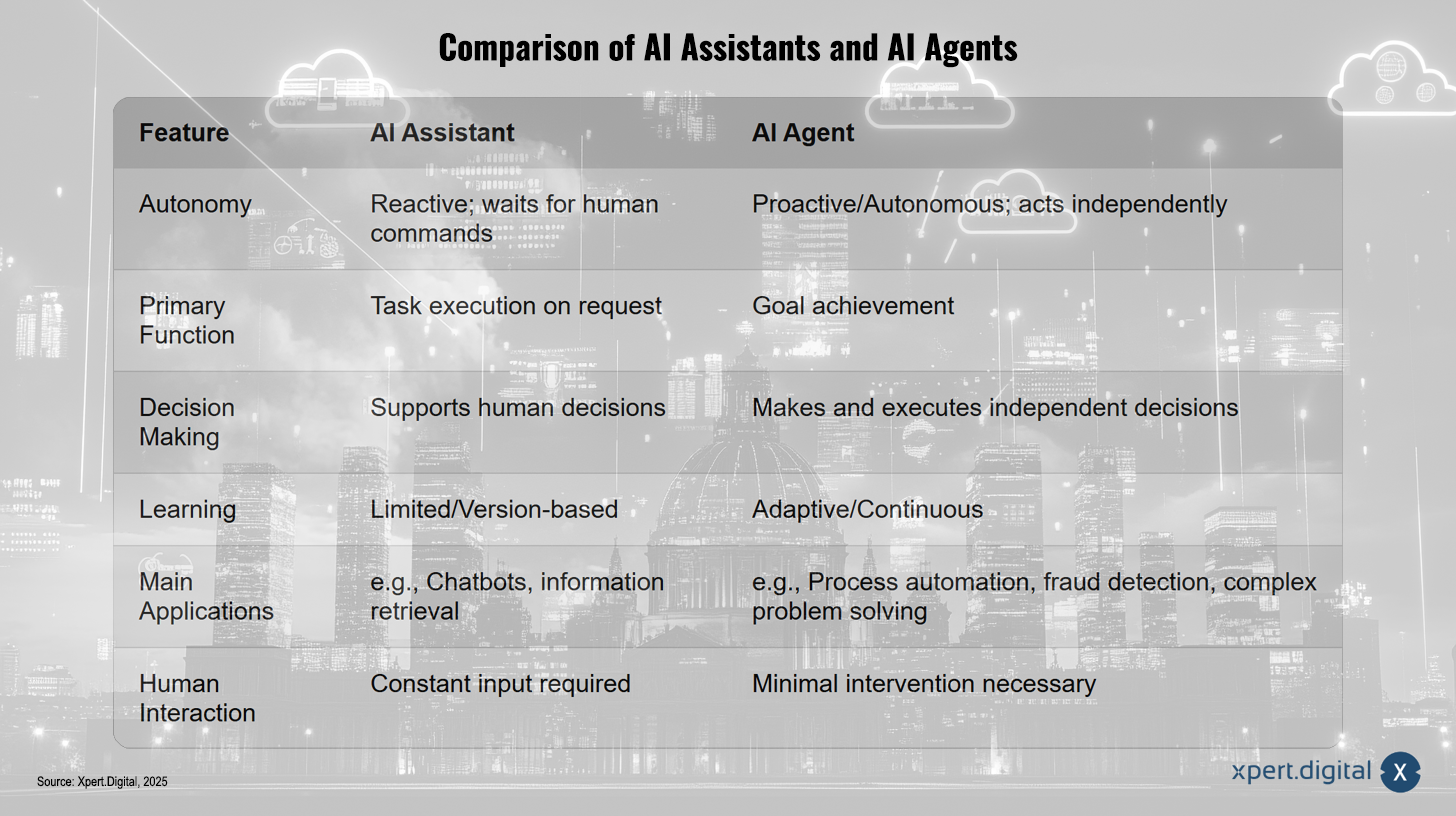
Comparison of AI assistants and AI agents – Image: Xpert.Digital
This table provides executives with a clear understanding of the fundamental differences to select the appropriate technology for specific needs and to anticipate the varying levels of oversight and integration complexity.
A comparison between AI assistants and AI agents reveals significant differences in their characteristics. While AI assistants tend to be reactive and wait for human commands, AI agents act proactively and autonomously, taking independent action. The primary function of an AI assistant is to execute tasks on demand, whereas an AI agent is focused on achieving a specific goal. In decision-making, AI assistants support humans, while AI agents make and implement decisions independently. Their learning behavior also differs: AI assistants typically learn in a limited, version-based manner, while AI agents learn adaptively and continuously. Key applications of AI assistants include chatbots and information retrieval, while AI agents are used in process automation, fraud detection, and solving complex problems. Interaction with humans requires constant input from AI assistants, whereas AI agents require only minimal human intervention.
The engine room: Machine learning, large language models (LLMs) and basic models
Machine Learning (ML)
Machine learning is a subfield of AI where computers learn from data and improve with experience without being explicitly programmed. Algorithms are trained to find patterns in large datasets and make decisions and predictions based on these patterns. ML models include supervised learning (learning from labeled data), unsupervised learning (finding patterns in unlabeled data), semi-supervised learning (a mixture of labeled and unlabeled data), and reinforcement learning (learning through trial and error with rewards). ML increases efficiency, minimizes errors, and supports decision-making in businesses.
Understanding the different types of machine learning is important for managers not only from a technical perspective, but also for understanding data requirements. Supervised learning, for example, requires large amounts of high-quality, labeled datasets, which has implications for data strategy and investment. While identifying the business problem should be the starting point, the applicability of a particular type of machine learning will depend heavily on the availability and nature of the data.
Large Language Models (LLMs)
Large language models (LLMs) are a type of deep learning algorithm trained on massive datasets and frequently used in natural language processing (NLP) applications to respond to natural language queries. Examples include OpenAI's GPT series. LLMs can generate human-like text, power chatbots, and support automated customer service. However, they can also inherit inaccuracies and biases from the training data, raising copyright and security concerns.
The problem of "memorization" in LLMs, where they output text verbatim from training data, poses significant copyright and plagiarism risks for companies using LLM-generated content. This necessitates careful review processes and an understanding of the origin of LLM output.
Basic models
Baseline models are large AI models trained on broad datasets and adaptable (fine-tuned) for a variety of downstream tasks. They are characterized by emergence (unexpected capabilities) and homogenization (a common architecture). They differ from classical AI models in that they are initially domain-independent, use self-supervised learning, enable transfer learning, and are often multimodal (processing text, images, and audio). Learning Lifecycle Management (LLMs) are a type of baseline model. Advantages include faster market access and scalability; however, challenges include transparency (the "black box" problem), data privacy, and high costs or infrastructure requirements.
The rise of basic models signals a shift toward more versatile and adaptable AI. However, their "black box" nature and the significant resources required for training or fine-tuning mean that access and control could become concentrated, potentially creating dependencies on a few large vendors. This has strategic implications for make-or-buy decisions and the risk of vendor lock-in. The multimodal capability of many basic models opens up entirely new categories of applications that can synthesize insights from different data types (e.g., analyzing text reports alongside surveillance camera footage). This goes beyond what text-focused LLMs can do and requires executives to think more broadly about their available data assets.
The regulatory compass: Navigating legal and ethical frameworks
The EU AI Law: Key provisions and implications for companies
The EU AI Law, which came into force on August 1, 2024, is the world's first comprehensive AI law and establishes a risk-based classification system for AI.
Risk categories:
- Unacceptable risk: AI systems that pose a clear threat to security, livelihoods, and rights are prohibited. Examples include social scoring by public authorities, cognitive manipulation of behavior, and the indiscriminate scanning of facial images. These prohibitions will largely come into effect by February 2, 2025.
- High risk: AI systems that negatively impact safety or fundamental rights. These are subject to strict requirements, including risk management systems, data governance, technical documentation, human oversight, and pre-market conformity assessments. Examples include AI in critical infrastructure, medical devices, employment, and law enforcement. Most rules for high-risk AI will apply from August 2, 2026.
- Limited risk: AI systems such as chatbots or those that generate deepfakes must comply with transparency obligations and inform users that they are interacting with AI or that content is AI-generated.
- Minimal risk: AI systems such as spam filters or AI-powered video games. The Act permits their free use, although voluntary codes of conduct are encouraged.
Suitable for:

The Act sets out obligations for suppliers, importers, distributors, and users (operators) of AI systems, with suppliers of high-risk systems subject to the strictest requirements. Due to its extraterritorial application, it also affects companies outside the EU if their AI systems are used on the EU market. Specific rules apply to general-purpose AI (GPAI) models, with additional obligations for those classified as posing a "systemic risk." These rules generally apply from August 2, 2025. The Act has a phased implementation: prohibitions (February 2025), GPAI rules (August 2025), most high-risk rules (August 2026), and specific high-risk product rules (August 2027). Non-compliance can result in substantial fines, up to €35 million or 7% of global annual turnover for prohibited applications. Article 4 also stipulates, from February 2025, an appropriate level of AI competence for the staff of providers and operators of certain AI systems.
The risk-based approach of the EU AI law requires a fundamental shift in how companies approach the development and deployment of AI. It is no longer solely about technical feasibility or business value; regulatory compliance and risk mitigation must be integrated from the very beginning of the AI lifecycle (“compliance by design”). The “AI competency obligation” is a significant, early-acting provision. This implies an immediate need for companies to assess and implement training programs, not only for technical teams but for everyone who develops, deploys, or monitors AI systems. This goes beyond basic awareness and includes an understanding of functionalities, limitations, and ethical and legal frameworks. The law’s focus on GPAI models, particularly those with systemic risk, indicates regulatory concern about the broad and potentially unforeseen impacts of these powerful, versatile models. Companies using or developing such models will be subject to heightened scrutiny and obligations, impacting their development plans and go-to-market strategies.
Overview of the risk categories of the EU AI law and key obligations
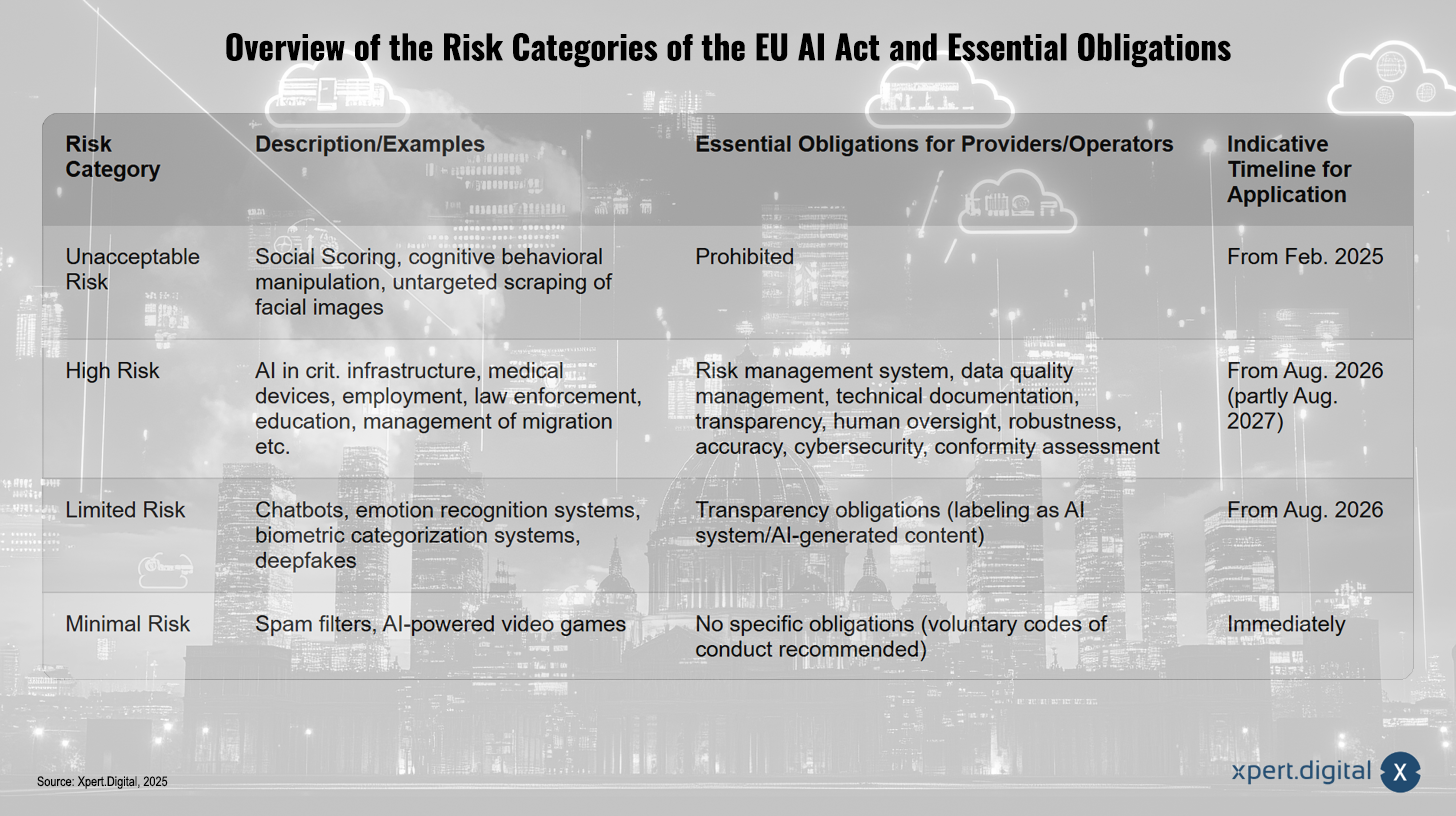
Overview of the risk categories of the EU AI law and key obligations – Image: Xpert.Digital
This table summarizes the core structure of the EU AI law and helps executives to quickly identify which category their AI systems might fall into and to understand the corresponding compliance burden and timelines.
An overview of the risk categories in the EU AI law shows that systems with an unacceptable risk, such as social scoring, cognitive behavioral manipulation, and indiscriminate facial image scraping, are completely prohibited and may no longer be used from February 2025. High-risk AI, used, for example, in critical infrastructure, medical devices, employment, law enforcement, education, or migration management, is subject to extensive obligations. Providers and operators must, among other things, demonstrate a risk management system, data quality management, and technical documentation, as well as ensure transparency, guarantee human oversight, and meet criteria such as robustness, accuracy, cybersecurity, and conformity assessment. The corresponding measures will come into force from August 2026, and in some cases from August 2027. Limited risk applies to AI applications such as chatbots, emotion recognition systems, biometric categorization systems, and deepfakes. Transparency obligations apply here, such as labeling as an AI system or AI-generated content, which will also come into effect from August 2026. For AI applications with minimal risk, such as spam filters or AI-powered video games, there are no specific obligations, although voluntary codes of conduct are recommended. Such systems can be deployed immediately.
The tension between innovation and accountability: Finding the right balance
Companies must navigate the tension between fostering AI innovation and ensuring accountability, data protection (GDPR), and ethical use. The GDPR principles (lawfulness, fairness, transparency, purpose limitation, data minimization, accuracy, and accountability) are fundamental to responsible AI and influence how AI systems are developed and deployed. Strategies for balancing these principles include the early involvement of compliance and data protection teams, regular audits, leveraging external expertise, and employing specialized compliance tools. Some view regulatory guidelines not as obstacles to innovation, but as accelerators that build trust and increase the adoption of new technologies.
The "innovation-accountability tension" is not a static compromise, but a dynamic equilibrium. Companies that proactively integrate accountability and ethical considerations into their AI innovation cycle are more likely to build sustainable, trustworthy AI solutions. This ultimately fosters greater innovation in the long run by avoiding costly retrofits, reputational damage, or regulatory penalties. The challenge of maintaining accountability is compounded by the increasing complexity and potential "black box" nature of advanced AI models (such as some discussed in basic models). This necessitates a stronger focus on explainability AI (XAI) techniques and robust audit mechanisms to ensure that AI-driven decisions can be understood, justified, and, if necessary, challenged.
🎯📊 Integration of an independent and cross-data-source AI platform 🤖🌐 for all business needs

Integration of an independent and cross-data-source AI platform for all business needs - Image: Xpert.Digital
AI Game Changer: The most flexible AI platform - Tailor-made solutions that reduce costs, improve your decisions and increase efficiency
Independent AI platform: Integrates all relevant company data sources
- This AI platform interacts with all specific data sources
- From SAP, Microsoft, Jira, Confluence, Salesforce, Zoom, Dropbox and many other data management systems
- Rapid AI integration: Tailor-made AI solutions for businesses in hours or days, instead of months
- Flexible infrastructure: Cloud-based or hosting in your own data center (Germany, Europe, free choice of location)
- Maximum data security: its use in law firms is irrefutable proof
- Deployment across a wide variety of enterprise data sources
- Choice of own or different AI models (DE, EU, USA, CN)
Challenges that our AI platform solves
- Lack of fit of conventional AI solutions
- Data protection and secure management of sensitive data
- High costs and complexity of individual AI development
- Shortage of qualified AI specialists
- Integration of AI into existing IT systems
More about it here:
AI Strategies for Executives: Practical Guidelines and Examples

AI strategies for executives: Practical guidelines and examples – Image: Xpert.Digital
AI in action: Applications, use cases and effective interaction
Recognizing opportunities: AI application possibilities and use cases across industries
AI offers diverse application possibilities, including content creation, personalized customer communication, process optimization in production and logistics, predictive maintenance, and support in finance, human resources, and IT.
Specific industry examples include:
- Automotive/Manufacturing: AI and simulation in research (ARENA2036), automated robot interaction (Festo), process optimization and predictive maintenance in production (Bosch).
- Financial services: Increased security through analysis of large data sets for suspicious transactions, automated invoicing, investment analysis.
- Healthcare: Faster diagnoses, expanded access to care (e.g., interpretation of medical images), optimization of pharmaceutical research.
- Telecommunications: Optimization of network performance, audiovisual improvements, prevention of customer churn.
- Retail/E-commerce: Personalized recommendations, chatbots for customer service, automated checkout processes.
- Marketing & Sales: Content creation (ChatGPT, Canva), optimized campaigns, customer segmentation, sales forecasts.
While many use cases focus on automation and efficiency, a key emerging trend is the role of AI in enhancing human decision-making and enabling new forms of innovation (e.g., drug development; product development). Leaders should look beyond cost reduction to identify AI-driven growth and innovation opportunities. The most successful AI implementations often involve integrating AI into existing core processes and systems (e.g., SAP using AI in enterprise software, Microsoft 365 Copilot), rather than treating AI as a standalone, isolated technology. This requires a holistic view of the enterprise architecture.
Suitable for:

Mastering Dialogue: Effective Prompting for Generative AI
Prompt engineering is an iterative, test-driven process for improving model performance that requires clear goals and systematic testing. Effective prompts depend on both their content (instructions, examples, context) and structure (order, labeling, separators).
Important components of a prompt include: goal/mission, instructions, constraints (what to do/not do), tone/style, context/background data, few-shot examples, chain of thought, and desired response format.
Best practices include:
- Set clear goals and use action verbs.
- Provide context and background information.
- Define the target group precisely.
- Tell the AI what not to do.
- Formulate prompts clearly, concisely, and with precise word choice.
- Add output limits, especially for writing tasks.
- Assign a role to the AI (e.g., "You are a math tutor").
- Prompt chaining (using interconnected prompts) can generate continuous ideas.
Effective prompting is less about finding a single "perfect prompt" and more about developing a strategic approach to interacting with LLMs. This involves understanding the model's capabilities, iteratively refining prompts based on output, and using techniques like role assignment and chain-of-thought to guide the AI toward desired results. It's a skill that requires practice and critical thinking. The ability to provide relevant context and define constraints is paramount for obtaining valuable results from GenAI. This means that the quality of AI-generated content is often directly proportional to the quality and specificity of the human input, underscoring the continued importance of human expertise in the process.
Best practices for creating effective AI prompts
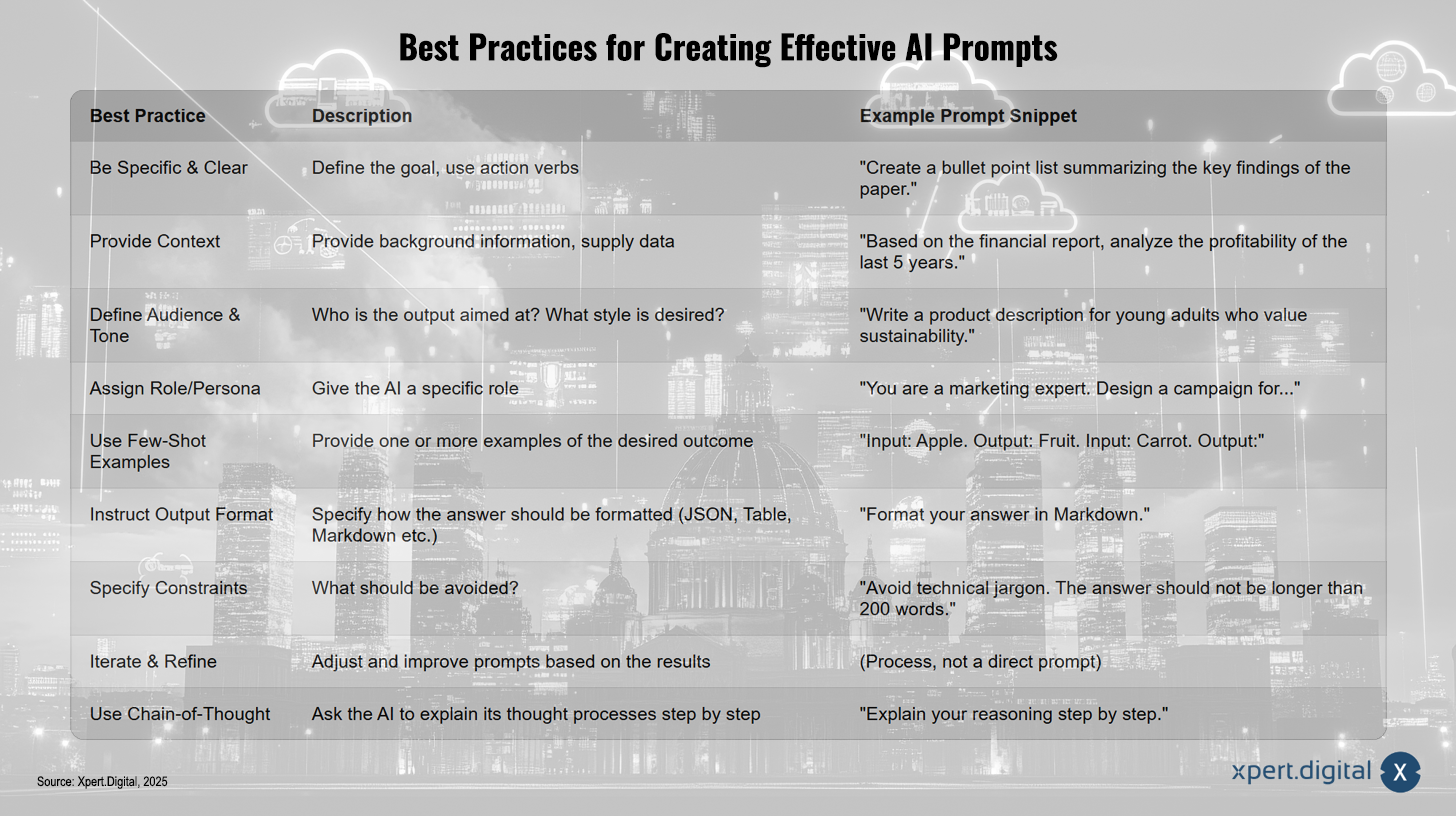
Best practices for creating effective AI prompts – Image: Xpert.Digital
This table offers practical, actionable advice that managers and professionals can immediately apply to improve their interactions with generative AI tools.
To achieve valuable results when using generative AI, it is crucial to proceed specifically and clearly, precisely defining the goal and using action verbs, such as "Create a bulleted list summarizing the key findings of the paper." Equally important is providing context, for example, by supplying background information and relevant data, such as "Based on the financial report, analyze the profitability over the past five years." The target audience and desired tone should be clearly articulated, such as "Write a product description for young adults who value sustainability." The AI can also be assigned a specific role or persona, for example, "You are a marketing expert. Design a campaign for…". Few-shot examples, such as "Input: Apple. Output: Fruit. Input: Carrot. Output:", can help clarify the desired output format. Defining the precise formatting of the responses is also advisable, such as "Format your response in Markdown." Restrictions such as "Avoid jargon. The answer should not exceed 200 words" help optimize the output. An iterative approach, where prompts are adjusted and refined based on previous results, further improves quality. Finally, the chain of thought can be utilized by asking the AI to explain its reasoning process step by step, for example, "Explain your argument step by step.".
Addressing invisible AI: Understanding and managing shadow applications (shadow AI)
Shadow AI refers to the unauthorized or unregulated use of AI tools by employees, often to increase productivity or circumvent slow official processes. It is a subcategory of shadow IT.
Risks of shadow AI:
- Data security & privacy: Unauthorized tools can lead to data breaches, the disclosure of sensitive public/company data, and non-compliance with GDPR/HIPAA.
- Compliance & Law: Violations of data protection laws, copyright issues, conflicts with freedom of information laws. The EU AI law's requirement for "AI competence" from February 2025 makes addressing these issues urgent.
- Economic/Operational: Inefficient parallel structures, hidden costs through individual subscriptions, lack of control over licenses, incompatibility with existing systems, disruption of workflows, reduced efficiency.
- Quality & Control: Lack of transparency in data processing, potential for biased or misleading results, erosion of public/internal trust.
- Undermining governance: Circumvention of IT governance, which makes it more difficult to enforce security policies.
Strategies for managing shadow AI:
- Development of a clear AI strategy and establishment of a responsible AI policy.
- Providing official, approved AI tools as alternatives.
- Establishing clear guidelines for AI usage, data processing, and approved tools.
- Training and raising employee awareness regarding responsible AI use, risks and best practices.
- Conducting regular audits to detect unauthorized AI and ensure compliance.
- Adopting an incremental AI governance approach, starting with small steps and refining the policies.
- Promoting cross-departmental collaboration and employee engagement.
Shadow AI is often a symptom of unmet user needs or overly bureaucratic technology adoption processes. A purely restrictive approach (“ban AI”) can backfire. Effective management requires understanding the root causes and providing viable, safe alternatives alongside clear governance. The rise of readily available GenAI tools (such as ChatGPT) has likely accelerated the proliferation of shadow AI. Employees can quickly use these tools without IT involvement. This makes proactive AI skills training (as required by EU AI legislation) and clear communication about approved tools even more critical.
Risks of shadow AI and strategic responses
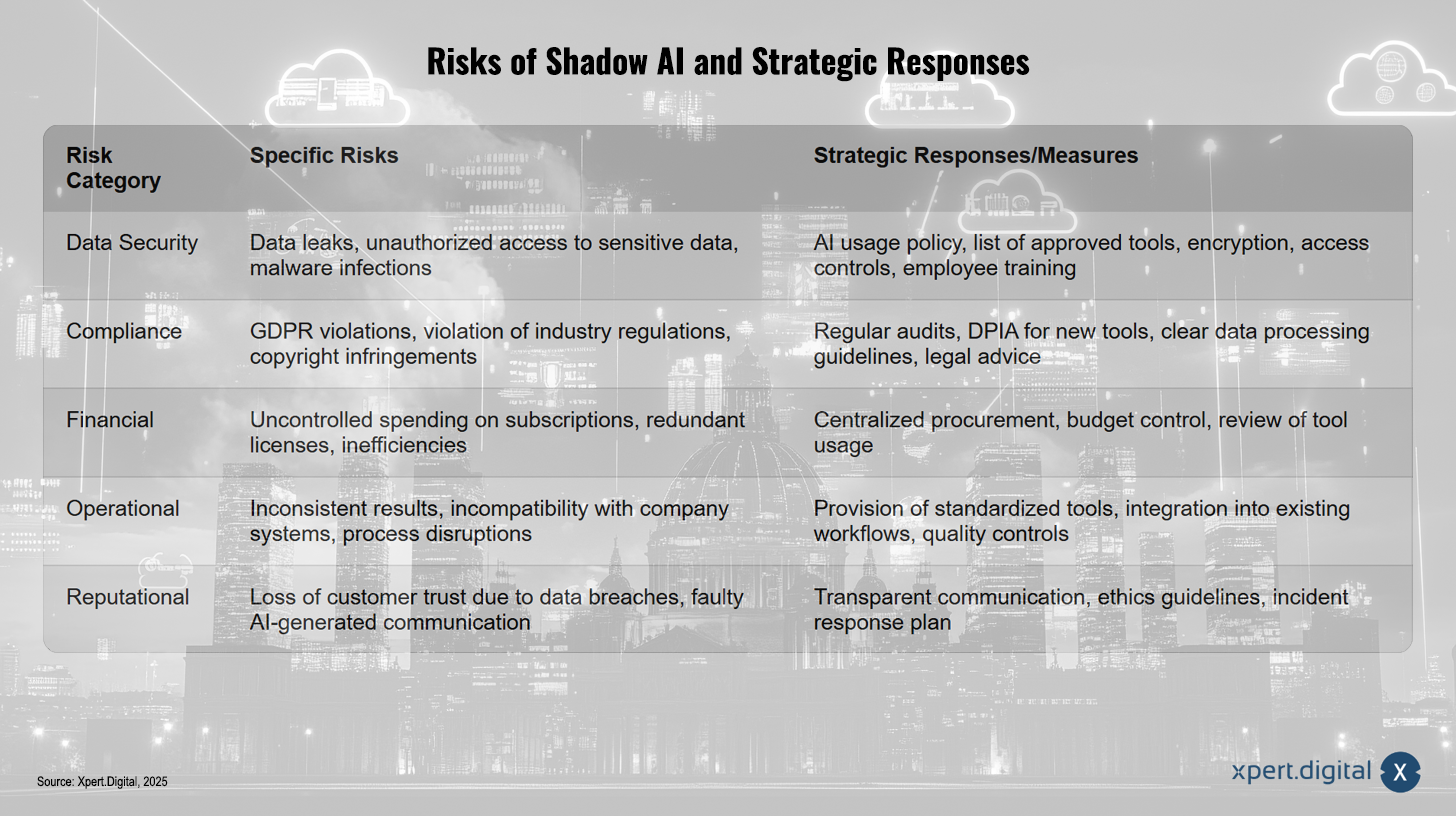
Risks of shadow AI and strategic responses – Image: Xpert.Digital
This table provides a structured overview of the diverse threats posed by unregulated AI use and concrete, actionable strategies for managers.
Shadow AI poses numerous risks that companies must address strategically. In the area of data security, data leaks, unauthorized access to sensitive information, and malware infections can occur. Strategic measures include implementing an AI usage policy, creating a list of approved tools, using encryption, implementing strict access controls, and training employees. Regarding compliance risks, such as GDPR violations, breaches of industry regulations, or copyright infringements, regular audits, data-driven data protection impact assessments (DPIAs) for new tools, clearly defined data processing policies, and, if necessary, legal counsel are essential. Financial risks arise from uncontrolled spending on subscriptions, redundant licenses, or inefficiencies. Therefore, companies should focus on centralized procurement, strict budget control, and regular review of tool usage. Operational challenges such as inconsistent results, incompatibility with existing enterprise systems, or process disruptions can be addressed by providing standardized tools, integrating them into existing workflows, and implementing continuous quality control. Reputational risks also pose a threat, for example, the loss of customer trust due to data breaches or faulty AI-generated communication. Transparent communication, adherence to ethical guidelines, and a well-designed incident response plan are crucial measures for maintaining trust in the company and minimizing potential damage.
🎯🎯🎯 Benefit from Xpert.Digital's extensive, five-fold expertise in a comprehensive service package | BD, R&D, XR, PR & Digital Visibility Optimization

Benefit from Xpert.Digital's extensive, fivefold expertise in a comprehensive service package | R&D, XR, PR & Digital Visibility Optimization - Image: Xpert.Digital
Xpert.Digital has in-depth knowledge of various industries. This allows us to develop tailor-made strategies that are tailored precisely to the requirements and challenges of your specific market segment. By continually analyzing market trends and following industry developments, we can act with foresight and offer innovative solutions. Through the combination of experience and knowledge, we generate added value and give our customers a decisive competitive advantage.
More about it here:
How AI is transforming leadership and collaboration and strengthening soft skills in leadership: The human advantage in the AI age

How AI is transforming leadership and collaboration and strengthening soft skills in leadership: The human advantage in the AI age – Image: Xpert.Digital
The human element: The impact of AI on leadership, collaboration, and creativity
Changing leadership in the age of AI: New requirements and skills
AI requires a shift in leadership focus toward uniquely human capabilities: awareness, compassion, wisdom, empathy, social understanding, transparent communication, critical thinking, and adaptability. Leaders must develop technological competence to make informed decisions about AI tools and guide teams through the transformation. This includes understanding data and critically evaluating AI-generated information.
Key leadership responsibilities include fostering a culture of data-driven decision-making, effective change management, addressing ethical considerations through AI governance, and promoting innovation and creativity. AI can relieve leaders of routine tasks, allowing them to focus on strategic and human aspects such as motivation and employee development. The new role of a Chief Innovation and Transformation Officer (CITO) may emerge, combining technical expertise, behavioral knowledge, and strategic vision. Leaders will need to navigate complex ethical landscapes, drive cultural transformation, manage human-AI collaboration, promote cross-functional integration, and ensure responsible innovation.
The core challenge for leaders in the AI age is not just understanding AI, but leading the human response to it. This includes cultivating a learning culture, addressing fears of job loss, and advocating for the ethical use of AI, making soft skills more important than ever. There is a potential discrepancy in the perception of the importance of interpersonal relationships in the AI age: 82% of employees consider them essential, compared to only 65% of leaders. This gap could lead to leadership strategies that underinvest in human connections, potentially harming morale and collaboration. Effective AI leadership involves a paradoxical skill set: accepting data-driven objectivity from AI while simultaneously strengthening subjective human judgment, intuition, and ethical reasoning. It's about augmenting human intelligence, not surrendering to artificial intelligence.
Suitable for:

Transformation of teamwork: The influence of AI on collaboration and team dynamics
AI can improve teamwork by automating routine tasks, allowing employees to focus on strategic and creative work. AI systems can support better decision-making by analyzing data and providing teams with insights. AI tools can promote better communication and coordination, enabling real-time collaboration and the sharing of information and resources. AI-based knowledge management can facilitate access to centralized knowledge, enable intelligent searching, and promote knowledge sharing. The combination of human creativity, judgment, and emotional intelligence with AI's data analysis and automation capabilities can lead to more efficient and informed work.
Challenges include ensuring data protection and ethical data handling in collaborative AI tools, the potential for a “loss of skills” among employees if AI takes over too many tasks without a strategy for further training, and the fear that personal contacts could become less frequent.
While AI can improve the efficiency of collaboration (e.g., faster information gathering, task automation), leaders must actively work to maintain the quality of human interaction and team cohesion. This means designing workflows so that AI complements team members rather than isolating them, and creating opportunities for genuine human connection. The successful integration of AI into teamwork depends heavily on trust—trust in the reliability and fairness of the technology, as well as trust among team members in how AI-powered insights are used. A lack of trust can lead to resistance and undermine collaborative efforts.
AI as a creative partner: Expanding and redefining creativity in organizations
Generative AI, when implemented strategically and thoughtfully, can create an environment where human creativity and AI coexist and collaborate. AI can foster creativity by acting as a partner, offering new perspectives, and pushing the boundaries of what's possible in fields like media, art, and music. AI can automate routine aspects of creative processes, freeing up people for more conceptual and innovative work. It can also help identify emerging trends or accelerate product development through AI-powered experimentation.
Ethical dilemmas and challenges arise from the fact that AI-generated content challenges traditional notions of authorship, originality, autonomy, and intent. The use of copyrighted data to train AI models and the generation of potentially infringing content are significant concerns. Furthermore, there is a risk of over-reliance on AI, which could potentially stifle independent human creative exploration and skills development in the long term.
Integrating AI into creative processes is not just a matter of new tools, but a fundamental redefinition of creativity itself – towards a model of human-AI co-creation. This requires a shift in mindset among creative professionals and their leaders, one that emphasizes collaboration with AI as a new modality. The ethical considerations surrounding AI-generated content (authorship, bias, deepfakes) mean that organizations cannot simply adopt creative AI tools without robust ethical guidelines and oversight. Leaders must ensure that AI is used responsibly to enhance creativity, not to deceive or violate rights.
Creating order: Implementing AI governance for a responsible transformation
The necessity of AI governance: Why it is important for your company
AI governance ensures that AI systems are developed and deployed ethically, transparently, and in accordance with human values and legal requirements.
Key reasons for AI governance include:
- Ethical considerations: Addresses the potential for biased decisions and unfair outcomes, ensures fairness and respect for human rights.
- Legal & Regulatory Compliance: Ensures compliance with evolving AI-specific laws (such as the EU AI Law) and existing data protection regulations (GDPR).
- Risk management: Provides a framework for identifying, assessing and controlling risks associated with AI, such as loss of customer trust, loss of competence or biased decision-making processes.
- Maintaining trust: Promotes transparency and explainability in AI decisions and creates trust among employees, customers and stakeholders.
- Value maximization: Ensures that the use of AI is aligned with business objectives and that its benefits are effectively realized.
Without proper governance, AI can lead to unintended harm, ethical violations, legal penalties, and reputational damage.
AI governance is not merely a compliance or risk mitigation function, but a strategic enabler. By establishing clear rules, responsibilities, and ethical guidelines, organizations can foster an environment where AI innovations can flourish responsibly, leading to more sustainable and trustworthy AI solutions. The need for AI governance is directly proportional to the increasing autonomy and complexity of AI systems. As organizations move from simple AI assistants to more sophisticated AI agents and base models, the scope and rigor of governance must also evolve to address new challenges related to accountability, transparency, and control.
Frameworks and best practices for effective AI governance
Governance approaches range from informal (based on company values) to ad-hoc solutions (response to specific problems) to formal (comprehensive frameworks).
Leading frameworks (examples):
- NIST AI Risk Management Framework (AI RMF): Focuses on helping organizations manage AI-related risks through functions such as controlling, mapping, measuring, and managing.
- ISO 42001: Establishes a comprehensive AI management system that requires policies, risk management, and continuous improvement.
- OECD AI Principles: Promote responsible use of AI and emphasize human rights, fairness, transparency and accountability.
Best practices for implementation:
- Establishment of internal governance structures (e.g. AI ethics councils, cross-functional working groups) with clear roles and responsibilities.
- Implementation of a risk-based classification system for AI applications.
- Ensuring robust data governance and management, including data quality, data protection, and verification for bias.
- Conducting compliance and conformity assessments based on relevant standards and regulations.
- Requiring human oversight, especially for high-risk systems and critical decisions.
- Involvement of stakeholders (employees, users, investors) through transparent communication.
- Development of clear ethical guidelines and their integration into the AI development cycle.
- Investment in training and change management to ensure understanding and acceptance of governance policies.
- Start with clearly defined use cases and pilot projects, then scale up gradually.
- Maintaining a directory of the AI systems used in the company.
Effective AI governance is not a one-size-fits-all solution. Organizations must adapt frameworks like the NIST AI RMF or ISO 42001 to their specific industry, size, risk appetite, and the types of AI they deploy. Simply adopting a framework theoretically without practical adaptation is unlikely to be effective. The "human factor" in AI governance is just as crucial as the "process" and "technology" aspects. This includes clearly assigning accountability, providing comprehensive training, and fostering a culture that values ethical and responsible AI use. Without employee acceptance and understanding, even the best-designed governance framework will fail.
Key components of an AI governance framework
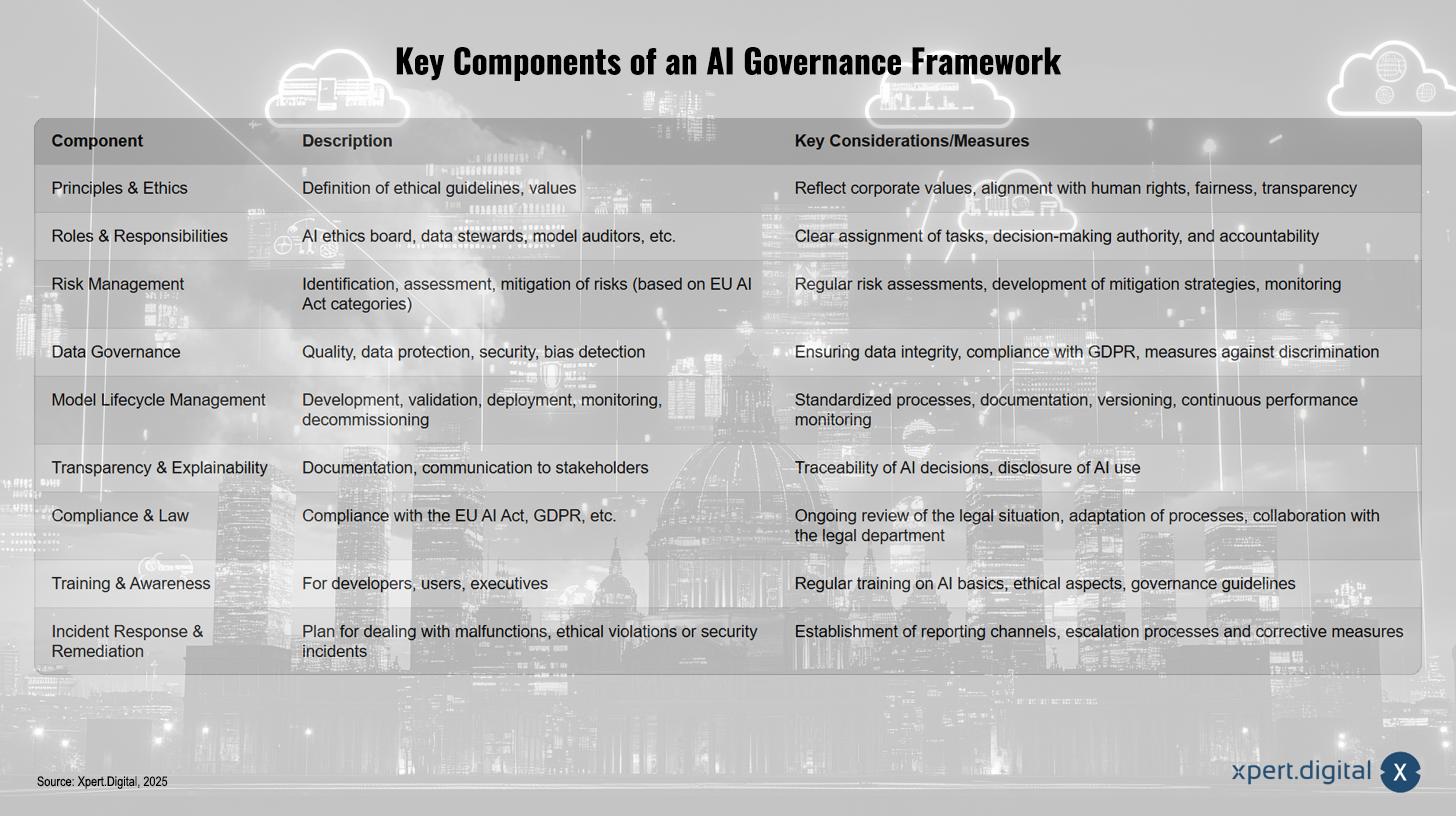
Key components of an AI governance framework – Image: Xpert.Digital
This table provides a comprehensive checklist and guide for executives who want to establish or improve their AI governance.
Key components of an AI governance framework are crucial for ensuring the responsible and effective use of AI. Core principles and ethical guidelines should reflect corporate values and be aligned with human rights, fairness, and transparency. Roles and responsibilities must be clearly defined; these include an AI ethics committee, data controllers, and model reviewers, with clearly defined duties, decision-making authority, and accountability. Effective risk management requires the identification, assessment, and mitigation of risks, as defined, for example, by the EU AI legislation categories. Regular risk assessments, as well as the development and monitoring of mitigation strategies, play a central role here. Data governance ensures that aspects such as quality, data protection, security, and bias detection are considered, including GDPR compliance and anti-discrimination measures. Model lifecycle management encompasses standardized processes for development, validation, deployment, monitoring, and decommissioning, with particular emphasis on documentation, versioning, and continuous performance monitoring. Transparency and explainability are essential to ensure the traceability of AI decisions and to disclose the use of AI. Compliance with legal requirements, such as the EU AI Directive and the GDPR, must also be ensured through ongoing review and process adjustments, as well as collaboration with the legal department. Training and awareness programs for developers, users, and managers promote an understanding of AI fundamentals, ethical considerations, and governance guidelines. Finally, incident response and resolution must be guaranteed to effectively address malfunctions, ethical violations, or security incidents. This includes established reporting channels, escalation processes, and corrective actions that enable rapid and targeted intervention.
Suitable for:

Taking the lead: Strategic imperatives for AI transformation
Cultivating AI readiness: The role of continuous learning and further training
In addition to technical expertise, executives primarily need a strategic understanding of AI to effectively advance their companies. AI training for executives should cover AI fundamentals, successful case studies, data management, ethical considerations, and the identification of AI potential within their own organization. The EU AI Directive (Article 4) mandates "AI competence" for personnel involved in the development or deployment of AI systems, effective from February 2, 2025. This includes an understanding of AI technologies, application knowledge, critical thinking skills, and legal frameworks.
The benefits of AI training for managers include the ability to manage AI projects, develop sustainable AI strategies, optimize processes, secure competitive advantages, and ensure ethical and responsible AI use. A lack of AI competence and skills is a significant obstacle to AI adoption. Various training formats are available: certificate programs, seminars, online courses, and in-person training.
AI readiness means more than just acquiring technical skills; it also means fostering a mindset of continuous learning and adaptability across the organization. Given the rapid pace of AI development, specific tool-based training can quickly become obsolete. Therefore, foundational AI knowledge and critical thinking skills are more lasting investments. The EU AI Law's "AI competency obligation" acts as a regulatory driver for upskilling, but organizations should view this as an opportunity, not just a compliance burden. A more AI-literate workforce is better equipped to identify innovative AI applications, use tools effectively, and understand ethical implications, leading to overall better AI outcomes. There is a clear link between a lack of AI skills/understanding and the proliferation of shadow AI. Investing in comprehensive AI education can directly mitigate the risks associated with unauthorized AI use by empowering employees to make informed and responsible decisions.
Synthesizing opportunities and risks: A roadmap for sovereign AI leadership
Leading the AI transformation requires a holistic understanding of the technology's potential (innovation, efficiency, quality) and its inherent risks (ethical, legal, social).
Sovereign AI leadership involves proactively shaping the organization's AI journey through:
- Establishing robust AI governance based on ethical principles and legal frameworks such as the EU AI Law.
- Promoting a culture of continuous learning and AI competence at all levels.
- Strategic identification and prioritization of AI use cases that deliver tangible value.
- Strengthening human talent by focusing on skills that AI complements rather than replaces, and managing the human impact of AI.
- Proactive management of emerging challenges such as shadow AI.
The ultimate goal is to leverage AI as a strategic enabler for sustainable growth and competitive advantage while mitigating its potential drawbacks. True "sovereign AI leadership" extends beyond internal organizational management and encompasses a broader understanding of AI's societal impact and the company's role within that ecosystem. This means engaging in policy discussions, contributing to the establishment of ethical standards, and ensuring that AI is used for the common good, not just corporate profit. The AI transformation journey is non-linear and will involve navigating ambiguities and unexpected challenges. Leaders must therefore cultivate organizational agility and resilience so their teams can adapt to unforeseen technological advancements, regulatory changes, or market disruptions caused by AI.
Suitable for:

Understanding and using technologies: AI basics for decision-makers
The transformation through artificial intelligence is no longer a distant vision of the future, but a present reality that challenges companies of all sizes and industries while simultaneously offering immense opportunities. For specialists and managers, this means taking an active role in shaping this change in order to responsibly leverage the potential of AI and confidently manage the associated risks.
The fundamentals of AI, from generative models and the distinction between assistants and agents to technological drivers such as machine learning and basic models, form the foundation for a deeper understanding. This knowledge is essential for making informed decisions about the deployment and integration of AI systems.
The legal framework, particularly the EU AI Directive, sets clear guidelines for the development and application of AI. The risk-based approach and the resulting obligations, especially for high-risk systems and regarding the required AI competence of employees, necessitate a proactive approach and the implementation of robust governance structures. The tension between the pursuit of innovation and the need for accountability must be resolved through an integrated strategy that considers compliance and ethics as integral components of the innovation process.
The potential applications of AI are diverse and span across industries. Identifying suitable use cases, mastering effective interaction techniques such as prompting, and consciously managing shadow applications are key competencies for realizing the added value of AI within one's own area of responsibility.
Last but not least, AI is fundamentally changing the way we lead, collaborate, and cultivate creativity. Leaders are challenged to adapt their skills, place greater emphasis on human abilities such as empathy, critical thinking, and change management, and to create a culture in which humans and machines work synergistically. Fostering collaboration and integrating AI as a creative partner requires new ways of thinking and management approaches.
Establishing comprehensive AI governance is not an optional add-on, but a strategic necessity. It creates the framework for the ethical, transparent, and secure use of AI, minimizes risks, and builds trust among all stakeholders.
The AI transformation is a journey that requires continuous learning, adaptability, and a clear vision. Professionals and managers who embrace these challenges and internalize the principles and practices outlined here are well-equipped to shape the future of their organizations, departments, and teams in a sound and confident manner in the age of artificial intelligence.









