
Vertical Farming | High-tech storage instead of tractors: The real secret of profitable vertical farms
Xpert Pre-Release

Available in 27 languages 📢
Prefer Xpert.Digital on GoogleⓘPublished on: August 7, 2026 / Updated on: August 7, 2026 – Author: Konrad Wolfenstein
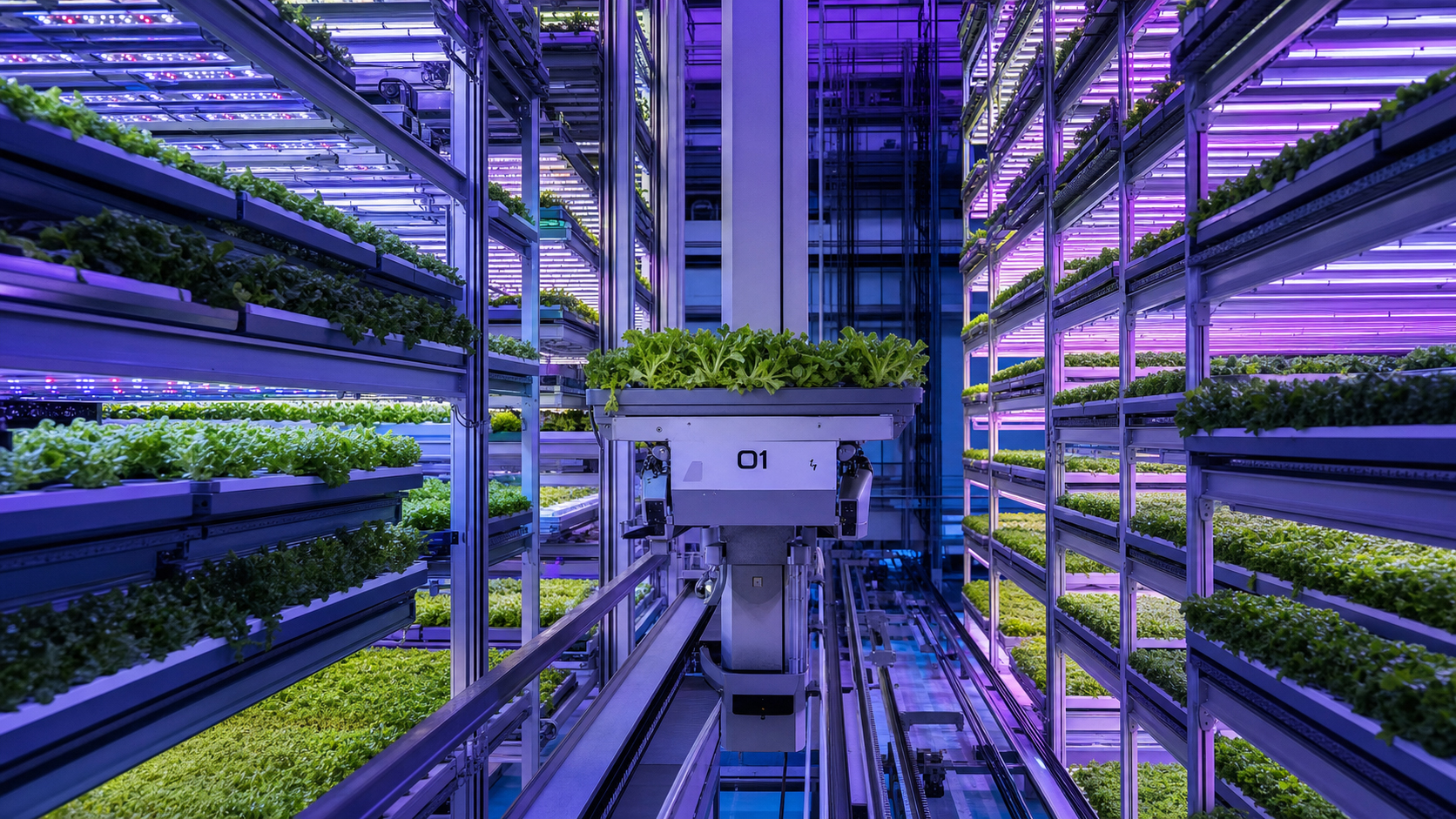
Vertical Farming | High-tech storage instead of tractors: The real secret of profitable vertical farms – Creative image on the topic, with AI: Xpert.Digital
98% less water: Where vertical greenhouses are no longer just a gimmick
Logistics beats agricultural romanticism: How robots are saving the future of our food production
Vertical farming was long considered the ultimate high-tech answer to climate change and rapid global population growth. But the initial hype was followed in recent years by a harsh reality check: Exploding energy costs, enormous capital requirements, and a miscalculation of the market drove once-celebrated industry pioneers, backed by millions in financing, into bankruptcy. Is the dream of the farm in a skyscraper over? Not at all. As the fields grow upwards, the focus is shifting from mere technological fascination to hard-nosed economic reality. It's becoming clear: Vertical farming is not a replacement for traditional agriculture, but rather a highly specialized solution for urban areas and water-scarce regions. To be profitable in the long term, the industry must also radically rethink its approach – moving away from pure agricultural romanticism and towards fully automated intralogistics. This is an in-depth analysis of failed visions, the underestimated factor of electricity, and the true future of our food production.
When fields grow upwards: The economic anatomy of vertical farming – why the future of agriculture doesn't come for free
A market on the rise – but with significant valuation differences
The global vertical farming market is undergoing rapid expansion, but this is accompanied by considerable disagreement among market researchers. While Global Market Insights estimates the market at around US$7.4 billion in 2025 and forecasts it to reach US$30.5 billion by 2035, other institutes, such as Grand View Research, see the market value as already at US$9.62 billion in 2025, with a projection of US$39.2 billion by 2033. Precedence Research is even more optimistic, forecasting a market size of up to US$67.9 billion by 2035. These sometimes substantial discrepancies between estimates—with compound annual growth rates (CAGR) ranging from 10 to 27 percent—reflect not only differing methodologies but also the fundamental uncertainty inherent in such a young and still-unconsolidated sector.
The direction is clear, however: all reputable market analyses predict strong growth, driven by structural megatrends such as urbanization, climate change, resource scarcity, and a growing awareness of food security. North America currently holds the largest market share of the global market at over 40 percent, while the Asia-Pacific region boasts the highest growth rates – China alone held a market share of 33.4 percent in the Asia-Pacific segment in 2025. Europe, on the other hand, is considered by some analyses to be the fastest-growing region, due in no small part to increasing political pressure to shorten supply chains and enhance food sovereignty.
Why vertical farming is not a gimmick – but a structural necessity
The real driving force behind the rise of vertical farming lies not in technological fascination, but in tangible demographic and ecological realities. The United Nations projects that by 2050 nearly 70 percent of the world's population will live in urban areas – a demographic pressure that makes the question of local food production a strategic priority. At the same time, globally usable arable land is shrinking due to soil degradation, sealing, and climate change, while freshwater resources are under increasing pressure.
Modern vertical farms address these problems through a paradigm shift: production is decoupled from natural conditions. In fully climate-controlled buildings based on hydroponics, aeroponics, or aquaponics, plants grow under LED artificial light, regardless of season, soil quality, or location. The water savings are particularly impressive: studies show that vertical farms use an average of 97.4 percent less water than conventional open-field production—a figure that even reaches up to 98 percent in some systems. This resource efficiency explains why vertical farms are attracting significant government interest, especially in water-scarce regions.
Added to this is the resilience to supply chain disruptions, which became painfully apparent through the COVID-19 pandemic and subsequent geopolitical upheavals. Locally based production not only shortens transport routes and improves product freshness, but also reduces dependence on global agricultural markets with their volatile prices and political risks.
The energy factor – the Achilles' heel of the business model
Despite all the justified optimism, one quickly encounters the fundamental economic contradiction that has plagued the industry since its inception: sunlight is free – electricity is not. This simple statement explains more bankruptcies in the industry than any other factor. In a fully enclosed plant factory (Plant Factory with Artificial Lighting, PFAL), every photon for photosynthesis must be supplied by electricity, typically for 16 hours a day across all growing levels.
The figures are soberingly precise: The average energy consumption of commercial vertical farms amounts to 31 kWh per kilogram of lettuce produced (ranging from 22 to 48 kWh/kg), with LED lighting alone accounting for 65 to 75 percent of total consumption. By comparison, conventional greenhouses consume an average of 5.4 kWh per kilogram – roughly one-seventh of this figure. Lighting and climate control together can account for 50 to 70 percent of total variable operating costs. In a facility in the United Arab Emirates (UAE) with approximately 1,000 square meters of growing area, daily electricity consumption amounts to 3,630 kWh, which translates to monthly electricity costs of around US$6,500.
Theoretically, the solution lies in integrating renewable energy. Research shows that switching to entirely renewable electricity sources can reduce the carbon footprint of vertically grown lettuce by up to 97 percent – from 6.4 to 0.16 kg CO₂ equivalents per kilogram of lettuce. Building-integrated photovoltaic systems could cover 10 to 30 percent of electricity demand, but the seasonal discrepancy between maximum solar production in summer and peak lighting needs in winter limits the practical integration rate. Power Purchase Agreements (PPAs) for certified green electricity from dedicated wind and solar power plants are therefore considered a more scalable alternative for large farms.
Technological progress is also evident: Next-generation LEDs with efficiencies of 4.0 to 5.0 µmol/J – compared to the currently commercially standard 2 to 3 µmol/J – could reduce lighting-related electricity consumption by 30 to 50 percent. According to forecasts, energy consumption for lettuce could be reduced to 12 to 15 kWh/kg within five to eight years, which would fundamentally improve the economic profile of vertical farms. The Institute for Energy Market Integration also demonstrates that price-driven adjustment of lighting intensity to spot market prices enables energy cost savings of 13.5 to 20 percent without significantly impacting the harvest.
Capital intensity and the failure of the pioneers
Besides operating costs, the extreme capital intensity is the second structural burden. While conventional open-field farms incur investment costs of US$5,000 to US$10,000 per acre (approximately 0.4 hectares), vertical farms—taking into account buildings, LED systems, HVAC, hydroponic infrastructure, automation, and climate control—require US$1 to US$2 million per acre of growing capacity. This corresponds to 100 to 200 times the conventional capital expenditure per unit of production.
This structural burden, coupled with rising interest rates and weakening investor risk appetite, led to a wave of bankruptcies that severely impacted the industry. AeroFarms, founded in 2004, had been considered a flagship vertical farming company for decades and had raised $238 million in venture capital before filing for Chapter 11 bankruptcy protection in June 2023. After a brief restructuring period, its largest investor withdrew in December 2025, leading to the permanent closure of its Virginia facility and the dismissal of 173 employees.
AppHarvest, which went public in 2021 via a SPAC transaction with a valuation of over one billion US dollars, raised more than 600 million US dollars in capital, and operated four high-tech greenhouses, was completely liquidated in 2023. A similar fate befell Fifth Season (Pittsburgh), Kalera, Infarm, Iron Ox, Upward Farms, Agricool (France), Future Crops, and Glowfarms (Netherlands). In 2025 alone, 14 indoor farming companies filed for bankruptcy—many of them companies that had previously raised hundreds of millions of dollars.
The diagnosis of the failed companies is multifaceted but consistent: Many scaled aggressively before demonstrating a viable unit economics. They built $100 million facilities before achieving profitability at a $10 million scale. Furthermore, many suffered from a fundamental weakness in their product markets: They focused on leafy greens and herbs—products with low margins and limited consumer willingness to pay a premium—and thus competed directly with cheaply produced, field-grown vegetables. The production cost for a pound of lettuce in a vertical farm is around $3.07, compared to just $0.65 for conventional field production—a cost disadvantage that can hardly be offset by a premium price.
Where vertical farming still works – Singapore and the Middle East
The economic constraints outlined above do not apply universally. In regions where land scarcity, water scarcity, or geopolitical vulnerability dramatically increase the alternative costs of traditional agriculture, the cost-benefit analysis shifts fundamentally. Singapore is perhaps the most vivid example of this structural exception.
The city-state cultivates less than one percent of its land area and imports around 90 percent of its food needs. Its dependence on global trade flows is a strategic risk, dramatically exposed by the COVID-19 pandemic. In response, the Singapore Food Agency (SFA) launched the "30 by 30" initiative in 2019 – the ambitious goal of meeting 30 percent of the nation's food needs with domestic production by 2030, up from less than 10 percent at the time of its announcement. Government support through programs such as the Agri-Food Cluster Transformation Fund and the 30 by 30 Express is explicitly aimed at capital-intensive technologies like vertical farming. The combination of high willingness to pay for locally produced food, government support, and a lack of alternatives makes Singapore a globally unique test case – one where vertical farming is not only economically viable but strategically essential.
Similar structures exist in the Middle East, particularly in the UAE. Eighty percent of the land area is desert, less than one percent is considered arable, and rainfall occurs on average only about twelve days a year. The UAE imports roughly 85 to 90 percent of its food needs. In a country where water scarcity and extreme heat make conventional agriculture structurally unattractive, the relative costs change completely. Hydroponics reduces water consumption by 90 to 95 percent compared to open-field cultivation—in a region where water is a critical resource, this saving carries far more economic weight than in Germany or the USA.
The UAE is responding with a national strategy: The National Food Security Strategy 2051 aims to make the country one of the ten most food-secure nations in the world by mid-century. Emirates Crop One in Dubai – currently one of the world's largest vertical farms at 30,000 square meters – produces leafy greens using 95 percent less water than traditional farms. Saudi Arabia's Public Investment Fund (PIF) has also signed a joint venture agreement with a US agritech company to establish vertical farms throughout the MENA region.

Expert partner in warehouse planning and construction
Higher margins through logistics: Why vertical farms are now relying on warehouse technology – automation as a success factor
Automation as the backbone – AS/RS between logistics and agriculture
At this point, a technological category comes to the fore that has previously been hardly associated with agriculture: the Automated Storage and Retrieval System (AS/RS). Originally developed for high-bay warehouses, fulfillment centers, and production environments, this system proves to be structurally extremely compatible with the requirements of modern vertical farms.
AS/RS systems typically consist of storage and retrieval machines or shuttle vehicles that automatically store and retrieve containers or trays in high-density storage structures. They increase storage density by 40 to 85 percent compared to conventional storage systems, achieve inventory accuracy of over 99.9 percent, and achieve throughput rates of more than 1,000 transactions per hour. These figures sound like logistics—and they are. But an advanced vertical farm is functionally more of a logistics system than traditional agriculture: substrate, water, nutrients, light, and harvest timing are algorithmically controlled, and the physical transport of growing trays between germination, growth, harvest, and packaging is a core intralogistics task.
Research on the integration of AGVs (Automated Guided Vehicles), robotic arms, and automated guided vehicles (AGVs) in vertical farms shows that this combination optimizes space utilization, minimizes manual intervention, and reduces downtime. Specifically, instead of sending employees through narrow aisles between storage racks—with the associated risk of contamination and efficiency losses—shuttle systems handle the transport of the trays. The result is a virtually germ-free production environment with controlled access points, comparable to a pharmaceutical cleanroom.
The parallel to the world of warehousing is not a metaphor, but a functional comparison. AS/RS maximizes cubic meter utilization in warehouse operations on the smallest possible footprint – the system achieves precisely the same feat in vertical farms, where land prices in urban areas can be prohibitively high. Storing hundreds to thousands of growing trays in a compact structure, the automated transfer to harvesting and packaging stations at precisely the right time, and maintaining a continuous production flow without bottlenecks: this is the performance promise that AS/RS is now beginning to deliver in agriculture as well.
From growth to flow – intralogistics as a success factor on a scale
A crucial flaw in early vertical farming concepts was the focus on efficiency solely at the plant cultivation level. Optimized light spectra, precise nutrient dosing, and climate control are undoubtedly important – but they address only one part of the value chain. As the size of the facility increases, the operational bottleneck shifts from production efficiency to handling efficiency.
A concrete example: If a farm manages hundreds of trays daily at various stages of growth, it must ensure that each tray is in the right place at the right time – during sowing, germination, growth, harvesting, and packaging. Any delay in tray handling means either an overripe harvest, wasted resources, or production interruptions. AS/RS systems solve this timing problem through algorithmically controlled, precise scheduling – the same principle that has long been standard practice in the automotive and pharmaceutical industries.
The efficiency gains from automation also counteract one of the industry's most pressing structural problems: the labor shortage. In a sector that requires highly specialized personnel for controlled environments and simultaneously suffers from high labor costs, automation allows operations to scale without a proportional increase in staff. Furthermore, the hygiene requirements in closed cultivation systems—no pesticide use, but all the more stringent contamination prevention—make human intervention a risk factor that automation eliminates.
Finally, the AS/RS integration enables a data density that is of enormous importance for quality management and certification. Every movement of a tray, every growth phase, and every harvest time is fully traceable – a requirement that is increasingly seen as a differentiating factor in the food retail and catering sectors and is gaining regulatory importance.
The harvest spectrum – Why not all crops are the same
Another economic nuance concerns the question of which crops are even economically suitable for vertical farming. Currently, leafy greens, herbs, microgreens, and strawberries dominate – all sharing a common characteristic: short growth cycles, high yield per unit area, and sufficient consumer willingness to pay for premium quality. Staple foods such as wheat, rice, or corn, on the other hand, are not economically viable to grow vertically under current energy costs, as their low market prices fall far short of covering production costs.
This realization is both a limitation and a strategic clarification: Vertical farming is not a universal replacement for conventional agriculture, but rather a highly specialized form of production for specific market segments. Its value proposition lies in freshness, consistent quality, the absence of pesticides, and year-round availability – attributes for which premium supermarkets, restaurants, catering companies, and institutional buyers are willing to pay a premium. Furthermore, its economic viability increases for crops such as mushrooms, microgreens, and medicinal herbs, which either command higher market prices or require particularly controlled growing conditions that only vertical systems can provide.
System integration as the next stage of evolution
The next phase of industry development will be characterized less by spectacular individual innovations and more by intelligent system integration. Combining AS/RS with AI-supported harvest planning, energy management systems that react to spot market prices, and building integration that utilizes waste heat from lighting as heating energy creates efficiency gains that, in total, significantly improve profitability.
Studies on the thermal integration of vertical farms into building structures demonstrate that bidirectional heat exchange can reduce the combined energy consumption of both systems by 12 to 51 percent. The simultaneous use of renewable energy sources and integration into energy balancing markets—so-called day-ahead markets or balancing energy markets—opens up additional revenue streams and demonstrably reduces net energy costs by a further 15 to 32 percent. This system architecture, which combines agriculture, logistics, energy management, and building technology, is not a science fiction scenario, but a concrete, emerging business model of the next generation.
The companies that have failed in recent years have left an important message: Vertical farming technology is fundamentally viable – but it requires disciplined capital allocation, realistic unit economics, and a precise understanding of which markets actually offer structural benefits that outweigh structural costs. The lessons learned from the failures of AeroFarms, AppHarvest, and dozens of other companies should not be seen as evidence against vertical farming, but rather as a necessary calibration of expectations for realistic growth paths.
Economic classification – When and where does vertical farming make sense?
A sober economic assessment leads to a more nuanced picture. Vertical farming is economically viable if at least two of the following three conditions are met: firstly, high opportunity costs for land (urban location, desert region, island nation); secondly, high costs or strategic importance of water resources; thirdly, a sufficiently affluent consumer base willing to pay for premium quality or local production.
Singapore fulfills all three conditions. The UAE fully meets at least two of the three conditions – and offsets energy costs through strategic subsidies and government demand. A similar argument can be made for major European cities like London, Amsterdam, or Berlin, although profitability here depends more heavily on local energy prices and consumers' willingness to pay more for locally produced, low-pesticide goods.
In contrast, classic agricultural regions such as the Midwest of the USA, large parts of Southern Europe or the North German Plain are structurally unfavorable for vertical farms: land is cheap, water is available, and the price difference to imported or regionally grown open-field vegetables can hardly be bridged for consumers by a mere promise of quality.
A technology that needs to know its niche
Vertical farming will neither replace nor render traditional agriculture obsolete – and that is not its aim. Its function is entirely different: it fills a specific supply gap for urban centers, resource-constrained regions, and markets that define food security as a strategic goal. Within this niche, the growth potential is considerable – despite all fluctuations, the consensus in market research points to an industry that will grow to many times its current size by 2033 or 2035.
Integrating AS/RS technology into vertical farms is not a technological luxury, but an operational necessity for any company that wants to grow beyond a certain production scale. The equation is simple: anyone who wants to scale seriously must transition from a purely crop-centric to a logistics-centric mindset. Excellent cultivation creates the product – excellent intralogistics creates the margin.
This leads to a clear recommendation for investors, urban planners, and political decision-makers: Vertical farming should not be promoted as a universal solution, but rather implemented selectively where the structural conditions are right. And with each scaling step, the question must be asked whether optimizing the workflow – from germination to packaging – receives at least the same strategic attention as optimizing the cultivation process itself.
Your intralogistics experts

Consulting, planning and implementation of complete solutions for high-bay warehouses and automated storage systems - Image: Xpert.Digital
More information here:
Your global marketing and business development partner
☑️ Our business language is English or German
☑️ NEW: Correspondence in your native language!

Konrad Wolfenstein
I and my team are happy to be available to you as your personal advisor.
You can contact me by filling out the contact form here [email protected]:or simply call me at +49 7348 4088 965. My email address is
I'm looking forward to our joint project.
☑️ SME support in strategy, consulting, planning and implementation
☑️ Creation or realignment of the digital strategy and digitization
☑️ Expansion and optimization of international sales processes
☑️ Global & Digital B2B trading platforms
☑️ Pioneer Business Development / Marketing / PR / Trade Fairs
Our global industry and economic expertise in business development, sales and marketing

Our global industry and economic expertise in business development, sales and marketing - Image: Xpert.Digital
Industry focus areas: B2B, digitalization (from AI to XR), mechanical engineering, logistics, renewable energies and industry
More information here:
A thematic hub offering insights and expertise:
- Knowledge platform covering global and regional economies, innovation and industry-specific trends
- A collection of analyses, insights, and background information from our key areas of focus
- A place for expertise and information on current developments in business and technology
- A hub for companies seeking information on markets, digitalization, and industry innovations










