
“Ukraine Support Act” – Rebellion in the US Congress: 18 Republicans oppose Trump on Ukraine aid
Xpert Pre-Release

Available in 27 languages 📢
Prefer Xpert.Digital on GoogleⓘPublished on: June 5, 2026 / Updated on: June 8, 2026 – Author: Konrad Wolfenstein
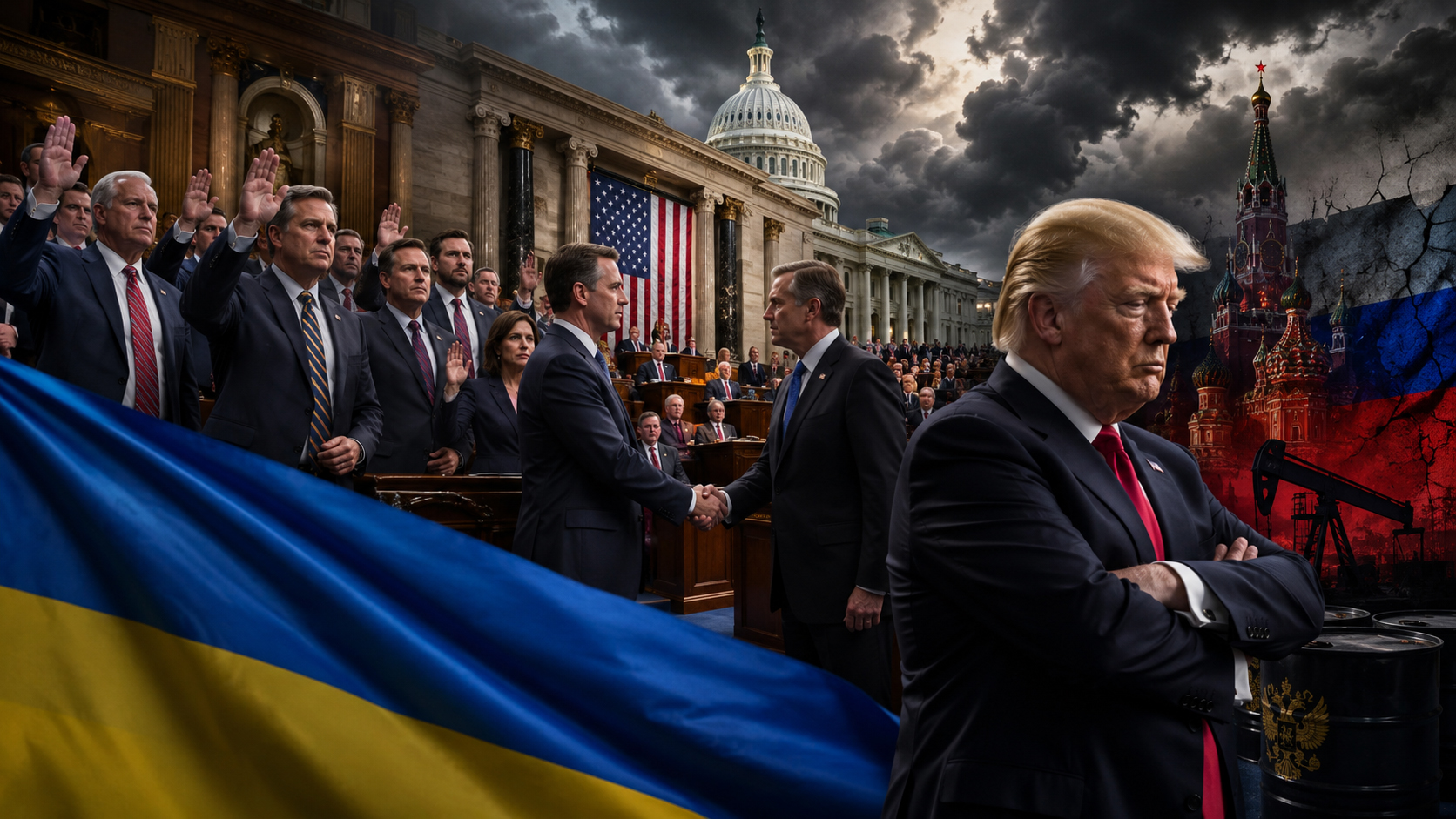
“Ukraine Support Act” – Rebellion in the US Congress: 18 Republicans oppose Trump on Ukraine aid – Creative image: Xpert.Digital
Historic bombshell: US Congress snubs Trump with gigantic sanctions package
500 percent tariffs: The unprecedented plan of the US Congress against Russia
Washington, June 2026: In the midst of Donald Trump's second term, the House of Representatives stages an open rebellion. With the "Ukraine Support Act," a bipartisan alliance—driven by 18 dissident Republicans—rams through not only billions in aid for Kyiv and draconian sanctions against Russia, but also makes an unequivocal commitment to NATO. But while Congress attempts to correct the course of US foreign policy, other developments reveal deep cracks in the Western security architecture: The sudden abandonment of the Tomahawk missile deployment in Germany and drastically reduced munitions stockpiles as a result of the Iran war, which lacked congressional authorization, clearly demonstrate that Europe can no longer rely unconditionally on the American security umbrella. A profound insight into a transatlantic order undergoing a historic transformation.
Related to this:

Congress versus President: When 18 Republicans have had enough – Parliament makes a statement
On Thursday, June 5, 2026, a parliamentary event of considerable symbolic significance took place in the U.S. House of Representatives in Washington, D.C.: By a vote of 226 to 195, the House passed the so-called Ukraine Support Act – a legislative package that provides billions in aid for Ukraine as well as drastic new sanctions against Russia. What makes this result particularly remarkable is not just the vote itself, but the political constellation that made it possible: 18 Republican representatives defied their own party leadership and U.S. President Donald Trump, voting for the bill along with almost all the Democrats. Only one Democratic representative – Ilhan Omar of Minnesota – voted against it. The vote thus marks the second serious foreign policy setback for Trump within just 48 hours: On Wednesday before, the House of Representatives had already passed a resolution by 215 to 208 votes calling on Trump to either withdraw US troops from Iran or seek formal congressional approval to continue the war.
The vote didn't come out of nowhere. The Ukraine Support Act had initially been stalled in Congress for months because Speaker Mike Johnson and the Republican leadership had consistently blocked a vote. The breakthrough came with a so-called discharge petition: enough representatives – 218 signatures, the majority threshold – signed it, forcing the leadership to put the bill to a vote. Particularly noteworthy are the moderate Republicans Don Bacon and Brian Fitzpatrick, as well as the independent Representative Kevin Kiley, who actively supported the Democratic-led initiative, thereby incurring the wrath of Speaker Johnson.
The package: Sanctions and financial aid as a double signal
The content of the passed law is ambitious, and its potential impact can hardly be overestimated. At its core are novel sanctions against the Russian economy: Russian banks and financial institutions, the entire oil and gas sector, and leading mining companies would be affected. Furthermore, the law would rescind a sanctions waiver that Trump unilaterally granted earlier this year, effectively circumventing some existing sanctions regimes. The provision regarding punitive tariffs is particularly far-reaching: The law stipulates 500 percent tariffs on all goods imported from Russia into the US, as well as a direct import ban on Russian crude oil.
This tariff provision is not a new development in parliament – it is modeled on the Sanctioning Russia Act, already debated in the Senate, which was introduced by Senators Lindsey Graham and Richard Blumenthal and enjoyed broad bipartisan support from 85 co-authors. The basic idea is economically simple, but strategically sophisticated: Anyone buying Russian energy should feel that this purchase comes at a price when accessing the American market. It is thus a form of secondary sanctions that go far beyond direct restrictions against Russia and also put pressure on third countries. On the financing side, the Ukraine Support Act initially provides over one billion US dollars in direct aid for security and reconstruction measures in Ukraine, as well as further funds for Baltic security and Radio Free Europe. Up to eight billion US dollars are to be mobilized for Ukrainian arms purchases through loans and military financing programs. The law also extends existing support programs for the Ukrainian armed forces and includes provisions against Russian disinformation.
Remarkably, the Ukraine Support Act also contains a clear political declaration of principle: The lawmakers condemn Russian war crimes, demand the unconditional withdrawal of all Russian troops from Ukrainian territory—including Crimea and Donbas—and make it clear that any negotiations must be based on Ukrainian sovereignty and cannot be dictated by Russia. Moreover, the House of Representatives explicitly affirms its commitment to NATO and specifically to Article 5 of the NATO Treaty. This wording is not a given in the current political context—it is an implicit correction of the sitting president's repeated public questioning of the alliance.
Parliamentary resistance and its limits
The symbolic value of the vote is undeniable. And yet, it would be premature to speak of a political turning point just yet. The path of this bill to being signed is long and fraught with institutional obstacles that make its success unlikely. In the Senate, the upper house of Congress, leading Republican politicians have consistently prevented similar Russia sanctions proposals from coming to a vote. They cite the official administration line and their desire not to jeopardize Trump's negotiating strategy. Even if the bill were to pass the Senate, which would require a majority of 60 votes, it would then be submitted to the president for his signature—who would very likely veto it.
Trump's reaction to the vote is unlikely to come as a surprise. His foreign policy stance toward Russia and Ukraine has been clear since the beginning of his second term in January 2025: distancing himself from Kyiv, a willingness to engage in dialogue with Moscow, and skepticism toward sanctions as a tool. The measure, against which Johnson unsuccessfully mobilized his members of Congress, is considered by Trump's inner circle to be counterproductive to ongoing mediation efforts. At the same time, it remains undeniable that resistance within his own party is growing and becoming institutionalized. A petition for his discharge with 218 signatures is neither a coincidence nor an isolated incident—it is the result of a coordinated, bipartisan parliamentary strategy aimed at deliberately undermining the Speaker's authority. The fact that this was achieved twice within a week sends a clear signal to the White House.
Comparative figures from the first Trump administration and the Biden era provide context: In April 2024, when Joe Biden was still president, the House of Representatives passed a $61 billion aid package for Ukraine by an overwhelming majority of 311 to 112 votes. The current vote, at 226 to 195, was considerably closer – evidence that political support for Ukraine has noticeably declined under Trump, even though a bipartisan majority still supports it.
Hub for Security and Defense - Advice and Information

Hub for Security and Defense - Image: Xpert.Digital
The Security and Defence Hub offers expert advice and up-to-date information to effectively support companies and organizations in strengthening their role in European security and defence policy. Working closely with the SME Connect Defence Working Group, it particularly promotes small and medium-sized enterprises (SMEs) that wish to further develop their innovative capacity and competitiveness in the defence sector. As a central point of contact, the Hub thus creates a crucial bridge between SMEs and European defence strategy.
Related to this:
US troop withdrawal and empty arsenals: The new reality of NATO – How the Iran war is changing Europe's security
Tomahawks refused: The silent withdrawal from NATO's defense architecture
Almost simultaneously with the congressional vote, another development, hardly less significant in its strategic importance, became public: The US Department of Defense, the Pentagon, has apparently abandoned its plan to station Tomahawk cruise missiles in Germany. The news portal Politico, citing insiders, reported that US government officials fear Russia could interpret such a deployment as an escalation and take retaliatory measures. This move is so significant because it undermines an agreement formally concluded under the Biden administration in 2024: At the NATO summit in Washington in July 2024, the US and Germany declared their intention to station US intermediate-range weapons – including Tomahawk cruise missiles with a range of up to 2,500 kilometers, SM-6 missiles, and newly developed hypersonic weapons – on German soil starting in 2026.
The cancellation of these plans was initially preceded by reports of the withdrawal of at least 5,000 US troops from Germany, which Trump announced in early May 2026 and which is to be implemented within six to twelve months. NATO Supreme Allied Commander General Alexus Grynkewich confirmed at the end of May that the deployment of a so-called "Long Range Fires Battalion" will not take place. The US troop withdrawal and the cancellation of the missile delivery together represent a significant weakening of the conventional deterrence architecture in Europe – and this at a time when Russia continues its war of aggression against Ukraine and escalates hybrid warfare against NATO members.
The German government in Berlin is reacting with a pragmatic alternative strategy: it is now striving to acquire the Tomahawk cruise missiles not for deployment, but for outright purchase. Defense Minister Boris Pistorius visited Washington and in July 2025 already submitted a formal letter of request for the Typhon missile launcher system, into which Tomahawks can be integrated. According to the Financial Times, the German government is even prepared to pay a premium. At the same time, possibilities are being examined for the future production of Tomahawk cruise missiles in Germany as part of a joint venture between German and American companies.
Related to this:

Empty Arsenals: The Iran War and its Impact on Europe's Security
The real strategic reason for Washington's hesitation, however, is not solely the desire to avoid provoking Russia. A second, material factor plays a crucial role: In the early weeks of the Iran-Iraq War—a military conflict that began without a formal declaration of war by Congress—US forces expended enormous quantities of precision-guided munitions. According to an analysis by the Center for Strategic and International Studies (CSIS), the US spent at least $25 billion in the 38 days of fighting before the ceasefire to launch thousands of Tomahawk and Patriot missiles at over 13,000 Iranian targets and to repel Iranian attacks. Between one-third and one-half of US arsenals for some of these key weapon systems—Patriot missiles, THAAD interceptor missiles, and Tomahawks—are estimated to have been used.
The political debate over this ammunition shortage is lively and heated. Defense Secretary Pete Hegseth initially downplayed the concerns, calling the public discussion "foolishly and unhelpfully exaggerated." At the same time, Pentagon Finance Director Jules Hurst revealed to the Congressional Budget Committee that the total cost of the Iran war had now reached $29 billion—$4 billion more than estimated at the end of April. Democratic senators paint a more dramatic picture: Senator Mark Kelly of Arizona, a member of the Armed Services Committee, stated publicly that ammunition stocks for Tomahawk, ATACMS, SM-3, and Patriot missiles had been depleted to an alarming degree, noting that Hegseth himself had stated in a public hearing that it would take "months and years" to replenish them. The Wall Street Journal had even reported that it could take up to six years.
For Europe, this munitions shortage has immediate security policy consequences that extend beyond the Tomahawk issue. Der Spiegel reported that the US government also intends to significantly reduce its support for other key military capabilities to NATO – including US fighter jets, warships, drones, and tanker aircraft. This combination of political withdrawal and material inadequacy is creating a new security reality in Europe.
The economic dimension: What sanctions can and cannot do
The sanctions provided for in the Ukraine Support Act should not be viewed in a vacuum. Since the start of Russia's war of aggression against Ukraine in February 2022, the EU and its partners have imposed numerous sanctions packages against Russia – by April 2026, the EU had reached its twentieth. The cumulative impact of these sanctions is difficult to quantify and politically contentious. On the one hand, the Russian economy has come under considerable pressure: the ruble has lost significant value, inflation has risen, and access to Western technology has been severely restricted. On the other hand, Russia has demonstrated a far more stable economic course than Western analysts initially expected – supported by high levels of government spending on defense, trade with China, India, and other countries in the Global South, and government intervention in the energy sector.
The 500 percent tariffs on Russian imports proposed in the Ukraine Support Act would be historically unprecedented in their absoluteness—if they were to come into effect. While US trade with Russia has collapsed significantly since 2022, some residual flows still exist. More significant, however, would be the impact on third countries: secondary sanctions, which penalize countries that continue to purchase Russian oil and gas, would place considerable economic pressure on China, India, Turkey, and other nations. Whether this pressure could be enforced diplomatically is another question—experience with previous secondary sanctions shows that the US regularly encounters resistance from key trading partners. The Council on Foreign Relations has warned that an overly stringent sanctions regime of this kind could destabilize the global economy if consistently enforced.
Nevertheless, the parliamentary message alone is already changing the dynamics of the negotiations. When the Russian leadership observes that a significant portion of the US Congress is prepared to vote for drastic economic measures – regardless of whether the president signs them – this is a signal about the state of American domestic politics that is being closely watched in Moscow.
Europe's structural dependency and the end of the old security model
What is currently happening in Washington is more than a political tug-of-war between Congress and the executive branch. It is the most visible expression of a tectonic shift in the transatlantic security architecture, which for decades rested on a simple basic model: The US provides the heaviest military hardware and nuclear security guarantees, while the Europeans supply bases, logistics, and a substantial portion of the conventional armed forces. This deal—made possible by the shared Cold War context and the subsequent Western-dominated order—has been crumbling for years. Under Trump, this process has accelerated dramatically.
The withdrawal of US troops from Germany—currently at least 5,000 of the approximately 36,500 soldiers stationed there, with further reductions announced—also has a direct economic dimension: A study by the ZEW Mannheim and the University of Cologne calculated that for every US soldier withdrawn, roughly half a full-time job is lost in the affected region, as 61 percent of the job losses affect regional companies that depend on the consumer spending of the troops and their families. Historically, affected communities have responded with tax increases and spending cuts, and the negative employment effects have demonstrably lasted for up to 15 years. The economic wounds caused by the military withdrawal are therefore real and long-lasting.
At the same time, this pressure is creating a new European logic of action. NATO is working to gradually replace American capabilities with its own European resources. NATO Supreme Allied Commander Grynkewich explicitly stated that Europe must close the capability gap created by abandoning the Tomahawk program itself. Germany is considering both purchasing American systems and domestic production. France, the United Kingdom, and Poland have increased their defense spending. The question is whether these European efforts will gain momentum quickly enough to close the security gaps left by the American withdrawal.
Article 5 under pressure: The erosion of collective security pledges
The US House of Representatives' endorsement of NATO's Article 5 in the Ukraine Support Act is symptomatic of a crisis of confidence within the alliance that could hardly be more pronounced. A study by the German Institute for International and Security Affairs (SWP) in Berlin has shown that the credibility of American security commitments depends on three factors: political will, the balance of military power, and operational contributions. Under the current Trump administration, all three factors have come under pressure: political will is being weakened by public downplaying of the alliance's value, the balance of military power is shifting due to the depletion of munitions in the Iran war and the announced troop reductions, and operational contributions are diminishing due to the abandonment of Tomahawk deployments and other key capabilities.
Officially, the US government continues to affirm its commitment to NATO and the mutual defense clause. Representatives of the US Security Council have publicly confirmed this. However, the gap between official rhetoric and actual behavior is widening. The fact that a bipartisan majority in Congress deems it necessary to explicitly reaffirm the commitment to Article 5 by law demonstrates the extent to which trust in the reliability of American pledges—even within the US—has been shaken. It is the parliamentary equivalent of an internal vote of no confidence in one's own president on one of the most crucial foreign policy issues.
The vote of June 5, 2026, can therefore be interpreted as one of several signals in a larger process that is challenging the foundations of the Western security order. Russia, which for years has based its foreign policy on the assumption that the Western alliance produces internal contradictions that will ultimately render it incapable of effective action, is observing these developments with strategic interest. The turmoil in American domestic politics—from the war with Iran without a congressional mandate to troop withdrawals and punitive tariffs on allies—provides Moscow with confirmation of its analyses, even if reality is more complex than any narrative.
What remains is a US House of Representatives that—for now—is fulfilling its constitutional role as a counterweight to the executive branch with more determination than in the first months of Trump's second term. Whether this translates into binding law depends on the Senate. Whether it fundamentally changes European security policy depends on how quickly Europe develops its own capacity for action. And whether it prompts Russia to change its behavior depends on factors that extend far beyond Washington voting results. The gates have been opened—but the game is far from over.
Consulting - Planning - Implementation

Markus Becker
I would be happy to serve as your personal advisor.
Head of Business Development
Chairman SME Connect Defense Working Group
Consulting - Planning - Implementation
Konrad Wolfenstein
I would be happy to serve as your personal advisor.
You can contact me at wolfenstein∂xpert.digital or
Just call me on +49 7348 4088 965 .





