
15 percent on EU goods? Trump's new tariff plans are meeting with resistance from US Democrats
Xpert Pre-Release

Available in 27 languages 📢
Prefer Xpert.Digital on GoogleⓘPublished on: November 26, 2026 / Updated on: November 26, 2026 – Author: Konrad Wolfenstein
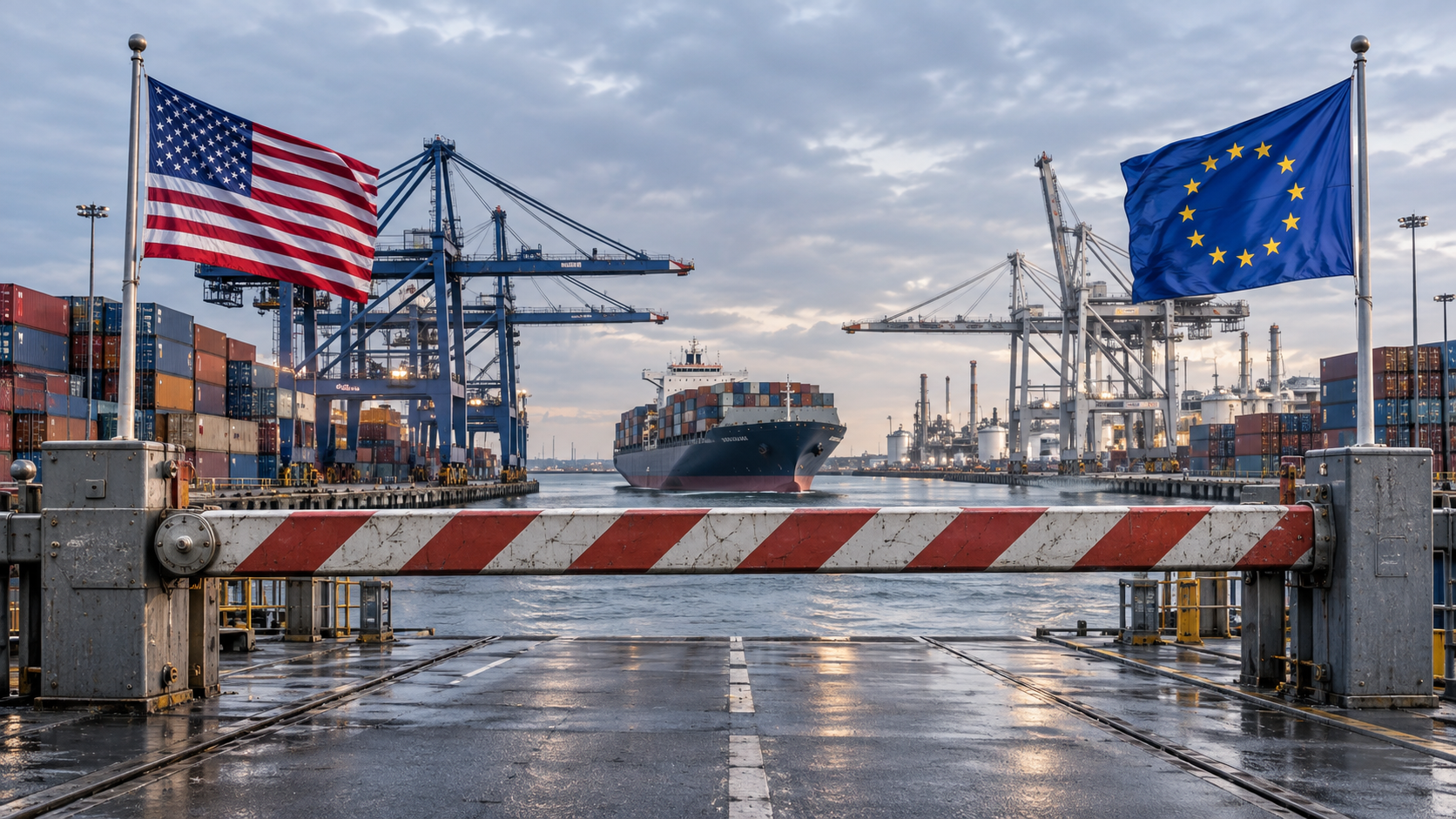
15 percent on EU goods? Trump's new tariff plans are meeting with resistance from US Democrats – Creative image on the topic, created with AI: Xpert.Digital
US tariffs against Europe: Why 15 percent isn't the whole story
New US tariff wall: Who really bears the costs of the trade conflict?
Washington wants to save its industry – and risks making its own economy more expensive
The United States is planning new tariffs on goods from the European Union and 13 other trading partners. A rate of 15 percent is proposed for EU products – but this does not automatically mean an additional surcharge of this amount on all existing duties. Which companies will actually have to pay more depends on the applicable tariffs, possible credits, and exemptions. At the same time, the move could have far-reaching consequences for prices, supply chains, and investments.
Washington justifies its move with government subsidies, industrial overcapacity, and allegedly unfair competitive conditions. Underlying this is a fundamental dispute about how far states are allowed to protect their domestic industries – and when such interventions distort international competition. The EU rejects the accusation that it is itself responsible for structural overcapacity and insists on compliance with existing agreements.
For companies, however, it's not just a question of whether a tariff is imposed. Crucially, it's also about who ultimately bears the costs: US importers, American customers, or European suppliers who have to lower their prices. While some US manufacturers might benefit from protection against foreign competition, other companies face higher costs for machinery and intermediate goods. For European SMEs in particular, additional bureaucracy and ongoing uncertainty could also pose a problem.
The full impact of the planned measures on the economy is currently impossible to quantify. Regulations, exemptions, and negotiations are still ongoing. However, one thing is clear: a tariff barrier can increase the cost of imports – it doesn't automatically build new factories, create skilled workers, or guarantee a competitive industry. The crucial factor will be whether political pressure leads to targeted action against proven distortions of competition or to a broader trade conflict that burdens companies on both sides of the Atlantic.
America's new tariff wall: Why the trade conflict with Europe costs more than 15 percent
The United States is preparing new tariffs against the European Union and 13 other trading partners. The central proposal calls for a 15 percent tariff on affected EU goods, taking into account certain existing duties. For Chinese products, tariffs of up to 20 percent are generally planned, although older tariffs may remain in place in some cases. The move is justified by claims of structural overcapacity, government subsidies for industry, and alleged disadvantages faced by American companies. This is not simply about making individual imports more expensive, but rather about a fundamental conflict over the organization of industrial value creation and the limits of national economic policy.
The key economic question, therefore, is not whether a 15 percent tariff appears high or low. What matters is the existing level of trade burden against which it applies, which products are actually affected, how companies adjust their prices, and whether the protection from foreign competition generates additional competitive production. Equally important is the political question of whether the announced resistance from US Democrats will lead to a genuine limitation of presidential trade policy.
A sober assessment must reconcile both sides. Government-subsidized overproduction can distort markets and jeopardize industrial capabilities. However, a broad tariff is an imprecise instrument for solving such problems. It makes only limited distinctions between subsidized mass-produced goods and highly specialized capital goods, between unfair subsidies and legitimate competitiveness, and between strategic dependency and economically sound division of labor.
There is no simple additional calculation behind the number 15
To properly assess the economic implications, a common misconception must first be addressed: The announced EU tariff should not be understood as a blanket 15-percentage-point increase on all existing tariffs. The proposal includes the crediting of regular most-favored-nation tariffs and existing Section 301 duties. Furthermore, there are product exemptions and separate treatment of other trade policy measures. Therefore, for businesses, what matters is not just the political headline, but the specific classification of their goods under the US tariff schedule.
A simplified example illustrates the significance. If a product is currently subject to a 5 percent duty and its relevant total duty is to increase to 15 percent, the additional duty amounts to ten percentage points. For an unchanged customs value of €100, the total duty payable would then be €15 instead of €20. However, if the relevant duty is already at 15 percent and only its legal basis is changed, the immediate increase in duty may not occur.
This distinction changes the entire impact analysis. A new legal act can create an additional economic burden, replace an existing one, or legally secure an already achieved tariff level. Therefore, neither a uniform price increase nor a specific export loss can be inferred from the announcement alone.
However, even the supposed upper limit is not entirely free of political risks. Besides the central EU proposal of 15 percent, the published draft includes an alternative of up to 20 percent if Washington deems ongoing consultations and existing commitments insufficient. This is not an already agreed-upon increase, but it shows that the negotiating conflict could extend beyond practical implementation.
A huge economic area is subject to political reservations
The sheer scale of the trade involved explains why even limited changes can have significant consequences. In 2025, the EU exported goods worth approximately €554.6 billion to the United States and imported American goods worth about €356.2 billion. The European trade surplus was therefore around €198.4 billion. Together, bilateral trade in goods reached approximately €910.8 billion.
These figures make the US a sales market whose importance cannot be replaced in the short term by a few additional orders in other regions of the world. At the same time, American deliveries to Europe show that the dependence is by no means one-sided. An escalating conflict also affects American manufacturers whose customers and business partners are located within the EU.
The economic dimension becomes even greater when services are included. According to preliminary figures, transatlantic trade in goods and services reached more than €1.77 trillion in 2025. Therefore, focusing solely on industrial goods only captures a portion of the true interconnectedness.
Furthermore, a trade surplus alone is not reliable proof of unfair practices. A trade balance initially describes the difference between exports and imports. It does not automatically explain whether products are subsidized, whether market access is hindered, or whether companies are successful due to quality, specialization, and productivity. Anyone who treats the balance as proof of guilt is confusing a statistical observation with its economic cause.
Washington is making the industrial policies of other countries a point of contention
The American argument goes beyond the classic accusation that individual foreign manufacturers sell certain products at artificially low prices. Washington criticizes the EU for, among other things, industrial expansion plans, export promotion, state-supported financing, market access barriers, and what it considers an inadequate approach to overcapacity from non-market economies. The automotive, chemical, and pharmaceutical sectors are cited as particularly relevant.
This shifts the focus of the conflict. The discussion now centers not only on individual subsidies, but also on institutional elements of European economic policy. Development banks, export credits, and industrial policy strategies become potential targets for trade policy countermeasures.
From an economic perspective, such a review is not inherently illegitimate. Government funding can distort investment decisions, shift risks onto taxpayers, and enable production capacities that would not arise under normal market conditions. However, it does not follow that all government support creates harmful overcapacity.
A publicly guaranteed loan for an energy-efficient factory, for example, can close an investment gap without problematically crowding out international competition. Conversely, permanently guaranteed financing for uncompetitive production can perpetuate structural surpluses. Crucial factors are the funding conditions, market effects, duration, and scope, not merely the existence of government participation.
The EU therefore rejects the blanket claim that Europe is a cause of structural global overcapacity. It intends to review the American assessment and demands compliance with existing transatlantic agreements. The dispute thus concerns both the empirical diagnosis and the political evaluation of economic policy instruments.
Not every vacant factory floor is proof of market distortion
Overcapacity sounds straightforward at first: more can be produced than buyers demand. In practice, however, the diagnosis is more complex. Companies need reserves to absorb order peaks, allow for maintenance, or ramp up new product launches. Even weak demand during economic downturns can temporarily lead to underutilized facilities, without necessarily indicating that their initial construction was uneconomical.
The situation becomes structurally problematic when capacities can only be maintained for extended periods through special support, even though their returns do not cover the economic costs. If such production volumes are permanently diverted to foreign markets, price pressure there can drive out competitors and discourage investment.
The distinction is important because a misdiagnosis leads to incorrect treatment. Different measures are effective against a short-term decline in demand than against systematically cheapened financing or government-enforced production growth. A blanket tariff cannot differentiate between these causes.
A proper analysis would therefore have to consider several factors simultaneously: capacity utilization, inventory levels, price trends, returns on capital, subsidy conditions, and demand trends. It would also have to address whether exporting companies are actually undercutting their costs or simply operating more efficiently than their competitors.
From this perspective, neither the American claim is automatically correct, nor is the European rejection sufficient on its own. Sound trade policy requires a verifiable link between concrete government practice, measurable distortion of competition, and actual harm.
Section 301 is intended to create a permanent customs architecture due to political pressure
The planned measures are based on Section 301 of the U.S. Trade Act of 1974. This instrument allows the U.S. to respond to foreign practices it deems unjustified, unreasonable, or discriminatory if they burden or restrict U.S. trade. The current investigations were initiated in March 2026; findings concerning 14 economic regions and proposals for countermeasures followed on November 25.
The legal basis is by no means irrelevant from an economic perspective. The more permanent a customs regulation appears, the more strongly it influences long-term location decisions. A company can initially mitigate a potentially short-term burden through inventory levels, price negotiations, or lower margins. However, a permanent trade barrier will more likely prompt an assessment of whether production and assembly need to be relocated.
At the same time, a national legal basis does not automatically mean that all questions of international admissibility are answered. The authority of American authorities under US law and the compatibility of a measure with international obligations are different assessments.
The new initiative is also related to the attempt to base American tariffs on other legal grounds after legal setbacks. The conflict therefore concerns not only the level of the tariffs, but also their legal validity.
This presents an unwelcome possibility for European companies: even if the nominal burden initially remains similar, the expected duration of the burden may change. A more stable tariff barrier has a different effect on investment than a temporary threat.
The economic burden begins with the American importer
Tariffs are often portrayed as foreign countries paying a levy to the United States. In reality, the immediate payment obligation arises upon import. The subsequent economic burden is then distributed through prices, margins, and sales volumes.
Empirical experience from previous US tariff measures is revealing in this regard. For the period from 2018 to 2021, the US International Trade Commission found that US importers bore almost the entire direct cost of the Section 232 and Section 301 tariffs under investigation. Import prices, including the tariff burden, rose on average almost in line with the tariffs.
This doesn't necessarily mean that only American consumers will ultimately pay. An importer can try to pass on higher costs to customers. They can also reduce their profit margin, decrease orders, or negotiate discounts from their foreign supplier. The European exporter can therefore be indirectly affected, even if they don't directly pay the customs duties to the American authorities.
How the burden is distributed depends largely on the product's interchangeability. For standardized goods with many available alternatives, price pressure on suppliers is usually greater. With specialized machinery, approved pharmaceuticals, or components that are difficult to replace, buyers have less opportunity to switch to alternatives.
That's precisely why sweeping statements about winners and losers are problematic. The customs border is uniform, but the economic adjustment options are not.
Why a moderate price reduction can almost wipe out the profit
For exporting companies, the relationship between tariffs and profit margin is crucial. A 15 percent tariff does not translate into a correspondingly large profit buffer. Many deals are calculated with significantly lower operating margins.
A simplified example illustrates the leverage effect. A company sells a product for €100 and, with costs of €92, achieves an operating profit of €8. If it reduces its price to €95 to offset some of the burden on the American customer, only €3 remains with unchanged costs. Revenue falls by 5 percent, while profit drops by 62.5 percent.
This example calculation is not an industry forecast. However, it illustrates why relatively small price concessions can have significant business consequences. Declining profits reduce the scope for research, modernization, and the financing of new projects.
Conversely, passing on the customs duty in full can negatively impact demand. For a hypothetical machine with a customs value of one million euros, a 15 percent duty equates to a charge of 150,000 euros. Whether this results in a loss of business depends on the available alternatives and the economic benefit the machine offers the buyer.
The decisive factor is therefore not just the product price. Productivity gains, lifespan, maintenance costs, financing, and failure risks are equally important. Highly specialized suppliers can thus be more resilient, but are not automatically protected against shifts in demand.
Our EU and German expertise in business development, sales and marketing

Our EU and German expertise in business development, sales and marketing - Image: Xpert.Digital
Industry focus areas: B2B, digitalization (from AI to XR), mechanical engineering, logistics, renewable energies and industry
More information here:
A thematic hub offering insights and expertise:
- Knowledge platform covering global and regional economies, innovation and industry-specific trends
- A collection of analyses, insights, and background information from our key areas of focus
- A place for expertise and information on current developments in business and technology
- A hub for companies seeking information on markets, digitalization, and industry innovations
Protecting individual manufacturers can weaken other US companies
Protecting individual manufacturers can weaken other US companies
A tariff can help American producers who compete directly with imported goods. It increases the price of foreign alternatives and can thereby strengthen sales, capacity utilization, or profit margins of domestic suppliers.
However, the same measure can burden American companies that require imported goods as intermediate inputs or capital goods. A more expensive specialized machine can delay the modernization of a US factory. Higher costs for chemical raw materials can weaken the competitiveness of downstream manufacturers. Thus, a protected production step and a more expensive value chain can occur simultaneously.
The empirical findings to date contradict the notion that strong import restrictions automatically trigger an equally strong boost in domestic production. In the case of the Section 301 tariffs examined, the affected imports from China fell by an average of 13 percent between 2018 and 2021. In contrast, the value of American production in the affected sectors rose by 0.4 percent; the prices of American products increased by 0.2 percent.
These values cannot be directly applied to the current conflict. However, they do highlight a fundamental difference between two objectives: reducing import volumes is not the same as building a competitive industry.
For this, an economy also needs skilled workers, energy supply, infrastructure, capital, technological capabilities, and reliable permits. Customs duties can change the relative price. They don't build a factory or train an engineer.
Investments can be redirected, but not accelerated at will
A key political calculation behind higher import duties is to encourage foreign companies to invest in the USA. Those who supply the American market from an American factory can avoid certain import burdens.
For individual companies, this can be economically plausible. Local production can shorten delivery times, improve customer proximity, and reduce exchange rate risks. However, whether it pays off depends on the expected sales volume and the total location costs.
This creates a timing problem. Tariffs can be introduced relatively quickly. However, building a competitive factory requires planning, financing, permits, construction work, and employee training. Therefore, the burden can increase significantly during the transition phase, especially while additional capacity is still lacking.
Even American final assembly doesn't solve every customs problem. If essential components continue to be imported, some cost exposure remains. The more complex the product, the more difficult it is to fully localize the supply chain.
From a European perspective, another difference emerges: A European corporation can continue to be successful with American production, while investments at its existing European locations dry up. Corporate profits and domestic value creation then diverge. An analysis that focuses solely on the stock market valuation of large corporations would overlook this regional impact.
For small and medium-sized enterprises (SMEs), uncertainty is often more expensive than for large corporations
Large companies can employ additional customs experts, utilize multiple production sites, and more easily organize the financing of new supply chains. Medium-sized specialist suppliers often have fewer alternative options.
Their burden extends beyond the actual duty itself. Additional costs include product classification, certificates of origin, contract review, and monitoring of changing exemptions. These tasks generate fixed costs that, with small delivery volumes, are spread across lower revenue.
Furthermore, a company with highly specialized manufacturing cannot simply establish a second location. The economic value of its existing site may lie precisely in its well-established network of development, suppliers, and skilled employees.
If a company has to accept lower margins in a key sales market, this can impair its overall investment capacity. At the same time, market exit remains expensive because customer relationships, technical adaptations, and sales structures have already been established.
This could lead to a shift in competition within Europe: not necessarily the most productive companies will fare best, but those with the greatest financial and organizational capacity to manage political complexity.
Supply chains react faster than industrial sites
Even before decisions are made about new plants, companies adjust their supply chains. They can bring forward deliveries, increase inventory, or supply customers earlier to avoid potential disruptions. Later, these advance orders may be lacking.
Therefore, strong monthly export growth prior to a tariff change is not automatically a sign of robust demand. Likewise, a subsequent decline is not necessarily entirely attributable to a loss of competitiveness. Part of it may be due to timing differences.
For logistics and intralogistics, this means a demanding adjustment. Higher safety stocks require storage space, additional financing, and reliable inventory data. At the same time, the risk increases that products will remain unsold for longer periods or that demand will have changed in the meantime.
A customs dispute can therefore have paradoxical effects. Certain warehousing and transport service providers temporarily benefit from higher inventories and earlier shipments. At the same time, underlying industrial efficiency can deteriorate because more capital is tied up and additional handling processes are required.
The idea of simply rerouting goods via a third country is also too simplistic. The decisive factor is regularly the customs origin, not just the final destination. An economically viable adjustment therefore requires more than just a new transport connection; it may necessitate genuine changes in production and value creation.
China is changing European risk calculations
The planned treatment of Chinese goods differs significantly from that in Europe. The announced tariffs of up to 20 percent can be added to existing Section 301 tariffs from Trump's first term for affected products. At the same time, credits against other, more recent measures and product exemptions are provided for. Therefore, simply adding up all politically announced tariffs would be incorrect.
This creates a twofold effect for European manufacturers. If Chinese competitors face higher tariffs in the US, European products can become relatively more attractive there. A disadvantage to their own tariffs can thus be partially offset by an even greater disadvantage for their competitors.
At the same time, Chinese suppliers may try to sell more goods in Europe or other regions of the world. This would increase competitive pressure there. A European company could therefore gain relatively ground in the American market while simultaneously facing greater price pressure in its European home market.
The extent of this trade diversion depends on the products, demand, transport costs, and alternative sales channels. It should not be treated as a fixed flow of goods. However, as an economic mechanism, it is an essential component of the analysis.
This presents European policymakers with a difficult balancing act. They must defend themselves against sweeping American accusations while simultaneously being able to investigate specific market distortions caused by third countries. Both are compatible, provided the assessment is product-related and evidence-based.
Democratic resistance is not yet a parliamentary all-clear
The announced opposition from the US Democrats opens a political countermovement, but does not guarantee a change of course. The crucial question is whether the rejection translates into a majority for a specific bill, and whether this majority would be sustainable even in the face of a potential presidential veto.
Overcoming a presidential veto requires not a simple majority, but a two-thirds majority in both houses of Congress. Under the political circumstances described, this would necessitate votes from within the Republican camp. Consequently, the political hurdle is significantly higher than for a mere declaration of opposition to the tariff policy.
There is also a substantive problem. Criticism of high consumer prices does not automatically mean rejecting all protectionist measures. A member of parliament can oppose broad tariffs while simultaneously supporting industrial policy protections for specific sectors.
Regional interests can also have a stronger influence than party-political principles. A constituency with import-dependent companies might assess a measure differently than a region with directly protected manufacturers. This leads to shifting coalitions instead of a consistently unified front.
For European companies, it is therefore risky to base their planning on a swift political withdrawal. Parliamentary opposition can favor exceptions, amendments, or negotiations. However, it does not replace a sound decision on the rules that actually apply.
Even the announcement can slow down investments
The proposed tariffs do not yet equate to immediate, nationwide implementation. Comments are due by January 5, 2027; public hearings are scheduled to begin on January 25, 2027. This process allows time for review and negotiation, but does not yet guarantee a final outcome.
Such an interim phase has an economic impact even before it comes into effect. Companies have to decide whether to accept new orders under unchanged conditions, agree to price reservations, or postpone investments.
Long-term supply contracts are particularly vulnerable. Anyone who agrees to a fixed price today but only delivers after a potential change in customs duties may be taking on a considerable risk. If this risk is then passed on to the customer, the order itself could be jeopardized.
Uncertainty thus has its own economic price. A potentially profitable project may be postponed until tariff levels and exemptions are clearer. The lost benefit of this delay doesn't appear on a customs invoice, but it is nonetheless real.
This also applies to location competition. If companies don't know whether a trade agreement will remain valid or be amended by new terms, the required safety margin for investments increases. Predictability thus becomes an economic production factor.
Exchange rates can shift burdens, but they cannot make them disappear
A weaker euro could make European goods cheaper for American buyers and thus offset some of the tariff burden. However, this does not necessarily translate into a reliable strategy for reducing tariffs.
Exchange rates depend on numerous factors, including interest rate differentials, growth expectations, and international capital flows. They do not react mechanically in a way that neutralizes a specific tariff.
Furthermore, European manufacturers themselves purchase intermediate goods and raw materials in foreign currencies. If a weaker euro makes their products cheaper in the US, their imported operating resources can simultaneously become more expensive. The advantage on the sales side is then partially offset by higher costs.
The impact on inflation also needs to be considered in a nuanced way. A tariff can initially trigger a one-off increase in certain prices. This does not necessarily lead to a permanently higher inflation rate. For that to happen, it would depend on whether further price adjustments follow and the burden is passed on more broadly in costs and incomes.
However, the central economic policy conflict remains: if the import of productive machinery and key intermediate goods becomes more expensive, this can simultaneously raise prices and weaken investment. The promised industrial strengthening then comes into conflict with short-term cost developments.
Europe's response must distinguish between deterrence and self-harm
It would be just as unconvincing for the EU to accept every American demand as it would be to automatically respond with equally broad countermeasures. A viable strategy must create negotiating power without unnecessarily burdening its own economy.
Targeted countermeasures can have a political impact because they highlight the costs of the conflict to American companies. At the same time, they may increase the cost of products that European companies need. Therefore, the selection process should not be based solely on symbolic value.
Furthermore, technical negotiations are economically significant. Clear crediting rules, comprehensible exceptions, transitional periods, and legal certainty can achieve more for an industrial company than a high-profile political declaration.
In the long term, however, it is not enough to focus solely on American tariff policy. Europe must improve its own competitive conditions. This includes efficient infrastructure, a reliable energy supply, faster administrative decisions, access to capital, and the ability to rapidly scale innovations within the single market.
These measures do not resolve the trade conflict directly. However, they increase the ability of European companies to withstand burdens and develop alternative markets. In this context, competitiveness is not only a question of growth, but also a prerequisite for foreign trade capabilities.
Three development paths with different economic consequences
One possible first course of action would be a legal reorganization with largely unchanged effective tariff burdens. The new rules would partially replace or safeguard existing tariff levels. The immediate price effects could then remain limited, while companies would have to reckon with a more permanent trade barrier.
A second approach would be a negotiated implementation with exceptions and differentiated transitions. Individual products or supply relationships would be treated differently. The burden might be lower than with a blanket application, but the administrative complexity would remain high.
A third scenario would be an escalation. Higher tariffs, European countermeasures, and increased trade diversion could reinforce each other. In addition to direct costs, this would lead to increasingly postponed investments, altered supply chains, and political decisions regarding production locations.
None of these scenarios can be definitively derived from the current proposal. Therefore, a sound analysis should not present precise growth or employment figures while product coverage, actual additional workload, and company reactions remain unclear.
What is crucial are verifiable developments: Which goods are included? Which existing duties are taken into account? Do exceptions remain in place? How are import prices, quantities, and investments changing? Only this information allows for a reliable assessment of the actual economic damage and potential protective measures.
What matters is not the height of the wall, but the strength behind it
The new American tariff initiative touches on a real economic problem: states can distort industrial competition through subsidies, financing, and market protectionism. However, this does not mean that broad import duties against very different trading partners are the most efficient solution.
Past experience shows that tariffs can limit imports and support individual domestic producers. It also shows that American importers incur significant costs, and a decline in foreign shipments does not automatically trigger a corresponding increase in domestic production.
For Europe, the risk therefore lies not only in a potential loss of sales. Equally important are lower margins, a lack of investment, rising administrative costs, and a gradual shift of industrial value creation. For the US, the danger is that the protection of certain manufacturers will be bought at the cost of higher costs for other companies.
The Democrats' resistance makes the political debate more open, but it eliminates neither the legal hurdles nor the economic uncertainty. Companies must therefore anticipate multiple possible outcomes instead of relying on a swift political retreat.
The clearly reasoned economic perspective is therefore this: Targeted measures against proven distortions of competition can be sensible. A permanent, broad tariff barrier, on the other hand, is no substitute for productivity, innovation, and efficient industrial framework conditions. It can buy time. Whether this leads to economic strength is not decided at the border, but within the companies and at the locations beyond it.
🎯🎯🎯 Data-driven B2B industry hub as a quasi-in-house solution

The quasi-in-house solution: How Xpert.Digital closes operational gaps in B2B marketing and sales – Smart Content-Driven Business - Image: Xpert.Digital
Xpert.Digital is a data-driven B2B industry hub led by Konrad Wolfenstein . The company acts as an external, quasi-in-house solution for industrial partners, closing operational gaps in marketing, content, and sales – without requiring additional resources on the client side.
More information here:
Your global marketing and business development partner
☑️ Our business language is English or German
☑️ NEW: Correspondence in your native language!

Konrad Wolfenstein
I and my team are happy to be available to you as your personal advisor.
You can contact me by filling out the contact form here [email protected]:or simply call me at +49 7348 4088 965. My email address is
I'm looking forward to our joint project.