

Published on: January 19, 2026 / Updated on: January 19, 2026 – Author: Konrad Wolfenstein
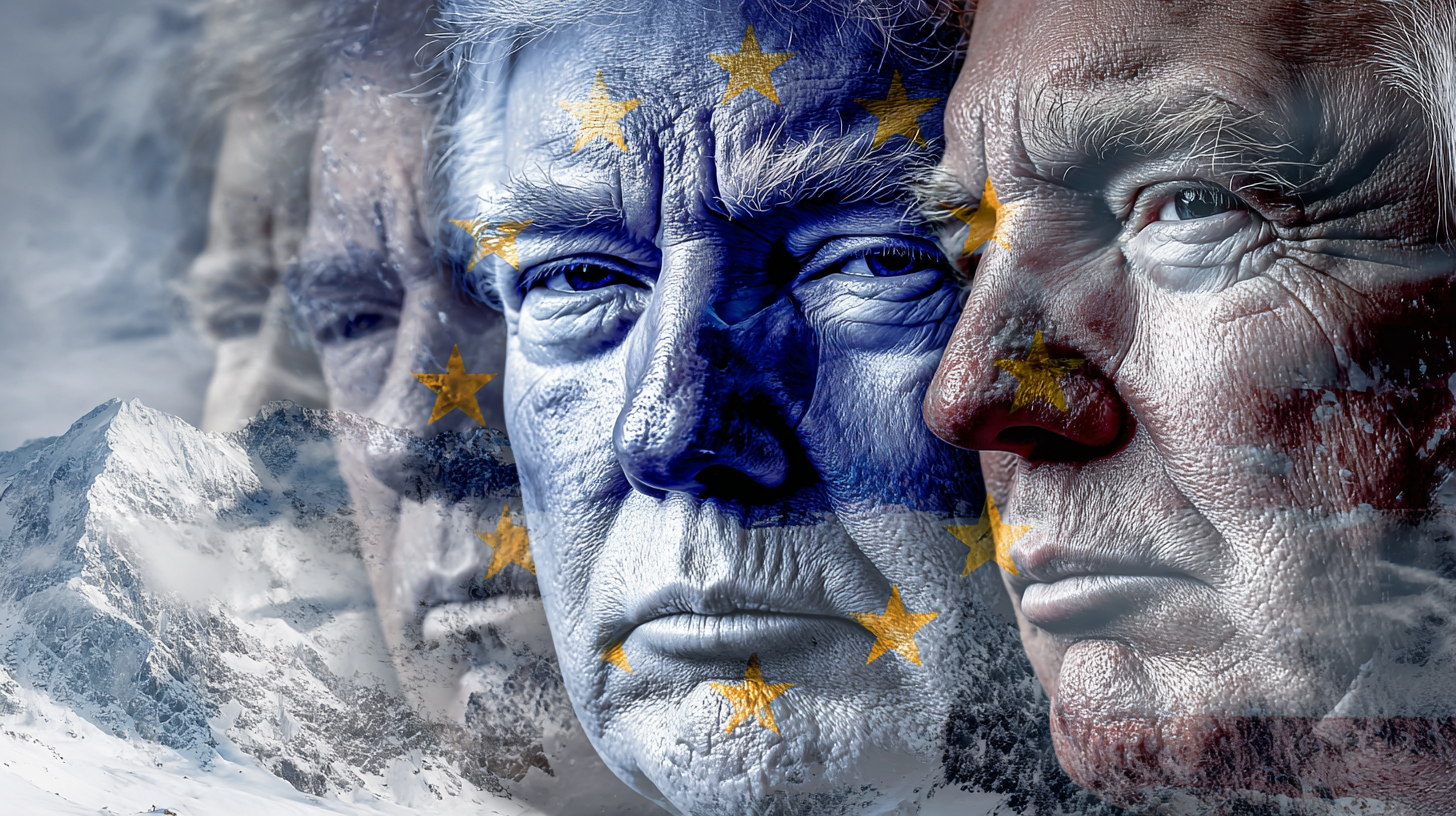
US justifies Trump's Greenland plan – EU prepares retaliatory tariffs and special summit – Further escalation in Davos? – Image: Xpert.Digital
Greenland in a pincer grip: How Trump is bringing a cold trade war to the Arctic
Technocratic blackmail triggers the biggest transatlantic crisis since the Cold War
Donald Trump's Greenland adventure reveals itself not as an improvised provocation, but as calculated economic blackmail that threatens the core of the Western security architecture. With the announcement of phased tariffs, initially ten percent from February 2026 and later 25 percent, Trump is linking an existential security problem to an economic demand that is untenable under international law. This reveals a deeper calculation: The primary interest is not in the raw materials, but in the reorganization of the North Atlantic sphere of influence.
The current situation differs fundamentally from previous tariff disputes. Trump is not only using trade policy instruments, but is systematically linking them to national security issues that were previously the domain of NATO. For eight European NATO states – Denmark, Germany, Norway, Sweden, France, Great Britain, the Netherlands, and Finland – this represents an unprecedented situation: They are to be forced, through economic pressure, to undermine their alliance by blackmailing a partner into surrendering its sovereignty.
The strategic raw materials code: Why Trump needs Greenland and China wants it
Greenland is not the romantic fantasy project of a headstrong president. The island possesses an estimated 35 million tons of rare earth elements—the very minerals that power the digital age. With uranium, gold, diamonds, zinc, and lead, it holds 43 of the 50 minerals classified as critical by the United States. From the perspective of strategic resource sovereignty, Greenland represents a geopolitical constant of vital importance to both the US and China.
China currently controls about 70 percent of the world's rare earth minerals and has already made substantial investments in Greenland's economy – at times, Chinese investments accounted for about twelve percent of Greenland's gross domestic product. In 2016, a Chinese company attempted to acquire a former Danish naval base, but Danish authorities blocked the deal for security reasons. Beijing is pursuing a longer-term strategy within the context of its Belt and Road Initiative, in which Greenland is intended to serve as a critical link in the so-called Polar Silk Road.
However, raw material deposits are only one dimension. Greenland's geopolitical significance stems from its location on future North Atlantic trade routes. With the accelerated melting of Arctic ice, the Northwest Passage and the Transpolar Routes will become viable trade routes, potentially reducing transport times and costs between Europe and Asia considerably. Whoever controls these routes will control a significant share of global trade in the future.
Added to this is the military dimension. Thule Air Base in Greenland forms the backbone of the American missile early warning system and is central to nuclear deterrence. Its geographical proximity to the GIUK Gap—the strategic gateway between Greenland, Iceland, and Great Britain—makes the island a key position for monitoring Russian submarines and naval vessels. Without this control, the US loses a fundamental instrument of its Atlantic power projection.
The architecture of blackmail: Tariffs as a weapon against the West
Trump's threat to impose 25 percent tariffs starting February 1st is deliberately targeting Europe's economic Achilles' heels. Germany, the continent's largest industrial nation, would lose approximately 0.25 percentage points of economic growth for every additional percentage point of tariffs. With 25 percent additional tariffs—applied to existing 15 percent rates—the cumulative burden threatens to fundamentally jeopardize the desired recovery of the European economy.
German exports to the US already plummeted by over seven percent to just under €150 billion in 2025. A further increase in tariffs would halt this decline and push the already fragile economy into a structural crisis. The consequences would be similarly destabilizing for France, the Netherlands, and Scandinavia, as their export dependence on the US is equally substantial.
Global dynamics are exacerbating this effect. World trade growth is projected to plummet from a meager 2 percent in 2025 to a paltry 0.6 percent in 2026 – a decline of two-thirds. The cumulative burden of tariffs, combined with geopolitical uncertainties and de-dollarization trends, could plunge the global economy into complete stagnation. Allianz Trade puts the probability of further tariff escalation leading to recession at 45 percent.
Trump's strategy is based on an asymmetric logic: The US possesses market power that Europe lacks. An American market of 330 million consumers with high purchasing power cannot simply be replaced. European retaliatory tariffs do affect American farmers and industrial companies, but only after a time lag and with the risk of further retaliation.
Our global industry and economic expertise in business development, sales and marketing

Our global industry and business expertise in business development, sales and marketing - Image: Xpert.Digital
Industry focus: B2B, digitalization (from AI to XR), mechanical engineering, logistics, renewable energies and industry
More about it here:
A topic hub with insights and expertise:
- Knowledge platform on the global and regional economy, innovation and industry-specific trends
- Collection of analyses, impulses and background information from our focus areas
- A place for expertise and information on current developments in business and technology
- Topic hub for companies that want to learn about markets, digitalization and industry innovations
The bill for 40 years of passivity: The global tariff spiral begins – Is the world heading for a new recession?
The European counterattack: The “trade bazooka” and its limits
The European Union is preparing for a counter-offensive. The special summit scheduled for Thursday will discuss activating the Anti-Coercion Instrument (ACI) – an emergency mechanism the EU established in 2023 specifically to combat economic blackmail by developing countries. The instrument is considered the EU's most powerful weapon in trade disputes and could encompass a wide range of sanctions: from punitive tariffs and the suspension of banking licenses for American institutions to bans on advertising by US tech platforms like Facebook and Instagram.
Macron's France is pushing for immediate activation. The idea is based on the logic that only a demonstration of European counterweight power can persuade Trump to back down. At the same time, the EU is halting ratification of the tariff agreement painstakingly negotiated in the summer of 2025, which would have taxed European products at 15 percent while allowing American goods to enter the EU duty-free. A steering committee under EPP leader Manfred Weber has already declared that this agreement will no longer be ratified.
The EU is also preparing retaliatory tariffs totaling €93 billion, which will automatically come into effect on February 6 if no agreement is reached. This sum is not arbitrary. It is specifically targeted at economic centers in Republican-leaning states – a tactical calculation to build political pressure within America.
However, the effectiveness of this resistance remains limited. The American market is globally irreplaceable, while Europe's internal fragmentation reaches its limits in a crisis. Activating the ACI requires first a Commission decision, and then a qualified majority in the European Council. A country like Hungary or Poland could veto it in a crisis—not out of sympathy for Trump, but for tactical reasons. Furthermore, there is a risk of an escalation spiral in which both sides successively increase their tariffs until global trade collapses.
The NATO Nexus: An Alliance Under Siege
The Greenland crisis reveals a deep rift in the Western security structure. Greenland belongs under international law to Denmark, which is a NATO member. A military attack on the island would, in principle, trigger Article 5 of the NATO treaty – the automatic mutual assistance obligation of all members. But therein lies the dilemma: An attack by the US on Danish territory would plunge NATO into a crisis for which the alliance was not designed.
The alliance was founded as a defensive alliance against external aggressors, particularly the Soviet Union. A scenario in which one member attacks another was deliberately not foreseen, as this was considered impossible. Trump is breaking this taboo. An attack on Greenland would directly affect Denmark, secondarily all European NATO states, and, via the extended solidarity clause (Article 42.7 of the EU Treaty), also non-NATO members such as Ireland.
European experts like international law scholar Christian Marxsen emphasize that while Article 5 is technically applicable, it would be politically disastrous. An alliance that has to act against its own leader is no longer an alliance—it is a union of mutual blackmail. At the same time, Trump's threat is increasing insecurity, particularly in Scandinavia and Eastern Europe. If the US calls into question the NATO guarantee, it will reinforce Putin's and China's calculations in the East and North Atlantic. The geopolitical temptation to destabilize the NATO order is thus growing exponentially.
The global tariff spiral: The domino effect of economic blackmail
The structural problem is that Trump is setting a precedent with the Greenland adventure. If economic blackmail through tariffs leads to political concessions, other actors will follow this model. Russia could employ similar tactics against European countries; China could increase its economic pressure on Taiwan; smaller powers might also be tempted to pursue their regional ambitions through economic warfare.
The consequence would be a rules-based international system that ultimately collapses. It would be replaced by a system of power politics in which economic resources and military strength are directly converted into one another. For small and medium-sized states that depend on open markets and the rule of law, this would mean a fundamental deterioration of their position.
Allianz Trade warns of a 45 percent probability of a full-scale tariff escalation, which could lead to a global recession. This is a serious concern. It would bring unemployment, rising consumer prices, and political instability on a scale that threatens to surpass the 2008 financial crisis.
The European Dilemma: Between Submission and Suicidality
Europe faces a classic strategic impasse. Capitulating to Trump's blackmail would mean Denmark would have to relinquish Greenland – a decision no European state can make without fundamentally undermining its standing under international law. This would send the message that sovereignty is negotiable for countries outside the inner circle of the West if enough economic pressure is exerted.
On the other hand, aggressive European resistance leads to a tariff spiral that would harm Europe economically more than the US – simply because the European economy is more dependent on trade and exports. Germany could slide into complete stagnation by 2026 under further tariffs without this seriously harming Trump. The American economy is autonomous enough to absorb external economic shocks.
The only way out is for Europe to overcome its internal fragmentation and develop a genuinely common defense policy – not as an alternative to NATO, but as a necessary complement. This would mean that European countries credibly signal that an attack on one is an attack on all. Such a signal would have a real deterrent effect.
Europe currently lacks this military capability. Without significant defense investment and a strategic realignment, Europe's position remains fundamentally weak. This is not Trump's fault; it is the result of four decades of strategic passivity while America guaranteed security. This bill is now being presented – and it is alarming.
Media assessments of the Davos meeting: The fear of the unpredictable
The international press views Trump's planned appearance in Davos with a mixture of concern and resigned anticipation. The Handelsblatt newspaper describes the speech as the "most spectacular item on the agenda" and the "wild card" of the entire event—a date that participants have already factored into their plans because it has the potential to change the entire agenda. The ZDF heute-journal analysis warns that participants are likely to be "shocked," as a relatively stable trade order with the US seemed to have been established, which is now being jeopardized by the Greenland demand. The Swiss magazine Blick even headlines directly: "Will the Davos WEF become a Greenland summit?" and emphasizes that the agenda is tipping directly toward the tariff dispute. Der Spiegel comments on the dynamics as a "heated World Economic Forum," where the central question is: "Will Trump stick to his Greenland plan and the tariffs?" The Financial Times and other business media outlets foresee a scenario in which Trump uses the platform to legitimize his demands while simultaneously putting pressure on the European business elite. The common concern is that Trump could misuse Davos as a global stage to internationalize his blackmail and demonstrate that even the most Western of all economic forums is not immune to his power politics. European policymakers are preparing accordingly – not for diplomacy, but for further escalation, which could potentially begin during his speech.


